

If you're over 50 and wondering whether it's too late to build income online, you're not alone. Many women feel behind financially, not because they failed, but because life happened. Retirement can feel less certain than it once did, and learning something new online can seem like one more mountain when you're already tired.
I understand that hesitation. The first time I stared at a blank screen and tried to figure out what “affiliate marketing” even meant, I felt older than I was. Not because of age, but because the internet can make simple things sound more complicated than they are.
The good news is this. How to write affiliate product reviews is not really a tech skill first. It's a trust skill. It's knowing how to be honest, useful, and clear when someone needs help deciding what to buy.
It's Not Too Late to Build Income with Your Wisdom
A lot of women reach this stage of life carrying a quiet worry. You may be doing the math in your head while making coffee. You may be wondering whether your savings will stretch far enough, whether work will stay steady, or whether there’s still time to build something of your own.
There is.
Not because online business is easy. It isn't. But because your experience matters more than you may think.

What Affiliate Marketing really is
Affiliate marketing means recommending a product or service and earning a commission if someone buys through your link. That’s the business side of it.
The human side is simpler. You’re helping someone make a decision.
If you've ever told a friend, “I bought this blender and it’s easy to clean,” or “This course was helpful, but the lessons moved too fast for me,” you've already done the heart of Affiliate Marketing. A product review is just that same advice written down in a clear way.
Why reviews matter so much
This is why reviews are such a practical place to begin. According to Post Affiliate Pro’s review statistics, 91% of customers read online reviews before buying, and products with positive reviews can increase conversion rates by up to 370%.
That matters because you don't need to become loud or flashy. You need to become helpful.
Practical rule: A calm, honest review often does more work than a salesy post ever will.
Many beginners think they need a big personality online. They don't. They need a clear voice and a steady point of view.
Your life experience is an advantage
Women over 50 often make excellent reviewers because they've spent years solving real problems, managing homes, helping family, comparing options, and noticing what works. That judgment is valuable.
If you review a skin care product, you know how to talk about texture, sensitivity, value, and whether it fits real life. If you review a kitchen tool, you can talk about ease of cleaning, storage, and whether it saves time. If you review software, you can explain whether a beginner would feel lost in the first ten minutes.
That’s not “less than” technical expertise. In many cases, it’s more useful.
If writing feels intimidating, it may help to read a few thoughtful articles from places outside the marketing world too. A good blog for fiction writers can be surprisingly useful because it teaches voice, clarity, and how to keep a reader engaged without sounding stiff.
A gentler way to think about this
You are not trying to become an internet celebrity.
You are building a small body of useful content that helps real people. Over time, those reviews can become assets. Each one is a little doorway someone can find through search, read at their own pace, and trust.
That’s a calmer model of online business. And for many women, it’s a much better fit.
The Simple Foundation of a Trustworthy Review
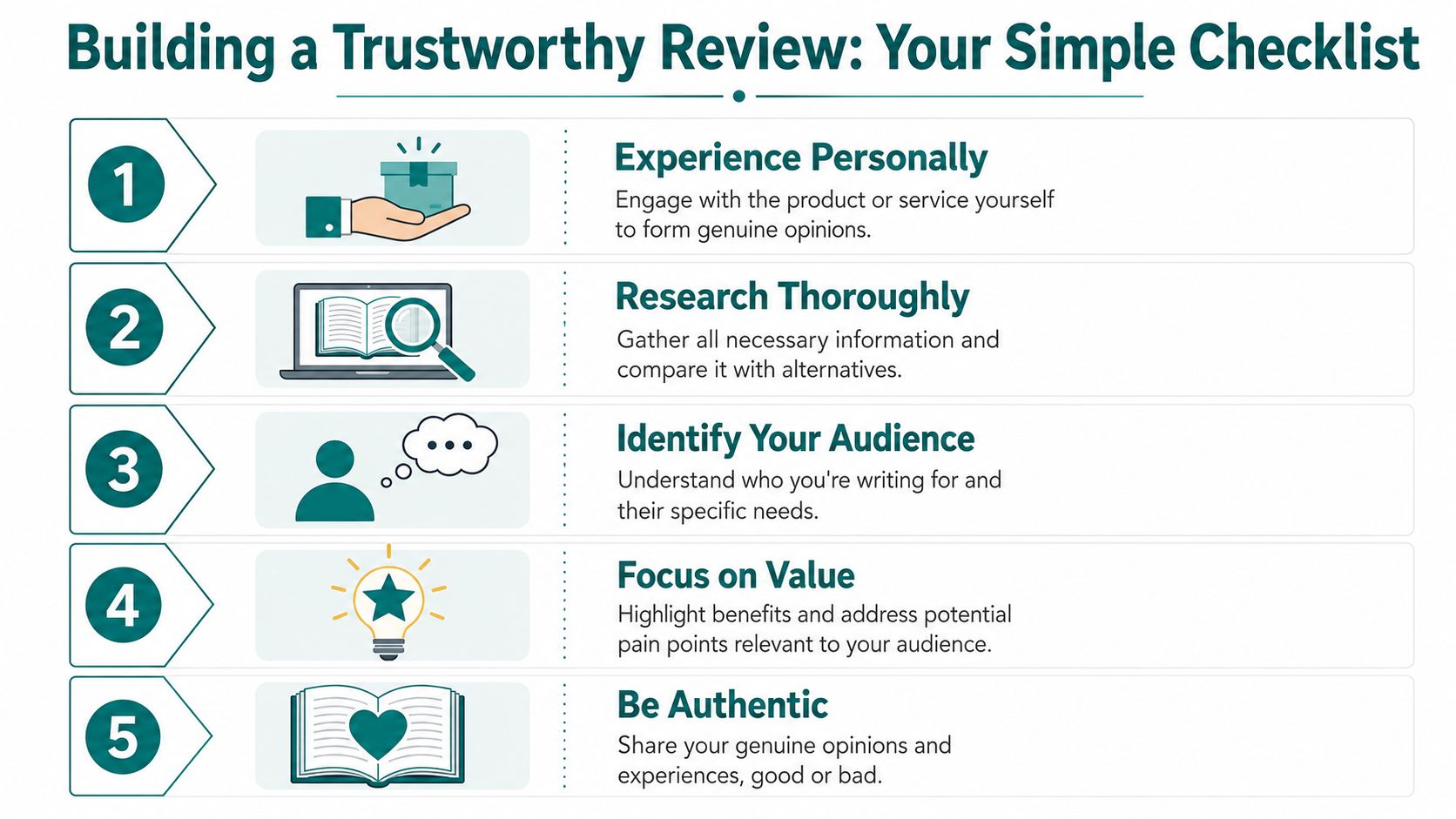
A trustworthy review starts before you write a single sentence. It starts with choosing the right product, the right angle, and the right questions.
This part often scares beginners because it gets called “research.” But research, in plain language, is just paying attention.
Start with products that fit your integrity
The easiest review to write is one that matches your actual values.
That might be:
- Something you already use like a planner, supplement, walking shoe, or email tool
- Something you understand well because you’ve compared options for yourself
- Something your audience is already asking about because the review solves a real problem
If a product feels off, skip it. If it promises the moon, skip it. If you’d feel uneasy sending your sister to that sales page, skip it.
That kind of filtering protects your reputation.
Focus on the reader’s problem first
The strongest reviews don’t begin with product features. They begin with the problem the reader wants solved.
According to Digistore24’s guide to affiliate product reviews, the most effective reviews follow a three-part formula. They identify a specific problem, provide clear evaluation to solve it, and present the information in an engaging way that goes beyond the manufacturer’s sales copy.
So instead of starting with:
- “This chair has lumbar support, mesh backing, and adjustable arms.”
Start with:
- “If your back hurts after an hour at your desk and you want a chair that feels supportive without being bulky, this is the kind of feature set that matters.”
That one change makes your review feel helpful instead of promotional.
Use a simple scoresheet
A review becomes more credible when you use the same standards each time. According to Affiliate Pro Solutions on writing your first affiliate review, experienced affiliate marketers often create a scoresheet with 3 to 5 main grading points and apply them consistently across similar products.
You can keep this very simple.
| Product type | Possible grading points |
|---|---|
| Skin care | texture, ingredients, ease of use, value, sensitivity |
| Online course | clarity, support, beginner-friendliness, organization, value |
| Kitchen gadget | ease of use, clean-up, storage, durability, time-saving |
| Software tool | setup, simplicity, customer support, features, pricing clarity |
When you use the same grading points, your reader learns how you think. That builds trust.
Use a review notebook or spreadsheet. Write the grading points once, then reuse them each time.
A beginner-friendly research routine
You don't need fancy systems. Try this:
Read the sales page carefully
Notice what the company promises.Read customer reviews
Look for repeating praise and repeating complaints.Compare similar products
This helps you avoid writing in a vacuum.Write down your reader’s likely questions
Is it easy to use? Is it worth the money? Is it good for beginners?Decide your honest angle
Best for beginners, best for busy women, better for small budgets, or not ideal for certain people
That’s enough to create a solid foundation.
How to Structure Your Review for Honesty and Impact
Once your notes are ready, the blank page gets easier. You don't need to sound polished or clever. You need a shape you can repeat.
A simple structure helps you stay calm and helps your reader keep up.

Write a headline that sounds like a real person
Skip clickbait. A good review title tells the reader what product you’re reviewing and who it may help.
Examples:
- Product Name Review for Beginners
- Is Product Name Worth It for Women Over 50
- Product Name Review After Comparing It With Other Options
- Product Name Review for Busy Beginners
A headline like that sets the right expectation. It doesn’t shout. It guides.
Open with the problem, not the product
Your first paragraph should sound like you understand the reader’s frustration.
For example, if you’re reviewing an email platform, you might open with something like this:
You may be looking for an email tool that doesn’t make you feel like you need an IT department just to send a welcome message. If you want something simple enough to learn without spending all weekend on tutorials, the platform's ability to stand out and its potential to fall short become evident.
That works because it speaks to the reader’s life.
Use the three-part review formula
A good review usually follows this path:
Name the problem
What is the reader struggling with?Evaluate the product clearly
Does it solve that problem well, partly, or poorly?Keep it engaging
Add real observations, comparisons, or examples that go beyond the sales page
This matches the framework described in the earlier cited Digistore24 source. It also keeps your writing from drifting into fluff.
A simple review template
You can use this format almost every time:
Introduction
Who is this product for, and what problem does it solve?Quick summary
A short verdict for busy readersWhat I liked
The strongest benefitsWhat could be better
Honest limitationsWho this is best for
Help the reader self-identifyFinal verdict
Your recommendation, stated clearly
If you want help creating useful content around your reviews, this guide on creating content for Affiliate Marketing gives a broader look at how review posts fit into a long-term content plan.
Explain benefits, not just features
Often, new writers get stuck understanding this distinction. A feature is what a product has. A benefit is what that feature does for the person using it.
Here’s a simple example:
| Feature | Benefit |
|---|---|
| Video tutorials | A beginner can follow along without guessing |
| Adjustable strap | It feels more comfortable for different body types |
| Drag-and-drop editor | You can build faster without feeling intimidated |
| Auto shut-off | It feels safer and easier to manage |
Readers don't buy features. They buy relief, ease, confidence, or convenience.
If you’re unsure what to write, finish this sentence: “This helps because…”
Add a small personal moment
You don’t need a dramatic story. One small detail makes your review warmer and more believable.
For example:
- “I get frustrated when tools hide basic settings behind too many menus.”
- “I pay attention to whether something is easy to clean, because if it’s fussy, I won’t keep using it.”
- “The first time I logged into a training dashboard years ago, I nearly closed the tab. So I always notice whether a platform welcomes beginners or overwhelms them.”
That kind of sentence gives your review a human voice.
Later, if you want to add video alongside written reviews, these Unfloppable video conversion tips can help you think through product demonstrations in a straightforward way.
Include pros and cons without sounding harsh
An honest review needs both sides.
Try this format:
Pros
- Easy to begin with
- Clear layout
- Helpful for a specific kind of user
Cons
- May feel too basic for advanced users
- Pricing may not suit every budget
- Some features take time to learn
You’re not trying to tear a product apart. You’re helping the right buyer make the right choice.
End with a clean verdict
A weak ending says, “It’s good.”
A stronger ending says:
- “I’d recommend this for beginners who want simplicity more than advanced customization.”
- “I wouldn’t choose this if budget is your main concern.”
- “This makes sense for someone who values support and ease of use over lots of extra features.”
That kind of ending respects the reader. It also makes your affiliate link feel earned, not pushed.
Adding the Final Touches That Build Credibility
A reader clicks your review, scrolls for a few seconds, and asks themselves, “Can I trust this person?”
That decision often happens before they study your full argument. Small details shape it. A clear disclosure, easy wording, and a page that feels calm to read all help your review feel safe in the best sense of the word.
Many women starting later in life worry they need sharper tech skills to sound credible online. You do not. Credibility usually comes from the same habits that build trust in everyday life. Say what you mean. Be clear about money. Make it easy for people to follow your thinking.
Write a disclosure that sounds human
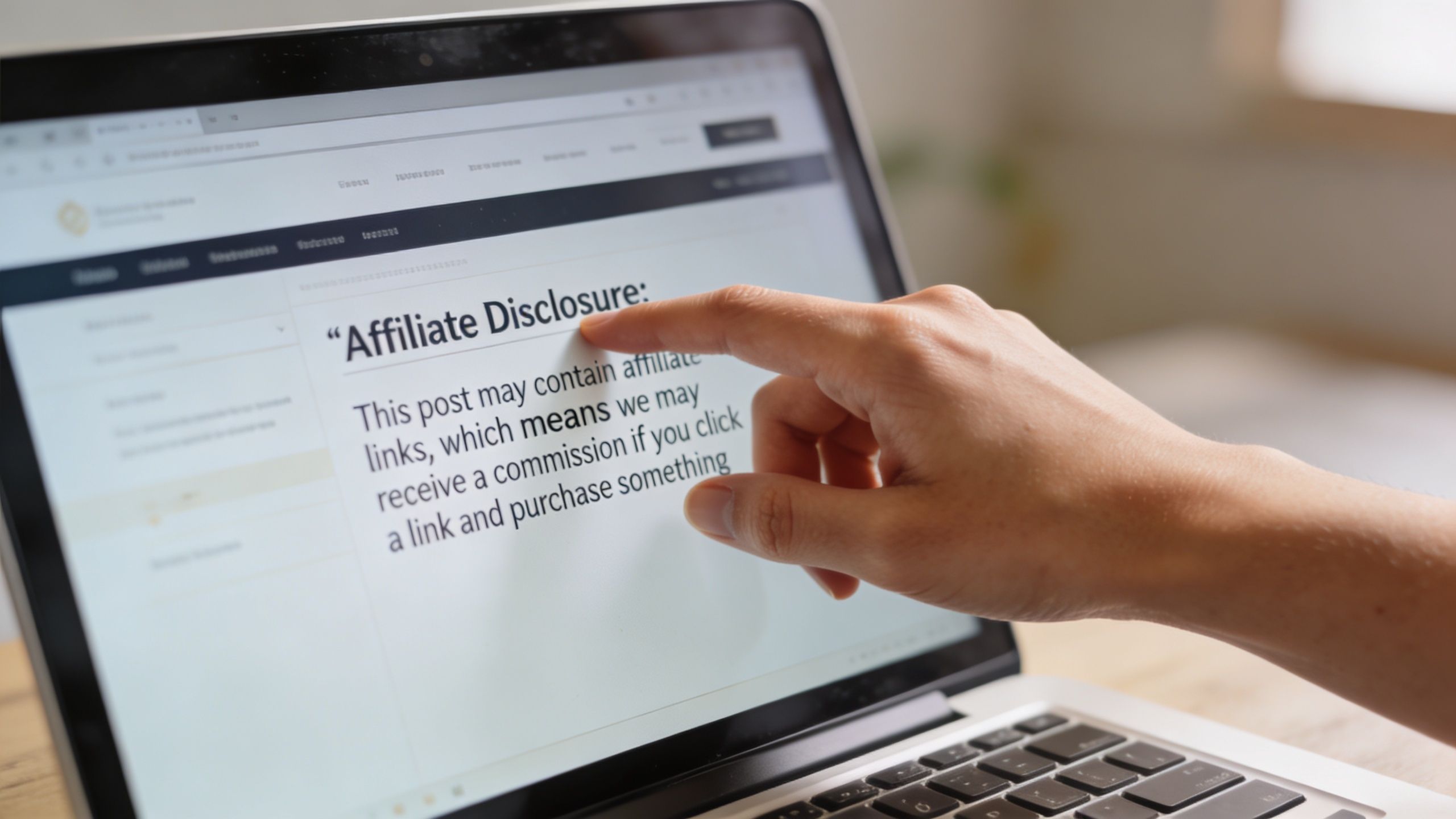
If you use affiliate links, tell people early and plainly.
A simple disclosure works well:
This post contains affiliate links. If you buy through my link, I may earn a commission at no extra cost to you. I only recommend products I believe are worth considering.
That sounds like a real person speaking. It does not feel stiff or hidden.
Clear disclosure protects trust. It also gives you peace of mind, because you are not wondering whether readers will feel misled later.
Use search language your reader would actually say
SEO is the habit of using the words a reader might type when she needs help.
A woman exploring Affiliate Marketing in her 50s may not search with technical jargon. She may type honest, everyday questions such as:
- how to write affiliate product reviews
- affiliate marketing for beginners over 50
- is Affiliate Marketing legit
- best email tool for beginners
Place phrases like these naturally in your title, subheadings, and early paragraphs. You are meeting readers where they are, much like using plain directions instead of handing someone a complicated map.
Make the page restful to read
A trustworthy review should feel easy on the eyes.
Online readers often skim first, especially if they feel cautious or overwhelmed. Short paragraphs, useful subheadings, and a few bullets help them find the part they need without working too hard. That simple courtesy can do more for trust than polished marketing language ever will.
If you want a few practical ideas for simplifying your workflow, Typist's content creation insights offer a helpful look at tools creators use to stay organized without making content creation feel overwhelming.
Let your standards become part of your brand
Readers do not only remember what you said about one product. They begin to remember how you judge things.
Your tone, consistency, and honesty become highly important for this reason. If you are fair when a product has flaws, readers notice. If you stay calm and specific instead of pushy, readers notice that too. Over time, those repeated signals form your reputation.
That is good news if you are building a business later in life. You are not starting with nothing. You are bringing decades of judgment, intuition, and lived experience. Those qualities help people feel safe with you, and safety builds trust more reliably than flashy tactics.
For a deeper look at that side of the work, this article on building a personal brand people trust in your second act connects trust, clarity, and long-term reputation in a very practical way.
A disclosure doesn’t weaken a recommendation. Hiding your relationship does.
Your Gentle Next Step Toward Peace of Mind
You do not need to build a whole business this week.
You only need one calm step.
Choose one product you already know well. It could be a notebook, a supplement organizer, a pair of walking shoes, a course platform, or a kitchen tool that you use. Then write down three things:
- what problem it helps solve
- what you like about it
- one limitation a buyer should know
That’s enough to begin.
If you want to take that one step and turn it into something more lasting, think about what happens after someone reads your review. A simple free guide or checklist can help you stay in touch with readers who aren’t ready to buy yet. This gentle guide on how to create a lead magnet can help you understand that next piece without making it feel complicated.
I know caution is part of wisdom. There are scams online, and skepticism is healthy. But learning to write clear, ethical reviews is not a scammy skill. It’s a communication skill. It’s a way to use your judgment to help people and create an asset one piece at a time.
You’re not behind.
You’re building differently.
And that may end up being your strength.
Answering Your Gentle Questions
How can I write a review if I can’t afford to buy the product
This is a very common concern, especially when you're starting on a budget. The ethical approach is to do deep research, gather customer feedback, study expert analysis, and clearly tell readers that your review is based on research rather than personal testing, as explained in AffiliatePrograms.com’s guidance on reviewing products.
That means you might say something like, “I haven’t personally tested this product, so this review is based on customer feedback, product details, and comparisons with similar options.”
That kind of honesty protects your credibility.
You can still add value by spotting patterns in reviews, explaining who the product seems best for, and helping readers understand tradeoffs. Your job is not to pretend. Your job is to clarify.
Is Affiliate Marketing legit or is it a scam
Affiliate marketing itself is a real business model. Companies pay people for referred sales. That part is legitimate.
What causes confusion is that some people present it in a misleading way. They make it sound instant, effortless, or guaranteed. It isn’t.
A healthy approach looks like this:
- Choose reputable products that you’d feel comfortable recommending
- Use clear disclosures so readers know you may earn a commission
- Write useful content first instead of chasing clicks
- Expect a learning curve because this is a business skill, not a shortcut
If you’ve been skeptical, that’s understandable. Caution is not weakness. It’s wisdom.
How long does it take to earn income from reviews
There isn’t one neat timeline that fits everyone, so I won’t pretend there is.
Some people write a few reviews and get discouraged because nothing happens right away. Others keep going, improve their writing, build trust, and slowly create momentum. This work tends to reward consistency more than speed.
The better question is often this: can you keep showing up long enough to build a useful library of content?
If you can, each honest review becomes part of something bigger. Not just a post, but an asset.
What if I’m not very tech-savvy
Then start smaller.
You do not need to master everything at once. You need to learn how to choose a product, think clearly, write plainly, and publish one piece at a time. Tech gets easier when it has a purpose.
Many women discover that once the emotional fog clears, the actual steps are much more manageable than they feared.
If you’d like gentle, practical guidance as you build your second chapter online, Victoria OHare offers beginner-friendly articles on Affiliate Marketing, content creation, and List Building for women who want more security, flexibility, and peace of mind. The next five years will pass either way. The question is whether you’ll use them to build something steady, honest, and your own.