
If you're over 50 and wondering whether it's too late to build income online, you're not alone. Many women feel behind financially, not because they failed, but because life happened. Careers changed, caregiving took priority, savings got stretched, and now the idea of learning something online can feel heavier than it should. Add tech overwhelm to the mix, and it's easy to freeze before you even begin.
The good news is that Affiliate Marketing doesn't have to look flashy, fast, or complicated. At its simplest, it's recommending products or services you trust and earning a commission when someone buys through your link. If you want a plain-English explanation before going further, this guide on what Affiliate Marketing is is a helpful place to start.
Starting Now for a Calmer Tomorrow
A lot of women arrive here with the same quiet fear. They aren't looking for internet fame. They're looking for breathing room. A little more control. A way to build something that belongs to them.
Affiliate marketing can fit that need because content keeps working after you publish it. A helpful blog post, an email, or a simple product guide can continue serving readers long after you write it. That matters when you want income built on assets, not just hours.

Why your stage of life can actually help
Most content advice online is written for younger creators chasing quick reach. That misses something important. Data noted in Awin's content blueprint shows that email open rates for audiences over 50 can exceed 30%, compared with 20% for younger groups, which suggests midlife creators have a real advantage when they build authentic connection through email and personal storytelling in a way that feels natural to them (Awin).
That doesn't mean you need to become a copywriter overnight. It means your calm voice, real experience, and practical judgment are useful. If you've ever helped a friend choose a supplement, a budgeting tool, a skincare product, or a course, you already understand the heart of affiliate content.
You don't need to sound like a marketer. You need to sound like someone worth trusting.
What this looks like in real life
A beginner usually starts small. One post a week. One email list. One topic they know well enough to discuss.
That topic might come from:
- Life transition experience such as going through menopause, downsizing, caregiving, or returning to work
- A practical skill like budgeting, easy cooking, organizing a home office, or learning beginner tech
- A product category you already use including education, beauty, wellness, or software that solves a clear problem
This isn't a race. It's a second chapter approach to business. You create content that helps someone make a good decision, and over time that trust can become income.
Building Your Foundation on Trust Not Trends
Most beginners don't struggle because they can't write. They struggle because they don't know what to trust. That's why this part matters more than logo design, website colors, or posting schedules.
Let's start with the question almost everyone asks privately.
Is Affiliate Marketing legitimate
Yes, but only when it's done ethically. It isn't a fringe model. Over 80% of brands use Affiliate Marketing, and 65% credit it for up to 20% of annual revenue, which tells you this is a normal part of modern business, not a side alley of the internet (FirstPromoter).
Scams do exist online. Your caution is healthy.
The difference is simple. Scammy content tries to pressure people into buying things the creator barely understands. Real affiliate content helps someone solve a problem and discloses that a commission may be earned.
Practical rule: If you wouldn't recommend it to a friend in real life, don't recommend it online.
Are you too old for this
No. In many ways, you're better positioned than someone younger who is trying to imitate trends.
Trust comes from judgment. Midlife creators often have more of it. You know when something sounds exaggerated. You know the difference between a helpful tool and a waste of money. You know that people want reassurance, not hype.
That shows up in content. A calm review with pros, cons, and a clear explanation often does better in the long run than a dramatic post full of big promises.
Do you need tech skills
You need basic digital comfort, not advanced technical ability.
For most beginners, the actual content system is simple:
- A place to publish such as a blog or newsletter platform
- An email tool like ConvertKit or Mailchimp
- A note-taking system for ideas, links, and draft outlines
- A basic affiliate dashboard where you copy your referral link
That's it at the start. You can learn the rest as needed.
I remember the first time I saw a creator dashboard years ago. The screen looked busier than it needed to be, and my first reaction was to close the tab. It's common to feel that way in the beginning. The answer isn't to become more fearless. It's to make the process smaller.
Choose a niche you can stay with
Trends burn people out because they demand constant reinvention. Trust grows when your topic has roots.
A good niche sits in the overlap between:
- Problems you understand
- Questions people keep asking
- Products or services that help
If you're still sorting that out, this guide to understanding your niche gives a useful beginner-friendly way to think about it.
Here is a simple comparison:
| Approach | What it feels like | What usually happens |
|---|---|---|
| Trend chasing | Fast, noisy, reactive | Hard to sustain, shallow trust |
| Experience-based niche | Calm, specific, grounded | Easier to create, stronger trust |
Build on an owned asset
A social platform can help you get noticed. An email list helps you keep the relationship.
That difference matters. Social media is borrowed land. Rules change, reach changes, and trends move fast. An email list is closer to a business asset. It's a direct line to people who asked to hear from you.
When you're learning how to create content for Affiliate Marketing, this is one of the most useful mindset shifts you can make. Don't just ask, "What should I post?" Ask, "What am I building that I still control next year?"
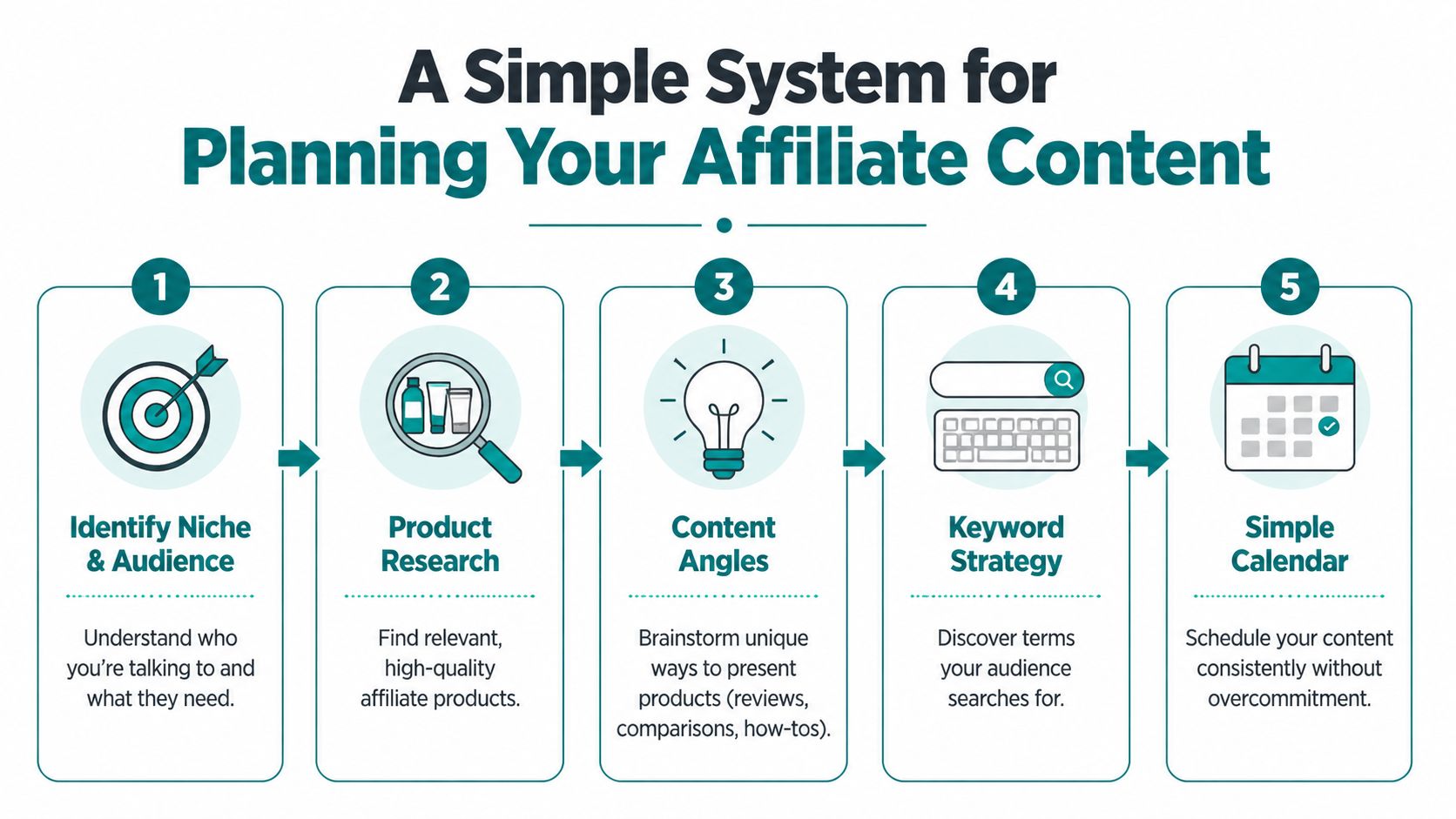
A Simple System for Planning Your Content
Often, this is made harder than it needs to be. They open a spreadsheet, create twelve tabs, save a color-coded content calendar, and then avoid the whole thing because it already feels like a job they don't want.
A better starting point is one helpful piece of content each week. That's enough to build skill, enough to build trust, and manageable enough to keep going.
 Affiliate Marketing content." />
Start with subscriber needs
The strongest content plans begin with people, not keywords. If you're building around a list-first model, that choice is already moving you in a solid direction. Successful affiliates are increasingly taking this approach, with 62% saying their email list is their top revenue driver, which supports planning content around subscriber needs instead of random traffic spikes (Post Affiliate Pro).
That means your first planning question is not, "What can I sell this week?"
It's this: "What does my reader need help understanding, comparing, deciding, or starting?"
Use the friend-question method
If you've ever answered the same question more than twice, that's content.
Write down questions people already ask you:
- How do I start this without getting overwhelmed
- Which one should I buy
- What's the difference between these options
- What worked for you
- Is this worth the money
Those are not small questions. They are search terms, email topics, review angles, and blog posts waiting to be written.
The easiest content to create is often the advice you've already given in everyday life.
A simple weekly rhythm
Instead of building a full editorial machine, try this low-stress rhythm.
Monday for idea picking
Choose one question your audience needs answered.Tuesday for light research
Look at the product, read the sales page, check the policy details, and note any pros or limits.Wednesday for outlining
Write a rough structure with a beginning, middle, and recommendation.Thursday for drafting
Get the full piece written without trying to make it perfect.Friday for publishing and emailing
Share it on your blog, then send a short email inviting subscribers to read it.
If you need a practical setup for the blog side of this, this guide on starting a blog for Affiliate Marketing can help you get the basic home base in place.
Choose beginner-friendly content types
Not every content format requires the same energy. Some are much easier to write when you're new.
Honest reviews
These work well when you've used the product yourself.
Include:
- what it helped with
- who it's best for
- what might frustrate some buyers
- whether you'd buy it again
Avoid writing a review like a brochure. Readers want your judgment.
How-to posts
These are often the best starting point because they solve a clear problem. They also fit naturally with affiliate offers when a tool or product supports the process.
Examples:
- how to start an email list without tech overwhelm
- how to choose a niche when you're over 50
- how to set up a simple weekly content routine
Comparison posts
These help readers make decisions. They work well when people are stuck between two tools, products, or approaches.
A simple comparison table can make the post much easier to scan.
| Content type | Best for | Easiest starting point |
|---|---|---|
| Review | Product trust | When you've used it yourself |
| How-to | Searchable questions | Best for most beginners |
| Comparison | Decision-making | Good after basic experience |
| Personal story | Connection | Best when tied to a lesson |
Keep SEO simple
SEO doesn't need to become a monster in your head. For a beginner, it mostly means answering questions people are already typing into Google.
Use plain phrasing that mirrors real questions:
- affiliate marketing for beginners over 50
- is Affiliate Marketing legit
- how to create content for Affiliate Marketing
- make money online after 50
If the phrase sounds unnatural in a sentence, don't force it. Write for people first, then tidy up the wording so search engines can understand it too.
Plan around one core topic, not endless ideas
One post can lead to several related pieces. If you write about starting an email list, your next topics might be:
- choosing a free lead magnet
- writing a welcome email
- recommending an email platform
- common beginner mistakes
That creates natural depth. It also keeps you from starting over every week with a blank mind.
Writing Content That Connects and Converts Gently
Many beginners think good affiliate content has to sound polished and persuasive. It doesn't. It has to sound clear, useful, and honest.
That's especially important because a lack of trust often causes momentum loss. A reported 95% of affiliates fail in their first year, often because they don't build enough trust, while an ethical framework centered on authenticity can reach a 2.1% average conversion rate, which is 26% higher than average (Dynuin Media).

Use a simple structure when the page feels blank
A blank page can make smart people feel clumsy. That's normal. A structure helps.
One of the easiest frameworks is PAS:
- Problem
Name the issue clearly. - Agitation
Explain why it matters or why it's frustrating. - Solution
Offer the help, tool, or next step.
Here is a calm version:
- Problem: Many beginners want to start Affiliate Marketing but feel buried by tech.
- Agitation: That overwhelm causes delay, and delay creates more self-doubt.
- Solution: Start with one platform, one topic, and one helpful article tied to one product you trust.
Another easy structure is this:
- what the reader is dealing with
- what you've noticed
- what helped
- who the recommendation fits
- what to do next
Write like a helpful guide, not a salesperson
Pushy copy usually sounds like this:
- this is the best thing ever
- you need this now
- don't miss out
- everyone should buy this
Grounded affiliate writing sounds more like this:
- this is useful if you want a simple option
- this worked well for me in this specific situation
- this may not fit you if your budget is tight
- I recommend this because it solves one clear problem
That difference matters. Readers can feel when you're helping versus performing.
If you study modern creator-led promotion, many of the strongest influencer content strategies follow that same principle. They lean on relevance, context, and trust rather than loud persuasion.
People don't click because you sound excited. They click because your explanation lowers uncertainty.
Add small stories, not dramatic ones
You don't need a dramatic backstory to write relatable content. Small moments work.
A micro-story might be:
- the first time you tried a tool and got confused
- why you switched from one option to another
- what made you hesitate before buying
- what happened after a few weeks of use
Here is the difference.
Flat version
This email platform is easy to use and good for beginners.
Human version
The first time I opened the platform, I worried I'd need to understand a dozen settings before I could send anything. I didn't. I wrote one welcome email, set up a signup form, and that was enough to get moving.
That kind of detail makes content feel lived-in.
If you want help learning how to bring more of your own voice into your writing, this guide on storytelling in sales and sharing your journey is a helpful companion.
Disclose clearly and move on
Affiliate disclosure doesn't need to sound stiff or apologetic. It should sound plain.
You can say:
- This post includes affiliate links, which means I may earn a commission if you buy through them, at no extra cost to you.
- I only recommend tools I believe are genuinely useful.
That's enough for most situations. Clear disclosure protects trust because it removes hidden motives from the conversation.
Use soft calls to action
A soft call to action invites. It doesn't corner.
Here are examples that work:
- If you'd like to look at the tool, you can check it out here.
- If this sounds like the kind of support you need, you can read more about it.
- If you're comparing options, this is the one I suggest starting with.
The tone matters. Readers don't need pressure. They need room to make a decision with dignity.
This short video can help you think about writing in a more natural and useful way.
Sharing Your Work Without Overwhelm
A lot of beginners assume the hard part is writing. Often the harder part is sharing. They think they need to be on every platform, post every day, learn video, design graphics, and somehow stay cheerful through all of it.
You don't.
A calmer approach is better. Pick one main channel and one supporting channel. For many midlife beginners, that means your email list first and one discovery channel second.

Start with the place you control
Your best sharing channel is usually the one you own. Email gives you that. A subscriber chose to hear from you. That changes the relationship.
You don't need long newsletters. A short weekly email can work well:
- Open with one relatable sentence about the problem
- Share one takeaway from your new post
- Link to the full article for readers who want more
- End with a gentle invitation to reply or explore the recommendation
That kind of email feels personal, not promotional.
Add one secondary channel
Choose one place where your audience naturally spends time. Keep it simple.
A few examples:
- Pinterest if your content is visual, evergreen, or tutorial-based
- Facebook groups if your niche is community-driven and conversation-based
- Simple video if you'd rather explain than write once you're comfortable
There is value in branching out eventually. Brands report $15 in ROI for every $1 spent on Affiliate Marketing, and simple video content can lift conversions by 49%, according to the compiled statistics at EntrepreneursHQ. But that doesn't mean you need to begin there. Writing is still a strong place to start.
Repurpose one piece into three smaller assets
One blog post doesn't need to stay a blog post.
Try this:
- Turn the introduction into an email
Use the core problem and one key lesson. - Pull out three key tips for a graphic or post
Keep each one short and readable. - Record a short audio or video note
Explain the main point in your own words.
Here is a simple repurposing table:
| Original piece | Repurpose option | Effort level |
|---|---|---|
| Blog post | Weekly email | Low |
| Blog post | Pinterest graphic with takeaways | Low |
| Blog post | Short talking-head video | Moderate |
| Comparison post | Decision email for subscribers | Low |
If you're looking for ways to bring people to your content without paid ads, this resource on free traffic for Affiliate Marketing is a practical next read.
Keep in mind: doing less consistently beats doing more sporadically.
Don't confuse visibility with progress
A post that gets fewer views but attracts the right subscribers can be more valuable than a post that gets quick attention and no relationship. That's why an owned audience matters so much.
The goal isn't to be everywhere. The goal is to become useful somewhere.
Measuring What Matters for Peace of Mind
Tracking can either calm you down or make you feel inadequate. The difference comes from what you choose to measure.
In the beginning, skip the obsession with dashboards. You do not need to monitor every graph to know whether your content is doing its job. What matters most early on is evidence that a real person found your work helpful enough to stay connected.
The signs that count early
Pay attention to small proof:
- A new email subscriber means someone wants to hear from you again
- A reply to your email means your content felt personal enough to answer
- A thoughtful comment means your writing connected, not just got skimmed
- A first sale means trust turned into action
These signals matter because they tell you more than traffic alone. They show that your content is helping someone make a decision.
Use a simple review habit
Once a week, ask yourself:
- Which post felt easiest to write
- Which topic got the warmest response
- Which recommendation felt natural, not forced
- Which email subject line got the most replies
That kind of review builds confidence because it keeps your attention on patterns you can use. You are not judging yourself. You are learning your audience.
A small sale is not small if it proves your words can help someone and support you at the same time.
Keep the emotional meaning in the numbers
Money matters. So does what the money represents.
For many women in this stage of life, one commission isn't exciting because of the amount. It's exciting because it represents possibility. It means your experience has value. It means you can build an asset. It means peace of mind might come from something you created yourself.
That's a very different feeling from chasing random clicks.
Your Next Small and Simple Step
If all of this still feels like a lot, make it smaller.
This week, write down three topics you feel comfortable giving advice on. Not expert-level advice. Just honest, useful guidance based on your own experience. Then under each topic, write three questions people often ask about it.
That's your starting content bank.
If you want one more step after that, choose just one of those questions and draft a short post answering it as if you were writing to a friend. Keep it plain. Keep it kind. If a product or tool genuinely helps with that problem, mention it naturally.
You are not behind. You're learning a skill that can still serve you for years. Content creation for Affiliate Marketing is not about performing online. It's about building trust, one useful piece at a time, in a way that supports your dignity, independence, and peace of mind.
The next five years will pass either way. The only real question is whether you'll use them to build something that belongs to you.
If you'd like calm, beginner-friendly help from Victoria OHare, you can explore her training and articles for step-by-step guidance on Affiliate Marketing, List Building, and creating an online income stream without tech overwhelm.