

If you're over 50 and wondering whether it's too late to build something online, you're not alone. A lot of women feel behind financially, not because they failed, but because life was full. Careers changed, families needed you, bills kept coming, and now the tech side of online business can feel like a language you were never taught.
That feeling gets stronger when someone mentions SEO.
I remember the first time I tried to make sense of search rankings. I opened one tab about keywords, another about backlinks, and a third about site audits. Ten minutes later, I felt like closing the laptop and deciding the whole internet had become too complicated for regular people. If that's where you are, you're not behind. You're learning a new skill in a noisy world.
You Can Build an Online Business Without SEO Overwhelm
For many beginners, SEO sounds more technical than it really is. At its heart, SEO boils down to helping the right people find your website when they search for something you offer.
If you run a blog, recommend products as an affiliate, sell a course, offer coaching, or build an email list, being discoverable matters. You can post on social media every day and still feel like you're borrowing attention from platforms you don't control. Search is different. It helps you build an asset that can keep working for you.

Why search still matters
The scale of search is enormous. Google processes over 8.5 billion searches per day according to this roundup of SEO statistics. For creators, bloggers, and small online businesses, that means SEO isn't some niche trick. It's a primary discovery system.
That matters because peace of mind online usually comes from owned assets. Your website. Your articles. Your email list. Your product pages. These are things you can improve over time instead of starting from zero every week.
Practical rule: If people can't find your content, even your best ideas stay hidden.
You don't need to become the expert
Many people get stuck at this point. They think the only two options are learning every technical detail themselves or giving up entirely.
There is a middle ground. You can understand the basics well enough to make good decisions without doing every task personally. That's true in home repair, bookkeeping, and it can be true in online business too.
If your business serves a local audience, a practical guide to SEO for local businesses can help you see how search visibility works in everyday terms. Reading something like that can lower the fear quickly because it turns SEO from a mystery into a checklist.
What done for you SEO really offers
Done for you SEO isn't about handing your business to strangers and hoping for the best. At its best, it's support. It's a specialist helping you improve the parts of your site that affect visibility, while you stay focused on your message, your offers, and your audience.
That can be a relief if you're trying to build income before Retirement, or if you're starting a second chapter and want your work online to become more stable over time.
You do not need to master every dashboard, plugin, and report this week. You need a clear way to get found, and a calm way to decide whether outside help makes sense for you.
Understanding Done For You SEO Services
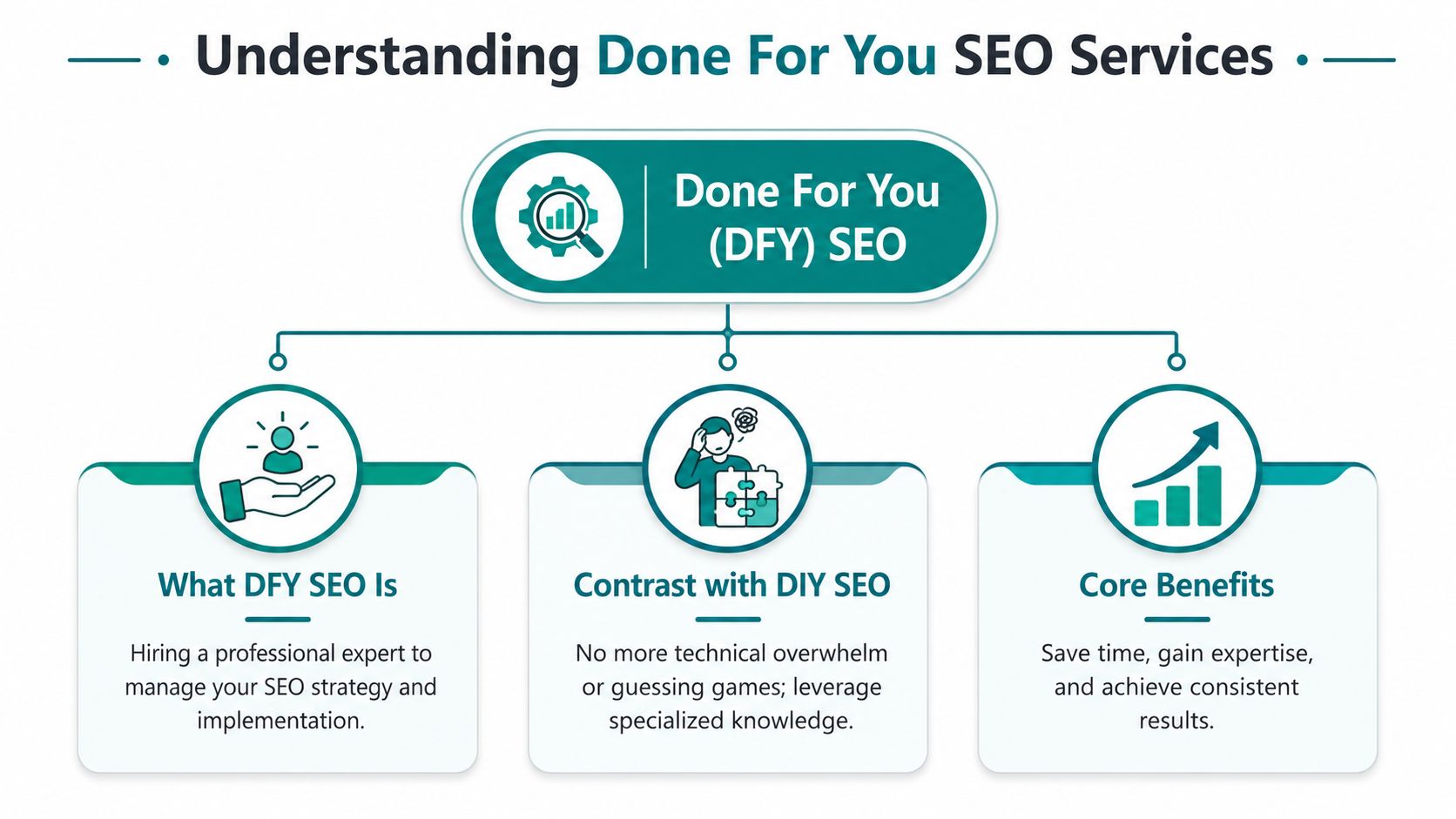
Think of done for you SEO like hiring a skilled contractor for your home. You could learn plumbing, electrical work, drywall repair, and flooring yourself. Some people do. But many people would rather hire someone who already knows how the pieces fit together and can do the work in the right order.
That's what Done For You SEO is. It's a full outsourcing model where a specialist or agency handles the moving parts for you. According to SEO.co's explanation of done-for-you SEO services, this usually includes keyword research, technical audits, on-page optimization, link building, and content creation.
What you're usually paying for
A good provider isn't just writing blog posts. They're managing a coordinated system.
- Keyword research helps them find the phrases your audience is already searching for. For a beginner affiliate marketer, that might mean topics tied to problems, comparisons, or product questions.
- Technical audits look for issues on your site that can make search engines struggle to understand or index your pages.
- On-page optimization improves titles, headings, page structure, internal links, and how clearly a page matches search intent.
- Content creation gives your site useful pages that answer real questions and support your offers.
- Link building focuses on building authority so search engines see your site as more trustworthy.
- Reporting shows what work was done, what changed, and what needs attention next.
What confuses people most
Many beginners assume done for you SEO means "someone flips a switch and traffic appears." It doesn't work like that.
You're hiring process, judgment, and consistency. A solid provider looks at your whole site, not just one article or one keyword. They should be thinking about whether your site is easy to understand, whether your content is helpful, and whether your pages support your business goals.
Some providers now also use AI in their workflow. That's not automatically bad. If you're curious about how newer systems fit into modern search work, this overview of AI for local SEO can give useful context.
If you're still learning the bigger picture, this simple realistic guide to digital marketing for beginners can help you place SEO in the wider online business puzzle.
Done for you SEO should remove confusion, not create more of it.
The real benefit
The primary value isn't only time saved. It's coordination.
SEO results usually come from many small things working together. Better page structure. Better topics. Fewer technical mistakes. Smarter internal links. More useful content. Done for you SEO can help because a specialist team can manage those pieces as one plan instead of leaving you to guess.
Choosing Your Path DIY vs Done For You SEO
Not everyone needs the same approach. Some people have more time than money. Others have some budget but very little mental space. Some want full control. Others want support with a clear monthly process.
All three paths can work.
A simple way to compare your options
| Factor | DIY (Do It Yourself) | DFY (Done For You) | Hybrid (DFY + Coaching) |
|---|---|---|---|
| Cost style | Lower cash cost, higher time cost | Higher cash cost, lower personal time | Mid-range, shared cost and effort |
| Learning curve | Steeper. You learn by doing and making mistakes | Lighter. You mainly review and approve | Moderate. You learn while getting help |
| Control | Highest control over every change | Less direct control over daily execution | Shared control |
| Speed of execution | Often slower if you're new | Often more consistent because a team handles tasks | Steady if roles are clearly divided |
| Best for | Curious beginners, tight budgets, hands-on learners | Busy business owners, creators, service providers | People who want help now and skills later |
| Main risk | Overwhelm, inconsistency, stalled progress | Hiring the wrong provider | Blurry responsibilities if expectations aren't clear |
DIY can be right if you want to learn slowly
If you're early in your journey, DIY might be enough for now. You may only need to learn how to write clearer blog posts, improve page titles, and connect related articles on your site.
This path makes sense if you:
- Enjoy learning new tools and don't mind experimenting.
- Have more time than budget right now.
- Want full ownership of the process before paying someone else.
- Run a small site that doesn't yet need a broad strategy.
The tradeoff is emotional energy. DIY often sounds cheaper, but it can cost you momentum if every task feels heavy.
Done for you can be right if your time matters more
A full done for you SEO service often fits people who already know their business matters, but don't want to become accidental technicians. Maybe you have a good offer, a growing email list, or a website with content that never seems to get found.
This path may fit if:
- You need consistency more than you need another course.
- You dislike technical troubleshooting and know you'll avoid it.
- Your business already earns money and you're trying to strengthen the foundation.
- You want a partner who can spot issues you wouldn't see alone.
This isn't laziness. It's resource allocation.
The right question isn't "Can I do this myself?" The better question is "Is doing it myself the best use of my season of life?"
Hybrid works well for cautious beginners
Hybrid support is often the most comfortable option for people who are skeptical, careful, and teachable. You get expert help with the heavier parts, but you still learn enough to stay informed.
A hybrid setup might look like this:
- You write from experience, and a specialist optimizes structure and technical details.
- You approve topics, and the provider handles research and implementation.
- You meet monthly, review reports, and decide priorities together.
That can be a good fit if you're building an online business after 50 and want confidence, not dependency.
A quick self-check
Ask yourself these questions:
- Time: Do you have regular hours each week to learn and apply SEO?
- Temperament: Do tech tasks drain you or energize you?
- Goals: Are you trying to build traffic, leads, email subscribers, or sales pages that last?
- Budget: If you hire help, will it feel like a thoughtful investment or constant stress?
- Patience: Can you stay steady while results build gradually?
You don't need the perfect answer today. You just need the path that matches your current capacity.
Realistic Results and a Typical Timeline
SEO is more like planting a garden than turning on a light switch. You prepare the soil, choose what to plant, water consistently, and wait for growth you can't force by staring at it every hour.
That's one reason many beginners get discouraged. They expect a dramatic jump right after hiring help. A trustworthy provider won't sell the work that way.
What the early months often look like
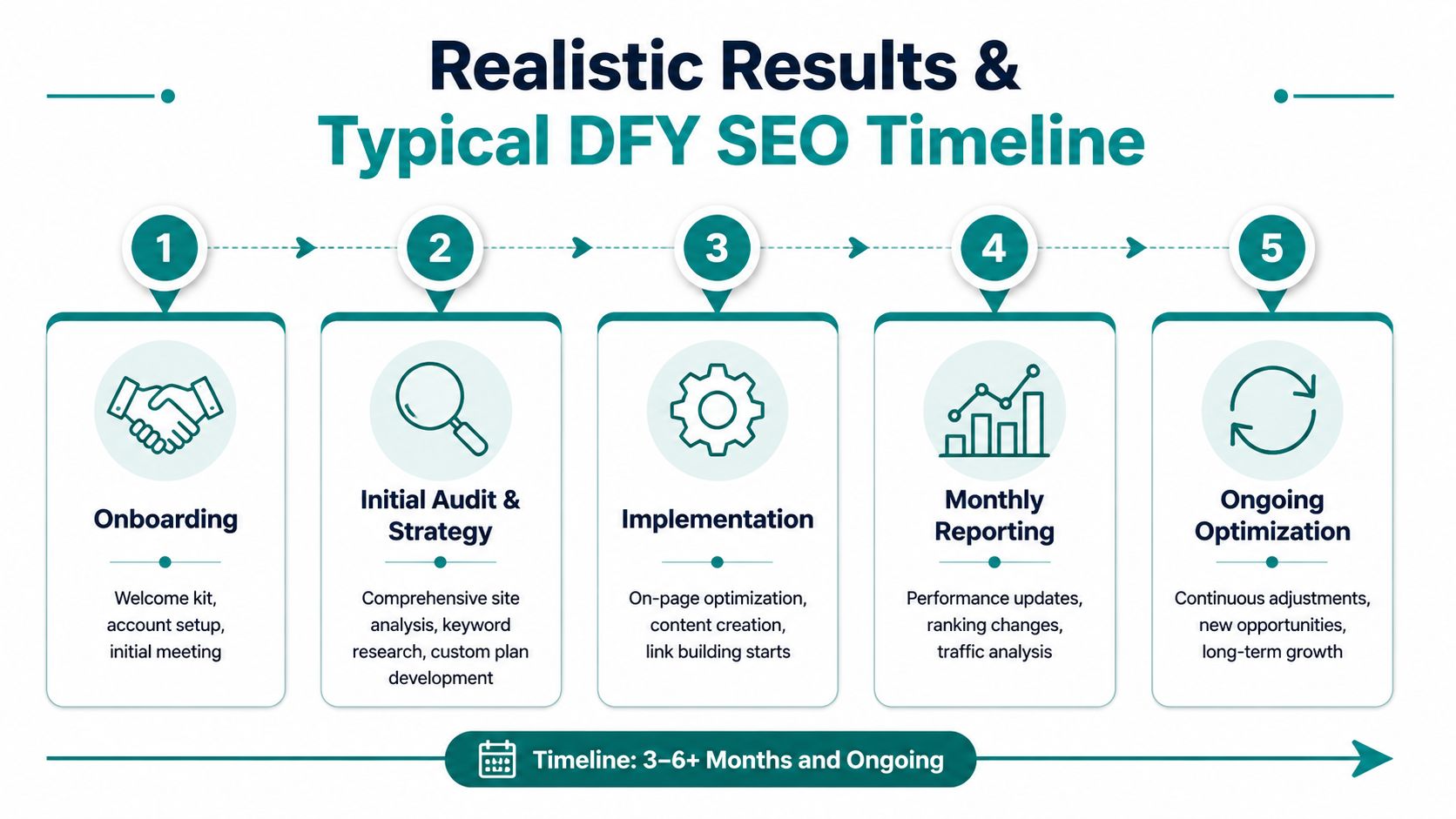
At the beginning, the provider usually needs access, context, and a clear picture of your site. That often includes your website platform, Google Search Console, your existing content, and your business goals.
Then the work usually unfolds in stages:
Onboarding and discovery
They learn what you offer, who you serve, and which pages matter most.Audit and strategy
They look for technical issues, weak pages, missing opportunities, and content gaps.Implementation
They start fixing pages, improving structure, publishing content, and handling authority-building work.Reporting and refinement
They watch what gains traction, what stalls, and what needs another pass.
Why patience matters
Top rankings are valuable because clicks are concentrated near the top of search results. The #1 organic result averages a 27.6% click-through rate, and the top three results capture 68.7% of clicks, according to Reboot's SEO statistics roundup. That's exactly why SEO takes time. Strong positions matter, and reaching them often requires steady work.
Some changes can help sooner. A technical fix may improve how your pages are crawled. Better titles may improve how often people click. Cleaner site structure can help search engines understand what your site is about.
But meaningful business results usually come from accumulation. One improved page. Then another. Then a cluster of related content. Then better internal linking. Then stronger authority.
A good SEO campaign should feel like a system getting healthier, not a magic trick.
What to expect emotionally
The first part can feel quiet. That's normal.
You may not see dramatic movement at first, but important work can still be happening behind the scenes. If your provider communicates clearly, explains what they changed, and connects the work back to your goals, you'll feel much calmer during that waiting period.
That calm matters. You're not chasing a viral moment. You're building something durable.
How to Vet an SEO Vendor and Avoid Scams
It's smart to be cautious here. SEO has real value, but it also attracts people who promise too much, explain too little, and rely on the fact that most clients don't know what to ask.
I understand the hesitation. There are scams online. That's why education matters.
Before you hire anyone, slow the conversation down and ask practical questions. If you want a broader consumer-minded checklist, this article on choosing a digital marketing agency is a useful companion read.
Questions worth asking before you sign
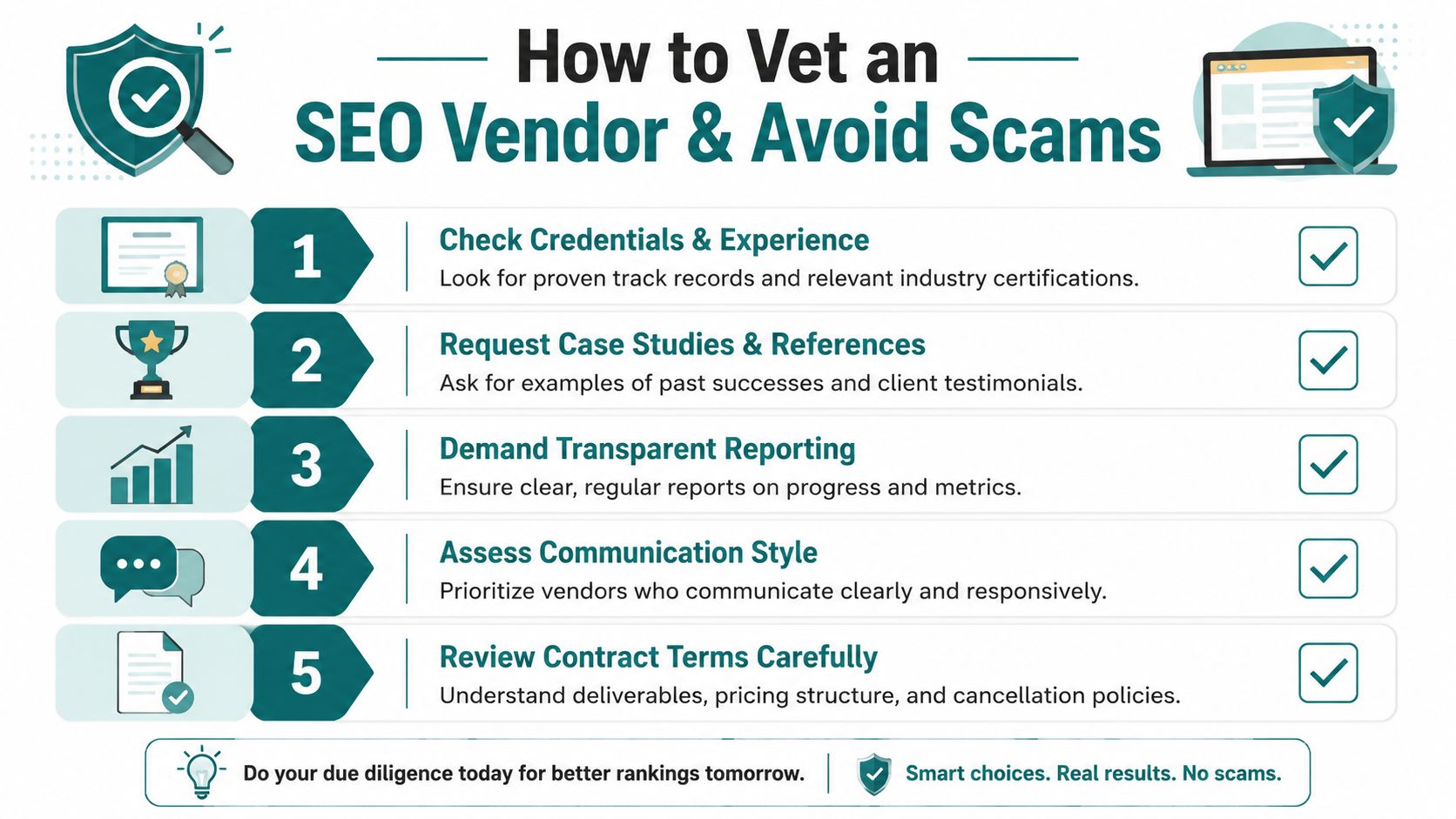
Use these in a discovery call or email exchange.
Ask about their process
What do they do in the first month? What gets audited first? How do they decide priorities?Ask what they need from you
A good provider should be able to explain your role clearly. Approvals, access, brand voice, offers, and audience details all matter.Ask how they report progress
You want reporting that connects effort to business outcomes, not a confusing spreadsheet with no explanation.Ask about content quality
This one matters more now. Google has said AI-generated content isn't bad in itself, but it must be helpful, original, and demonstrate expertise. This point is summarized in this discussion of AI content and SEO quality. Ask how they maintain quality and authoritativeness, not just output volume.Ask what they won't promise
An honest vendor should be comfortable telling you what SEO can and can't control.
Here is a short video that can help you think more critically as you evaluate offers:
Red flags that deserve caution
Some warning signs are simple.
Guaranteed rankings
No ethical provider can guarantee a specific Google position.Instant results language
If the message sounds like overnight transformation, step back.No clear deliverables
You should know what work is being done each month.Vague explanations
If they hide behind jargon instead of teaching you, that's a concern.Ownership problems
Be careful if you won't own your content, accounts, or website assets.
One more check for skeptical readers
If you've spent any time online, you've probably already seen hype around digital business models. That's one reason people ask harder questions now, and they should. If scam concerns are already on your mind, this article on whether John Crestani is a scam shows the kind of careful skepticism that helps when evaluating online offers in general.
Choose the vendor who explains clearly, answers directly, and makes you feel more informed after the call, not more intimidated.
Calculating the Potential Return on Your Investment
This is the part many articles skip.
They talk about rankings, impressions, and traffic. Those things matter, but they don't answer the question most small business owners care about. Is this likely to be a smart investment for my business, or just another monthly expense?
That question matters because organic search is a major source of discovery. BrightEdge reports that organic search drives 53% of all trackable website traffic on average, as noted in this discussion about SEO ROI and business outcomes.
A simple back-of-the-napkin framework
You don't need a finance degree for this. You just need a few business numbers of your own.
Start with these:
Your monthly SEO cost
What would the done for you SEO service cost you each month?Your conversion value
What is one new customer worth to you? If you're an affiliate marketer, what is a typical commission worth? If you sell a service, what is one sale worth? If email subscribers matter first, what is one qualified subscriber worth to your business over time?Your break-even target
How many new subscribers, leads, or customers would you need each month to cover the fee?
The formula is simple:
Monthly SEO cost ÷ value of one conversion = number of conversions needed to break even
A plain example without made-up numbers
Let's say your SEO provider gives you a monthly price. You then ask, "How many sales would I need to cover this?" If you don't sell directly, ask, "How many email subscribers would I need if my list usually leads to offers later?"
That shifts the conversation.
Instead of asking, "Will this get me traffic?" you ask:
- Will this bring the right people?
- Will it improve pages that already matter?
- Will it help me build content that supports sales or email growth?
- Can I afford the waiting period before the payoff becomes clear?
Think in payback, not just profit
Payback period means how long it may take for the investment to start feeling justified. For some businesses, that may come from direct sales. For others, it comes from better lead flow, stronger email list growth, or content assets that keep working for months.
If a provider can't help you connect their work to those business outcomes, be careful.
SEO is most attractive when it builds owned assets you can keep using, not when it only produces a monthly report.
A healthy mindset is to treat done for you SEO like hiring help to improve a property you plan to keep. You're not only buying activity. You're improving an asset.
Your Next Steps for Sustainable Growth
You don't need to solve all of SEO this week. You just need one steady next move.
A good small step is this. Make a list of your three most important pages. That might be your homepage, your main offer page, and your best article. Then ask one question about each page: "If a stranger found this from Google, would they quickly understand who this is for and what to do next?"
That single exercise can tell you a lot.
If you want a gentle next read after that, this article on building on success fits well with the bigger idea of creating something steady instead of chasing quick wins.
You are not too old for this. You are not too late. And you do not need to become a tech genius to build a business that supports your next chapter.
The next five years will pass either way. The only question is whether you'll use them to build something that gives you more peace of mind, more control, and a stronger asset of your own.
If you'd like more calm, beginner-friendly guidance for building an online business without getting lost in the tech, Victoria OHare offers step-by-step resources designed for new creators, especially women in midlife who want to build sustainable income with clarity and confidence.