
If you're over 50 and wondering whether it is too late to build income online, you're not alone. Many women feel behind financially, not because they failed, but because life happened. Retirement can feel less certain than it once did, and the idea of learning tech at this stage can feel heavier than it should.
If you've already had one small win online, a first affiliate sale, a kind reply from a reader, a few new subscribers, that mix of hope and fear is very real. You might feel proud for a moment, then wonder if it was just luck. That question does not mean you are failing. It means you care about building something steady.
You've Had Your First Win. Now What?
The first win often feels smaller on the outside than it does on the inside.
Maybe it was a commission notification. Maybe someone joined your email list and replied with, “This helped me.” Maybe a blog post finally connected. Whatever it was, it mattered because it showed you this can work.
Then the second feeling arrives. It is usually not celebration. It is pressure.
I remember the first time I saw an online result that felt real. My first thought was not, “I’ve made it.” It was, “Oh no. Can I do that again?” That is such a common response, especially when you are trying to build something in a season of life where peace of mind matters more than excitement.

Why this moment matters
A first win is not the finish line. It is a clue.
It tells you that something you shared solved a problem, built trust, or reached the right person at the right time. Building on success starts there. Not with doing more, but with paying attention.
Many women over 50 dismiss their first result because it seems too small to count. Please do not do that. Small proof matters. It is often the beginning of a pattern.
Your first win does not need to be dramatic to be meaningful. It only needs to show that real people respond to what you already know.
The fear behind the excitement
A lot of readers feel three things after an early result:
- Doubt: “Was that just luck?”
- Pressure: “Now I have to keep it going.”
- Overwhelm: “Do I need a website, emails, funnels, and social media all at once?”
No. You do not need to build everything at once.
The wiser approach is slower and steadier. If you are in your second act, that is good news. You are less likely to chase noise for the sake of it. You are more likely to build something with care.
That mindset matters. If you need encouragement around that part, this piece on developing a success mindset for your second act in 2026 speaks directly to the emotional side of starting later and still moving forward well.
A calmer way to think about growth
Instead of asking, “How do I scale fast?” ask:
- What exactly worked here?
- Who seemed to connect with it?
- What can I repeat?
That shift changes everything.
You stop treating success like a lucky break and start treating it like a lesson. That is where confidence begins. Not from hype, but from understanding.
Deconstructing Your Success A Guide to Finding the Pattern
It is common for individuals to celebrate a win and rush into the next thing. That is often where momentum gets lost.
Building on success means pausing long enough to study what happened. There is a reason this matters. Only 10% of startups survive long-term, and 90% fail overall, with 70% failing during years two through five according to this startup statistics guide. The lesson is clear. Early traction is not enough by itself. Sustainable growth comes from understanding what works before expanding.
Ask simple questions, not complicated ones
You do not need spreadsheets or business jargon for this. A notebook works fine.
Start with these questions:
- Who responded? Think about the person behind the click, reply, or sale. Was she trying to save money, learn a skill, or feel less alone?
- What problem did you solve? Be specific. “Helped with Affiliate Marketing” is broad. “Made the first step feel less intimidating” is clearer.
- What format connected best? Was it a short email, a blog post, a video, or a personal story?
- What words seemed to land? People often respond to language that feels safe, honest, and clear.
- What promise did you make? Often the true draw is not the product. It is the outcome. Less stress. More confidence. A simpler path.
Look for emotional patterns
This part matters more than many beginners realize.
People do not only buy information. They respond to relief, clarity, trust, and relevance. If your first success came from a post about earning income before Retirement, the result may not have happened because the topic was trendy. It may have happened because your words made someone feel seen.
That is a repeatable strength.
Here is a simple way to review your first win:
| Question | What to notice |
|---|---|
| What got attention? | The headline, subject line, or topic |
| What built trust? | Your story, tone, or practical advice |
| What led to action? | A clear next step that felt manageable |
Turn the win into evidence
When readers over 50 say, “I’m not sure I know enough,” I often think the opposite is true. You may know more than you realize because your experience helps you explain things in a grounded way.
If someone responded well to your content, that is evidence.
- Evidence of need: Your audience has a problem they want help with.
- Evidence of connection: Your voice resonates.
- Evidence of direction: You now have a starting point for what to create next.
Do not ask whether your success was impressive. Ask whether it revealed a pattern you can use again.
Write down the repeatable parts
A small “success log” can help. Keep it plain.
Include:
- The content or recommendation that worked
- The audience need it addressed
- The tone you used
- The action people took
- What felt easy or natural for you
After a few wins, patterns start to show.
You may notice that personal emails outperform polished posts. Or that readers trust product recommendations more when you explain why they helped you in everyday life. Or that beginner tutorials do better than advanced advice.
That is valuable. It tells you where to focus.
One caution that saves time
Do not expand too early.
A common mistake is getting one result from one topic, then immediately branching into five new ideas. That feels productive, but it often hides uncertainty. Building on success works better when you stay close to the original problem you solved.
Think of it this way. If one recipe turns out well, you make it again before opening a full restaurant menu.
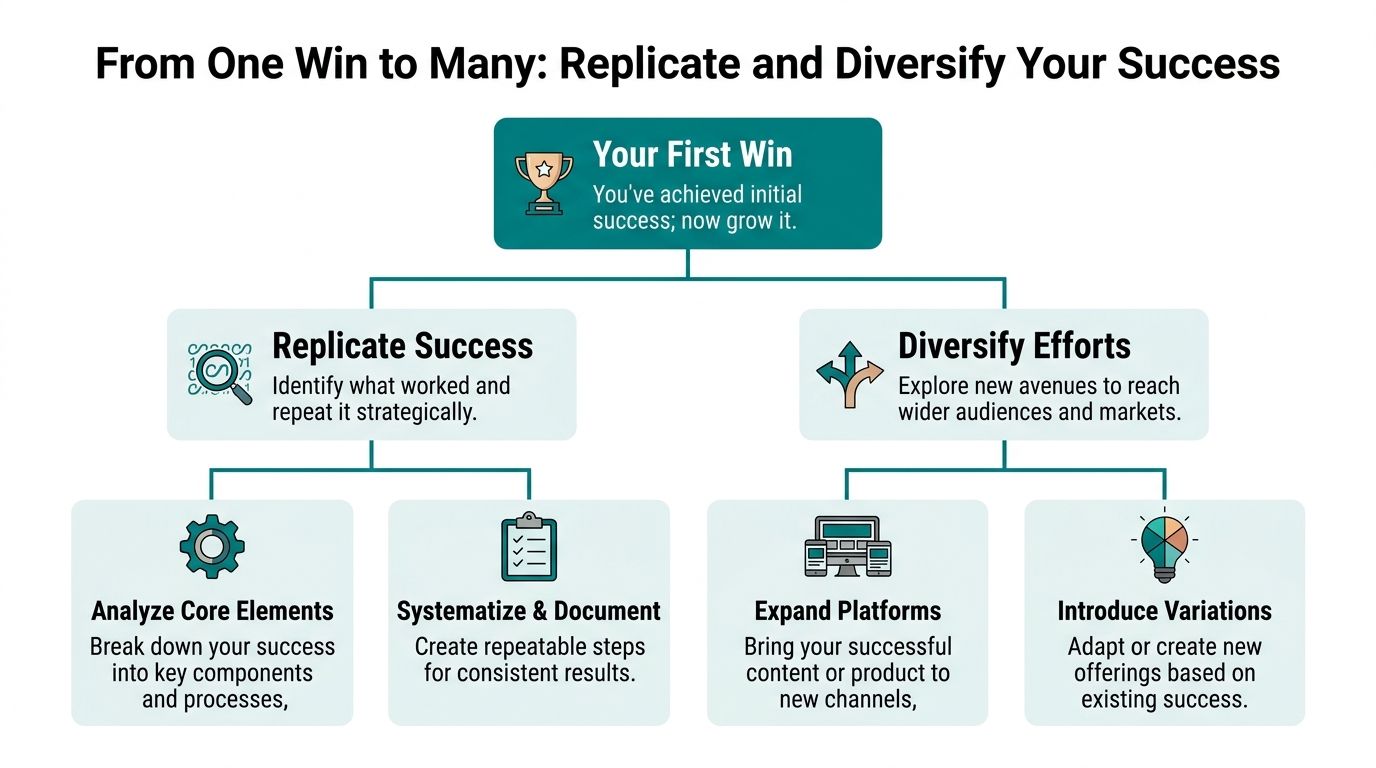
From One Win to Many How to Replicate and Diversify
Once you understand why a first win happened, growth becomes less mysterious.
You are no longer throwing content into the internet and hoping. You are making thoughtful choices. That is a much steadier place to build from, especially if you want security more than speed.
Replicate before you reinvent
Start by repeating the conditions that helped the first result happen.
If a blog post about beginner Affiliate Marketing connected, write another one that helps with the next question your reader is likely asking. If a personal email got replies, send another with a similar tone. If a recommendation led to a sale, look closely at why people trusted it.
Replication is not copying yourself in a lazy way. It is honoring what already proved useful.
Some examples:
- One helpful post becomes a series. If readers liked your explanation of affiliate links, write follow-ups on choosing products, writing honest reviews, or disclosing recommendations clearly.
- One question becomes several content pieces. A reader asking, “Is Affiliate Marketing legit?” can lead to an email, a blog post, and a simple checklist.
- One live teaching session can keep working. If you ever host a webinar or video session, you can turn one session into multiple marketing assets instead of starting from scratch each time.
What diversification means
The word “diversify” can sound technical. It does not need to be.
In this context, it means finding additional ways to help the same audience. Not chasing every platform. Not becoming a full-time content machine.
For many beginners, diversification can look like this:
- Affiliate marketing means recommending products or services you trust and earning a commission when someone buys through your link.
- Brand ambassadorships usually mean an ongoing relationship with a company whose products fit your audience and values.
- Digital content offers can include guides, workshops, newsletters, or simple teaching resources.
The key is fit.
If your audience trusts you for simple, beginner-friendly advice, then your offers and recommendations should feel like a natural extension of that trust.
Why your age is not a disadvantage
Many women hesitate here because they assume online business belongs to younger people. That belief is understandable, but it is not the whole story.
A 2025 AARP study found that 62% of women 50+ interested in side hustles cite feeling too old to start online as a top barrier, yet midlife creators aged 45+ achieve 25% higher list retention rates with legacy framing according to this analysis. In plain language, when you present your work as an extension of your life experience, people stay connected longer.
That makes sense.
A woman who has lived through career shifts, family responsibilities, financial pressure, and reinvention often communicates with more empathy and less performance. Readers can feel that.
Your credibility does not come from being trendy. It comes from being trustworthy.
A simple filter for what to add next
Before adding a new income stream, ask:
- Does this serve the same person who responded to my first win?
- Would I feel comfortable recommending this to a friend?
- Can I explain it clearly without sounding salesy?
- Will it support peace of mind, or just add more tasks?
If the answer is no, let it wait.
Addressing the scam concern
I understand being cautious. There are scams online.
That is why ethical Affiliate Marketing matters. The basic idea is simple. You recommend something useful, disclose that you may earn a commission, and only share what aligns with your audience’s needs. That is very different from pushing random products for quick cash.
A good rule is this: if you would not email it to your sister, do not promote it to your audience.
Small expansion beats frantic expansion
Many people make one sale and immediately feel they need ads, courses, short-form video, and a bigger brand. Often, they need none of those things yet.
The gentler path is to deepen before you widen.
- Help the same audience with the next problem.
- Offer one more useful resource.
- Test one additional channel only if it feels manageable.
That is still growth. It is just calmer growth.
Building Your Core Asset The Gentle Guide to Email Lists
If social media disappeared tomorrow, what would you still own?
That question matters more than most beginners realize. A platform account is useful, but it is borrowed space. An email list is different. It is a direct connection to people who have invited you into their inbox.
That is why List Building is one of the strongest forms of building on success.

Why an email list matters so much
When someone joins your list, they are saying, “I want to hear from you again.”
That gives you stability. It also gives you a way to serve people without depending on algorithm changes or constant posting. Customer success initiatives drive up to 50% of total revenue growth, and existing customers can account for 33% to 50% of revenue growth according to these customer success statistics. For a creator, the takeaway is clear. The relationships you keep often matter more than the strangers you chase.
An email list supports that kind of steady relationship.
If tech feels intimidating, start smaller than you think
You do not need a complex setup.
A basic list can begin with:
- An email platform such as Kit or MailerLite
- A simple signup form
- One useful free resource, such as a checklist, short guide, or email mini-series
- A habit of writing one helpful email at a time
That is enough to begin.
If you want a beginner-friendly walkthrough, this guide on how to build an email list the ultimate beginners guide can help you see the pieces more clearly without making it feel technical.
What do you even send people
Many women freeze at this point. They think they need to be brilliant, polished, or endlessly creative.
You do not.
A simple weekly email can include:
| Email type | What it might include |
|---|---|
| Personal note | A short story from your week and what it taught you |
| Helpful tip | One practical step your reader can apply today |
| Trusted recommendation | A tool, book, or resource you use |
| Gentle invitation | A blog post, workshop, or product that fits the topic |
You are not writing a magazine. You are starting a conversation.
A good email does not impress people. It helps them feel understood and supported.
Focus on trust before promotion
If your list only hears from you when you want them to click or buy, they will feel it.
A healthier rhythm is:
- teach,
- encourage,
- share,
- then recommend when it fits.
This also protects your peace. You stop feeling like you must perform. You become useful on a regular basis.
Here is a quick visual if email marketing still feels abstract:
Keep the first system gentle
You do not need fancy copywriting. You need consistency.
Try this:
- Once a week, send one email.
- Once a month, review which emails got replies.
- Keep notes on what readers ask about most.
- Build future content from those questions.
If writing each response from scratch feels tiring, simple support tools can help. These automated email response templates are useful for thinking through common replies while still keeping your tone warm and human.
Think of your list as a community asset
This is the heart of it.
An email list is not just a marketing tool. It is a place where trust compounds. It is where your readers learn your voice, your values, and the way you help. Over time, that creates a kind of security that quick social spikes rarely provide.
That is why assets matter more than a paycheck mindset.
A paycheck arrives, then it is gone. A healthy list can keep serving both you and your readers for years.
Simple Automation to Create More Freedom Not More Work
Automation sounds bigger than it is.
Many people hear the word and imagine complicated funnels, software dashboards, and hours of setup. For a beginner, especially one already feeling stretched, that can be enough to shut the whole idea down.
A better way to think about automation is this. It handles the repeatable parts so you have more energy for real connection.

Start with one automation only
If you do nothing else, create a simple welcome sequence.
This is a short series of emails that new subscribers receive automatically after they join your list. It does not need to be clever. It needs to be warm and useful.
That single system can help people feel oriented before they ever hear from you live.
A practical guide to this is available here: affiliate marketing automation step by step.
A three-email welcome sequence
Try something like this.
Email one say hello
Thank them for joining.
Keep it short. Tell them what kind of emails they can expect from you and remind them why they signed up. If you offered a free guide, make sure it is easy to access.
Email two share your why
Tell a short story.
Why did you start learning this? What felt hard at first? What do you want to help people avoid? This is often the email that builds the most trust, because people connect to honesty more than polish.
Email three give one strong win
Teach one useful thing.
Not ten things. One. Show them a simple next step they can take today. If a product or training fits, you can mention it softly, but make the value the main point.
Automation works best when it feels like hospitality, not pressure.
Keep the scope small on purpose
This matters.
Projects that follow best practices like SMART objectives and detailed action plans show 30% lower cost overruns, and scope creep can double labor costs according to this PMI resource. Even if you are not managing a formal project, the lesson applies. When you try to build too much too fast, complexity grows unnoticed.
For a solo creator, that often looks like:
- setting up too many automations,
- buying tools you do not yet need,
- rewriting emails endlessly,
- and feeling behind because nothing feels finished.
A calmer plan is better.
Use SMART in a very human way
Your automation goal can be simple:
- Specific: Create one welcome sequence
- Measurable: Write three emails
- Achievable: Finish one email each week
- Relevant: Help new subscribers feel supported
- Time-bound: Complete it this month
That is enough.
You do not need a giant funnel map. You need one completed system that serves real people.
Automation should reduce decision fatigue
The primary benefit is not just saved time. It is saved mental energy.
When a new subscriber joins your list and immediately receives a thoughtful welcome, you no longer have to wonder what happens next. The process is already there. That gives you more control, not less.
And control creates calm.
If you ever feel yourself drifting into overbuilding, come back to one question: Will this make my business simpler to run, or just more impressive to look at?
That question protects both your time and your peace of mind.
Redefining Success for Lasting Peace of Mind
The internet often defines success in loud ways.
More followers. Faster growth. Bigger launches. Constant visibility.
That version of success can be exhausting, especially if what you want is steadier income, more dignity, and less financial worry. Building on success does not have to mean building a bigger machine. It can mean building a calmer one.
The metrics that matter more
A first sale is exciting. A growing audience can be encouraging. But lasting business Health usually shows up in quieter ways.
Ask yourself:
- Are people staying connected? If subscribers keep opening, reading, and replying, that matters.
- Are people being helped? Genuine feedback tells you more than vanity numbers.
- Do you have energy left? If your system drains you, it needs adjusting.
- Can you maintain this pace? Sustainability is a form of wisdom.
These are not glamorous questions. They are better questions.
The hidden risk after early momentum
Many beginners assume the answer to early success is “do more.” More content. More offers. More platforms. More speed.
That can backfire. A common psychological pitfall of early success is burnout from chasing growth myths. Forum analyses show 35% of queries on “what next” go unanswered beyond “scale ads,” while neglecting list Health contributes to a 52% failure rate in year 2 according to this analysis. The point is not to scare you. It is to remind you that growth without care is fragile.
You are allowed to choose a different pace.
Slow, steady improvement is not a sign that you lack ambition. It is often a sign that you are building something that can last.
A gentler definition of success
For many women in midlife, success looks like this:
| Hustle definition | Peace of mind definition |
|---|---|
| Constant expansion | Thoughtful consistency |
| Attention from everyone | Trust from the right people |
| More tasks | Better systems |
| Chasing trends | Building assets |
That second column is not smaller. It is stronger.
It is also more realistic if you are building around family, Health, caregiving, or a transition toward Retirement. Your business should support your life, not consume it.
Let your business fit your season
You do not have to prove anything by making this harder.
You can choose:
- One platform you enjoy
- One list you nurture
- One or two offers you trust
- One pace you can maintain
That is enough to build a meaningful second chapter.
Many readers need permission to stop comparing themselves to people who have different goals, different energy, and different life circumstances. If that is you, take the permission. You are not behind. You are building with perspective.
Keep asking the right question
Not “How do I grow as fast as possible?”
Ask, “What kind of business would give me more peace five years from now?”
That question changes your choices. It leads you toward systems, trust, and owned assets. It also honors what many women over 50 already know deep down. Peace of mind is not laziness. It is a worthy goal.
The next five years will pass either way. You can spend them reacting, doubting, and starting over. Or you can spend them building something simple, ethical, and durable.
If you’d like calm, step-by-step help from Victoria OHare, you can explore her beginner-friendly training and articles on Affiliate Marketing, List Building, and simple automation. If you are ready for a second chapter with more control and peace of mind, that is a gentle place to start.