
If you're over 50 and wondering whether it's too late to build income online, you're not alone. A lot of women reach this stage and start doing quiet math in their heads about Retirement, savings, and whether the plan they counted on still feels secure. Feeling behind can make every new tech skill look bigger than it really is, but you're not behind. You can learn this.
That's why the question affiliate marketing how much can you make deserves a calmer answer than most articles give. Affiliate Marketing is simple at heart, it's recommending products and earning a commission when someone buys through your link. The tricky part isn't the definition, it's the expectation. One tab full of headlines can make the income look easy, while the path is slower, steadier, and much more human.
I remember logging into a training dashboard for the first time and almost closing the tab. It felt like too many buttons, too many terms, too many chances to get it wrong. If that's where you are right now, I understand. This can feel overwhelming at first, but it's not too late to start building an asset that gives you more control.
The Honest Answer to How Much You Can Really Make
A realistic answer starts with the fact that affiliate income isn't evenly spread. The industry average can sound encouraging, but averages hide the shape of the curve. A large survey-based summary reports an average affiliate marketer income of $8,038 per month or about $96,000 per year, yet the same data shows that 41% of affiliates make under $1,000 per month, 23% make $0, and only about 15% earn between $80,001 and $1 million+ annually AffiliateWP statistics.
What that means in plain English
The average is pulled upward by a small group of very high earners. That's why a headline number can be true and still feel misleading for a beginner. If you're just starting out, the more useful question isn't “What does the average person make?” It's “What does a realistic first year look like while I learn, publish, and build trust?”
Simple rule: the average tells you what's possible, but it doesn't tell you what's typical.
That's also why it helps to think in terms of a profitability curve, not a single number. Early on, your income may be tiny or nonexistent. Later, once you have content, trust, and a simple list-building system, the same effort can start producing steadier results.
A better way to frame the topic is this. Affiliate marketing can become meaningful income, but it's not a shortcut. It's more like planting a small orchard than flipping a switch. The trees take time, yet they can keep giving once they're established.
If you want a gentle framework for setting expectations without pressure, this guide is a good companion: how to set realistic income goals with Affiliate Marketing.
What the Average Income Numbers Show
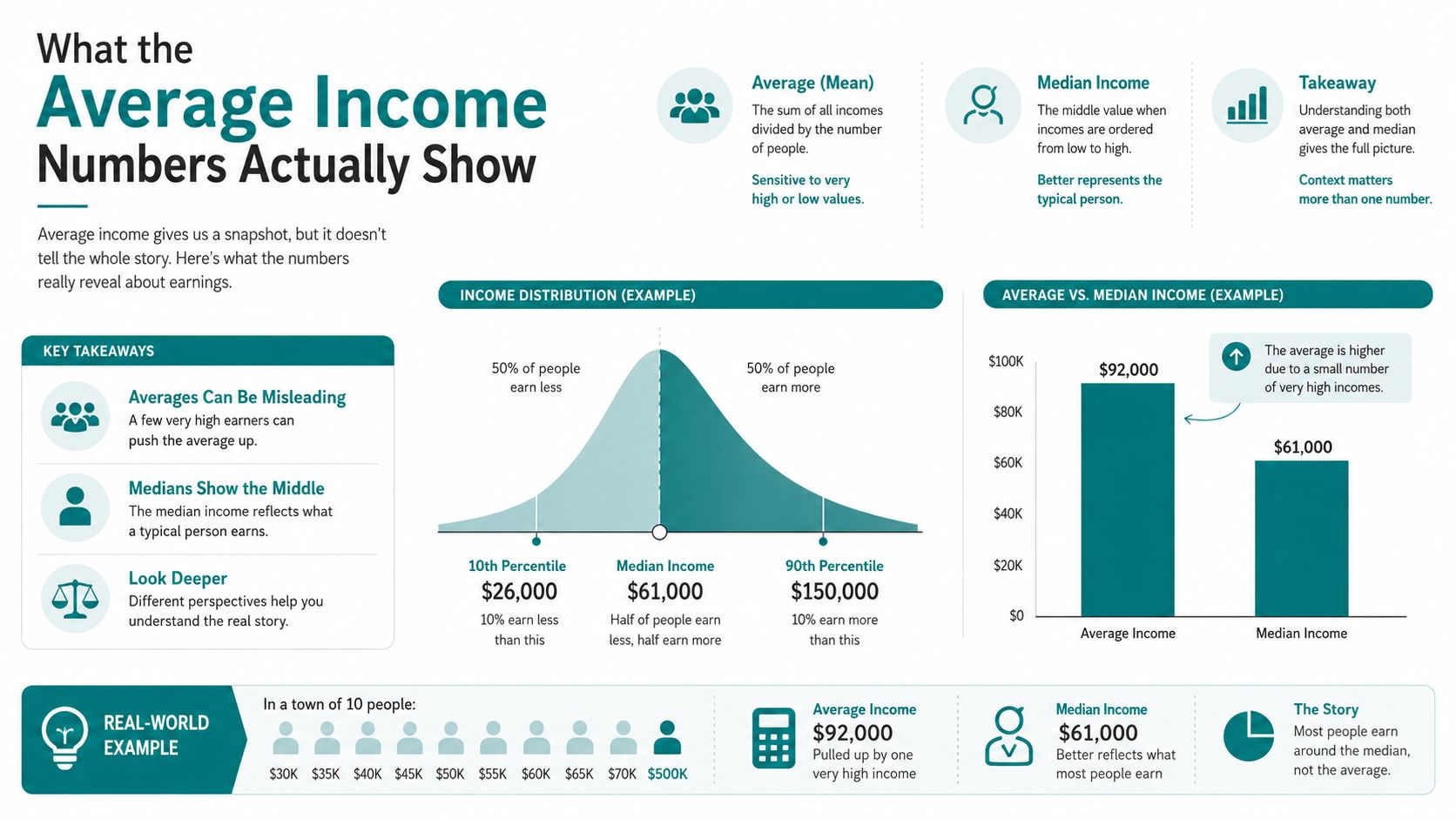
The biggest mistake people make is treating the average like a promise. In Affiliate Marketing, that number is pulled upward by a smaller group of people who have built large audiences, stronger offers, and better traffic systems. A beginner is usually standing somewhere else entirely, so one blended figure can create a picture that feels clearer than it really is.
Why the mean can mislead you
If a room has 10 people and one person earns far more than everyone else, the average rises even when the other nine are still near the bottom. That is why the $8,038 monthly average needs careful reading AffiliateWP statistics. The same source says 41% earn under $1,000 per month and 23% earn $0, which gives a much more grounded view of the starting point AffiliateWP statistics.
A beginner should plan around the lower, more common outcomes first. That does not mean thinking small forever. It means setting a goal that matches the stage you are in, then building from there. A six-figure outcome can happen, but it sits in a narrow part of the market, while a steady four-figure month is a more practical early milestone.
The emotional part matters too. If you are not earning much yet, that does not mean you have failed. It usually means you are still in the setup phase, and setup phases rarely look polished.
Reassuring translation: most affiliates are not starting at the average, they are starting far below it, and that is normal.
For many readers, that perspective brings relief. The goal stops being “match the average fast” and becomes “move one step up the curve with better content, better traffic, and better trust.”
How Your Niche Changes the Income Math
The same effort can produce very different results depending on where you publish. That's because some niches attract buyers who are already close to making a purchase, while others attract casual browsers. A higher-intent niche is like a neighborhood where people already know what they want, so the conversation moves faster.
Side-by-side niche comparison
| Niche | Average Monthly Revenue |
|---|---|
| E-learning | $15,551 |
| Travel | $13,847 |
| Personal finance and investment | $9,296 |
| Home improvement | $5,095 |
| Pet care | $920 |
These niche averages come from a compiled industry table, which shows how sharply earnings can vary by category ElectroIQ affiliate statistics. The spread is wide enough that niche choice can matter as much as effort. A creator in e-learning may be writing to people who are ready to invest in a course or tool, while someone in pet care may be working with products that pay less per sale.
Why this matters for you
You don't need to chase the highest-paying niche on paper. You need a niche where your experience gives you credibility. If you've lived through a problem, solved it, and can explain it, that trust is worth a lot.
A practical way to consider it:
- Ticket size matters: higher-value offers can create more revenue with fewer sales.
- Buyer intent matters: people closer to a decision are more likely to convert.
- Trust matters: readers buy from voices that feel honest and specific.
- Fit matters: a niche you can talk about for years will usually beat one you picked only for money.
The best niche is often the one where your background and your audience overlap. That gives you a better chance of earning without feeling fake.
Why Experience Changes What You Earn Over Time
Experience changes income because it improves judgment, not because the platform suddenly becomes magical. According to a summary of Authority Hacker data, affiliates with less than one year of experience averaged $636 per month, while those with more than a decade of experience earned nearly $45,000 per month on average Wix Affiliate Marketing statistics.
The gap is built, not granted
That jump usually comes from better niche decisions, stronger audience trust, and more durable traffic sources. Over time, experienced affiliates stop depending on every new post to do all the work. They also build assets, such as evergreen content and email lists, that keep sending visitors back to their offers.
The first year can feel slow because it is slow. That doesn't mean you're doing it wrong. It means you're in the stage where you're learning what your readers need, what they click, and what converts.
Every successful affiliate was once earning very little, and most of them didn't start with confidence.
That sentence matters for anyone who feels behind. Early income isn't a verdict on your talent. It's usually a sign that the system is still getting built.
If you can stay consistent through the early low-income phase, you give yourself a real chance to reach the part where the work compounds. That's the quiet truth behind the numbers.
The Four Levers That Move Your Affiliate Income
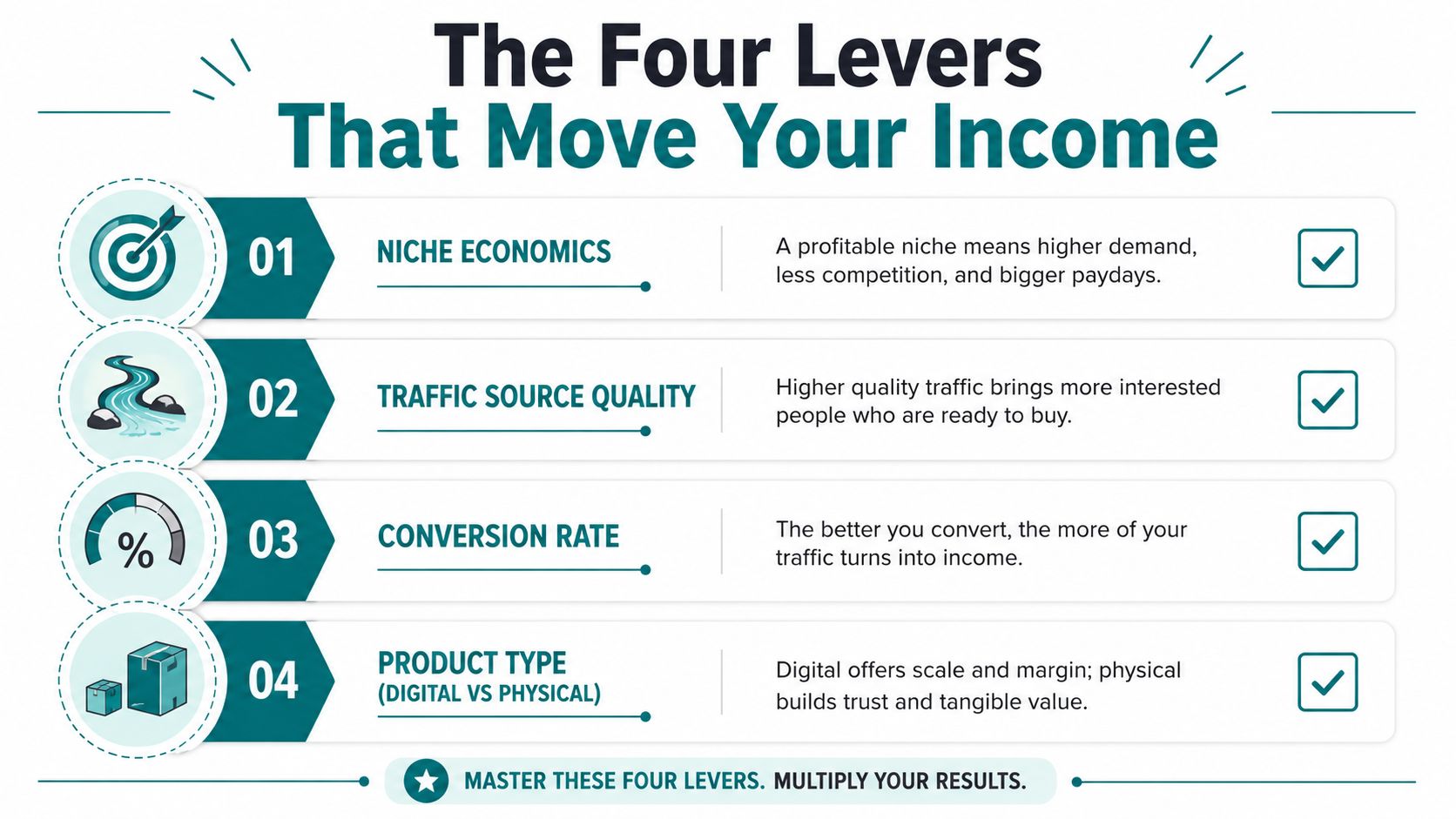
Income usually moves because one of four things changes. Think of them like knobs on a stove. You don't need to turn all of them at once, but you do need to know which one is too low.
1. Niche economics
Some niches pay more because the products cost more or the commissions are stronger. That's why a digital course can sometimes out-earn a lower-priced physical item with far more clicks. The niche is the neighborhood, and the income you can earn depends partly on what kinds of stores are there.
2. Traffic source quality
Traffic is not just traffic. A visitor from a search result who came looking for a solution is different from someone who scrolled past a post by accident. The first person is closer to buying.
3. Conversion rate
Conversion rate is how often a visitor buys. A window shopper is useful, but a ready buyer is better. If your content is trusted, clear, and matched to the reader's problem, more people will take the next step.
4. Product type
Digital products and services often pay differently from physical products. That doesn't make physical products bad. It just means the math changes depending on the offer.
A simple way to audit your current setup:
- Ask about the niche: does this topic attract buyers or just browsers?
- Check the traffic source: are people arriving with intent or by chance?
- Look at your offer: does it fit the reader's problem clearly?
- Review the product type: is the commission structure realistic for your goals?
If you're comparing traffic sources, this guide can help you think it through in a practical way: affiliate marketing traffic sources 2026 guide.
Building an email list as an Owned Income Asset
The better question isn't only how much can you make, it's what asset are you building that keeps paying you. That's where an email list changes the math. Social media is borrowed attention. Email is a direct line you control.
The reason this matters is simple. When a subscriber joins your list, they've already raised their hand. They're warmer than a stranger on social, and a warm reader is easier to help than a cold visitor. The message also doesn't disappear behind an algorithm that decides who sees it.
That ownership piece is becoming more valuable. A 2026 statistics roundup notes that 93% prioritize first-party data, and that lines up with the bigger trend toward durable audience assets rather than rented attention OptinMonster Affiliate Marketing statistics. For a midlife creator, that can be a relief. You don't need to live inside a platform that changes the rules every month.
I've seen the email idea click for people in a very ordinary way. Someone sends one honest email to a tiny list, explains what helped her, and earns a first commission. It's not glamorous. It's encouraging because it proves the model without requiring a huge audience.
If you want a plain-language walkthrough, this resource explains the mechanics well: how to monetize an email list.
The logic is straightforward. Build the list, keep showing up, and let the asset compound. That's how Affiliate Marketing starts to feel less like chasing clicks and more like building something that can support your peace of mind.
A useful tool for outreach-based creators is affiliate commissions for outreach platforms, especially if your business depends on warm contact and steady follow-up rather than constant social posting.
A Realistic 12-Month Timeline and Milestone Map
The first year usually looks more like a staircase than a sprint. Months 1 through 3 are often setup and learning, with income near $0 for many beginners, which matches the low-end reality already described. Months 4 through 6 are often the first small commission phase, where a few sales can start to show up and the work finally feels connected to money.
What the year tends to feel like
By months 7 through 9, the job is usually less about “starting” and more about repeating what works. That's when traffic and your email list can begin to make the business feel real. By months 10 through 12, consistency can make four-figure monthly income feel plausible for some creators, especially if they've picked a niche with stronger economics and they're building owned traffic alongside search traffic.
A small story helps here. One woman almost quit in month two because she thought nothing was happening. She kept going, wrote a few more helpful posts, and later earned her first $400 month in month seven. That kind of progress is much more believable than the fantasy version people sell online.
Slow progress still counts. In Affiliate Marketing, the people who last are usually the ones who can stay patient while the curve bends.
The point of a 12-month map is not to promise a specific income. It's to show you that slow starts are normal, and that your first year is allowed to be a learning year. You're not late, and you don't need to race.
Your Next Gentle Step Toward Real Online Income
A calm next step is enough. Pick one action this week, and keep it small enough that you can finish it without second-guessing yourself. Choose a niche you can talk about, write one helpful review, or set up a simple page where people can join your email list. You do not need to do all three at once, and you do not need to understand every part of Affiliate Marketing before you begin.
A lot of confusion comes from treating online income like a single leap instead of a set of small, repeatable moves. A better way to approach it is the same way you would build a garden. You start with one patch of soil, plant one thing that can grow, and then keep caring for it instead of digging up the whole yard. That is why beginning with owned audience-building matters, especially for readers who want something steadier than chasing random traffic.
I understand why caution matters. Scams do exist, and clear education helps you sort useful guidance from hype. If you want a structured next step, Victoria OHare's site lays out beginner-friendly training and practical guidance for creators who want to build an owned audience without drowning in tech overwhelm. It also fits if you want SEO blog writing for indie hackers, because one useful article can keep working long after you publish it.
The next five years will pass either way. The core question is whether you use them to build something that gives you more peace of mind.
If you want a calm, step-by-step path, Victoria OHare shares beginner-friendly guidance on Affiliate Marketing, List Building, and simple systems that help you build income with more control. If you have been waiting for a sign that it is not too late, this is it.