
If you're over 50 and wondering whether it's too late to build income online, you're not alone. A lot of women carry a quiet fear about Retirement, rising costs, and whether they should have started sooner. That feeling doesn't mean you've failed. It usually means life was busy, responsibilities were real, and now you want a little more security and peace of mind.
Tech can make this feel harder than it is. New terms, new tools, new platforms. It can all seem built for younger people who grew up online. But building an email list and learning how to monetize an email list is not reserved for experts. It's a learnable skill, and it can become one of the steadiest assets in your second chapter.
An Introduction to Your Most Valuable Asset
A woman joins your email list because she wants help with something specific. Maybe she wants to simplify meal planning, learn beginner Affiliate Marketing, or find flexible ways to earn income before Retirement. She gives you her email because she wants to hear from you directly.
That small moment matters more than it seems.
Social media is useful, but it isn't something you own. Platforms change. Posts get buried. Accounts can lose reach without warning. An email list is different. It's a direct line to people who asked to hear from you.
That's why an email list is often your most valuable digital asset.
Why this matters more than followers
Followers can disappear into a busy feed. Subscribers have raised their hand and said, "Yes, I'd like this." That creates a different kind of relationship. Slower, warmer, and often more trusting.
If you're trying to build income with dignity, trust matters more than noise.
A healthy list can support:
- Affiliate income from products you personally recommend
- Digital product sales like guides, checklists, or workshops
- Service offers such as coaching, consulting, or done-for-you help
- Carefully chosen sponsorships if your audience is a good match for a brand
A simple way to think about it
Think of your email list as a garden, not a vending machine.
You don't shake a seed packet and demand tomatoes by Friday. You plant, water, pay attention, and give things time to grow. Email works the same way. People join, get to know you, learn from you, and over time some of them buy.
Your list isn't just a place to send promotions. It's a place to build a relationship that can turn into steady income.
I remember when I first understood this. Up until then, email felt old-fashioned to me. I thought social media was where all the action was. But the more I watched creators build stable businesses, the more I noticed they all came back to the same thing. They were building an owned audience.
If you're still at the very beginning, this simple beginner guide to building an email list can help you start without overcomplicating it.
What makes it so powerful
An email list gives you something many people want more of right now. Control.
You control when you write. You control what you offer. You control how often you communicate. And you can shape your business around your values instead of chasing every trend.
That doesn't mean instant income. It means something better. A foundation you can build on patiently.
Building Your Foundation with Trust not Hype
A lot of people feel skeptical here, and that caution is healthy. The internet is full of flashy promises, vague screenshots, and people selling fantasy instead of skill. If you've ever thought, "I don't want to get pulled into some scam," you're thinking clearly.
Learning how to monetize an email list is not about gaming people. It's about building trust, offering something useful, and creating a fair exchange of value.
What makes this legitimate
A real email business has a few simple qualities:
- You help a specific person with a specific problem
- You collect permission-based subscribers who choose to hear from you
- You recommend or sell relevant offers
- You respect the relationship instead of pushing people into pressure tactics
That last part matters. Sustainable email income comes from usefulness, not manipulation.
According to a 2022 Digiday report covered by LiveIntent, 92% of email marketers plan to monetize their emails, with roughly half choosing email advertising. The important point isn't that you need ads. It's that professional marketers already view an email list as a business asset.
You're not too old, and you're not too late
Many women worry age is a disadvantage online. I see the opposite.
Life experience gives you judgment. It gives you stories. It gives you empathy. It gives you a better sense of what people need, and that can make your emails more grounded than the polished but empty content people are tired of reading.
Trust is easier to build when you speak like a real person.
Practical rule: If your emails sound like you talking to one thoughtful friend, you're usually closer to the right tone than if they sound like a marketing script.
About the tech fear
I understand the panic that can rise when you open a dashboard and see forms, automations, tags, and settings. The first time I logged into an email platform, I nearly closed the laptop and decided I wasn't "that kind of person."
But email platforms are just tools. You don't need to master everything at once.
Start with the basics:
- A signup form so people can join your list
- A lead magnet or simple reason to subscribe
- A welcome email so new people hear from you right away
- A regular newsletter where you show up consistently
That's enough to begin.
Proof helps calm buyer hesitation
Once you do start offering something, people often want reassurance that it works or that you're credible. That's normal. A kind word from a customer can go a long way, which is why learning how to get customer testimonials that truly convert can help you present social proof in a way that feels honest, not pushy.
How to spot the wrong path
If someone tells you email income is automatic, effortless, or guaranteed, step back.
This is slower than hype, but safer. You build trust. You learn what your audience needs. You create or recommend solutions. You improve over time. That's not flashy. It is reliable.
And reliable is what many of us are after.
Four Calm Ways to Earn Income from Your List
A quiet kind of email business is possible.
You do not need to build your whole income around big launches, countdown timers, and the pressure to be "on" all the time. Your list can support steadier, more recurring revenue if you choose offers that match your energy, your skills, and the kind of relationship you want with readers.
That matters because different income models create different kinds of work. Some ask for constant promotion. Some create income in smaller, steadier streams. If peace of mind is part of your goal, it helps to choose on purpose instead of copying the loudest person online.
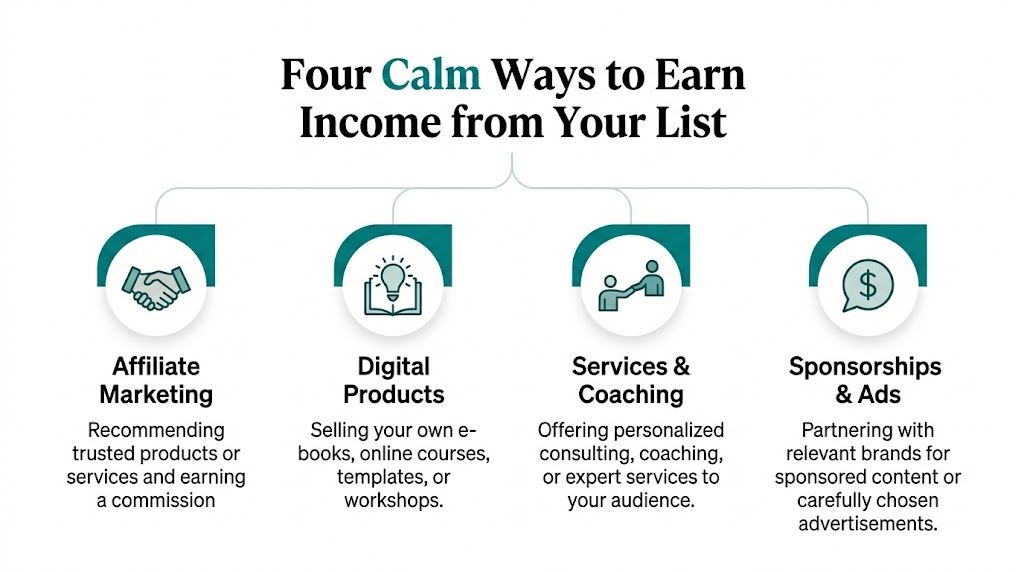 email list: Affiliate Marketing, digital products, services, and sponsorships." />
Affiliate marketing
Affiliate marketing is often the gentlest place to start. You recommend a product or service you already use, and if a reader buys through your link, you earn a commission.
That can be as simple as emailing your list about the scheduler that saves you an hour a week, the course that helped you learn a skill, or the software you use every day. Done well, this feels less like advertising and more like pointing a friend toward something useful.
Why this works for many beginners:
- You do not need to create your own offer first
- You can learn what your readers care about by noticing which recommendations get clicks and replies
- It fits naturally inside educational emails
The caution is simple. Recommend tools because you trust them and because they fit your audience. A quick commission is rarely worth the long-term cost of sounding careless or self-serving.
Digital products
Digital products help you turn one useful idea into repeatable income. A checklist, workshop replay, template, short guide, or mini-course can all work.
A small digital product is often better than an overbuilt first offer. If subscribers keep asking the same question, that is usually a clue. You may already have the topic for a paid resource.
A lead magnet and a paid product also work well together. The free resource solves a first small problem. The paid offer helps with the next step. If you are still shaping your free entry point, this guide on creating a lead magnet that attracts the right subscribers can help you connect those pieces in a way that feels natural.
A digital product works like a well-labeled shelf in a small shop. Someone arrives with a specific need, sees the right solution, and buys without needing a big event or a long sales process.
Services and coaching
Services are often the clearest route to early income. They are personal, direct, and easier to validate because your subscribers already know how you think.
If you can write, edit, advise, organize, design, teach, or review, your list can bring in clients who feel warmer than strangers from social media. They have already heard your voice in their inbox. That familiarity lowers hesitation.
Here is a simple way to choose the right service model:
| Option | Best for | Why it feels steady |
|---|---|---|
| Consulting | People with clear expertise | Clients usually come with a defined problem and a defined budget |
| Coaching | People who enjoy guiding others | Regular sessions can create recurring monthly income |
| Done-for-you service | People who prefer practical execution | Clear packages make it easier for readers to say yes |
This income is active, not passive. But active income has a place in a calm business. It can pay the bills while your digital products, affiliate income, or sponsorships grow at a healthier pace.
Sponsorships and paid placements
Sponsorships can work well when your audience is specific and attentive. A brand pays to appear in your newsletter because your readers are the exact group they want to reach.
That might look like a short sponsored mention in a weekly email, a dedicated placement, or a recurring slot in a newsletter series. The most sustainable version is simple. You only accept sponsors that would still feel helpful if no money changed hands.
This model is especially appealing for creators who want more predictable income without creating a large catalog of products. As explained in this guide on monetizing an email list without launches, recurring sponsor agreements, affiliate income, and membership-style offers can create a steadier business than relying on constant launch cycles.
If you want to study how promotional emails can still feel helpful and clear, these actionable welcome email series examples offer useful ideas you can adapt to your own tone.
Recurring revenue often feels calmer than launch revenue. It may grow more slowly, but it is usually easier to maintain and easier on your nervous system.
Which one should you start with
If you feel torn, start with the model that matches both your current stage and your temperament.
- Choose Affiliate Marketing if you already use products you recommend
- Choose a digital product if readers ask the same question often and want a clear next step
- Choose services if you want income sooner and like helping people directly
- Choose sponsorships if you serve a focused niche and want a newsletter that works like a media asset
You are not picking a forever model.
You are choosing a first reliable stream. Over time, many creators combine two or three of these. That mix often creates the kind of business people want. One that earns steadily, grows gradually, and leaves enough room to breathe.
Creating a Gentle Welcome for New Subscribers
When someone joins your list, those early emails shape the relationship. Not in a dramatic way. In a human way. They help a new subscriber decide whether your emails feel helpful, safe, and worth opening.
That's why a welcome sequence matters so much.

Start with a quick win
A successful monetization framework often begins with a welcome sequence of 5 to 7 emails, where the first email delivers a quick win and consistent communication builds trust over time.
That phrase, quick win, is worth pausing on.
A quick win is something small your subscriber can use right away. Not a giant library of content. Not a long life story. Just one useful thing that helps them feel glad they joined.
Examples might include:
- A checklist that helps them take one clear action
- A short tutorial that solves a beginner problem
- A simple resource list with tools you recommend
- A personal note pointing them to your best starting article
A gentle sequence you can actually write
If the idea of 5 to 7 emails feels heavy, don't let that stop you. Write a basic version first. You can improve it later.
A simple structure might look like this:
Email one
Deliver the freebie or resource they requested. Keep it clear and warm.Email two
Share a short story about why this topic matters to you. Here, readers begin connecting with you, not just your information.Email three
Teach one helpful idea. Small is better than impressive.Email four
Point them to a useful blog post, video, or tool.Email five
Introduce a related offer, recommendation, or next step.
If you want inspiration before writing your own, these actionable welcome email series examples can help you see how different brands structure their early emails.
Keep the tone human
A welcome sequence is not where you prove how smart you are. It's where you help a new reader exhale.
Write like this:
- Use simple subject lines they can understand at a glance
- Keep one email focused on one idea
- Sound like a person rather than a brochure
- Make the next step obvious so they don't have to guess
A good welcome email doesn't overwhelm. It reassures.
If you're still deciding what to offer when someone subscribes, this guide on creating a lead magnet can help you choose something simple and useful.
A small template you can borrow
Here is a basic shape for your first email:
Hi [First Name],
I'm glad you're here.
Here's the resource I promised: [link]
I created it to help you take one simple step without getting lost in information overload.
Over the next few emails, I'll share a few practical ideas that can make this easier.
You don't need to figure everything out today. Just start with page one.
Warmly,
[Your Name]
That kind of email works because it lowers pressure. It gives value first. It sounds steady.
And steady is memorable.
Growing Your Income with Care and Connection
Once your welcome sequence is in place, growth becomes less about sending more emails and more about sending better-matched emails. With the shift to better-matched emails, many creators hear the word segmentation and immediately assume things are getting too technical.
They aren't.
Segmentation means organizing your list so different people receive different messages based on what fits them best.

What segmentation looks like in real life
Not every subscriber wants the same thing.
Some are brand new and need beginner help. Some already bought from you. Some click every email. Some haven't opened in a while. Sending the same message to all of them can feel noisy and unnecessary.
According to Travelpayouts, segmentation is critical because a vast majority of email users only interact with offers personalized to their history with a brand. The practical takeaway is simple. Relevance improves the experience for your reader and supports monetization at the same time.
You might segment by:
- Behavior such as what they clicked on
- Purchase history such as buyers and non-buyers
- Interest such as Affiliate Marketing, branding, or List Building
- Engagement level such as active readers versus quiet subscribers
Why this protects trust
Segmentation is not about squeezing more money out of people. It's about avoiding irrelevant emails.
If someone already bought your beginner guide, they don't need five more emails pushing the same guide. They may need help using it, or they may be ready for a related offer. If someone never clicks on advanced topics, your beginner content may serve them better.
That kind of care reduces friction.
A simple approach is enough at first:
| Subscriber type | Better email approach |
|---|---|
| New subscriber | Helpful teaching and orientation |
| Recent buyer | Support, encouragement, and related offers |
| Engaged reader | Invitations to deeper offers |
| Inactive reader | A warm check-in or simpler content |
If you ever feel stuck on what to send in your regular emails, these powerful newsletter content ideas can help you keep your content useful without turning every message into a pitch.
Pricing with respect
Pricing can feel emotional. Many women underprice because they don't want to seem pushy. Others freeze because they worry no one will buy.
Try a calmer question. What would feel fair for the problem you're helping solve?
A short guide that saves someone time can be worth paying for. A personal service that gives clarity can be worth paying for. You don't need to apologize for charging for useful work.
Later in your system, visual teaching can help people understand how email strategy supports revenue. This overview gives a clear example:
The quiet compounding effect
When you send relevant emails to the right people, a few things happen. Readers feel seen. Offers make more sense. You stop repeating yourself to people who have already moved on.
That creates a business that feels calmer to run.
And for many of us, that matters just as much as the income itself.
Staying True to Your Values and Your Audience
A list can make money and still feel honest.
That balance matters more than many creators expect. An inbox is a private space. Your readers did not wander past a post by accident. They raised their hand and let you in. If your emails start to feel careless, too frequent, or too sales-heavy, trust weakens fast. If your emails stay useful and respectful, income has room to grow in a way that feels steady instead of draining.

Watch the signs that keep you honest
You do not need a spreadsheet obsession. You need a simple habit of noticing what your readers are telling you through their actions.
Open rates can show whether people still recognize and trust your emails. Clicks can show whether the topic or offer matched what they needed. Sales can show whether the offer solved a real problem. Unsubscribes after a certain type of email can show where your message drifted away from what people expected when they joined.
As noted earlier, even modest conversion can create meaningful income from a list. The lesson is simple. Predictable revenue usually comes from relevance and consistency, not from pushing harder.
That can be a relief.
If your goal is peace of mind, these signals help you adjust early. You can send fewer emails that work better, keep your list aligned with your values, and avoid the stress of constant launches just to make the month work.
Simple rules that protect trust
Some practices make your business calmer and cleaner over time:
- Disclose affiliate relationships when you earn from a recommendation
- Make unsubscribing easy so people can leave without frustration
- Recommend products sincerely and only if you would suggest them to a friend
- Remove disengaged subscribers so your list reflects people who still want your emails
These are not small details. They shape the kind of business you are building.
A smaller list of attentive readers is often more useful than a bigger list full of people who stopped listening months ago. If you want help with upkeep, this guide on how to clean an email list walks through a practical way to keep your list healthier over time.
Integrity supports recurring income
Many creators assume ethics and income sit on opposite sides of the table. In practice, they often support each other.
Readers stay longer when they feel respected. They buy more comfortably when your recommendation sounds measured instead of breathless. They remain open to future offers when each email feels like help, not pressure. That is how a list begins to produce recurring income with less drama. You are building a relationship people want to stay in.
For creators who are tired of hustle culture, this matters. You do not need to become louder to earn more. You need a clear promise, useful emails, and offers that fit the life your audience is trying to build.
That kind of business supports income. It also supports self-respect, steadiness, and a little more peace of mind.
Your Next Five Years Start Now
It's easy to look backward and wish you'd started earlier. This tendency applies to money, Health, confidence, and business. But regret doesn't build anything. A small decision made today does.
If you want to learn how to monetize an email list, begin with one simple action. Start a basic signup form. Write one welcome email. Recommend one product you trust. Draft one tiny digital offer that solves one problem. Small steps count because they create momentum.
You do not need to become a different person to do this. You don't need to act younger, louder, or more polished. You need patience, a willingness to learn, and the courage to begin before you feel fully ready.
I know that can still feel intimidating. That's normal. It doesn't mean stop. It means go gently.
This can become more than an online project. It can become an asset that gives you more control, more options, and more peace of mind as the years move forward.
The next five years will pass either way. The only question is whether you'll use them to build something that supports your security, independence, and second chapter.
If you'd like calm, beginner-friendly guidance for building sustainable online income, Victoria OHare is a thoughtful place to keep learning. The training and articles are designed for people who want simple steps, ethical strategies, and a business they can grow with confidence.