

If you're over 50 and wondering whether it's too late to build income online, you're not alone. You may be worried about Retirement security, feel behind financially, or wonder whether technology has moved too quickly for you. Many women doubt themselves at exactly the moment they need more independence and peace of mind.
Affiliate marketing can be a legitimate way to build an online business, but the industry also contains deceptive programs and dishonest partners. Learning the difference doesn't require advanced technical skills. It starts with slowing down, asking sensible questions, and refusing to let pressure make your decisions.
You Are Not Behind and It Is Not Too Late
A woman in her fifties might open her laptop after dinner, search for “make money online after 50,” and quickly find promises of effortless income. One video shows screenshots of commissions. Another says enrollment closes tonight. A third suggests that anyone who hesitates lacks ambition.
That experience can leave you feeling more confused than hopeful. You might already be thinking about Retirement savings, rising costs, or the possibility that a traditional paycheck won't provide the security you want. Guidance reported by CNBC on Retirement savings benchmarks explains that Fidelity-linked guidance suggests saving about six times annual income by age 50 for someone targeting Retirement at 67, while T. Rowe Price considers 3.5 to 5.5 times preretirement income at age 50 to be on track.
Those benchmarks can be useful, but they can also make an already worried person feel judged. If your savings don't match a guideline, that doesn't mean you failed. Families, caregiving, divorce, Health concerns, job changes, and ordinary life can all affect a financial path.
A different starting point is not the same as being behind.
Affiliate marketing means recommending another company's product or service through a special link. If someone purchases through that link, the company may pay you a commission. The model is simple, but building trust, useful content, and a consistent audience takes patience.
I remember feeling overwhelmed the first time I logged into a training dashboard. There were unfamiliar menus, new words, and instructions that seemed written for someone younger and more confident. The answer wasn't to become a technical expert overnight. It was to learn one small task, repeat it, and ask for help when needed.
You can learn this. An online business for older women doesn't need to begin with a large audience or a complicated website. It can begin with your knowledge, your lived experience, and a careful decision about what deserves your recommendation.
Understanding the Scale of Affiliate Marketing Fraud
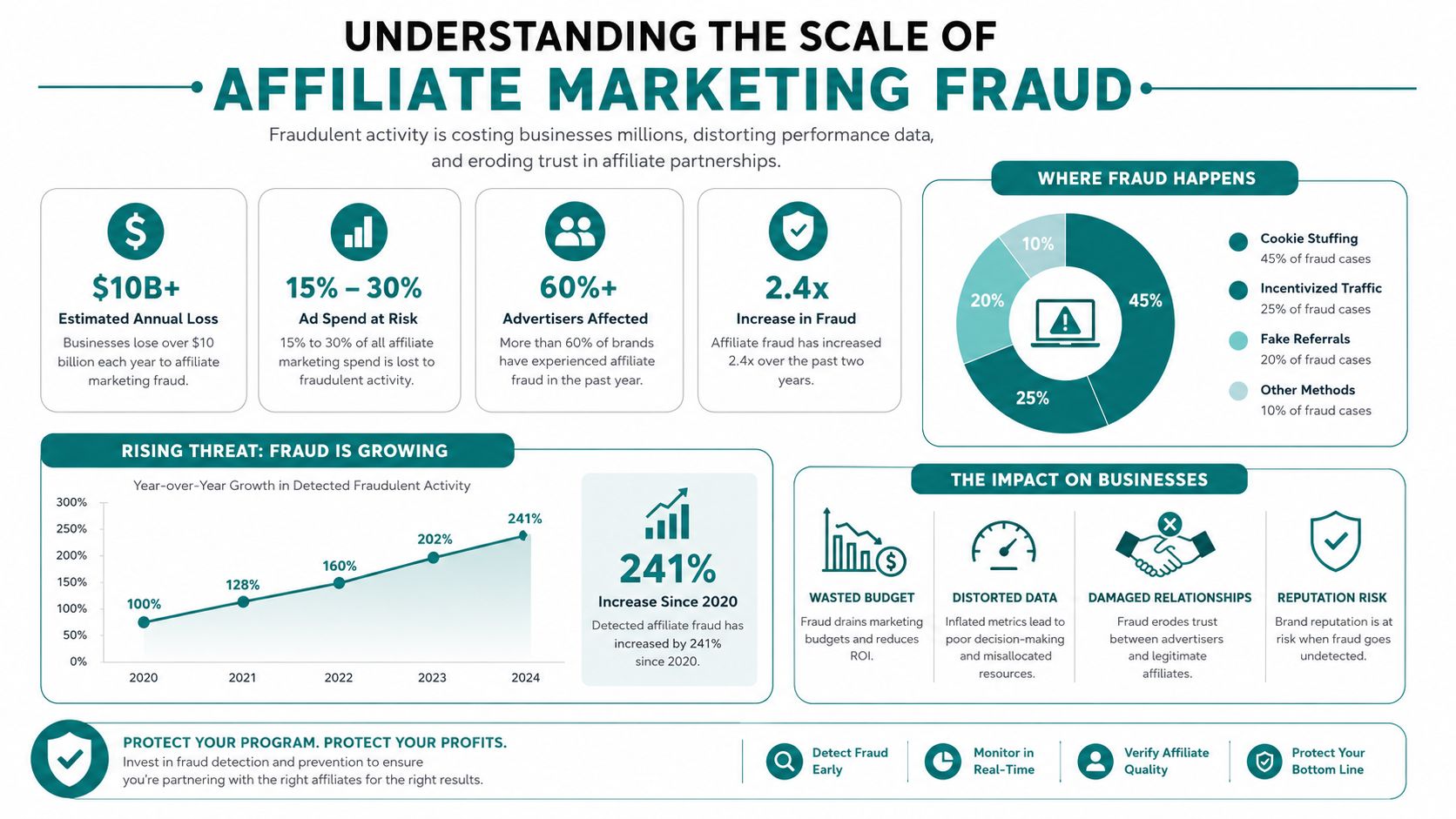
Affiliate marketing fraud is large enough to affect the industry, but that doesn't mean every beginner is personally surrounded by scammers. The first distinction matters: a scammy affiliate program may deceive the person who joins it, while affiliate-channel fraud may manipulate tracking, traffic, or leads to cheat an advertiser.
A CHEQ study estimated that marketers would lose $1.4 billion in 2020 to Affiliate Marketing fraud, using a conservative 9% fraud rate across a $15 billion affiliate sector. By 2022, coverage of the same issue reported fake traffic at 17% of affiliate-program traffic and projected industry losses of $3.4 billion, as the sector expanded from about $15 billion to $20 billion. These figures are discussed in CHEQ's overview of Affiliate Marketing fraud cases.
The important lesson isn't that every affiliate link is dangerous. It's that fraud moved from a niche abuse problem to a measurable, multibillion-dollar cost as the channel grew. A beginner is more vulnerable when she trusts impressive screenshots, skips the terms, or assumes a popular personality has already checked the company.
 Affiliate Marketing fraud." />
Why the wider advertising picture matters
Fraud also persists across digital advertising. Fraudlogix reported that 20.64% of 105.7 billion ad impressions analyzed in 2025 were classified as invalid traffic. Its Q1 2026 update reported an 18.12% invalid-traffic rate across 26.3 billion impressions, including 4.77 billion impressions flagged as fraudulent, and estimated about $37 billion in U.S. ad spend was at annual risk. These figures are summarized by AffNinja's affiliate fraud statistics report.
Fake clicks, fake leads, and non-human traffic can affect advertisers without being obvious to a new creator. Cookie stuffing is another technical example. It overwrites tracking cookies without the user's knowledge so an attacker can claim attribution. An academic study based on HTTP request logs from a large public university found measurable affiliate fraud in real traffic, and research cites the Shawn Hogan eBay case as a $28 million wire-fraud example involving cookie stuffing. The technical details appear in this academic study of cookie stuffing.
You don't need to detect every advanced fraud method. Your first responsibility is simpler: don't hand money, personal information, or your reputation to a program you haven't checked. For a practical example of questions to ask about a questionable opportunity, see this discussion of the John Crestani scam.
Red Flags That Signal a Scammy Affiliate Program
A scam often becomes easier to recognize when you stop listening to the promise and examine the structure. Legitimate Affiliate Marketing explains what you promote, how customers buy, how tracking works, and when commissions are paid.
Watch for these warning signs before you register or publish a link:
- Guaranteed earnings: Claims that everyone will earn a specific income, quickly and with little work, should make you pause. No honest program can guarantee your audience, content, skills, or results.
- Countdown pressure: A timer, urgent call, or “last chance” message tries to replace careful research with fear of missing out. A sound opportunity can withstand a thoughtful decision.
- Large buy-in fees: Be cautious when the main path to earning appears to be purchasing expensive training or access. The FTC described a MOBE case in which affiliates earned millions in commissions while persuading thousands of consumers to pay as much as $60,000 for mentoring services. Read the FTC's account of the MOBE affiliate-marketer settlement.
- Recruitment over customer value: If the program talks more about enrolling new members than selling a useful product, your income may depend on recruitment rather than genuine consumer demand.
- Vague product details: You should be able to understand what the customer receives, who provides it, what it costs, and what happens after purchase.
- Unclear commissions: A high commission sounds attractive, but hidden payout conditions, vague approval rules, or missing payment terms can make it meaningless.
- Fake testimonials: Polished success stories don't prove that a program is trustworthy. Look for details that can be checked independently, not only screenshots supplied by the seller.
- No reachable company: Missing contact information, evasive replies, and a business identity that can't be verified are serious concerns.
- Requests for sensitive information: Don't click an urgent password-reset link from an unexpected email. Open the platform directly through a verified address instead.
- Discomfort that gets dismissed: If questions are treated as negativity, disloyalty, or a lack of belief, leave. Ethical businesses welcome informed participants.

The recruitment test
Ask one direct question: Would this business still make sense if no one recruited another affiliate? If the answer is no, you may be looking at a recruitment-focused operation rather than ordinary Affiliate Marketing.
The same question helps with high-ticket coaching. A real course may charge for education, but that purchase should be clearly separate from the right to promote products. You need to understand whether affiliates earn by referring genuine customers or by bringing in more people who pay to participate.
Here's a short video to watch before you make a decision:
Legitimate Programs Versus Scam Operations
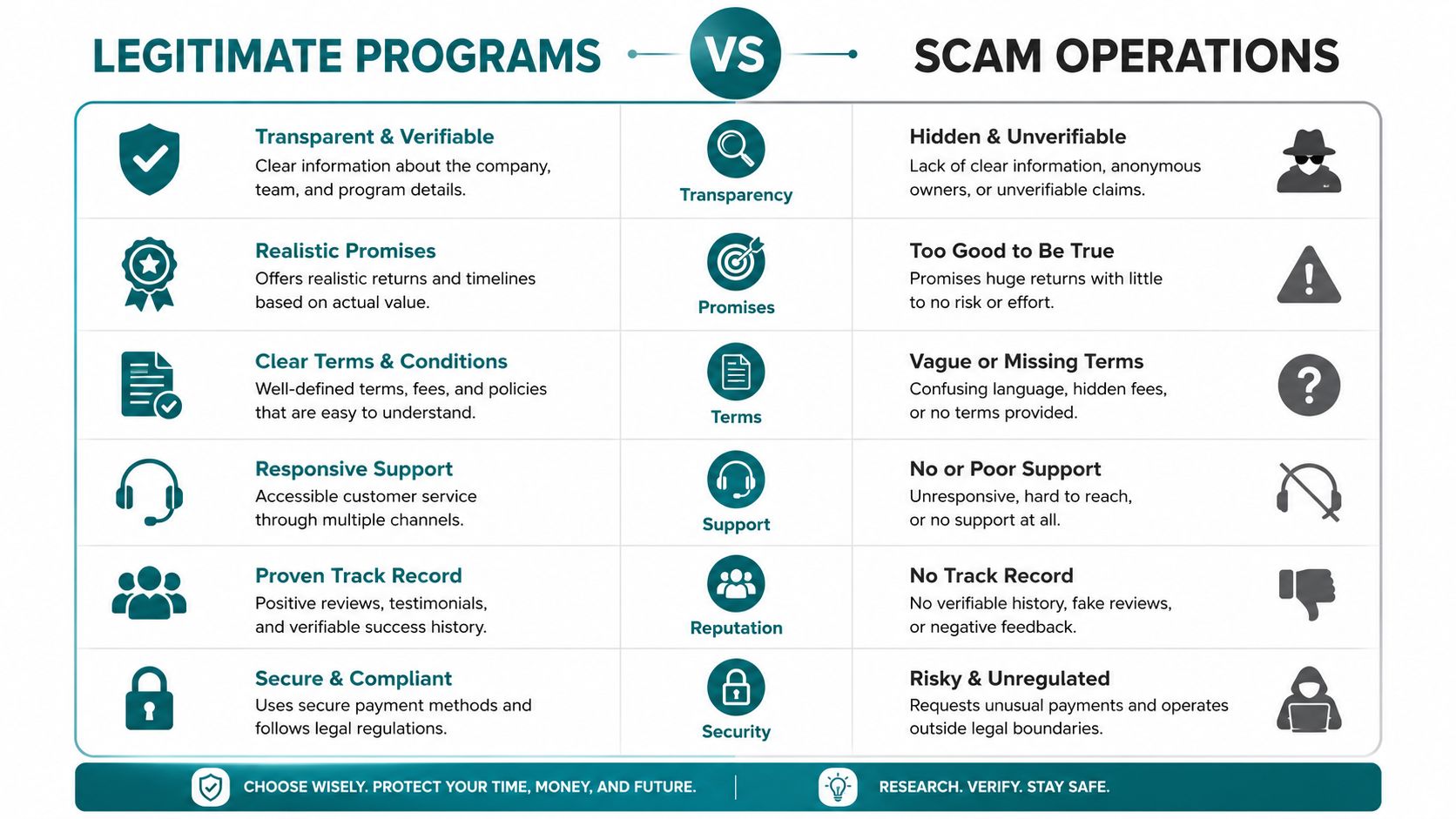
A legitimate program respects three relationships at once: the company needs valuable customers, the customer needs an honest recommendation, and the affiliate needs clear rules. A scam operation usually places its own revenue first and asks everyone else to accept uncertainty.
| Area | Legitimate program | Scam operation |
|---|---|---|
| Product | Offers a real product or service with understandable customer value | Uses vague promises, poor-quality material, or a product nobody can properly explain |
| Earnings | Describes commissions and conditions clearly | Highlights dramatic outcomes while hiding the actual process |
| Payment | Provides terms, approval rules, and payment information | Avoids direct answers about when or why affiliates get paid |
| Recruitment | Rewards genuine sales or qualified actions | Makes recruiting paying participants central to the model |
| Communication | Provides accessible support and business details | Uses pressure, secrecy, or disappearing contacts |
| Reputation | Can be researched beyond its own promotional pages | Relies mostly on controlled testimonials and social posts |
Why transparency protects your reputation
Your audience won't separate your recommendation from the product forever. If you promote something deceptive, customers may remember that you sent them there, even if you didn't create the offer.
A legitimate partner should let you review the product, understand the customer journey, and explain your financial relationship transparently. The FTC's affiliate-marketing rules also show that some contexts involve compliance responsibilities beyond just placing a recommendation link. The FTC Fair Credit Reporting Act affiliate-marketing rules address identity-theft red flags and address-discrepancy procedures under the Fair and Accurate Credit Transactions Act.
For a beginner-friendly overview of how the model works, Sight AI's guide to Affiliate Marketing can provide useful background before you compare individual programs. You can also review affiliate marketing compliance guidance before publishing promotional content.
The best choice isn't always the program with the most exciting commission. It's the one you can recommend without hiding important information from people who trust you.
Your Step-by-Step Vetting Checklist
Use the same process every time. A repeatable checklist protects you from both excitement and intimidation.
Start with the company
Search for the legal business name, contact details, customer support information, and terms of service. Look beyond testimonials hosted on the program's own website. Independent reviews can reveal delayed payments, poor customer treatment, or confusing conditions that promotional pages leave out.
Don't treat one angry review as proof of fraud. Look for patterns, unanswered complaints, and whether the company responds with specific information.
Examine the product before the commission
Can you describe the product to a friend without repeating marketing language? Check what the customer receives, who the product serves, refund arrangements, and whether the claims sound reasonable.
If you wouldn't recommend it without earning a commission, don't promote it. Your credibility is an asset, and protecting it matters more than accepting a new link.
Read the payment terms carefully
Find the commission rate, payment schedule, minimum payout, refund treatment, approval process, and restrictions on advertising. A program that refuses to explain these points is asking you to work with incomplete information.
Ask support a simple question before joining. Note how quickly and clearly the company answers. Helpful support doesn't guarantee an ethical business, but evasive support gives you a reason to step away.
Check the tracking arrangement
Understand how the program records referrals and what happens when a customer returns later to buy. Look for an explanation of attribution, reporting, and anti-fraud procedures. You don't need to understand every technical detail, but you should know where to view clicks, conversions, and commission status.
The affiliate marketing reviews resource can help you think through the questions to ask before committing.
Protect your identity and your audience
Use a separate business email for program accounts. Don't send passwords, banking information, or identity documents through an unexpected message. Go directly to the company's verified website, and save copies of the terms that applied when you joined.
Finally, give yourself permission to wait. A legitimate opportunity won't disappear because you took time to read the agreement, test customer support, and consider whether the product fits your values.
Addressing Your Doubts and Building Confidence
You may still be thinking, “Is Affiliate Marketing legit, or am I walking into another online promise?” That caution is sensible. There are Affiliate Marketing scams, and some programs deliberately target people who feel financially pressured.
The answer isn't to trust everyone. It's to create standards you won't abandon when someone uses urgency, praise, or fear. You can say no to guaranteed income claims, recruitment-heavy offers, unclear products, and payment demands without giving up on the entire model.
You don't need to be a technology expert
Affiliate marketing for beginners over 50 can start with familiar tools. You may write a helpful article, record a simple video, publish a newsletter, or share a carefully explained recommendation. The complicated parts can be learned gradually, and you can ask a community or mentor to explain unfamiliar steps in plain English.
You also don't need to pretend to be someone else. Your experience with work, family, budgeting, Health, home life, or changing careers may help you understand questions that younger creators overlook.
Your age can give your recommendations context, patience, and credibility.
I once watched a beginner hesitate for days over a simple profile setup because she assumed everyone else understood it already. After completing that one task, she realized the barrier wasn't ability. It was the fear of being judged while learning.
Legitimate income won't arrive because you joined a program. You'll need useful content, honest disclosures, consistent effort, and patience. But those requirements are manageable when you treat the work as a second chapter rather than a desperate gamble.
Your Next Steps Toward Legitimate Affiliate Income
Choose one subject you know well and can discuss with genuine care. That might be practical home organization, professional experience, wellness routines, travel planning, or tools that make daily life easier.
Then take these steps:
- Write down the problem your audience wants solved.
- Find companies with real products and clear affiliate terms.
- Research each company before applying.
- Start with one recommendation you can explain thoroughly.
- Publish useful information before asking for a purchase.
- Add a clear disclosure when you may earn a commission.
- Keep notes on questions, responses, and payment conditions.
- Build an email list so your audience isn't dependent on one social platform.
Choose education that teaches sustainable content, ethical promotion, List Building, and simple automation rather than pressure-based selling. A supportive community can make the learning process less lonely, especially when technology feels unfamiliar.
You don't have to decide your entire future today. One careful step can give you more control and help you learn whether this path fits your life.
Victoria OHare offers beginner-friendly guidance for midlife women and new creators who want to understand Affiliate Marketing, build an owned audience, and avoid deceptive programs. Visit Victoria OHare to explore practical training and encouragement for building online income with greater clarity, dignity, and peace of mind.