
If you're over 50 and wondering whether it's too late to build income online, you're not alone. Many women feel behind financially, not because they failed, but because life happened. Careers changed, caregiving took priority, savings didn't grow the way you hoped, and now the future can feel less certain than it once did.
Tech can make that feeling worse. New platforms, new jargon, new promises. It can seem like everyone else got there first.
You are not behind. And you do not need to become a tech expert to build something steady. An Affiliate Marketing business can be a calm, learnable way to create income and, above all, a sense of control.
A Quiet Question About Your Future
She sits at the kitchen table with a cup of coffee gone half cold, looking at numbers she wishes felt more comforting. Retirement is getting closer. Prices keep rising. She isn't looking for a flashy new identity online. She just wants peace of mind.
If that sounds familiar, I understand it.
I remember how heavy that kind of thinking can feel. Not dramatic. Just constant. A quiet mental math that follows you through the day. Will what I have be enough? If something changes, what then?
When security feels thinner than expected
For many women, the old picture of Retirement doesn't feel as solid as it once did. A paycheck may stop, but bills don't. Health needs change. Family needs change. Life keeps asking for flexibility.
That doesn't mean you need to panic. It means it's reasonable to look for a second source of support.
You don't need a huge business. You need a reliable asset that can grow over time and give you more options.
An Affiliate Marketing business fits that need for many beginners because it doesn't require inventory, shipping, or hiring a team. It can start small. It can fit around your life. It can grow slowly and still matter.
A different kind of next chapter
This isn't about trying to be a twenty-year-old influencer. It's about using what you already know.
Maybe you've spent years solving practical problems for your family, your coworkers, your community, or your clients. Maybe people already ask your opinion about tools, products, routines, or resources. That instinct to help is not small. In business, it becomes useful.
A calm online business often starts there:
- You notice a problem people struggle with
- You share what helped you in plain language
- You recommend a useful product when it fits
- You earn a commission if someone buys through your link
That simple pattern can become an asset over time.
The deeper shift is emotional as much as financial. Instead of hoping everything works out, you begin building something with your own hands. That brings dignity. It brings independence. It brings a little more room to breathe.
What an Affiliate Marketing Business Really Is
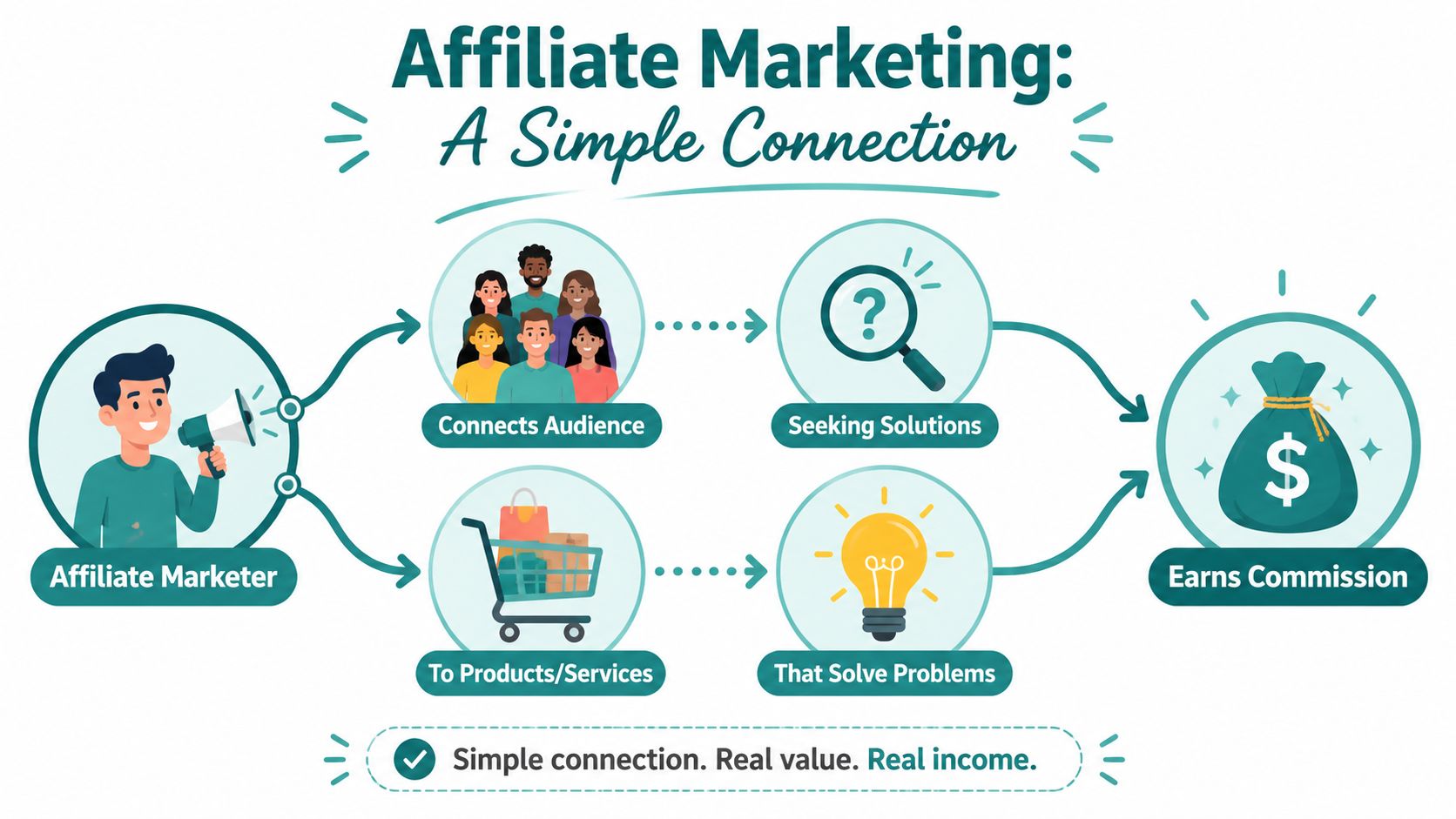
An affiliate marketing business is simple. You recommend a product or service. If someone buys through your special link, you earn a commission.
That sounds almost too simple at first, which is why many people get suspicious. I did too.
The first time I looked into Affiliate Marketing, I had that same guarded feeling many beginners have. Is this one of those internet things that sounds easy but turns out to be shady? That caution is healthy. There are scams online. But Affiliate Marketing itself is a real business model used by major brands.
Recent projections put the industry at over $17 billion in 2025 and $27.78 billion by 2027, and more than 80% of digital brands have affiliate programs, according to affiliate marketing industry statistics from ElectroIQ. That doesn't mean every program is good. It does mean this model is established, not a passing fad.
What it looks like in real life
Think of yourself as a thoughtful connector.
A friend says, "I'm overwhelmed. I need a better way to organize my recipes, meals, and shopping." You share a tool you've used. If you were part of that company's affiliate program, your recommendation could earn a commission.
That's the model.
You don't need to invent a product. You don't need customer service. You don't need to pressure anyone. Your job is to help people find solutions that fit their needs.
The fears most women have
Here are the worries I hear most often:
- Is it a scam? No, not when you're working with legitimate companies and disclosing your links transparently.
- Do I need tech skills? You need basic digital skills, not advanced ones. Most of this can be learned step by step.
- Am I too old? No. Trust, clarity, and life experience help in this business.
- Do I need a huge audience? No. A smaller audience that trusts you can be far more useful than a large audience that barely knows you.
Practical rule: If you'd feel comfortable recommending it to a close friend, it's a stronger fit than a product chosen only for a commission.
If you're exploring programs, it can help to look at examples in different niches. For instance, the ShortsNinja affiliate program shows how software companies structure partnerships for creators who help people solve content problems. You don't need to join that specific one. It helps to see how real programs work.
The most important mindset shift is this. You're not trying to become slick. You're learning how to be useful in a more intentional way.
Four Calm Paths to Building Your Business
Not every Affiliate Marketing business is built the same way. Some models are slow and steady. Some are faster but more stressful. If you're looking for peace of mind, the business model you choose matters.
A helpful way to think about it is this. You're deciding where your business will live and what kind of asset you're building.
Comparing the common models
| Business Model | Best For | Tech Skill Needed | Stability |
|---|---|---|---|
| Niche Site | Writers who enjoy long-form content and search-based traffic | Moderate | Medium |
| Content Creator | People who like teaching through video, posts, or short-form content | Low to Moderate | Medium |
| Email-First | Beginners who want to build an owned audience and long-term trust | Low to Moderate | High |
| Paid Ads | Experienced marketers comfortable with testing and spending money upfront | Higher | Lower for beginners |
The niche site path
A niche site usually means writing articles around one topic, often with search traffic in mind. This can work well if you enjoy writing and patience comes naturally to you.
The challenge is that it can feel slow in the beginning. You may publish helpful articles for a while before they gain traction. For some people, that's fine. For others, it feels discouraging.
The content creator path
This path works well if you like talking, demonstrating, or explaining. You might post on YouTube, Pinterest, Instagram, or another platform and recommend products that match your message.
This can feel more human and natural than traditional blogging. But there is a catch. Social platforms are borrowed space. Their rules can change, and your reach can rise or fall without warning.
The email-first path
This is the calmest path for many beginners.
An email list is an owned audience asset. That means you aren't depending only on search rankings or social media algorithms. More nuanced guidance in this space points to list-first businesses as the most sustainable option for new creators, especially those who want more control and stability, as noted in Elementor's discussion of profitable affiliate business models and list-first strategy.
When someone joins your list, you have a direct way to serve them again. You can teach, recommend, and build trust over time.
The safest business isn't always the fastest one. It's often the one you still control next year.
The paid ads path
Paid ads can work, but they're rarely the calmest starting point. You're spending money before you've fully learned your audience, your message, and your offer.
For beginners, that often creates pressure instead of confidence.
If you're building your first Affiliate Marketing business, the most grounded combination is usually this:
- Create helpful content
- Invite people onto your email list
- Recommend useful products only when they fit
That approach gives you room to learn without feeling like you're racing anyone.
Your First Step Choosing a Niche with Wisdom
Many find themselves overthinking the niche question. They assume they need to find the biggest, trendiest, highest-paying topic on the internet.
You don't.
A good niche sits at the meeting point of three things. What you understand, what people need, and what products can genuinely help.
Start with your lived experience
Your life has already given you material.
You may know more than you think about:
- Home and family systems like meal planning, budgeting, caregiving, or organizing
- Health-related routines such as walking, meal prep, sleep support, or specialty diets
- Hobbies with practical depth like gardening, sewing, journaling, baking, or travel planning
- Life transitions including downsizing, empty nesting, returning to work, or learning tech later in life
That kind of knowledge is valuable because it comes with context. You know what beginners struggle with. You know what helps.
Why narrower is often wiser
Broad niches can be crowded. Smaller niches can be clearer.
Recent coverage points to lesser-known spaces such as eco-friendly products, smart home tech, and other specialized categories where merchants may offer 15% to 50% commissions because expertise is rarer, according to Post Affiliate Pro's look at lesser-known high-commission niches. The bigger lesson isn't to chase a number. It's to notice that specialization can work in your favor.
A woman who talks about "wellness" is very broad.
A woman who helps beginners set up simple eco-friendly swaps for a smaller home is much clearer.
People trust specific help. "I help with this problem" is easier to believe than "I talk about everything."
If you want a simple framework, this guide on how to choose a profitable niche can help you sort your ideas without getting lost in guesswork.
A gentle niche exercise
Take out a notebook and answer these three prompts:
- What do people already ask me about?
- What problems have I solved in my own life?
- What products, tools, or services have helped me?
Then circle the ideas that feel both useful and sustainable.
You're not marrying a niche forever. You're choosing a starting point. A wise niche is one you can speak about with honesty and enough interest to keep showing up.
Creating Content That Builds Trust and Connection
Once you know your niche, your next job is simple. Help people.
Not impress them. Not perform for an algorithm. Help them solve a real problem in a calm, clear way.
The trust-building loop
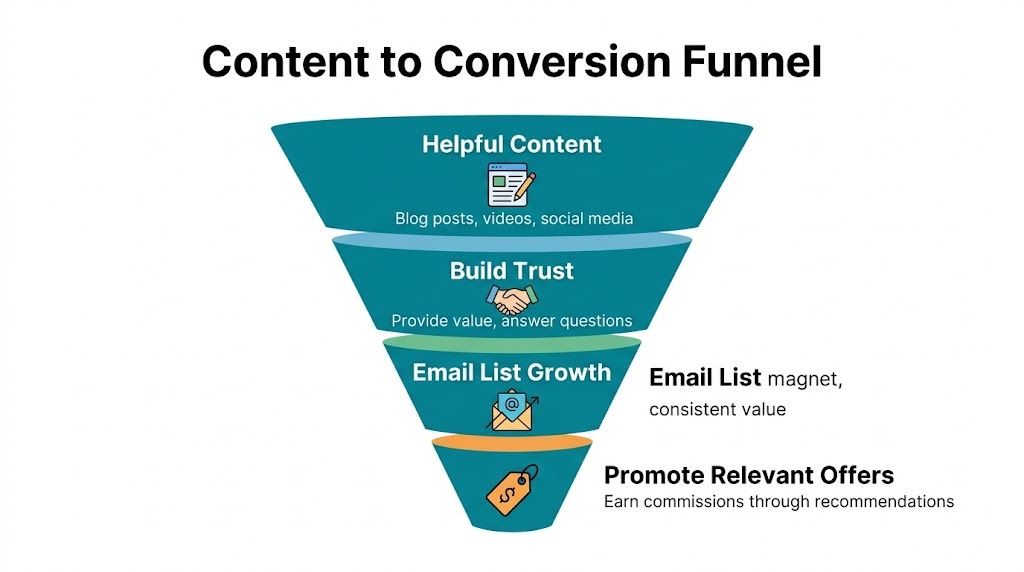
A healthy Affiliate Marketing business usually follows this pattern:
- Create helpful content through blog posts, videos, emails, or social posts
- Offer a simple free resource so readers can join your email list
- Send welcome emails that continue helping them
- Recommend relevant offers when they support the problem being solved
Think of your email list like a garden you tend. Social media can introduce people to you. Your list is where the relationship deepens.
What kind of content works
Useful content often looks ordinary from the outside. That's part of the beauty of it.
You might create:
- How-to posts that walk someone through a task
- Beginner guides that explain a confusing topic in plain English
- Tool comparisons that help people choose between two options
- Personal walkthroughs that show how you use something in daily life
If you want a practical starting place, this article on how to create content for Affiliate Marketing breaks the process into manageable pieces.
A simple free gift can be just as practical. A checklist. A short guide. A printable planner. A list of beginner mistakes to avoid.
Why the email list matters so much
An email address is more than a contact detail. It's permission to keep showing up.
Businesses report an average $15 return for every $1 spent on Affiliate Marketing, according to Maestra's Affiliate Marketing statistics roundup. One reason is trust. Recommendations work better when they come through a relationship, not a random ad.
That same trust grows when someone hears from you more than once.
Later, if you use social platforms to share your ideas, it helps to make the next step easy for people. A simple guide on optimizing your social media landing pages can help you connect content to email signup without making the process confusing.
This short video also gives a helpful visual overview of how content and simple systems can support affiliate income:
A small list of engaged readers is not a small thing. It is the beginning of a business asset.
You don't need a fancy funnel. You need a clear invitation, a useful free resource, and a few kind emails that sound like you.
Making It Official Monetization and Metrics
At some point, your Affiliate Marketing business needs structure. Not complexity. Just structure.
Many beginners tense up at this stage. Money, links, disclosures, numbers. It can sound more technical than it really is.
How monetization actually begins
You choose products that fit your niche. Then you apply to affiliate programs offered by those companies or through affiliate platforms.
As you do that, keep your standards simple:
- Promote what fits your audience's problem
- Read the program terms so you understand how links and commissions work
- Use clear disclosures so readers know you may earn if they buy
- Stay honest if a product has limits or isn't right for everyone
Trust is the ultimate business asset here. Once people feel pushed, you lose the thing that makes affiliate recommendations work.
If you're building around email, this guide on how to monetize an email list shows practical ways to do it without sounding salesy. Victoria OHare also offers training and articles focused on Affiliate Marketing, List Building, and beginner-friendly workflows for new online business owners.
The only metrics most beginners need first
You do not need a spreadsheet obsession.
Professionals often focus on Conversion Rate and Earnings Per Click, according to Partnerize's explanation of key affiliate KPIs. In plain language:
- Conversion Rate means how many clicks turn into sales
- Earnings Per Click means how much you earn, on average, for each click
These are not grades. They are road signs.
If people click but don't buy, the offer may not fit. If one piece of content earns more per click than another, that tells you what your audience finds more relevant. If you want a simple refresher on the math side, this article on optimizing your lead capture conversion can make the idea feel less intimidating.
A useful mindset: metrics don't judge you. They guide your next decision.
You can build this skill one layer at a time. First learn how to help. Then learn how to invite. Then learn how to measure.
That's enough.
Your 90-Day Plan for Calm Progress
The easiest way to get overwhelmed is to think you need a full business by next week. You don't. You need a reasonable plan and the willingness to keep going before you feel fully ready.
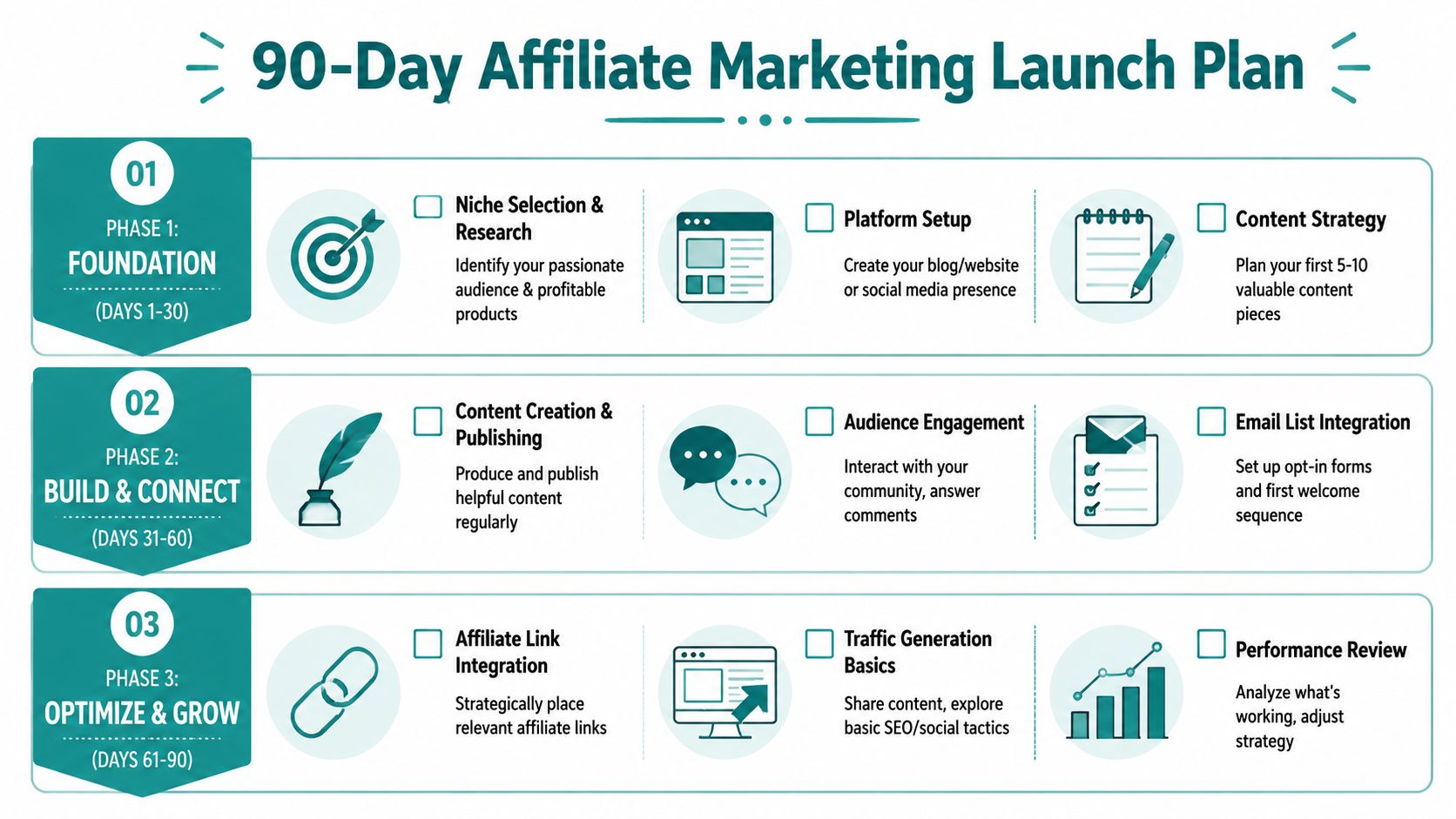 Affiliate Marketing launch plan infographic broken down into three phases for business growth." />
Days 1 to 30
Choose one niche. Study the problems people in that niche want solved. Pick one platform to start with, such as a simple blog, YouTube channel, or email platform connected to a landing page.
Write down five content ideas and one free gift idea. Keep it basic.
Days 31 to 60
Create and publish helpful content each week. Set up your email signup and welcome sequence. Focus on clarity more than design.
Reply to comments or messages when people reach out. Those early conversations teach you what your audience needs.
Days 61 to 90
Apply to a few relevant affiliate programs. Add links only where they naturally fit your content. Watch your clicks and early conversions without panic.
Adjust based on what feels useful and what your audience responds to.
This kind of progress may look quiet from the outside. That's fine. Quiet progress still builds something real.
The next five years will pass either way. The question is whether you'll use them to build an asset that gives you more peace of mind, more dignity, and more control over your future.
If you'd like a calm place to keep learning, Victoria OHare shares step-by-step guidance on Affiliate Marketing, List Building, and simple online business strategies for women who want to start this next chapter without tech overwhelm.