
If you're over 50 and wondering whether it's too late to build income online, you're not alone. Many women feel behind financially, not because they failed, but because life happened. Retirement can feel less secure than you hoped, and the idea of starting something online can bring up a mix of hope, doubt, and pure tech overwhelm.
If that's where you are, take a breath.
You do not need a perfect business idea. You do not need to be a marketing expert. And you do not need to compete with people half your age who seem to live on social media.
If you're learning how to choose a profitable niche, your real starting point is much simpler than often suggested. It begins with your own life. Your experience, your judgment, your story, and the problems you've already solved are often far more valuable than fancy software.
Affiliate marketing, if you're new to it, means recommending products or services and earning a commission when someone buys through your link. It can be a legitimate online business model, but like anything worthwhile, it works best when it's built with trust, patience, and a clear focus.
The First Step That Stops So Many from Starting
A lot of women don't get stuck on the website part.
They get stuck before that, at the notebook stage.
They sit down to pick a niche and suddenly every idea feels wrong. Too broad. Too narrow. Too late. Too competitive. Too silly. Too ordinary. The pressure to choose "the right thing" can stop you before you ever publish a single word.
I remember staring at a blank notebook once, convinced I had nothing unique to offer. I thought other people were already doing everything better, faster, and with prettier graphics. What I couldn't see then was that I was treating the niche decision like a final exam, when really it was just a first step.

Why this feels so heavy
Choosing a niche can feel loaded because it seems tied to your future security.
If Retirement feels uncertain, you don't want to waste time on the wrong idea. If technology already feels intimidating, you don't want to build something complicated only to discover nobody wants it. That hesitation makes sense.
Many women also assume they need a brand-new idea. They think profitable means trendy. But that usually points them away from their strengths and toward markets they don't even enjoy.
You are not behind. You are at the beginning of learning a skill.
There's also a reason this matters right now. Recent 2025 data shows a 45% year-over-year surge in searches for terms like "affiliate marketing at 50", and midlife-specific pain points can lead to 2.5x higher retention in email lists. That tells us something important. Women in this season of life are looking for answers, but content still rarely speaks to their real concerns.
The quiet advantage you may be overlooking
Your life experience is not a side note. It's often the clearest clue.
If you've spent years helping aging parents, managing a home budget, navigating menopause, rebuilding confidence after divorce, dressing a changing body, simplifying healthy meals, or learning how to earn from home around caregiving, you already understand real problems. Those aren't random life events. They're lived knowledge.
That matters because people don't just look for information. They look for someone who understands what the problem feels like.
A profitable niche often starts where someone says, "You get it."
A better first question
Instead of asking, "What's the most profitable niche on the internet?"
Ask this:
- What do people already ask me about
- What have I learned the hard way
- What part of my life experience could save someone else time, stress, or money
- What could I talk about without pretending to be someone I'm not
That is a much calmer way to begin.
You don't need a perfect idea today. You need a starting point grounded in real life, not panic. That's how a business begins to feel possible instead of overwhelming.
Why Follow Your Passion Is Only Half the Story
"Follow your passion" sounds lovely, and sometimes it helps. Passion gives you energy. It makes writing, learning, and showing up feel lighter. But passion on its own doesn't always lead to income.
Many beginners often get disappointed at this stage.
A woman might love wellness, clean eating, skincare, or exercise. She starts creating content around broad inspiration, but nothing really connects. Not because the topic is bad. Because the message is too wide. People don't buy "wellness." They look for help with a specific problem inside wellness.
Passion needs a problem to solve
A profitable niche sits where interest meets need.
The broader Health & Wellness market is huge. According to OptinMonster's affiliate niche data, it's a $6.32 trillion global market. That sounds exciting, but the useful lesson isn't "pick wellness and you'll do well." The useful lesson is that large markets still reward specificity.
In that same source, the Beauty & Skincare sub-niche shows affiliates earning an average of $12,476 monthly. The key difference is focus. These creators aren't talking vaguely about "self-care." They solve clear issues for a defined audience.
The hobby trap
I've seen beginners choose a niche based only on what they enjoy.
They love candles, so they decide their niche is candles. They love journaling, so they decide their niche is journaling. They love walking, so they decide their niche is walking. Those interests can absolutely become part of a niche, but only if they connect to a real struggle or desire.
Compare these two ideas:
| Broad interest | Problem-focused niche |
|---|---|
| Journaling | Journaling prompts for women rebuilding confidence after 50 |
| Skincare | Skincare for dry, changing skin in midlife |
| Walking | Walking routines for beginners easing back into fitness after burnout |
The second column gives people a reason to care.
What people pay for
People usually spend money for one of these reasons:
- Relief. They want a problem to feel smaller.
- Results. They want to improve something important.
- Reassurance. They want guidance from someone who understands them.
- Convenience. They want a trusted recommendation instead of endless trial and error.
That doesn't mean you need to be pushy. It means your content should help people move from frustration to clarity.
Practical rule: Passion helps you stay consistent. A real problem helps your audience say yes.
If Affiliate Marketing has ever sounded scammy to you, I understand that caution. There are plenty of shallow promises online. The difference is intent. Ethical Affiliate Marketing is not convincing people to buy nonsense. It's matching useful products to genuine needs and being honest about what fits and what doesn't.
A smarter way to think about profit
Try thinking in three circles:
- What you care about
- What you're credible in
- What people actively want help with
Where those overlap, a niche becomes much more than a hobby. It starts becoming an asset. And that's what matters if your goal is peace of mind, not more busyness.
You don't need to abandon passion. You just need to anchor it in a problem people are already trying to solve.
Uncovering Your Hidden Assets Your Life Experience
The most helpful niche ideas usually don't arrive in a flash of inspiration.
They show up when you stop asking, "What should I do online?" and start asking, "What have I already spent years learning?" Your life has given you more raw material than you probably realize.
If you've been telling yourself, "I'm not an expert," I want to gently challenge that. Expertise doesn't always look like certificates on a wall. Sometimes it looks like lived experience, practical judgment, and the ability to explain something in plain English.

Your experience is an asset
Think about the things you've done repeatedly over the years.
Maybe you've managed family finances on a tight budget. Maybe you've learned how to dress confidently after body changes. Maybe you know how to host gatherings, organize small spaces, care for sensitive skin, simplify meal prep, or encourage others through difficult seasons.
Those are not "small" topics. Those are useful topics.
If you need help seeing your strengths more clearly, this guide on why your life experience is your greatest asset in 2026 expands on that idea in a practical way.
Questions that pull good niche ideas out of hiding
Take a notebook and answer these slowly. Don't edit yourself yet.
- What do people ask me for help with again and again
- What challenge have I personally come through
- What have I learned through work, parenting, caregiving, marriage, Health, or reinvention
- What products do I already use regularly and understand well
- What topic could I explain patiently to a beginner
- What problem do I wish someone had helped me solve sooner
You may notice a pattern.
For example, if friends often ask you about managing menopausal symptoms naturally, organizing a smaller home after the kids leave, or finding flattering style options in midlife, those are all clues. They point toward areas where your voice can feel trustworthy and grounded.
A simple asset inventory
Use a quick list like this:
| Area of your life | Hidden asset | Possible niche angle |
|---|---|---|
| Career | Professional skill or insider knowledge | Simple systems, training, templates, beginner guidance |
| Health journey | Personal trial and error | Midlife wellness, skincare, sleep, gentle fitness |
| Home life | Repeated practical problem solving | Budgeting, meal planning, decluttering, caregiving |
| Personal reinvention | Emotional and practical resilience | Confidence, new routines, second-career transitions |
One woman might write about style after 50. Another might focus on affordable wellness routines. Someone else might build around home-based side hustles for caregivers. None of those require being flashy. They require being useful.
The market doesn't need another polished expert voice nearly as much as it needs honest guidance from someone who's lived it.
Don't judge the idea too soon
This part is important.
At this stage, you're not deciding your final niche. You're collecting possibilities. Let the list be a little messy. Write down ten ideas if you can, even if some feel ordinary.
Ordinary is often where trust begins.
A lot of profitable businesses are built on topics that seem simple on the surface. The difference is that they speak clearly to a specific person with a specific need. Your age is not the problem. In many cases, it's the reason your content will feel more credible, calmer, and more helpful than what people are already finding online.
Finding the Sweet Spot Your Niche Evaluation Framework
Once you have a short list of possible niche ideas, you don't need to guess. You can evaluate them calmly.
Many find themselves overwhelmed here, believing niche selection must be technical. It doesn't. You don't need to bury yourself in dashboards. You need a simple way to tell the difference between a good idea, a vague idea, and a hobby that probably won't support a business.
This framework helps you sort that out.
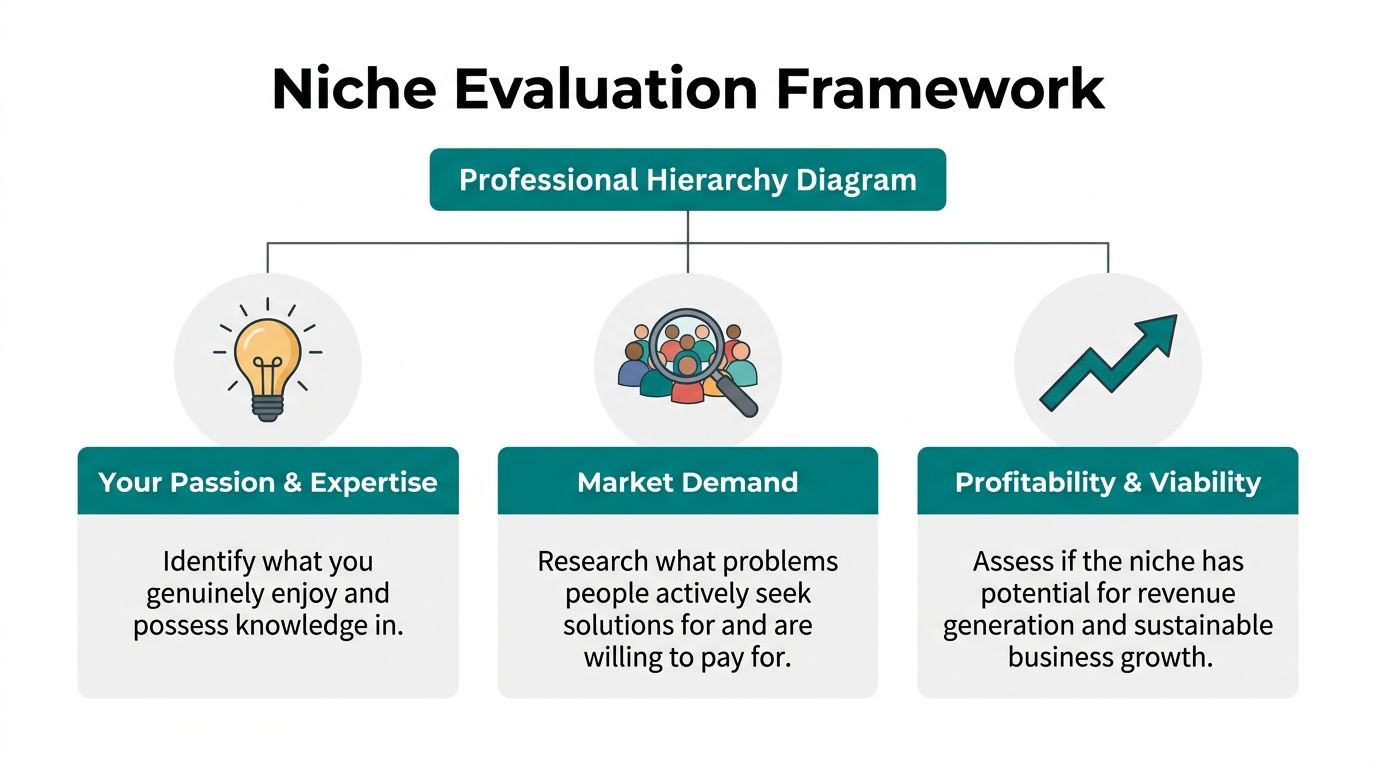
Pillar one your authentic interest
Start with the human part.
Can you see yourself talking about this topic for years, not just a few excited weeks? Could you answer beginner questions about it without feeling drained or fake? Are you willing to keep learning about it?
A niche doesn't have to be your life's grand passion. But it should hold your attention. If you choose something only because it looks profitable, you'll likely get bored before momentum arrives.
Ask yourself:
- Would I still want to write or speak about this next year
- Do I have real experience or honest curiosity here
- Does this topic fit my values and the kind of business I want to build
This protects you from building around a subject that feels empty.
Pillar two audience pain
This is the part many beginners miss.
A niche becomes stronger when it solves a problem people feel now, not someday. That problem might be emotional, practical, financial, or physical. The key is that people care enough to seek help.
Experts who study niche selection place a lot of weight on Willingness to Pay, often shortened to WTP. In simple terms, that means this: are people motivated enough to spend money to solve this problem?
According to FounderFAQs on profitable niche validation, niches where over 70% of potential customers describe a problem as urgent have a 100% success rate when validated, and these higher-WTP niches can produce 2-3x higher margins than passion-only projects.
You don't need to sound like an economist to use that idea.
You just need to ask: does this topic deal with something people urgently want fixed, improved, simplified, or understood?
If the problem feels urgent, people pay attention differently.
For a helpful outside perspective on refining this process, Finding Your Niche offers another way to think through fit and positioning.
Pillar three profitability and viability
The third pillar is practical.
You want signs that money already moves in this space. That doesn't mean every niche needs to be enormous. It means people already buy products, services, courses, books, memberships, or tools connected to the problem.
Here's a plain-language way to judge the three pillars together:
| Question | Weak signal | Strong signal |
|---|---|---|
| Do I care about this topic? | I picked it because someone said it's profitable | I have experience, interest, or both |
| Is there real pain? | It's nice to know | It solves an active problem |
| Do people spend money here? | I can't find offers or products | I can see people already buying solutions |
A quick scoring method
If numbers make you nervous, keep this light. Give each niche idea a simple score of low, medium, or high in these three areas:
- Interest
- Urgency
- Buying activity
Then compare your ideas.
A topic like "wellness" might score high in buying activity, but low in clarity because it's too broad. A topic like "sleep support for women in menopause" may score more evenly because it's clearer, more urgent, and easier to match with products and content.
A topic like "fashion" may feel crowded, but "sustainable fashion for mature women" becomes much more focused. "Budget meal prep" becomes stronger when shaped into "budget meal prep for women caring for aging parents" if that's the audience you understand best.
When readers get stuck
Confusion often pops up here.
Some women worry that narrowing down means they will lose opportunities. Usually the opposite happens. A clearer niche makes it easier for the right people to recognize themselves in your content.
Others worry they don't know enough yet. That's normal too. You do not have to know everything. You need to know enough to help someone a few steps behind you.
A good niche is not chosen by chasing what sounds impressive. It's chosen by noticing where your knowledge, your audience's pain, and real buying behavior meet. That intersection is the sweet spot.
Simple Ways to Validate Your Niche Without Tech Stress
This is the part that scares people unnecessarily.
You do not need expensive software to test a niche idea. You do not need to become an SEO expert before you begin. Early validation can be much simpler than that. Think of it as listening before building.
You're looking for signs that people are already asking questions, expressing frustration, and searching for better solutions.
Start where people talk openly
Forums and discussion platforms are useful because people speak in their own words there.
Search places like Quora or Reddit using phrases your audience might type. If your niche idea is about mature style, look for questions around fit, comfort, confidence, or sustainable shopping. If your idea is about wellness in midlife, look for the exact struggles women describe.
The point is not to gather perfect data. The point is to hear repeated language.
Try searches like:
- How do I
- Best way to
- What helps with
- Anyone else struggling with
- Products for
- Tips for women over 50
If the same kinds of questions keep appearing, that's a healthy sign.
Use reviews as market research
Amazon reviews are underrated for this.
Look up books, journals, planners, skincare items, supplements, or style guides related to your niche. Then read the reviews carefully. People often explain what they hoped the product would solve, what disappointed them, and what they still need.
That gives you three useful clues:
- Language people naturally use
- Pain points they still haven't solved
- Content ideas you could build around
For example, if women repeatedly mention confusion about skincare ingredients for changing skin, that's not just product feedback. That's niche validation.
Listening cue: Repeated frustration is often a stronger signal than polished market language.
Look for proof inside bigger markets
Sometimes a broad niche feels too intimidating at first. That's when sub-niches help.
Fashion is a good example. It's not a tiny niche. In fact, affiliate market data from SQ Magazine shows Fashion holds 23.27% of affiliate market share. But the helpful part is not just that it's large. It's that simple validation can uncover smaller, specific pockets of demand inside it.
That same source notes that a quick search reveals thousands of questions about "sustainable fashion for mature women" on forums. That tells you there is a defined audience with active interest, even before you touch a complicated tool.
Do a low-tech validation check
You can test a niche idea with a short checklist like this:
| Validation question | What to look for |
|---|---|
| Are people asking questions? | Forum threads, comments, repeated concerns |
| Are products already being sold? | Books, tools, courses, affiliate offers |
| Can you describe the audience clearly? | A specific type of woman with a specific problem |
| Can you name content topics easily? | If ideas come quickly, the niche has depth |
You can also make a simple list of ten article ideas. If that feels impossible, the niche may still be too vague. If the ideas come easily, that's encouraging.
Keep validation gentle and useful
One of the easiest mistakes is overcomplicating this stage.
You don't need a spreadsheet that makes your eyes glaze over. You need enough proof to move forward with confidence. Read conversations. Notice patterns. Check whether products already exist. See whether your topic naturally leads to helpful content.
If your niche will eventually support email marketing, you'll also want to think about what free resource could attract the right people. This beginner-friendly guide on how to create a lead magnet can help you connect your niche idea to a real audience-building step later on.
Validation is not about proving you'll never make a mistake. It's about reducing guesswork before you invest too much time. That's a much calmer and smarter way to begin.
Building Your Business with Peace of Mind
A profitable niche is not just a clever category. It's the foundation of an asset.
That's worth remembering if you've spent years depending on a paycheck, worrying about Retirement, or feeling like your options are shrinking. When you choose a niche carefully, you're not just picking topics for content. You're choosing a direction that can support trust, audience growth, and income over time.
What makes this worth doing
The online world can feel noisy. Some people make it sound as if success comes from chasing trends and posting constantly. But sustainable businesses are usually built more steadily than that.
They grow when someone chooses a focused niche, understands the audience, and keeps showing up with useful content.
According to Niche Site Project's niche validation guidance, successful niche sites averaging $25K/month are often found by reverse-engineering what already works, and validating first by checking search volume in the 5k-50k/month range and audience pain. That's a practical reminder that building an asset starts with research, not wishful thinking.
Keep your next step small
You do not need to map out the next five years today.
You only need to choose one niche idea worth testing, one audience worth helping, and one simple way to begin. That might be a few article ideas, a short email freebie, or a basic content plan.
If you want to understand how other creators package communities, offers, and digital products around a focused audience, browsing a resource like this Whop review can give you context for what online business models can look like without needing to copy them.
And once your niche is clearer, building an audience becomes much easier. This guide on how to build an email list is a sensible next step because your email list becomes something you own, not something an algorithm controls.
You are allowed to begin simply
If you're still wondering whether Affiliate Marketing is legit, skepticism is healthy. Education matters. Mentorship matters. Ethics matter.
What matters most is that you build around trust.
Choose a niche where your experience gives you credibility. Validate it without drama. Start helping real people with real problems. That is a grounded way to build income online after 50.
The next five years will pass either way. The only question is whether you'll use them to build something that gives you more peace of mind, more independence, and more control over your next chapter.
If you'd like a calm, beginner-friendly next step, you can explore Victoria OHare for practical training on Affiliate Marketing, niche selection, List Building, and creating an online business without tech overwhelm.