
If you've been worrying about Retirement security, feeling behind, or wondering whether you're too late to learn something new, you're not alone. A lot of smart women sit at the kitchen table with the same quiet question: how do I build something steady when everything online feels noisy and technical? The good news is that you can learn this, and it doesn't have to start with hustle or confusion. A why build an email list answer begins with something simple: owning a direct line to people who want to hear from you.
Email is still one of the most practical channels a creator can own. Twilio says there are about 4.4 billion email users worldwide, and Mailjet puts the number at roughly 4 billion today, with a projection of 4.6 billion in 2025 (Twilio's email list guide). That scale matters because it means email isn't some old habit that's fading away, it's a living channel where permission and trust still count.
For a midlife creator, that changes the emotional math. Social platforms can feel like renting a booth at a crowded fair, while email feels more like keeping the key to your own front door. You don't need to be perfect, and you don't need to be everywhere. You need one calm, reliable place where your work can reach people again and again.
Feeling Behind Is Not the End of Your Story
I can still remember the feeling of opening a new dashboard and wanting to close it five minutes later. The buttons looked unfamiliar, the words felt technical, and my brain went straight to, “Maybe I'm not cut out for this.” If you've ever felt that way, especially while worrying about money or Retirement, I want to say this clearly, you're not behind.
A lot of women were taught to focus on getting through the week, not building assets. So when they finally look at online income, it can feel like everyone else got a head start. That's not failure. That's just life being full.
A list is a small asset that can grow quietly
An email list is not a loud, flashy thing. It's more like a seed tray on a windowsill. You water it, you check on it, and over time it becomes something you can rely on.
That matters because email is an owned audience channel. Once someone gives you permission to reach them, you're not waiting for a platform to decide whether your post gets seen. You're building a direct relationship that can support launches, education, repeat offers, and simple trust over time (Campaigner on owned email audiences).
Practical rule: If you can only build one audience asset this year, build the one you can still reach next year.
That is why List Building feels calmer than chasing attention. You're not trying to outpost an algorithm. You're creating something steady enough to support a second chapter with more dignity and less noise.
The Difference Between Borrowed Land and Owned Ground
Social followers are useful, but they live on borrowed land. A platform can change its rules, shift its feed, or stop showing your posts to the people who asked to hear from you. When that happens, you don't just lose reach, you lose momentum.
An email list works differently. It's owned ground. You can contact subscribers directly, without depending on a platform's mood or a paid boost to stay visible. That's why List Building keeps showing up in serious conversations about long-term business stability, not just marketing tactics.
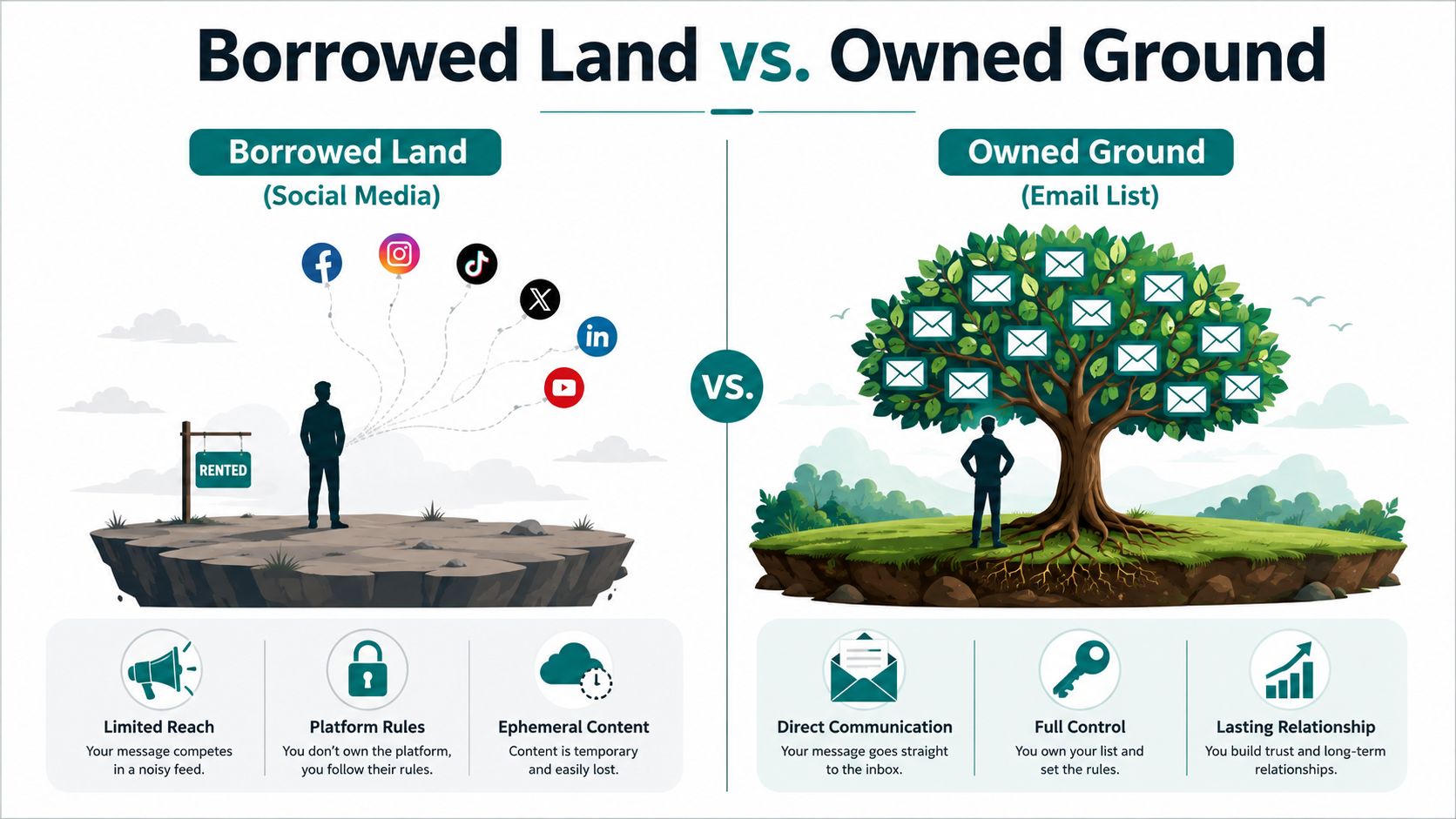 email list as owned ground." />
For a useful comparison on audience ownership, the article on building an email list versus social media followers makes the tradeoff easy to see. If you're a podcaster or creator trying to move people from one platform to another, the discussion at why Spotify links fall short is also a helpful reminder that one link or one platform usually isn't enough on its own.
Why direct communication changes the game
When you own the list, you can keep showing up with the same message until someone is ready. That's not pushy, it's respectful. People often need repeated contact before they trust a recommendation, buy an offer, or just remember your name.
Your list is not a crowd to impress. It's a relationship to tend.
That is also why email is often treated as essential infrastructure. It doesn't replace social media. It gives your social media a home to send people back to.
What the Numbers Actually Say About Email Marketing
Email has a practical payoff, not just an emotional one. That shows up in the economics, which is why so many business owners treat it like an asset rather than a side task. MessageFlow reports that email marketing generates $36 to $42 in revenue for every $1 spent, Twilio cites $38 per dollar spent, and Mailjet cites about $41 per dollar invested (MessageFlow's email marketing article, Twilio's email list guide, Mailjet's email list guide).
The point is not to chase a perfect number. Once someone joins your list, you can keep building that relationship without paying to reach them from scratch every time. That makes launches, education, repeat offers, and simple follow-up easier to manage.
Why small creators should care
If you run a solo business, steady contact matters more than spectacle. A channel that supports direct communication, segmentation, and automation can lower the strain of trying to create fresh attention every week. Campaign Monitor notes that email can be 6x more likely to get a click-through than a Tweet, and it describes email as 40 times more effective at acquiring new customers than Facebook or Twitter (Campaign Monitor's email list-building guide).
Social media still has a place. It often works as the doorway, while email is the room where trust has time to deepen. For many creators, that room feels calmer because the audience is something they own, not something they keep renting attention from.
What those numbers mean in real life
A better return on a small effort brings less panic. It means fewer late-night worries about whether the next post will land. It also means you can set up a system where people hear from you even when your feed goes quiet.
Practical rule: If a channel lets you use the same audience relationship again without starting over, it is doing more than marketing, it is building stability.
That is the answer to why build an email list. It can support income, yes, but it also supports calm.
Addressing the Doubts You Are Probably Feeling
If you have ever opened a new tool and felt your shoulders tense, you are in good company. Email can look intimidating at first, especially when online advice makes everything sound urgent, technical, or risky. A steadier path helps here. You are not trying to master the whole field in one evening, you are just learning how to own a simple channel that stays with you.
The worries usually come in a few familiar forms.
- “Is this a scam?” Email itself is not a scam. It is a communication channel, like a mailbox or a phone line. The problem is bad offers, not the idea of having a list.
- “Am I too old to learn this?” No. A basic platform, a signup form, and one simple email are learnable skills.
- “Do I need to be tech-savvy?” No. Patience matters more than technical confidence.
- “What if nobody signs up?” Every list begins with one person. Then another. That first small group is enough to prove the system works.
For midlife creators, the emotional shift matters as much as the practical one. Social platforms can feel like rented space, always changing under your feet. An email list feels more like a key to your own front door. You still need to invite people in, but you are building on ground you can keep.
I know how easy it is to freeze when a screen looks unfamiliar. The first login can make you question whether you belong there at all. That feeling is common, and it passes. Once you slow the process down and treat each step like setting up a kitchen appliance with a simple manual, the work becomes much less scary.
If you want a beginner-friendly overview of the basics, guide to starting a newsletter from scratch lays out the core pieces in a clear way. That kind of clarity helps because the hardest part is often not the software, it is trusting that you can learn it and use it without needing to become a tech expert first.
Your Simple First Steps to Start Building Today
You do not need a big launch plan to begin. A small, steady setup is enough to turn email into something you own, instead of something you keep renting from a platform that can change on you overnight.
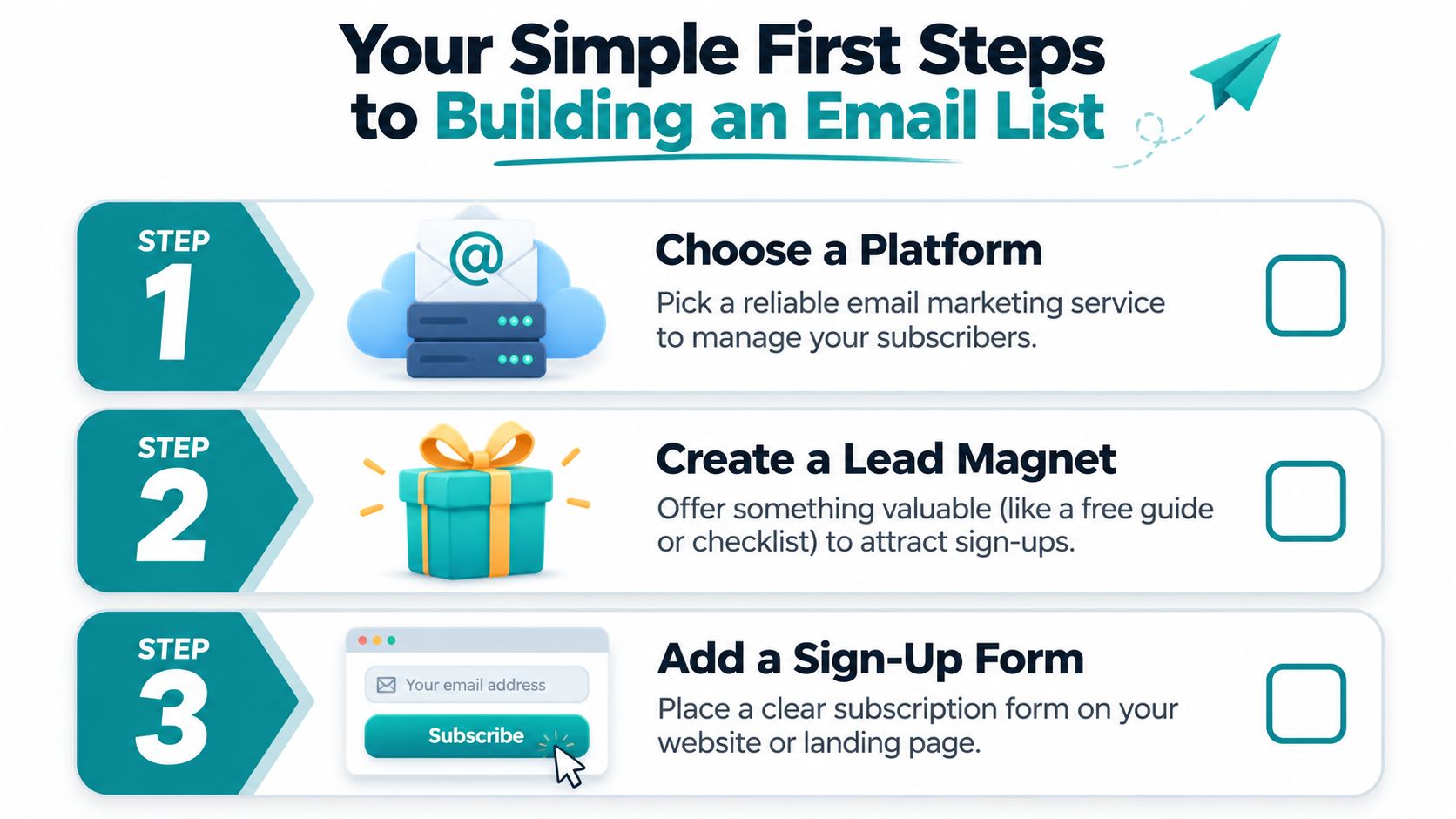 email list with icons and descriptions." />
Start with one tool, one reason for someone to join, and one place where people can sign up. That is enough to get the first pieces in place without turning the process into a second job.
Three simple moves
- Choose a platform. Pick one email service that stores subscribers and sends messages for you. You want something clear and easy to use, not a maze of settings.
- Create one lead magnet. A lead magnet is a small free gift, like a checklist, guide, or worksheet, that gives people a fair reason to join your list. A practical walkthrough from Victoria OHare, how to create a lead magnet, can help you shape that first offer.
- Add one signup form. Put it where people already spend time, on your website, your blog, or a simple landing page.
A simple setup guide can also help when the process starts to feel bigger than it is. The guide to starting a newsletter from scratch lays out the moving parts in a clear way, and that kind of clarity matters when you are learning something new. You are not trying to become a technician first. You are learning how to make it easy for the right people to hear from you.
If you learn better by watching, this short video helps show how the pieces fit together.
A list does not have to be large to matter. A small group of real people who asked to hear from you is already a valuable asset, because it gives you a place to build trust one name at a time.
Quality Over Quantity in Growing Your List
More subscribers is not always better. A large list full of people who never open your emails can feel impressive and still do very little for your business. For midlife creators especially, trust matters more than vanity.
That's why quality should come before raw growth. If people signed up because of a giveaway they barely cared about, they may never engage again. If they joined because your message felt useful, they're more likely to stay with you.
Build for responsiveness, not just size
Simple segmentation helps here. When you separate people by interest, behavior, or where they joined, your emails can feel more relevant and less random. That usually supports stronger relationships over time, because people get messages that match why they subscribed in the first place.
The same idea applies to list hygiene. A cleaner list is often healthier than a larger, dusty one. If you want a practical walkthrough, how to clean an email list is a useful companion read.
For content creators who repurpose a lot of material, the automated content repurposing playbook shows how one idea can be adapted across formats without starting from zero each time. That kind of thinking pairs well with email, because consistency is easier when your best ideas can do more than one job.
A smaller list that opens, clicks, and replies can support more peace of mind than a bigger list that ignores you.
That's the long game. It's not about inflating numbers. It's about building an audience that trusts your voice, remembers your name, and makes room for your offers when they're ready.
Your Next Five Years Start With One Small Step
The next five years will pass either way. The question is whether you'll let them pass while feeling behind, or use them to build something that gives you more control. Email List Building is one of the quietest ways to do that.
It doesn't ask you to become a different person. It asks you to become a more intentional one. You can start with one list, one form, and one simple email, then let trust build from there.
If you've been waiting for the perfect moment, this is enough of a moment. You're not too late, and you're not starting from nothing. You're starting from experience, and that counts for a lot.
Victoria OHare shares practical guidance for building an owned audience, starting simple, and using email as a steady asset instead of a stressful chore. If you want step-by-step support that fits a calm, beginner-friendly approach, visit Victoria OHare and take the next small step when you're ready.