
If you're in midlife and wondering whether you've missed your chance to build something online, you're not alone. A lot of women feel financially behind, uneasy about Retirement, and overwhelmed by all the tech talk. That doesn't mean you've failed. It usually means life was full, and now you're finally asking a new question.
You may have years of experience, hard-earned judgment, and a real desire for more peace of mind. But when people start talking about funnels, launches, automations, and audience growth, it can feel like everyone else got a manual you never received.
I understand that feeling. The first time I logged into an online dashboard with too many tabs and buttons, I wanted to close the laptop and walk away. But confusion at the beginning isn't a sign that you can't do this. It's just the normal first step of learning something new.
From Feeling Unsure to Sharing Your Wisdom
Many women over 50 carry a painful belief that they're too late to start. They think the internet belongs to younger people, faster people, more technical people. I don't believe that for a second.
What often matters most online isn't speed. It's clarity, steadiness, and trust. Those are qualities many midlife women already have in abundance.
You may not call it expertise. You may call it "just life." But if you've solved problems, supported a family, worked through setbacks, built a career, cared for others, or learned a craft over time, you have something valuable to teach.
Your experience is not too small
A virtual business challenge doesn't have to begin with a polished brand or a big audience. It can begin with one useful idea that helps one person move forward.
That could be:
- A practical skill like meal planning, decluttering, budgeting, or organizing paperwork
- A personal transition like downsizing, starting over after divorce, returning to work, or adjusting to an empty nest
- A creative strength like gardening, sewing, writing, journaling, or simple content creation
- A work-based lesson from customer service, leadership, teaching, caregiving, or administration
Small knowledge is often the most helpful knowledge because people can use it right away.
I also know self-doubt can creep in fast. If that's where your mind goes, this gentle guide on dealing with imposter syndrome after 50 may help you steady yourself.
You don't need to know everything. You need to know enough to guide someone through one small win.
There are many ways to build online income from what you know. If you're exploring broader creator paths, this resource on how to monetize your content business with Suby gives a helpful overview without making it sound like a race.
Why this matters now
Retirement doesn't always feel as secure as people hoped it would. Costs change. Life changes. Sometimes what you want isn't luxury. It's dignity, breathing room, and more control over your future.
A simple online project can become an asset. Not overnight riches. Not pressure. Just something you build steadily that belongs to you.
That shift matters. You're not starting from nothing. You're starting from your life.
What Is a Virtual Challenge Really
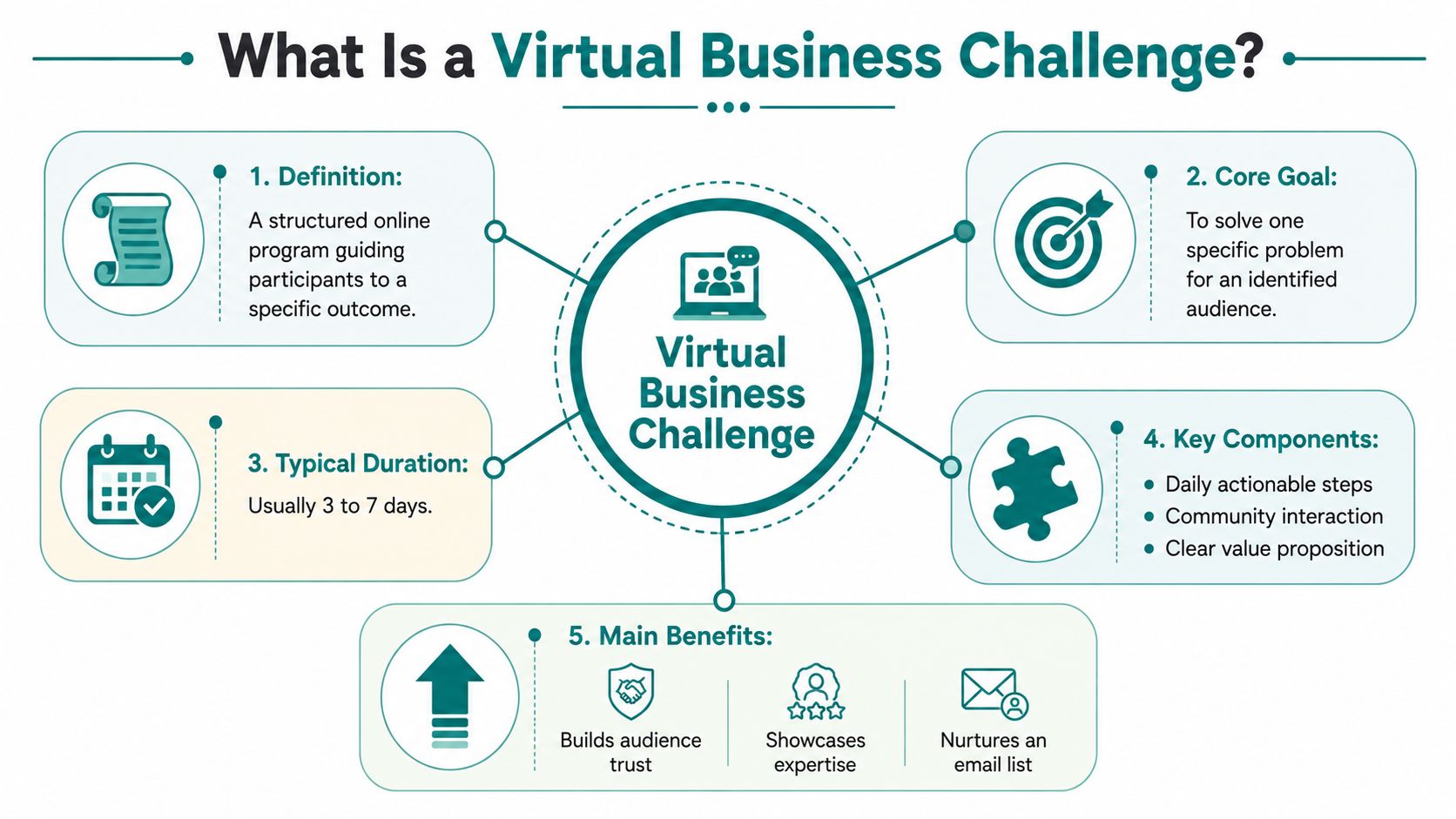
A virtual business challenge sounds more intimidating than it needs to be. In plain language, it's a short online experience where you help a group of people take a few simple steps toward one result.
Picture it as hosting a small workshop from home. Or like leading a book club with a practical outcome. People join, receive a daily prompt or lesson, and move forward together.
What makes it a challenge
The word "challenge" doesn't mean pressure or competition in the harsh sense. It means there's a short timeframe and a clear focus.
Instead of dumping lots of information on people, you guide them through one small sequence. That structure helps beginners stay engaged because they know what to do next.
Major organizations use this time-boxed model for learning. For example, the FCCLA and Knowledge Matters Virtual Business Challenges run in two distinct rounds, Fall 2025 and Spring 2026, showing how a structured online challenge can guide learning and action at scale, as described by FCCLA's virtual business challenge overview.
What it can do for a beginner creator
For a new or midlife creator, a virtual business challenge can serve three gentle purposes:
| Purpose | What it means in real life |
|---|---|
| Build trust | People see how you teach, support, and simplify |
| Grow an email list | Interested people give you permission to stay in touch |
| Create community | Participants encourage each other instead of learning alone |
Your email list matters because social media platforms can change. An email list is an asset you own and can return to.
A simple example
Say you know how to help women organize a chaotic pantry.
Your challenge could be called something like "Five Days to a Calmer Kitchen." Each day, participants do one small task. Clear one shelf. Group similar items. Make a simple shopping zone. Toss expired products. Create a maintainable reset habit.
That isn't flashy. It's useful. Useful creates trust.
Practical rule: A good virtual business challenge solves one problem, for one group of people, in one short stretch of time.
If you've worried that online business means becoming pushy, this is the opposite. You're creating a focused space where people can experience your help in a real way.
Designing Your First Gentle Five-Day Challenge
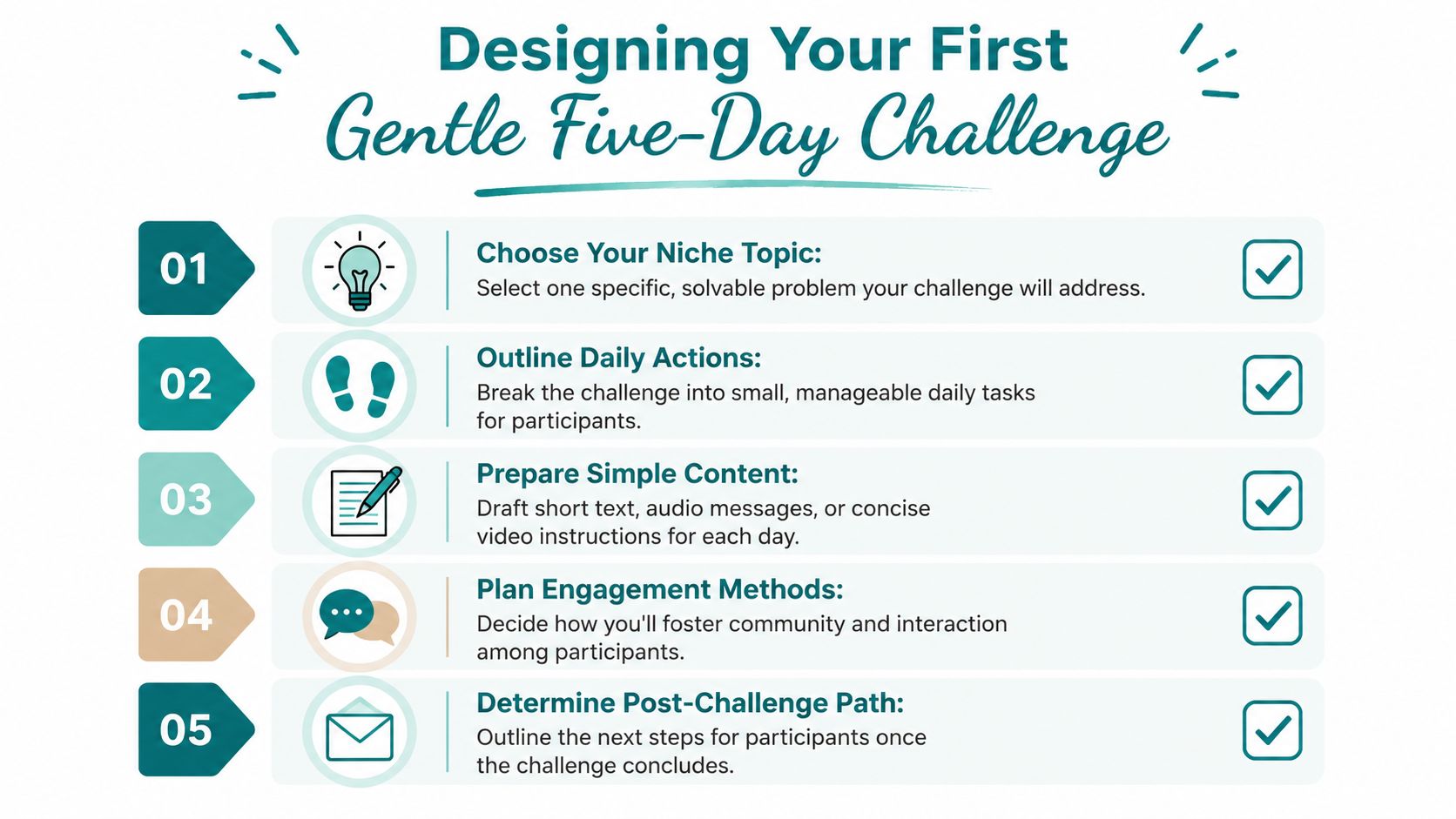
The best first challenge is usually the simplest one. Not your biggest idea. Not your life's entire body of work. Just one problem you can help someone solve calmly.
In many simulation-based learning environments, participants improve by making sequential decisions and observing what happens next. That's part of how the DECA entrepreneurship challenge is designed, where participants analyze data, interpret financial reports, and make decisions over time in a browser-based environment, as described by DECA's virtual business challenge entrepreneurship page. Your version can borrow that same rhythm in a much gentler way. One day, one action, one reflection.
Start with a topic from real life
You don't need a trendy niche. You need a useful one.
Choose a topic by asking yourself:
- What do people already ask me about when they need help or reassurance?
- What problem have I solved for myself that others still struggle with?
- What can I explain clearly without pretending to be perfect?
- What result can someone feel quickly in a few days?
A good beginner topic is narrow. "Get healthier" is too broad. "Prepare simple lunches for the work week" is much easier to teach.
Here are a few gentle examples:
- For organizing. Help women set up a simple paper system for bills and records.
- For wellness. Lead a short routine for walking, stretching, or meal prep.
- For money habits. Guide people through tracking spending without shame.
- For online beginners. Show new creators how to choose a niche and write one simple welcome email.
Use an easy five-day rhythm
A five-day challenge works well because it feels manageable. People can commit without feeling trapped, and you can teach without burning out.
One format that works:
Day 1. Reassure and simplify
Name the problem. Let participants know they don't need to be perfect. Give them one easy starting step.Day 2. Clear the clutter
Remove a common obstacle. This could be confusion, fear, or too many choices.Day 3. Take one visible action
Help them do something they can point to. A list created. A drawer sorted. An email draft written.Day 4. Strengthen the habit
Show them how to repeat the action in a realistic way.Day 5. Reflect and choose a next step
Let them see what they've done. Then offer a small way to continue.
That structure works because it lowers resistance. People don't need to transform their whole life in a week. They need progress they can feel.
Here's a quick visual walkthrough if seeing the concept in motion helps:
Keep the daily lesson short
Your daily content doesn't need to be complicated. A simple daily lesson might include:
- A short message that explains the day's focus
- One action step that takes a manageable amount of effort
- A reflection question so participants notice progress
- A gentle reminder that imperfect action still counts
You can deliver that as text, audio, or a brief video. Choose the format that feels least stressful to you.
If your challenge feels too large to create, shrink the promise until it feels peaceful again.
A sample five-day challenge outline
Let's say your audience is women who want to start an online business but feel stuck.
| Day | Focus | Small action |
|---|---|---|
| Day 1 | Calm the fear | Write down one skill or life lesson you could teach |
| Day 2 | Choose a topic | Pick one small problem you can help solve |
| Day 3 | Define the person | Describe who needs this help |
| Day 4 | Create the first message | Draft a simple invitation or lesson |
| Day 5 | Decide the next step | Choose whether to offer a workbook, email series, or follow-up group |
That is enough. Enough.
Your Simple Tech Setup Without the Overwhelm
Many people assume a virtual business challenge requires a full website, a funnel builder, a webinar platform, paid software, and a long list of integrations. For a first challenge, that often creates more fear than progress.
You can start much smaller.

The tools you actually need
At the beginning, a simple setup can do the job:
- An email service provider such as ConvertKit or MailerLite. This sends your daily lessons and welcome messages.
- A community space such as a private Facebook group. This gives participants a place to check in and encourage each other.
- A simple sign-up page so people can join your challenge without confusion.
That last piece doesn't have to be fancy. If you're looking at beginner-friendly options, automation without coding can help you understand how these parts fit together without making your head spin.
Think of each tool in plain language
Sometimes tech gets easier when you rename it in everyday terms.
| Tool | Plain-language role |
|---|---|
| Email platform | Your post office. It delivers each day's lesson. |
| Private group | Your meeting room. People gather there and talk. |
| Sign-up page | Your welcome desk. People leave their name and email so they can enter. |
That's really it for many first-time creators.
If you later want to save time creating content, this guide to Klap's AI tools for creators may give you a few ideas. Use tools like that as support, not as a replacement for your own voice.
Simple is often better
I understand being cautious. There are scams online, and there are also plenty of systems that make beginners feel inadequate unless they buy more software.
You don't need to prove you're serious by making things complicated.
Knowledge Matters describes DECA's simulation environment as cloud-based, browser-only, and compatible across Macs, PCs, and Chromebooks in its materials for advisors. The lesson for everyday creators is simple. Lower friction helps more people participate. Your challenge should feel easy to join and easy to follow.
The best first setup is the one you can understand, maintain, and use without dread.
If you want one more option in the mix, Victoria OHare offers factual, beginner-focused guidance around pre-built systems that include an email list and a simple webpage for communicating with an audience. That's one possible route if starting from a blank screen feels too heavy.
What you do not need yet
You probably don't need:
- A custom website design
- A paid webinar system
- Complex tagging logic
- A dozen automations
- Professional video editing
You can learn more later. Right now, the goal is not sophistication. The goal is a calm first launch.
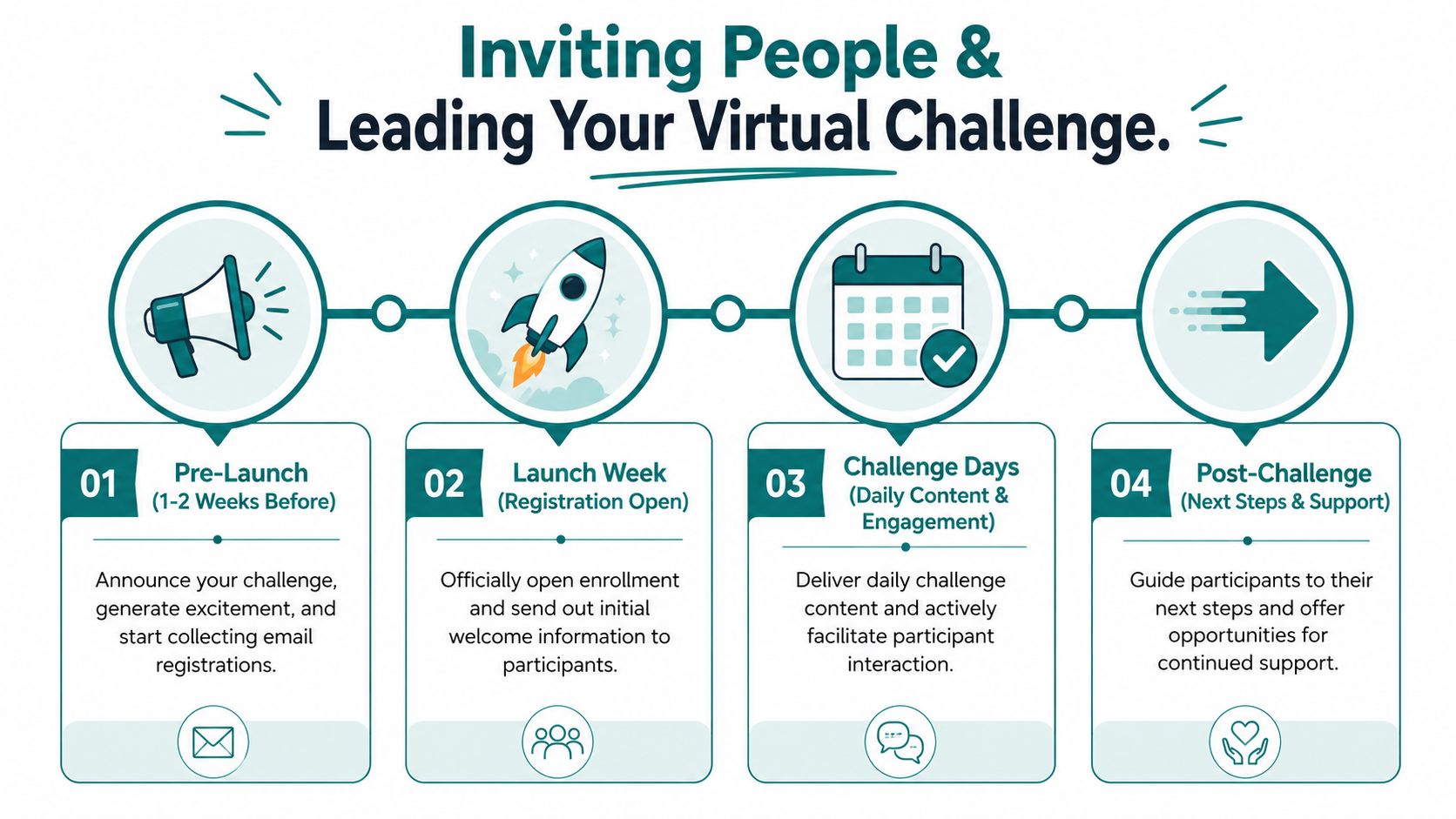
How to Invite People and Lead Your Challenge
Many beginners get stuck on promotion because the word "marketing" feels loud and uncomfortable. A softer and more accurate word is inviting.
You are not trying to pressure strangers. You're offering help to people who may want it.
Keep the invitation personal
One gentle way to begin is with people who already know you. Friends, former coworkers, family members, church groups, hobby circles, or social media contacts may know someone who needs what you're offering.
You don't need polished copy. You need honesty.
Try something like this for a post:
I'm hosting a simple five-day online challenge for women who want help with [specific problem]. It will be gentle, beginner-friendly, and focused on one small win each day. If that sounds helpful, send me a message and I'll share the details.
Or for email:
Hi friends, I'm trying something new. I'm leading a short online challenge to help with [specific issue]. If you'd like to join or know someone who might, I'd be happy to send the information.
Why short timelines help
A virtual business challenge works better when it has a clear start and finish. In professional virtual competitions, rounds often run inside a fixed window. Knowledge Matters notes that DECA VBC registrants typically get an 11-day window to compete nationally in a round, which creates a time-boxed problem-solving environment, as explained in Knowledge Matters' DECA advisor overview. Your gentle five-day format uses that same idea in a friendlier way. A short window helps people stay focused and gives the group a shared sense of momentum.
A simple invitation plan
You don't need to be everywhere. Choose a few places and show up consistently.
- Email your existing contacts. Even a tiny list is enough to begin.
- Post on one social platform where you already feel comfortable.
- Send direct messages carefully to people who have shown interest.
- Mention the challenge in communities where it's appropriate and welcome.
If social posting feels messy, a guide on how to manage social media for small business can help you create a calmer routine.
For the long term, building your own list matters even more than getting likes. This practical guide on how to build an email list is worth bookmarking because your list becomes the home base for future challenges, offers, and conversations.
How to lead without performing
I remember the first time I considered going live in a group. My mind made it sound like a stage performance. It wasn't. It was showing up as a real person and saying, "Welcome, here's today's small step."
That mindset shift changes everything.
Here are a few ways to lead well:
- Open each day warmly. Greet people like guests, not leads.
- Celebrate tiny wins. A finished worksheet or posted comment matters.
- Repeat key points. Beginners often need reassurance more than new information.
- Keep your promises small. Don't overload the group to prove value.
- Answer questions directly. You don't need a lecture for every reply.
People remember how safe they felt learning with you.
A calm daily rhythm
You might use a routine like this each day:
| Time | Action |
|---|---|
| Morning | Send the day's email lesson |
| Midday | Post a reminder or encouragement in the group |
| Evening | Reply to questions and celebrate progress |
This doesn't need to consume your whole day. Steady presence is more powerful than constant noise.
Turning Connection Into Lasting Support
When your challenge ends, you don't need to switch into hard-sell mode. A better path is to make a gentle invitation for anyone who wants more support.
That invitation can take several forms. The right next step depends on your topic, your comfort level, and what your participants seem to need.
Soft ways to continue helping
You might offer:
- A low-cost workbook that helps people keep going on their own
- A small group coaching circle for those who want guidance and accountability
- An email follow-up series with extra lessons and encouragement
- An affiliate recommendation for a tool you personally used during the challenge, explained in plain terms
If you mention an affiliate link, keep it honest and simple. Tell people what the tool does, why it may help, and let them choose without pressure. That's what makes Affiliate Marketing for beginners over 50 feel ethical instead of uncomfortable.
Success is bigger than the sale
A first virtual business challenge may produce income. It may also produce something just as important. Proof that you can do this.
Look for signs like:
- Participants replying to your emails
- People completing the daily actions
- Messages saying your teaching felt clear
- Greater confidence in your own voice
- A small but real email list you now own
Those are not minor things. They are foundations.
A steady online business grows from trust, not pressure.
What you've really built
You haven't just run a challenge. You've practiced teaching, created a repeatable experience, and started gathering a community around your wisdom.
That's valuable because it can grow with you. You can run the same challenge again with improvements. You can turn it into a workshop, a paid mini-course, or a welcome path for new subscribers. You can keep it simple and still make it meaningful.
Most of all, you've taken a step away from helplessness and toward ownership.
You're not too old. You're not too late. And you don't need to become someone louder, younger, or more polished to begin. You need a clear problem to solve, a kind way to guide people, and the willingness to learn one step at a time.
The next five years will pass either way. The only question is whether you'll use them to build something that gives you peace of mind.
If you'd like a calm, beginner-friendly place to learn how to build income online with email lists, Affiliate Marketing, and simple systems, you can visit Victoria OHare. Start where you are. That's enough.