
If you're over 50 and wondering whether it is too late to build income online, you're not alone. Many women feel behind financially, not because they failed, but because life happened.
Retirement can feel less secure than it once did. Add tech overwhelm, self-doubt, and the pressure of learning something new, and even a simple task like pricing a digital product can feel heavier than it should.
If that is where you are, take a breath. You are not behind. You can learn this. The psychology of numbers pricing is not a secret language for marketing experts. It is a practical way to present your work so people understand its value.
The Quiet Fear of the Blank Price Box
You finish your workbook, mini-course, or bonus guide. You upload the file, write the description, and then you reach the price box.
And everything gets wobbly.
Do I charge too much?
Do I charge too little?
Will anyone buy this from me?
Am I too new to ask for money?
Am I too old to be doing this now?
That moment is more emotional than commonly acknowledged.

I remember the first time I priced something online. It was not a big product. It was a simple offer. Still, I stared at the screen far longer than I needed to. The number felt personal. It did not seem like I was choosing a price. It felt like I was declaring what my experience was worth.
That is where many beginners get stuck.
Pricing is not just math
A price does more than collect payment. It sends a message.
It tells people whether your offer is meant to feel like a quick bargain, a thoughtful investment, or a premium service. That is why the psychology of numbers pricing matters. You are not only picking a number. You are shaping the way your work is understood.
For women in a second chapter of life, this can feel tender. You may have decades of wisdom, patience, and practical knowledge, but still wonder whether it “counts” online.
It does.
A price is not a test of your worth. It is a tool that helps the right buyer understand the value of what you made.
Confidence is often a key issue
Many new creators underprice because they want to avoid rejection. Others freeze because they fear looking foolish. Both reactions are normal.
A calmer way to think about it is this:
- You are not forcing anyone: You are offering help, not demanding approval.
- You can adjust later: Your first price is not permanent.
- Your life experience matters: People often pay for clarity, simplicity, and trust. Those qualities often grow with age.
If you need encouragement beyond pricing, this gentle piece on building a second-act mindset may help: how to develop a success mindset for your second act in 2026.
The blank price box feels intimidating because it touches money, identity, and visibility all at once. But once you understand a few simple patterns, pricing becomes less mysterious and far more manageable.
You Already Understand Pricing Psychology
Many hear “pricing psychology” and assume it is complicated. It is not. You have already seen it your whole life.
At the grocery store, you have noticed prices ending in .99. In a department store, you have probably seen a premium item priced with a round number. On a menu or sales page, one option often feels “about right” because of what sits next to it.
That is the psychology of numbers pricing in everyday life.
You have seen it in stores for years
Retail has trained all of us to notice certain price patterns.
A price like $9.99 tends to feel like a deal. A price like $100 feels cleaner, steadier, and sometimes more premium. Neither number is magic on its own. The meaning comes from the context.
This is why pricing should be treated as communication, not manipulation.
Some tactics can feel pushy or gimmicky. I understand being cautious. There are scams online. That is why education and ethical use matter. If you are building an email list, recommending products as an affiliate marketer, or creating your first small digital offer, trust matters more than flashy tricks.
Retail logic does not always fit digital products
A lot of advice online talks only about store shelves and product tags. That leaves beginners confused when they try to price a workshop, a coaching session, or a short course.
Research summarized by Craftybase notes that existing content often misses digital products, and that round numbers such as $100 can outperform charm prices such as $97 for high-ticket, trust-based sales because they signal quality and reduce decision friction ([Craftybase on pricing psychology and magic numbers]).
That matters if you are creating offers built on trust, not impulse.
Here is a simple way to categorize offers:
| Type of offer | Price style that may fit | Why |
|---|---|---|
| Low-cost checklist or workbook | Charm pricing | Can feel lighter and more deal-focused |
| Coaching session or premium workshop | Round pricing | Can feel clearer and more trustworthy |
| Affiliate bonus bundle | Either, depending on audience | Test what feels natural for your readers |
If you want broader context on online pricing models, this complete guide to Ecommerce pricing strategies is useful because it shows how different pricing approaches fit different products.
The skill is simpler than it sounds
You do not need advanced tech skills. You do not need a marketing degree.
You need to ask a few calm questions:
- What am I selling?
- Is this an impulse buy or a trust-based decision?
- Do I want this to feel like a bargain or a premium solution?
Once you answer those, the number becomes easier to choose.
The Power of .99 and Charm Pricing
Some prices feel smaller than they really are. That is the basic idea behind charm pricing.
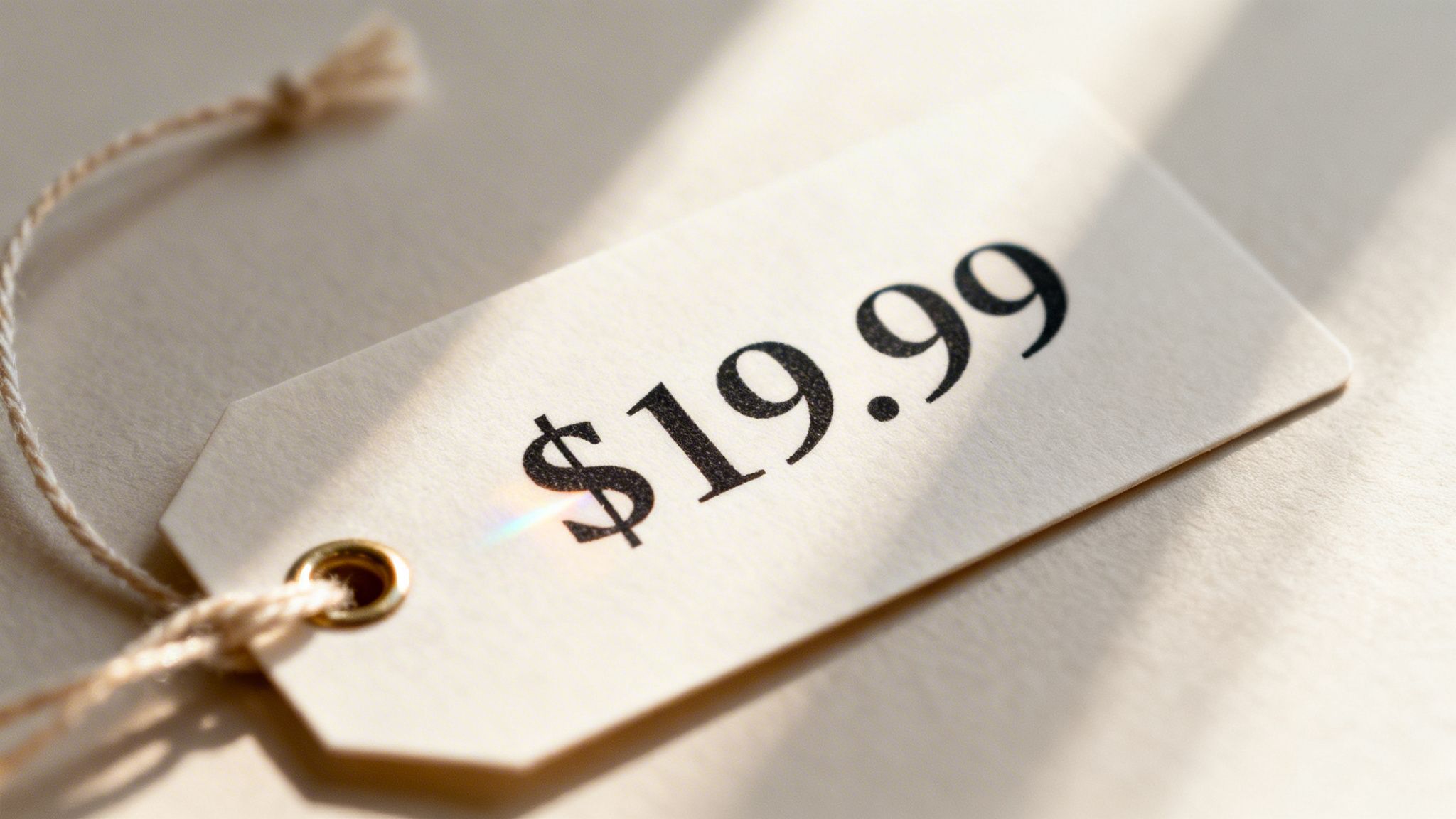
When a buyer sees $19.99, the brain often gives more attention to the first part of the number than the last few cents. That is why charm pricing remains so common in retail.
Why .99 can change perception
A landmark study highlighted by The Quota reported that an identical item priced at $39 outsold the same item priced lower at $34, and that the left-digit bias can increase sales by up to 24% because people anchor on the leftmost digit (The Quota on the psychology of pricing).
That result surprises people. We want to believe buyers carefully compare every number. Often, they do not.
They scan quickly.
They notice the first digit.
They react to the overall feel.
A simple way to picture it
Think about how you read a book. Your eyes move left to right. Prices work similarly.
When someone sees $29.99, the brain often registers “twenty-something” before it bothers with the cents. When someone sees $30, it feels more complete and firm.
For beginner creators, that can make charm pricing useful for:
- A mini guide: A lower-priced digital file can feel easier to try.
- A starter workshop: A small training offer may benefit from a lighter, bargain-like feel.
- An affiliate bonus offer: If you are framing a bonus or entry-level recommendation, a charm price can support that lower-friction decision.
Here is where people get confused. They think charm pricing is about being sneaky. It is not. It is about recognizing that buyers make quick judgments.
If your offer is small, practical, and easy to buy, a charm price can make the decision feel simpler.
This short video gives a helpful visual explanation of how price perception works in practice.
Where charm pricing fits best
Charm pricing usually makes more sense when the offer is:
- Low risk: The buyer does not need a long internal debate.
- Easy to understand: The value is obvious quickly.
- Meant to feel accessible: You want a “why not?” response.
Examples for creators:
- A printable planner
- A short email template pack
- A beginner checklist
- A low-cost tripwire product after a free lead magnet
If your offer depends on deep trust, personal guidance, or premium positioning, charm pricing may not be your best fit. In those cases, a cleaner number can often do a better job.
Setting the Stage with Anchoring and Decoys
A single price tells a story. Multiple prices tell an even stronger one. In this context, anchoring helps. People rarely judge a price in isolation. They compare it with what they saw first.
If a buyer sees a higher-priced option before your main offer, your main offer can feel more reasonable. That first number becomes the reference point.
How anchoring works in plain English
Think about ordering coffee in three sizes. If the largest size appears first, the medium can feel sensible, even if it costs more than you planned to spend.
The same pattern shows up in digital products.
According to NetSuite, presenting a high anchor price first in e-commerce A/B tests can boost selection of mid-tier options by 20% to 40% because people compare options rather than judging a price alone (NetSuite on psychological pricing).
For creators, this matters when you offer more than one choice.
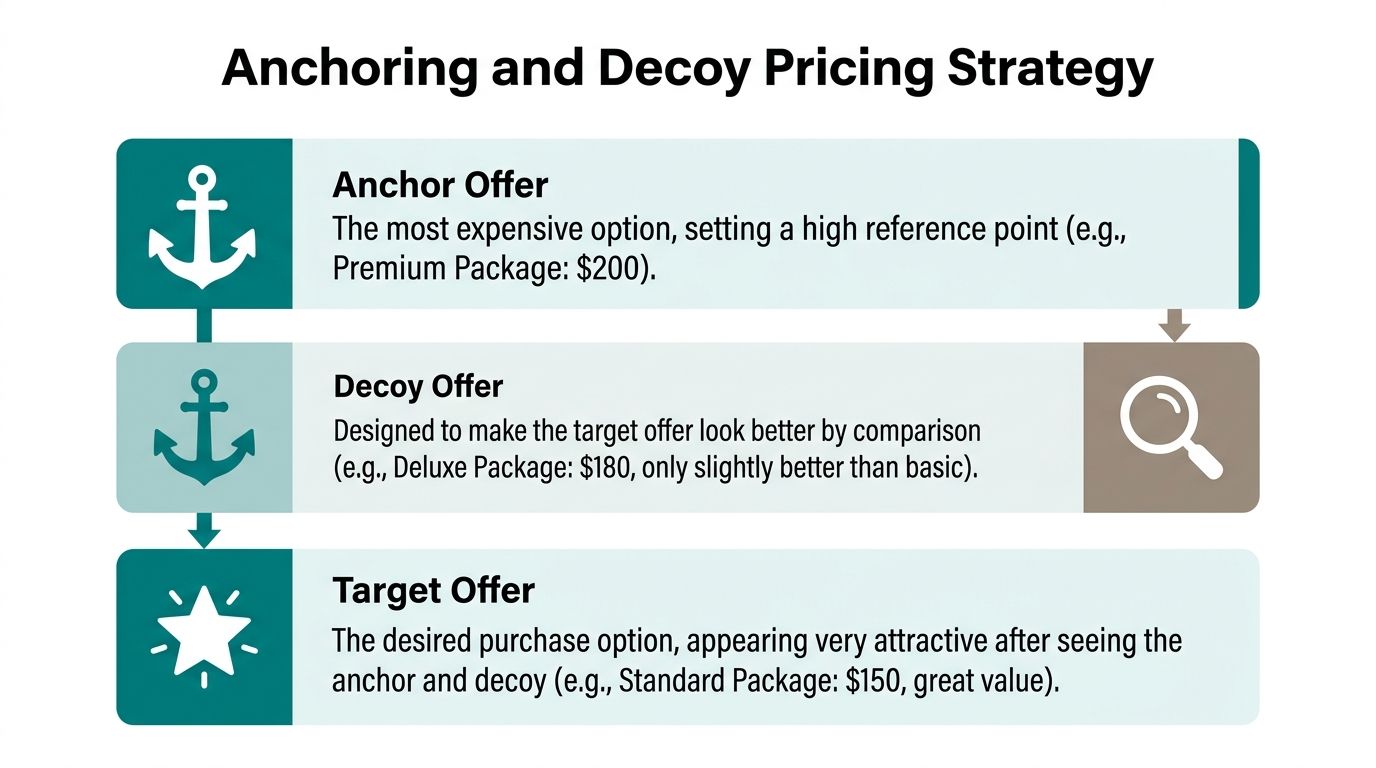
A simple three-offer example
You do not need a big funnel. Even a small offer stack can use this ethically.
| Role | Example offer | Purpose |
|---|---|---|
| Anchor | Premium package | Sets the high reference point |
| Decoy | Less compelling middle-adjacent option | Makes the target look stronger |
| Target | The offer you most want people to choose | Feels balanced and attractive |
The decoy is the part that often confuses beginners.
A decoy is not a fake offer. It is a real option, but one that is positioned so your target choice looks more appealing by comparison.
For example, a creator might offer:
- Premium package: More support, more depth, highest price
- Decoy package: Slightly stripped-down, but still priced close enough to make buyers pause
- Target package: Best balance of value and affordability
I hesitated the first time I saw this used in online business. It felt too clever. But the more I looked at it, the more I realized something important. Buyers often appreciate structure. Too many vague choices create stress. Clear pricing tiers reduce that stress.
Ethical use matters
Anchoring helps when each option is honest and useful.
Use it well by following these principles:
- Make every option real: Do not invent nonsense tiers.
- Keep differences visible: Buyers should quickly see what changes between choices.
- Guide, do not pressure: The goal is clarity.
If you want more examples of psychological pricing strategies, including anchoring, that overview can help you see how brands organize choices without making the page feel chaotic.
When buyers can compare a few clear options, they often feel more confident saying yes.
When to Use Round Numbers for Prestige and Trust
Not every offer should end in .99.
Sometimes a round number does a better job. It can feel cleaner, steadier, and more confident. For trust-based offers, that matters.

Why round numbers can feel better
Strategy+Business reported that 57% of consumers chose whole-dollar amounts in one study, and round numbers are processed more fluently and emotionally, which can make them feel more right for significant purchases and services (Strategy+Business on why customers prefer round numbers).
That helps explain why a coaching session, consulting offer, or premium workshop may feel stronger with a round price.
A round number can signal:
- Confidence
- Transparency
- Quality
- Simplicity
For women building a second stream of income, this is especially important. You are not trying to look like a discount bin. You are building something with dignity and trust.
Good fits for round pricing
If your offer depends on personal connection or expertise, round numbers often make sense.
Examples include:
- Coaching
- Strategy calls
- Done-with-you support
- Deep-dive workshops
- Service-based packages
A round number can also reduce mental friction. It is easier to repeat, easier to remember, and often easier to share in conversation.
That matters when you are promoting a lead magnet funnel or a premium next step. If you are shaping that journey, this guide on how to create a lead magnet can help you think through what belongs at each stage.
A useful rule of thumb
Use a round number when you want the offer to feel thoughtful, premium, or trust-based.
Use a charm price when you want the offer to feel accessible, light, or bargain-friendly.
Neither one is morally better. The question is whether the number matches the relationship you want with the buyer.
A Simple Pricing Test You Can Run This Week
You do not need fancy software to start learning what works. You need one offer, one audience, and a willingness to pay attention.
If you are new, keep the test small.
The point is not to prove you are a pricing genius. The point is to learn how your audience responds.
A low-stress test for beginners
The book Priceless, as summarized by Business.com, described a famous experiment where a charm price outsold a rounded price by 24% or more (Business.com on how the number 9 affects purchase behavior).
That does not mean charm pricing will always win for your offer. It means small changes can matter.
Try this with a low-cost product or affiliate bonus.
Test idea one
Version A uses a charm frame.
- Headline: Special bonus training
- Price line: Valued at $47
- Call to action: Get instant access
Version B uses a round frame.
- Headline: Special bonus training
- Price line: Valued at $50
- Call to action: Get instant access
Use the same email, same graphic style, and same audience type if possible.
What to watch
You do not need complicated analytics. Start with simple signals:
- Clicks: Which version gets more interest?
- Replies: Does one price feel more natural to your readers?
- Your own comfort: Which one feels more aligned with the tone of your brand?
If you want to test anchoring instead, try this:
- Email A: Bonus training valued at $47
- Email B: Full bundle normally priced higher, with the smaller bonus positioned underneath
The wording changes the frame, even if the actual offer stays the same.
Keep one variable as steady as you can. If you change the price style, do not also rewrite the whole sales message.
A copy-and-paste mini template
You can adapt this for email or a simple sales page:
Option A
I created this bonus to make the first steps simpler. It is a practical resource you can use right away. Valued at $47.
Option B
I created this bonus to make the first steps simpler. It is a practical resource you can use right away. Valued at $50.
That is enough for a first test.
Do not overcomplicate it. You are building the habit of observing buyer behavior. That habit becomes one of your strongest business skills.
Pricing Your Work with Confidence and Peace of Mind
Pricing gets easier when you stop treating it like a verdict on your worth.
It is a decision. A useful one. A flexible one.
The psychology of numbers pricing gives you a few simple tools. Charm pricing can make a smaller offer feel accessible. Anchoring can help buyers compare options with more clarity. Round numbers can support trust and premium positioning.
Used ethically, these are not manipulation tactics. They are ways to communicate value more clearly.
If you are building a small online business after 50, that matters. You do not need hype. You need simple methods that help you present your work with confidence.
I know many beginners worry about getting it wrong. I did too. The first pricing choices often feel heavier than they are. But your first number is not your last number. You can test, adjust, simplify, and learn.
If your work helps people solve a problem, save time, or feel less overwhelmed, it deserves a thoughtful price.
And if you are also exploring the wider path of content-based income, this guide on how to make money as a content creator may give you a helpful next step.
Peace of mind does not usually come from one perfect launch. It comes from building useful assets, learning what your audience needs, and trusting yourself enough to keep going.
The next five years will pass either way. The only question is whether you will use them to build something that gives you peace of mind.
If you'd like calm, beginner-friendly help as you learn to build income online, Victoria OHare offers practical guidance for midlife women and new creators who want to grow with clarity, not pressure.