
If you're over 50 and wondering whether it's too late to build income online, you're not alone. A lot of women carry a quiet mix of fear, guilt, and exhaustion around money. Retirement may be getting closer, tech may feel unfamiliar, and part of you may still wonder whether wanting more financial breathing room means you're being selfish.
It doesn't.
You are not behind. You are living in the middle of a real life, with real responsibilities, and it's completely reasonable to want more stability, more dignity, and more peace of mind.
The phrase money and evil has shaped how many people think for years. The trouble is that this belief can keep good people from building the kind of income that would let them live with less stress and more freedom. Let's slow it down and look at this carefully.
Is It Wrong to Want More Than Just Enough
Maybe this feels familiar.
You check your Retirement savings and think, "It could be worse." Then, a second thought follows close behind. "But it also doesn't feel safe enough." You'd like a little more cushion. A little more control. A little less dependence on circumstances you can't control.
Then the guilt shows up.
You tell yourself you should be grateful. You tell yourself other people have it harder. You tell yourself maybe wanting to make money online after 50 sounds unrealistic, or worse, greedy.

The quiet thought many women carry
A lot of women in midlife live with an unspoken sentence that starts like this:
"I shouldn't complain, but I don't feel secure."
That sentence matters.
It tells me you aren't chasing luxury. You're thinking about groceries, bills, Health costs, home repairs, and what life might look like if one more unexpected expense lands in your lap. You're thinking about whether you'll have choices later, or whether you'll have to settle for whatever is available.
That's not greed. That's wisdom.
Wanting peace is not the same as worshipping money
There's a big difference between:
- Wanting status so other people admire you
- Wanting security so you can breathe
- Wanting excess for the sake of ego
- Wanting income so you aren't trapped
Those are not the same thing.
I remember how many beginners describe their first steps online. They don't say, "I want to be flashy." They say, "I want to stop worrying." They say, "I want options." They say, "I want to contribute without working myself into the ground."
Small truth: Needing more support from your money doesn't mean you love money too much. It may simply mean life got more expensive and less predictable.
If you've been feeling torn, that inner conflict makes sense. You've probably absorbed strong messages about what "good" people are supposed to want. Many women learned to serve, stretch, sacrifice, and stay quiet. So when the idea of building income appears, it can feel strangely uncomfortable.
Not because it's wrong.
Because it's unfamiliar.
Where We Learned That Money is Evil
The belief didn't appear out of nowhere. Most of us inherited it.
We heard versions of it in families, churches, schools, books, and everyday conversation. Sometimes the message was direct. "Rich people are selfish." Sometimes it was subtle. "Nice women don't talk about money." Over time, the idea settles in. Money starts to feel morally suspicious.

Why the belief feels so believable
Part of the reason this belief sticks is simple. History gives us awful examples of powerful people using wealth in cruel ways.
One of the clearest examples is King Leopold II of Belgium. During his rule over the Congo Free State from 1885 to 1908, his pursuit of rubber profits led to the deaths of an estimated 10 to 20 million people through forced labor and brutality, a horror described as one of the first genocides on an industrial scale by this historical summary of Leopold II's atrocities.
When people see evil committed for profit, they naturally connect the two. The human mind says, "If money was involved, money must be the problem."
But that skips an important step.
Money did not wake up and decide to brutalize anyone. A human being made those choices.
The real problem was power without ethics
That distinction matters.
A ruler can use money to oppress. A business owner can use money to exploit. A scammer can use money to manipulate. In each case, the problem isn't that money exists. The problem is the character, motives, and actions of the person using it.
A simple way to think about it is this:
| Situation | What caused harm |
|---|---|
| A tyrant hoards wealth | Abuse of power |
| A scammer lies for income | Deception |
| A family saves for emergencies | Responsibility |
| A woman builds online income to support Retirement | Stewardship |
The phrase money and evil becomes confusing when we treat money as if it has a personality. It doesn't. It has influence, but not intent.
This short clip helps illustrate how much these old ideas still shape the way people think about wealth and morality.
Why this matters for you now
If you've felt ashamed for wanting more income, it may help to see that this belief is often a learned script, not a personal truth.
You may have inherited the warning without ever questioning it. Many good women did.
Some of the strongest guilt around money comes from confusing the misuse of wealth with the mere act of earning it.
Once you separate those two things, something opens up. You can reject greed without rejecting provision. You can dislike exploitation without deciding you must stay under-earning forever.
That's a very different way to look at your next chapter.
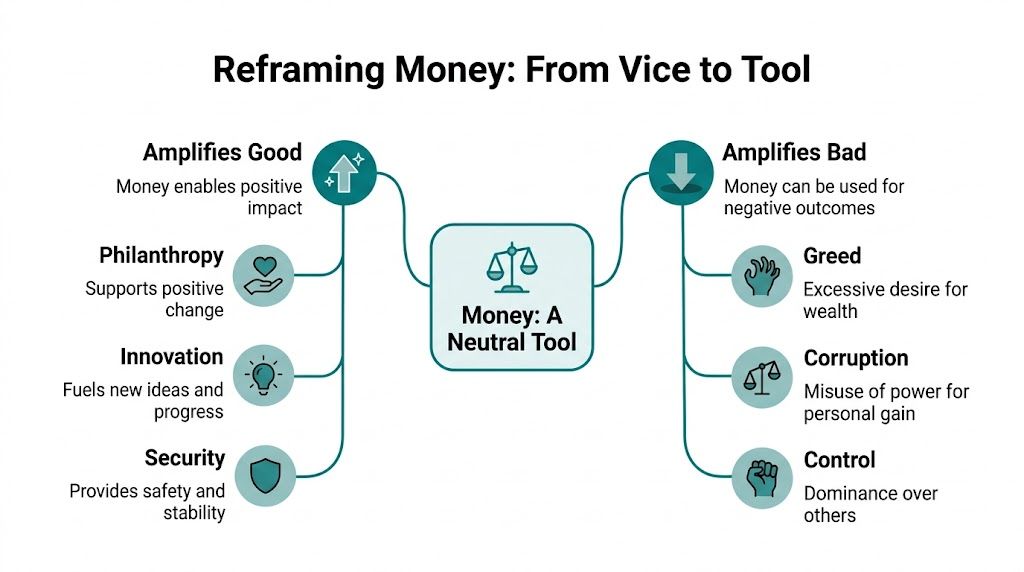
Reframing Money From a Vice to a Tool
A hammer can build a porch or break a window. The tool isn't moral or immoral on its own. The hand using it matters.
Money works much the same way.
If your goal is to manipulate, dominate, or show off, money can amplify that. If your goal is to care for yourself, help others, support your family, and create breathing room, money can amplify that too.
A gentler way to think about earning
Many women don't struggle with greed. They struggle with permission.
They want to be responsible, but they don't want to be judged. They want a second stream of income, but they worry about what people will think. According to Gallup findings discussed here, 62% of women over 50 in major markets like the US and UK said fear of judgment for chasing money is a top barrier to starting a side hustle.
That number says a lot.
This isn't just a private insecurity. It's a shared burden.
Money can serve your values
When you stop treating money as the villain, you can ask a better question:
What would I do with more stability?
Your answer might be simple.
- Pay for peace by covering bills without panic
- Buy back time so you can reduce draining work
- Support family without feeling stretched thin
- Give generously from a place of strength, not stress
That is not a vice. That is wise use.
If you've ever wrestled with the meaning of freedom, this reflection on what financial freedom can really mean in everyday life is worth reading. It moves the conversation away from flashy income claims and toward choice, calm, and self-respect.
A new sentence to practice
Try replacing "Money is evil" with one of these:
- Money is a tool
- Money gives me options
- Money can support good work
- Money helps me care for people without constant fear
You don't have to force yourself into a personality that doesn't fit. You don't have to become aggressive, salesy, or obsessed with numbers.
Mindset shift: Earning with integrity is not greed. It's responsibility guided by values.
That shift matters if you're exploring an online business for older women or wondering whether it's possible to build income in a way that still feels like you. It is.
The goal isn't to worship money.
The goal is to use it well.
Ethical Earning Through Affiliate Marketing
A lot of midlife women hit a strange emotional wall here.
You can understand that money is a tool and still freeze the moment earning online becomes personal. Recommending something for a commission can stir up old fears fast. Am I being pushy? Am I taking advantage of people? Am I becoming one of those internet marketers?
Those questions matter. They are often the sign of a thoughtful person who wants to do this well.
Affiliate marketing is one business model where you share a product, service, or tool that you believe is useful. If someone buys through your link, the company pays you a commission. A referral works much like the everyday word-of-mouth women have done for years, except online the recommendation can be tracked and you can be paid for the value you helped create.
What Affiliate Marketing looks like in ordinary life
It often starts with something very normal.
You tell a friend which walking shoes helped your knees.
You mention the meal planner that made caregiving easier.
You write about a budgeting app that helped you stop dreading bill day.
You send an email explaining why a course saved you months of confusion.
Online, Affiliate Marketing follows that same pattern. You share what helped, explain who it fits, and let the reader decide.
That last part matters.
Ethical Affiliate Marketing leaves room for the other person to think. There is no pressure, no pretending, and no performance of being an expert on everything. For women over 50 starting an online business, that can be a relief. You do not need a slick personality. You need honesty, judgment, and lived experience.
What makes it ethical
The loud version of online marketing gets attention, but it is not the only version.
An ethical approach is quieter and stronger:
- You recommend products you would feel comfortable suggesting to a friend.
- You explain what the product does, who it helps, and where it may fall short.
- You disclose that you may earn a commission.
- You create useful content first, then include relevant recommendations.
If you want context for the business model itself, this guide on how websites make money shows where affiliate income fits among other common online revenue streams.
Why this model fits many women in midlife
Affiliate marketing can be a gentle starting point because you do not have to invent a product from scratch, hold inventory, or become a full-time salesperson. You are helping people sort through choices. That skill often gets stronger with age.
A woman who has managed a household budget, cared for parents, raised children, changed careers, or rebuilt after divorce already knows how to compare options, spot waste, and notice what helps in real life. Those are business skills. The internet did not erase them. It gave them a new place to be used.
That is why the hurdle is often emotional before it is technical. Some women do not struggle because they lack ability. They struggle because being paid for a recommendation feels morally suspicious at first.
What it can look like as a beginner
Start small enough that your nervous system stays calm.
Choose one topic you know from lived experience. Pick one place to share, such as a blog, email list, or social account you already use. Then recommend one useful resource that solves one clear problem.
For example, if you have years of experience organizing a chaotic home, you could write a short post about the label maker, storage bins, or planner system that saved you time. If you have cared for aging parents, you might share tools that made appointments, medications, or paperwork easier to manage. The goal is not to impress strangers. The goal is to help the right person feel less alone and less confused.
If you want a clear walkthrough, this guide on how to start Affiliate Marketing explains the basic steps in plain language.
Ethical earning through Affiliate Marketing is paid helpfulness. That is a very different thing from manipulation.
Addressing the Voices of Doubt and Skepticism
You sit down with your coffee, open your laptop, and within ten minutes you see three very different messages. One person says Affiliate Marketing changed her life. Another says the whole thing is shady. A third promises fast money if you follow a secret system.
Of course you feel cautious.

For many midlife women, this is not just a business question. It touches an older fear. If money has always felt morally loaded, then online business can feel like a test of character instead of a skill you can learn. That is why doubt gets so loud.
Is this just another scam
Some offers online are careless, exaggerated, or flat-out dishonest. Your skepticism makes sense.
The goal is not to shut that skepticism off. The goal is to aim it well, the same way you would inspect a used car before buying it. You are looking for signs of honesty, signs of pressure, and signs that the person teaching respects beginners.
A healthier path usually looks like this:
- Transparent teaching that explains how commissions work
- Specific examples instead of vague promises about freedom
- Realistic timelines instead of overnight income claims
- Useful content that helps even before anyone buys
If you want an example of how to examine bold claims with a clear head, this review of whether John Crestani is a scam or a legitimate training option shows the kind of questions a careful beginner should ask.
Be careful with anyone who sells speed harder than substance.
Am I too old for this
Age is not the problem. Unfamiliar tools are the problem, and tools can be learned.
In fact, many women in midlife have an advantage that younger beginners do not. You have context. You know what disappointment feels like. You can hear when advice sounds polished but hollow. You have solved real problems in real homes, real jobs, and real relationships.
That kind of judgment matters online.
A 27-year-old creator may know the latest platform trick. A 52-year-old woman may know how to explain a hard-earned solution in a way that makes another woman feel relieved instead of sold to. Trust grows faster from that kind of wisdom than from flashy editing.
Do I need to be a tech genius
No. You need a simple process and enough patience to learn one piece at a time.
A lot of beginners freeze because they treat online business like walking into a hardware store and being told to build the whole house tonight. No one learns well that way. You start with a hammer, not the full blueprint.
Try replacing panic questions with steadier ones:
| Fear | Better question |
|---|---|
| "What if I can't do tech?" | "What is the next small task?" |
| "What if I break something?" | "Where can I practice safely?" |
| "What if everyone else is ahead?" | "What can I learn this week?" |
That shift matters. It moves you from shame to problem-solving.
What if I still feel unsure
Uncertainty does not mean you are incapable. It often means you care about doing this in a clean, honest way.
That is especially common if you were raised to believe that wanting more money makes a person selfish. In that frame, every business step can feel suspicious. Charging, promoting, recommending, earning. It can all stir up old guilt.
A better question is this: am I helping someone make a more informed choice?
If the answer is yes, your work is closer to good teaching than manipulation. You are not forcing. You are guiding. You are saying, "Here is what helped me, here is who it is for, and here is who it is not for."
That is a very different posture from hype.
You do not need perfect certainty before you begin. You need enough self-trust to move carefully, keep your standards high, and let experience teach you what is solid and what is not.
Your First Small Step Towards Financial Peace
Leave the tech alone for a moment.
Take out a notebook and write down three things people already ask you about. Not what you think sounds impressive. What people come to you for.
A simple 15 minute exercise
Make three short lists:
What you've lived through
This could be caregiving, budgeting, menopause, downsizing, meal planning, grief, Health routines, faith, or starting over.What you've learned to use
Maybe it's a kitchen tool, a planner, a supplement routine, a course platform, a budgeting app, or a home organization product.What you enjoy talking about
Not because it's trendy. Because you could discuss it without forcing yourself.
Now put a star next to anything that appears on more than one list.
That's where your early online business ideas often begin.
Why this works
Affiliate marketing gets easier when it starts from real life.
If you already have experience, language, and empathy around a topic, you won't sound robotic. You'll sound helpful. That's the foundation of trust.
You also won't need to invent a brand-new personality. You can build from who you already are.
A good first step isn't "launch a complicated funnel." A good first step is noticing where your lived experience already has value.
Write the list. Keep it simple. Let that be enough for today.
The Next Five Years Will Pass Anyway
A woman in her fifties sits at her kitchen table after dinner, laptop open, reading about online business. She has raised children, solved problems, stretched money, cared for people, and learned a hundred things the hard way. Yet one thought keeps stopping her hand before she clicks anything.
What if wanting more money changes who I am?
That question carries more weight in midlife than many people realize. By this stage, you have had years to absorb messages about being humble, not asking for too much, and keeping your needs small. If you also grew up hearing some version of "money and evil" in church, family conversations, or everyday comments, building an online income can feel less like a practical decision and more like a moral test.
It helps to slow that thought down and examine it.
Wanting breathing room is not greed. Wanting to pay bills without dread is not selfish. Wanting choices later in life is not a character flaw. Money works like a hammer. In careless hands, it can do harm. In wise hands, it can build a safer home.
A better question for this season of life is simpler and more honest: what would more stability allow you to protect, repair, or enjoy?
For one woman, it means replacing panic with a small emergency fund. For another, it means helping an aging parent without wrecking her own finances. For someone else, it means working from home in a way that respects her energy, Health, and experience.
As noted earlier, the old Mark Twain line about lack of money points to something uncomfortable but true. Financial pressure can corner people. It can shrink patience, strain relationships, and make bad options look reasonable. Steadier income creates room to make calmer, cleaner decisions.
That matters when you are starting an online business. Midlife women often hesitate because they do not want to become pushy, fake, or obsessed with sales. Ethical Affiliate Marketing offers another path. You recommend products or tools you would suggest anyway, based on real use, real judgment, and real care for the person on the other side of the screen.
You do not need a dramatic reinvention.
You need a quiet beginning that matches your values.
Maybe you learn one platform. Maybe you write one helpful email each week. Maybe you share one product that solved a problem you know well. Small steps count because trust is built that way, and trust is often your strongest asset.
The next chapter does not need to be flashy. It needs to be honest enough to keep going.
The next five years will pass whether you start or stay stuck. Technology will keep changing. Birthdays will keep coming. The only real question is what these years will hold for you: more second-guessing, or more skill, confidence, and peace.
It is still possible to build something useful now. Your age is not disqualifying you. In many ways, it is the reason people will trust you.