
If you're over 50 and wondering whether it's too late to build income online, you're not alone. Many women feel behind financially, not because they failed, but because life happened. Careers changed, caregiving took priority, savings didn't grow the way you hoped, and now the internet can feel like a noisy place full of promises you don't trust.
That skepticism is healthy.
A search like john crestani scam usually comes from a deeper question. Not just "Is this person legitimate?" but "If I spend money on this, will I regret it?" and an even deeper question, "Can I still learn something new at this stage of life without being taken advantage of?"
I understand that caution. The first time I looked at online business training, I felt the same mix of curiosity and resistance. It all seemed fast, technical, and built for people younger than me. But slow, careful learning is still learning. And clear thinking is still your advantage.
Is It Too Late to Secure Your Financial Future Online
Some women reach this stage of life and feel a low hum of worry in the background every day. They don't always say it out loud. They just feel it when they look at their bank account, or when another expense pops up, or when Retirement starts looking less like a finish line and more like a question mark.
That doesn't mean you've missed your chance.

The feeling of being behind is common
You might be thinking:
- I'm not technical enough.
- Online business sounds risky.
- There are too many scams.
- Maybe this is for younger people, not me.
Those thoughts make sense.
Many women over 50 have spent years becoming capable in work, family, and life, only to sit down at a laptop and suddenly feel like beginners again. That can be discouraging. It can also make flashy online marketing promises feel even more confusing.
You don't need to become a different person to learn this. You just need a calmer path than the one most ads are selling.
Why this topic feels personal
When people search for someone like John Crestani, they usually aren't just researching a course. They're trying to protect themselves. They're trying to avoid losing money, time, confidence, or all three.
That's especially true if you're looking for a second chapter with more dignity and independence.
You may not want a giant business. You may just want:
- A little more breathing room each month
- A sense of control over your future
- Something that belongs to you
- Work you can do from home without constant stress
Those are reasonable goals.
My quiet reminder to you
The online world often makes it sound like you need speed, youth, and endless energy. You don't. What helps more is patience, common sense, and the willingness to ask better questions before pulling out your credit card.
If you feel overwhelmed, that doesn't mean you're incapable. It means you're new.
If you feel cautious, that doesn't mean you're negative. It means you're wise.
And if you're wondering whether it's too late, the honest answer is no. Not if you're willing to start small and think clearly.
Rethinking Retirement and Finding a Path to Peace of Mind
For many women, Retirement used to sound like security. Work hard, save what you can, and eventually life gets easier. But real life doesn't always follow that script.
Costs rise. Plans change. Families need help. Sometimes a paycheck stops, but the pressure doesn't.
That gap is why so many people start looking for a simple online income stream. Not because they want hype. Because they want peace of mind.
What Affiliate Marketing actually is
Affiliate marketing is recommending a product or service and earning a commission if someone buys through your special link.
That's all it is.
If you've ever told a friend which kitchen tool you love, which skincare product worked for you, or which book helped you through a difficult season, you already understand the basic idea. Online, you do that through content like:
- A blog post
- A YouTube video
- An email newsletter
- A social media post
You aren't creating the product. You're connecting the right person to something useful.
Why this appeals to women over 50
This model can fit midlife women well because it doesn't require you to become loud, flashy, or perform like an influencer stereotype.
It can work well if you like helping people make good decisions.
A woman with years of life experience often has real insight into topics like:
- Healthy aging
- Budget-friendly home products
- Caregiving tools
- Faith, wellness, or personal growth
- Simple beauty, fashion, or travel choices
- Hobbies you've practiced for years
That experience matters. People trust grounded recommendations more than hype.
Practical rule: Good Affiliate Marketing isn't pushing. It's guiding.
A gentler way to think about online income
Some people treat Affiliate Marketing like a shortcut. That's where confusion starts.
A healthier way to see it is this:
| Approach | What it feels like | Long-term result |
|---|---|---|
| Chasing quick commissions | Stressful and reactive | Often unstable |
| Building helpful content around things you know | Slower but steadier | More trust and more control |
If tech feels intimidating, remember this. You don't have to learn everything at once.
You only need to learn one small skill at a time:
- Choose a topic you understand
- Learn how affiliate links work
- Create one simple piece of content
- Improve as you go
That's much less frightening than trying to "build a funnel empire" by next week.
Why this matters before judging any course
Before you decide whether a course is worth buying, it helps to understand the business model itself. A solid course should make the process clearer and safer. A weak course often makes the process sound easier, faster, and more automatic than it really is.
That difference matters.
You're not looking for fantasy. You're looking for a path you can live with.
Investigating the John Crestani Scam Allegations
A woman in her 50s sits down after dinner, opens her laptop, and types "john crestani scam" because she is trying to answer a bigger question than internet drama. She wants to know whether this is a real path toward more security, or one more expensive detour at a stage of life when mistakes feel harder to recover from.
That context matters.

John Crestani is a visible name in Affiliate Marketing, especially around paid ads. People search his name with the word "scam" attached because his marketing makes large promises, and large promises naturally trigger doubt. Skepticism is not a sign that you're negative. It's a sign that you're trying to protect your time, savings, and peace of mind.
Why his marketing creates so much curiosity
Part of the interest comes from the story around him. He presents himself as someone who achieved major success in Affiliate Marketing and now teaches others to do something similar.
For a beginner, that can feel hopeful and unsettling at the same time. Hopeful, because the message suggests change is possible. Unsettling, because bold success stories are often used the way glossy photos are used in real estate listings. They show the best angle first, not the everyday reality of upkeep, risk, and cost.
That is often where the "scam" question begins. People are not only asking whether a product exists. They are asking whether the marketing creates expectations that a typical buyer is unlikely to reach.
What usually triggers scam concerns
In online business education, the problem is often less about outright fraud and more about misfit, exaggeration, or omission.
A course can be real and still be wrong for you.
That distinction is especially important for women over 50 who may be balancing Retirement worries, caregiving, Health changes, or a strong desire to stop feeling financially dependent. In that situation, urgency-based marketing can hit hard. It can make a complicated business model feel like a rescue plan.
Common reasons people get uneasy include:
- Income claims that are hard to verify independently
- Heavy focus on lifestyle imagery instead of day-to-day work
- Student success stories hosted mainly on the seller's own platforms
- Little emphasis on how much trial, testing, and ad spend paid traffic usually requires
- Refund complaints or confusion around terms
None of those points proves a scam by itself. Together, they tell you to slow the decision down.
A better question than "Is it legit?"
"Is it legit?" sounds useful, but it is often too blunt to help.
A better question is, "Does this offer fit my season of life, risk tolerance, budget, and learning style?"
That shift changes everything. A high-pressure paid-traffic course might suit someone with extra capital, strong tech confidence, and emotional room for testing campaigns that may fail before they work. It may be a poor fit for someone who wants steadier progress, lower upfront risk, and a business model she can build in calm, repeatable steps.
If you want another perspective before making up your mind, this independent John Crestani review can help you compare how others interpret his positioning and offers.
What a fair investigation should examine
A fair review should look past the personality and ask practical questions:
- Are the biggest earnings claims backed by evidence outside the seller's own materials?
- Are total costs clear, including any tools or ad budget needed to apply the training?
- Is the refund policy easy to understand before purchase?
- Does the method depend on skills that beginners usually find difficult?
- Would the average student, especially someone starting later in life, have a realistic path to use what is taught?
Those questions work like a flashlight. They help you see the floor before you take the next step.
Later in your research, it can help to watch a breakdown rather than only reading sales copy.
A calm verdict at this stage
The careful answer is simple. Public concern around John Crestani appears to come mostly from aggressive marketing, hard-to-verify claims, and beginner confusion about how Affiliate Marketing works. That is different from having clear proof of fraud.
For a cautious buyer, the takeaway is this. Do not let a polished success story make the decision for you.
If your goal is peace of mind, a path that demands large spending, fast technical learning, and emotional tolerance for risk may not be the best first move. You do not need the flashiest option. You need one you can understand, afford, and stick with without feeling pressured or ashamed.
A Calm Look at the Super Affiliate System Pro
A woman in her 50s sits down after dinner, opens her laptop, and sees a course that promises a faster path to online income. Part of her feels hopeful. Part of her feels guarded. That tension matters more than the sales page headline, because the key question is whether this course fits her season of life, risk tolerance, and budget.
Super Affiliate System Pro is the training product most closely tied to John Crestani. To judge it fairly, it helps to look at it the way you would look at a major household purchase. You would not ask only, "Is it real?" You would also ask, "Will I use it well, and what might it cost me beyond the sticker price?"
What the offer seems to center on
The course is presented as Affiliate Marketing training with a strong emphasis on paid traffic. That point matters because paid ads are not a side detail. They shape the whole learning experience.
For someone with prior marketing experience, that may feel normal. For a beginner, especially someone trying to protect Retirement savings or rebuild confidence after a career change, it can feel like learning to drive in highway traffic on day one.
The emotional pull is easy to understand. A polished pitch can make paid ads sound like a shortcut. In practice, they often require testing, patience, and a willingness to lose money while you learn.
Why this can feel especially risky later in life
Women over 50 often bring strengths that online marketing courses rarely talk about enough. Patience. Judgment. Life experience. A healthy instinct to question hype.
Those strengths are useful here.
A high-ticket course can create pressure to "make the money back" quickly. That pressure can lead buyers to spend more on tools or ads before they fully understand what they are doing. It is a bit like buying an expensive sewing machine before you know whether you enjoy sewing. The machine may be real and capable. It still may be the wrong first purchase.
That is why fit matters so much.
If your goal is peace of mind, a business model built around ad buying and fast execution may feel more stressful than sustainable.
Where beginners often struggle
Many newer students do not fail because they are lazy. They get stuck because the model asks them to learn several skills at once.
Here is the mismatch that often shows up:
| What a cautious beginner often wants | What a paid-traffic course may require |
|---|---|
| Simple first steps | Multiple tools and moving parts |
| Small, controlled risk | Ongoing testing and spending |
| Time to build confidence | Quick decisions under pressure |
| Clear feedback | Results that can vary fast |
That gap can create disappointment even if the course contains real information.
A buyer may expect clear guidance and a gentle learning curve, then discover a method that depends on copywriting, funnel setup, ad compliance, and budget discipline. For someone already worried about making a costly mistake, that is a heavy load.
Cost is more than the price on the checkout page
The course price is only one part of the decision.
The fuller cost may include software, tracking tools, landing pages, and ad spend. Even if a student can technically afford the course, she may still decide the method is too expensive for where she is right now. That is a wise distinction.
Some beginners are better served by learning audience building first, using lower-risk traffic methods and simpler systems before they ever touch paid ads. A slower approach can feel less exciting, but it often gives you more room to think clearly. If you want an example of a lower-cost traffic option people compare against paid ad models, this guide to low-cost solo ads for beginner traffic testing can help frame that tradeoff.
How to assess the course without getting swept up
Try these questions before you buy:
- Do I understand the business model well enough to explain it to a friend in plain English?
- Am I comfortable learning paid advertising, not just Affiliate Marketing in general?
- If results come slowly, can I stay calm instead of spending more out of panic?
- Would a simpler path help me build confidence first?
- Am I choosing this because it fits me, or because I feel behind?
That last question is often the most revealing.
People in a vulnerable financial season are not just buying information. They are often buying hope, relief, or the feeling that they are finally doing something. There is nothing foolish about that. It means the decision deserves extra care.
A measured conclusion on the course itself
Super Affiliate System Pro may suit someone who is comfortable with direct-response marketing, paid traffic, and a steeper learning curve. It may be a poor fit for a beginner who wants a slower, steadier, lower-pressure path.
That is the calmer way to look at it.
The issue is not only whether the course is legitimate in a narrow sense. The larger issue is whether it asks you to learn and spend in a way that supports your long-term financial stability. A course can contain useful instruction and still be the wrong vehicle for the person considering it.
Red Flags to Watch for in Any Online Course
A course can look polished and still be a poor financial fit.
That distinction matters for anyone, but it matters even more for women over 50 who may be weighing online income against real responsibilities: catching up on Retirement savings, covering rising household costs, or protecting what they have left after a setback. In that season of life, a bad course purchase is not just frustrating. It can shake your confidence and push you into spending more to fix the first mistake.
Contradictory advertising is a major warning sign
One of the clearest problems in this corner of online marketing is mixed messaging. A sales message may highlight "free traffic" through ad credits, while the training still centers on ongoing paid ads. That creates confusion at the exact moment a beginner is trying to judge risk.
A video analysis of this style of training argues that some programs promote free traffic while still requiring significant daily ad spend, and it also describes Facebook affiliate account bans as a real concern for beginners working through compliance issues (YouTube analysis of these red flags).
For a skeptical beginner, the question is simple. What will I have to spend, learn, and risk in the first month?
If the honest answer involves regular ad costs, technical setup, policy compliance, and the chance of losing an account, that should be stated plainly. Hiding the hard part inside the program is like selling someone a car based on the paint color while glossing over the engine repair bill.
A checklist you can use every time
Use this filter before you buy any course, not after you feel committed.
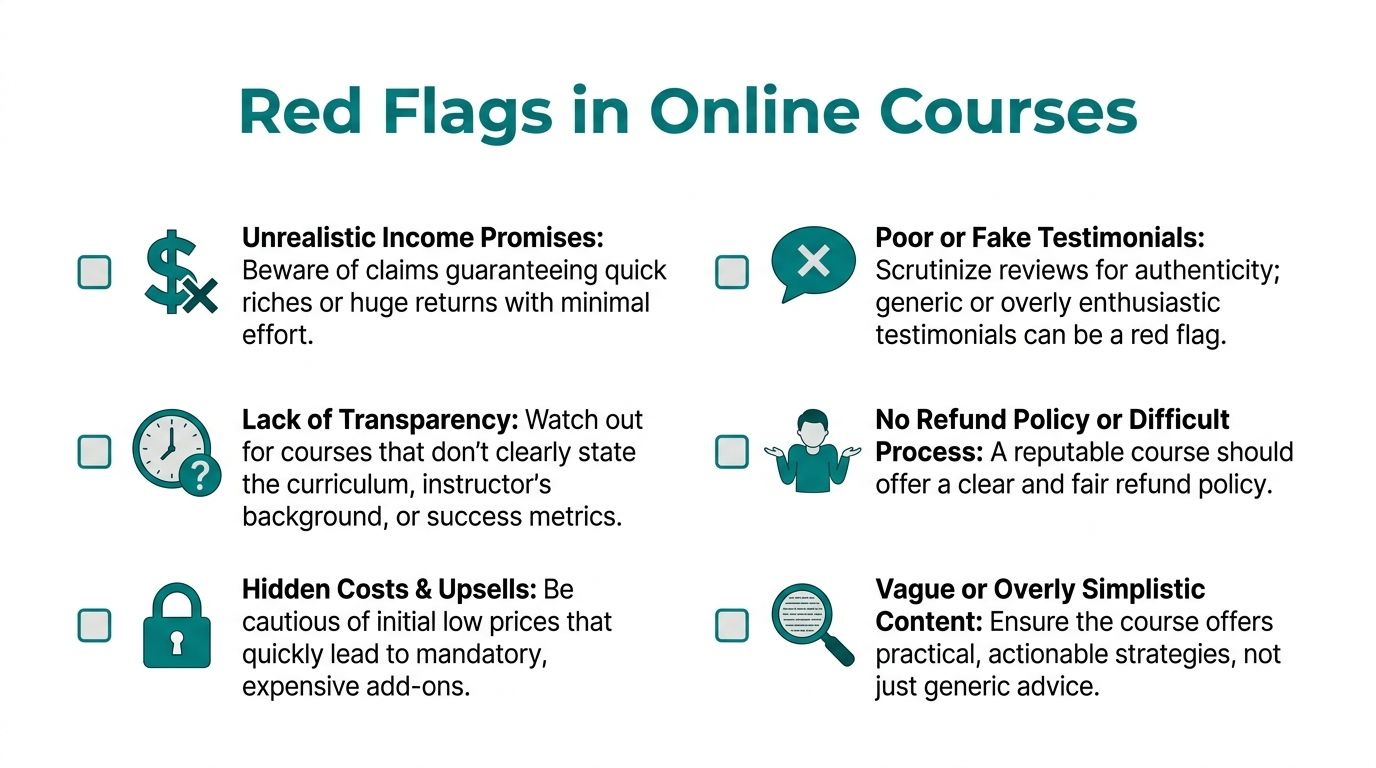
- Watch the promise closely. Claims about easy money, fast results, or dramatic lifestyle change should make you pause and ask for specifics.
- Look for hidden spending. A lower entry price can lead to software fees, ad costs, upsells, coaching offers, or done-for-you extras later.
- Check where testimonials appear. Reviews on a seller's own pages are less persuasive than independent feedback and third-party affiliate marketing ratings.
- Read the refund policy before paying. Make sure you understand deadlines, conditions, and what counts as a valid refund request.
- Ask what week one looks like. If a complete beginner is expected to launch ads, buy tools, or master several platforms right away, the learning curve may be steeper than the sales page suggests.
That last point catches many people. Beginners often assume the first steps will be simple because the marketing felt simple.
Paid ads are one path, not the default path
Some course sellers present paid traffic as if it is the normal starting point for everyone. It is one option. It is often the most expensive option, and for cautious beginners, it may be the most stressful one too.
If you want to compare that with a lower-pressure traffic method, this guide to low-cost solo ads for beginner traffic testing shows one alternative. The point is not that solo ads are perfect. The point is that you have choices, and choices give you room to protect your cash while you learn.
Decision filter: If a course asks you to spend money quickly before you understand the system, treat that as risk.
Vague success stories should not carry the sale
Stories can be inspiring. They are not the same as evidence.
A trustworthy course should make several things easy to find and easy to understand:
- Who the course is for
- What skills you will learn
- What extra costs may appear later
- How support is delivered
- How long the process may take for a beginner
If those answers stay fuzzy while the emotional pitch stays strong, slow the decision down.
That is especially important if you are in a season where you feel pressure to "make something work" soon. Pressure can make almost any promise sound reasonable. A better course, or a better path, will help you build skill without asking you to gamble your peace of mind.
Safer First Steps in Affiliate Marketing for Beginners
You may be sitting at the kitchen table after dinner, looking at another online income pitch and wondering whether this is a real opportunity or one more expensive detour. That hesitation is healthy, especially if you are thinking about Retirement, caregiving, or stretching one income further than it used to go.
A safer start usually looks quieter than the sales pages suggest.

Affiliate marketing works a lot like building a small garden in containers. You start with one healthy plant, learn how much water and light it needs, and give it time to grow. You do not fill the whole yard on day one. That same slow approach can protect both your money and your confidence.
Start with something you control
The strongest first step is building an audience you can reach again later.
That could be:
- An email list
- A simple blog
- A YouTube channel
- A small social account that points people back to your own content
Ownership matters because platforms change. Algorithms shift. Accounts get limited. If all your effort lives on borrowed space, your progress can disappear faster than you expected.
For women over 50, this point is often bigger than a marketing tactic. It is about peace of mind. You are not just trying to make a commission. You are trying to build something stable enough to support your future.
A steadier beginner model
A calmer path is to learn the basics in an order that keeps risk low.
Choose a topic connected to real experience
Start with something you already understand from daily life. That might be healthy cooking, downsizing, skincare for mature women, travel planning, mobility, caregiving, faith resources, or a hobby you have practiced for years.
Create one helpful piece of content at a time
Answer common questions. Share lessons you learned the hard way. Keep your tone honest and simple. People trust clarity more than hype.
Build a small way to stay in touch
Email is useful here because it gives you a direct line to readers or viewers who want more help.
Recommend products carefully
Add affiliate links where they fit naturally. If you would not suggest the product to a close friend, it does not belong in your content.
This method is slower at the start. It is often easier to stick with, and that matters more than a dramatic promise.
Use outside research before you commit
If you are still deciding whether this business model fits your goals, review broader affiliate marketing ratings. A wider view helps you judge the model itself instead of getting swept up by one instructor, one funnel, or one emotional sales pitch.
That perspective can lower the pressure.
A course might be legitimate and still be the wrong fit for your season of life. If your budget is tight or your stress level is already high, a lower-cost learning path may serve you better than a premium program with upsells and fast expectations.
Keep the setup simple
Many beginners get stuck because they assume they need a full website, polished branding, and lots of tech before they can begin. You can start smaller than that.
If you want a simpler option, this guide to affiliate marketing without a website shows a few beginner-friendly ways to test the waters first.
A practical starting setup can be very modest:
- One topic
- One platform
- One helpful post or video each week
- One product you feel comfortable recommending
That is enough to learn how this works in real life.
And for many women over 50, real progress starts there. Not with rushing. With choosing a path you can afford, understand, and keep building without losing sleep.
Your First Small Step Toward Building an Online Asset
You don't need a complicated plan tonight. You need one small action that lowers the emotional temperature and helps you move forward without pressure.
Try this.
Do a simple topic inventory
Set a timer for half an hour and write down answers to these prompts:
- What do people already ask me for help with?
- What have I learned the hard way in life?
- What products, tools, books, or services do I recommend naturally?
- What could I talk about for ten minutes without needing notes?
Don't judge your list while you write it.
You're looking for clues, not perfection.
What you're really building
At first, it may seem like you're choosing a niche. But you're also doing something deeper. You're identifying where your experience can become an asset.
That shift matters.
Instead of asking, "Can I still catch up?" you start asking, "What do I already know that could help someone else?" That question is more encouraging, and it's usually more profitable in the long run because it leads to authentic content.
Start where you have lived experience, not where someone else's sales page says the money is.
If video feels interesting but intimidating
Many women over 50 are curious about YouTube but assume it's too technical or too crowded. It doesn't have to be either. If that platform interests you, this guide on how to create a successful YouTube channel and find your niche can help you think through your topic before you worry about fancy equipment.
You don't need to become flashy. You need to become clear.
Hold onto this
The online world can be noisy, but your next step doesn't have to be.
You don't need to buy the boldest course.
You don't need to master every tool.
You don't need to prove anything to anyone.
You just need to begin building something that belongs to you.
The next five years will pass either way. The only question is whether you'll use them to build something that gives you peace of mind.
If you'd like a calm, beginner-friendly place to keep learning, Victoria OHare offers practical guidance for building online income step by step, with a strong focus on owned assets, simple systems, and sustainable Affiliate Marketing for women who want clarity more than hype.