
If you're over 50 and wondering whether it's too late to build income online, you're not alone. Many women feel behind financially, not because they did something wrong, but because life asked a lot of them. Work, family, caregiving, divorce, illness, rising costs, and years that moved faster than expected can leave even capable women feeling uncertain about Retirement.
The hard part is that this fear is often private.
You might look calm on the outside and still feel unsettled when you think about the years ahead. You may also feel overwhelmed by how fast the online world seems to move. New platforms, new tools, new terms. It can make you feel like the door has already closed.
It hasn't.
Affiliate marketing without a website is one of the simplest ways to begin learning online income. Not because it's magic. Not because it's instant. But because it lets you start with what you already have. Your judgment, your life experience, your ability to help someone make a good decision.
A Quiet Question About the Future
A woman sits at her kitchen table with coffee gone cold beside her.
She opens a Retirement statement, scans the page, and feels that familiar drop in her stomach. The numbers may not be terrible. But they don't feel like peace. They don't feel like room to breathe, room to help family, or room for one unexpected expense.
That moment is more common than people admit.
Many women over 50 aren't looking for luxury. They're looking for stability, dignity, and a little more control over what the next chapter looks like. They want income that doesn't depend entirely on one paycheck, one pension, or one version of the future going perfectly.
When experience feels invisible
One painful part of this stage of life is that your experience should count for more than it often does.
You may know how to solve problems, calm people down, explain things clearly, and follow through. Those are valuable business skills. Yet online spaces can make it seem like only the youngest, loudest, or most tech-savvy people have a chance.
That isn't true.
A lot of women don't need another complicated system. They need a quiet, practical model they can understand. One that doesn't require building a large website, learning coding, or pretending to be someone they're not.
You don't need to become a different person to earn online. You need a clear method and enough patience to learn the basics.
I remember the first time I looked at online business options and felt my brain shut down. There were funnels, dashboards, content calendars, automations, and advice coming from every direction. It all sounded urgent. None of it felt calm.
That's why many women end up doing nothing at all. Not because they lack ability, but because the noise makes the first step hard to see.
A gentler way to begin
Affiliate marketing without a website can remove one big mental barrier. You don't have to start by building a full online home. You can begin by recommending useful products through channels that feel more manageable, like email, social content, or communities where you already spend time.
If you've been asking whether this path still works, this piece on is Affiliate Marketing dead can help settle that fear.
For now, the main thing to know is this:
| Fear | Calmer truth |
|---|---|
| "I'm too late" | You're starting from today's reality, and that's enough. |
| "I'm not technical" | You can learn one simple tool at a time. |
| "I don't want to be pushy" | Good Affiliate Marketing is helping, not pressuring. |
| "I don't have a website" | You can start without one and still build something meaningful. |
Retirement security isn't guaranteed for everyone. That's why building even a small stream of independent income matters. Not for status. For peace of mind.
And peace of mind often starts with one quiet decision. To stop assuming you're behind, and start learning one practical skill at a time.
What is Affiliate Marketing Really
Affiliate marketing is simple in essence.
You recommend a product or service. If someone buys through your special link, you earn a commission. This is much like telling a friend which book stand helped your back, which kitchen tool saved you time, or which course finally explained something clearly. The difference is that the company tracks your referral and pays you for bringing them a customer.
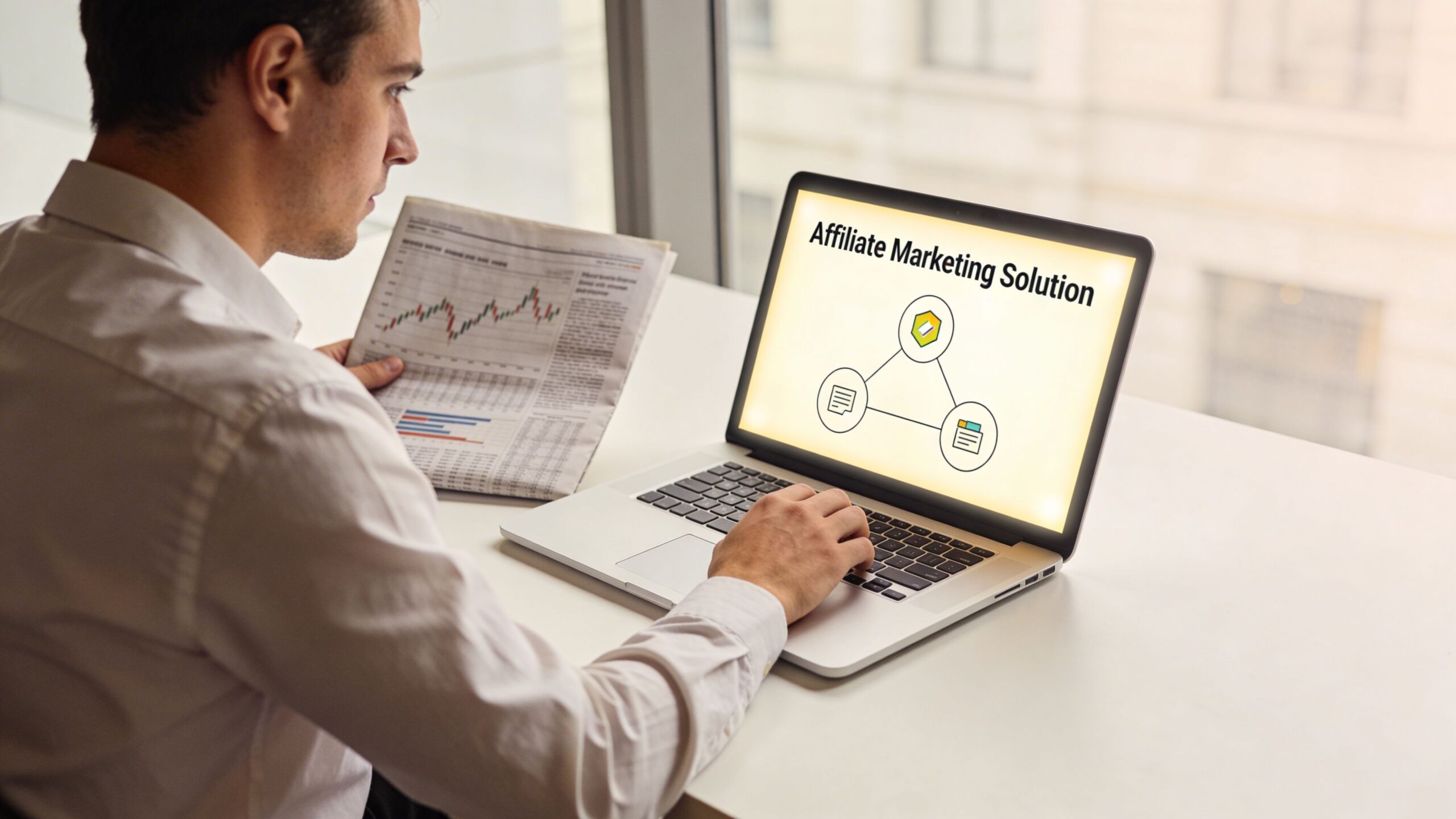 Affiliate Marketing solution on his laptop." />
The everyday version
Let's keep it plain.
Say you love a blender that makes healthy breakfasts easier. You share how you use it in a short email, a Facebook post, or an Instagram Reel. Someone clicks your link and buys it. You receive a small commission because your recommendation helped them make a decision.
You didn't create the product.
You didn't pack a box.
You didn't handle customer service.
Your role was to connect a person with a useful solution.
Why this isn't some fringe online trick
This model is much more established than many beginners realize. The legitimacy of it is well established. In 2026, the global Affiliate Marketing industry is projected to surpass $20 billion, and 81% of all advertisers use affiliate programs to connect with customers, according to Post Affiliate Pro's 2025 industry overview.
That matters because skepticism is healthy.
If you've ever thought, "Is this even real?" you're asking the right question. A real business model should be used by real companies at scale. Affiliate Marketing is.
What it looks like without a website
A website can help later, but it isn't required to begin.
You can share affiliate recommendations through:
- Email newsletters if you enjoy writing and building trust slowly
- Instagram if you like visuals, short captions, or simple Reels
- YouTube if you prefer teaching or demonstrating
- Facebook groups or communities when you already participate helpfully
- Short-form video if you want to keep things brief and direct
If Instagram feels like your natural starting point, this guide on how to monetize your Instagram account gives a helpful overview of ways creators use the platform responsibly.
Practical rule: Affiliate Marketing works best when you recommend products you can explain in plain language and feel comfortable standing behind.
What you're really building
On the surface, you're sharing links.
Underneath, you're building something more valuable. Trust.
People don't buy because you posted a link. They buy because your recommendation feels thoughtful, relevant, and honest. That is good news for women over 50, because trust isn't built by being flashy. It's built by being clear, steady, and useful.
That's what makes Affiliate Marketing without a website so appealing for beginners. You can begin with your voice, your experience, and your ability to help someone choose well.
Addressing Your Doubts Head-On
Most beginners don't get stuck on the mechanics first. They get stuck on the doubts.
Is this a scam?
Do I need to be good with tech?
Am I too old to start?
Those questions deserve real answers.
 Affiliate Marketing business doubts and obstacles." />
Is this a scam
Affiliate marketing itself is not a scam. But some people market it in scammy ways.
That's an important difference.
A healthy affiliate business is built on transparency. You tell people you're recommending something. You choose products carefully. You avoid hype. You don't promise outcomes you can't guarantee.
A shady version usually has a few warning signs:
- Big income promises that sound effortless
- Pressure-heavy language that pushes urgency over clarity
- Low-quality products the promoter doesn't seem to understand
- Missing disclosures about affiliate relationships
- Advice that centers on manipulation instead of service
If your instinct says, "This feels off," trust that instinct.
I understand being cautious. There are scams online. That's why education and mentorship matter. A good beginner path should make you feel more grounded, not rushed.
Do I need to be a tech genius
No. You need basic comfort with simple tools, and you can learn that gradually.
The first time I logged into an online training dashboard years ago, I nearly clicked out of it for good. Too many tabs. Too many terms. Too many people acting like everything was obvious.
It wasn't obvious.
What helped was shrinking the task. Not "build a business." Just "learn how to copy a link." Then "learn how to place that link in an email." Then "learn how to write two sentences about why this product helps."
That pace works.
Here are the only kinds of tools many beginners need at first:
| Tool type | What it does |
|---|---|
| Affiliate network | Gives you products to promote and a unique tracking link |
| Email platform | Lets you write to subscribers and build an audience you own |
| Social platform | Gives you a place to share helpful content |
| Simple link tool | Helps organize your links neatly if needed |
None of that requires advanced technical skill. It requires repetition.
Am I too old for this
No. In many cases, your age gives you an advantage.
People trust calm communication. They trust lived experience. They trust someone who doesn't sound desperate for attention. Those strengths often grow with age.
While many guides focus on platforms favored by younger creators, it's true that mature audiences may build trust differently. For example, data highlighted by Breezy's article on Affiliate Marketing without a website notes that email marketing can generate a $36 return for every $1 spent, which helps explain why deeper, relationship-based channels may fit many older beginners so well.
That doesn't mean you have to avoid social media.
It means you don't have to force yourself into a style that feels unnatural just because it's trending.
The best channel isn't the loudest one. It's the one you can use consistently and with integrity.
A better way to think about age
Instead of asking whether you're too old, ask better questions:
- Where do I communicate best
- What kinds of products can I explain clearly
- What audience would naturally relate to my life stage
- Which platform feels manageable enough to use each week
Those questions lead to a real strategy.
Age can become an asset when you stop treating it as a liability. If you're a woman with life experience, practical judgment, and a desire for more financial control, you're not disqualified from Affiliate Marketing without a website.
You're often better suited for the trust side of it than you realize.
Your Simple Playbook for Getting Started This Week
The easiest way to get overwhelmed is to think you need to do everything.
You don't.
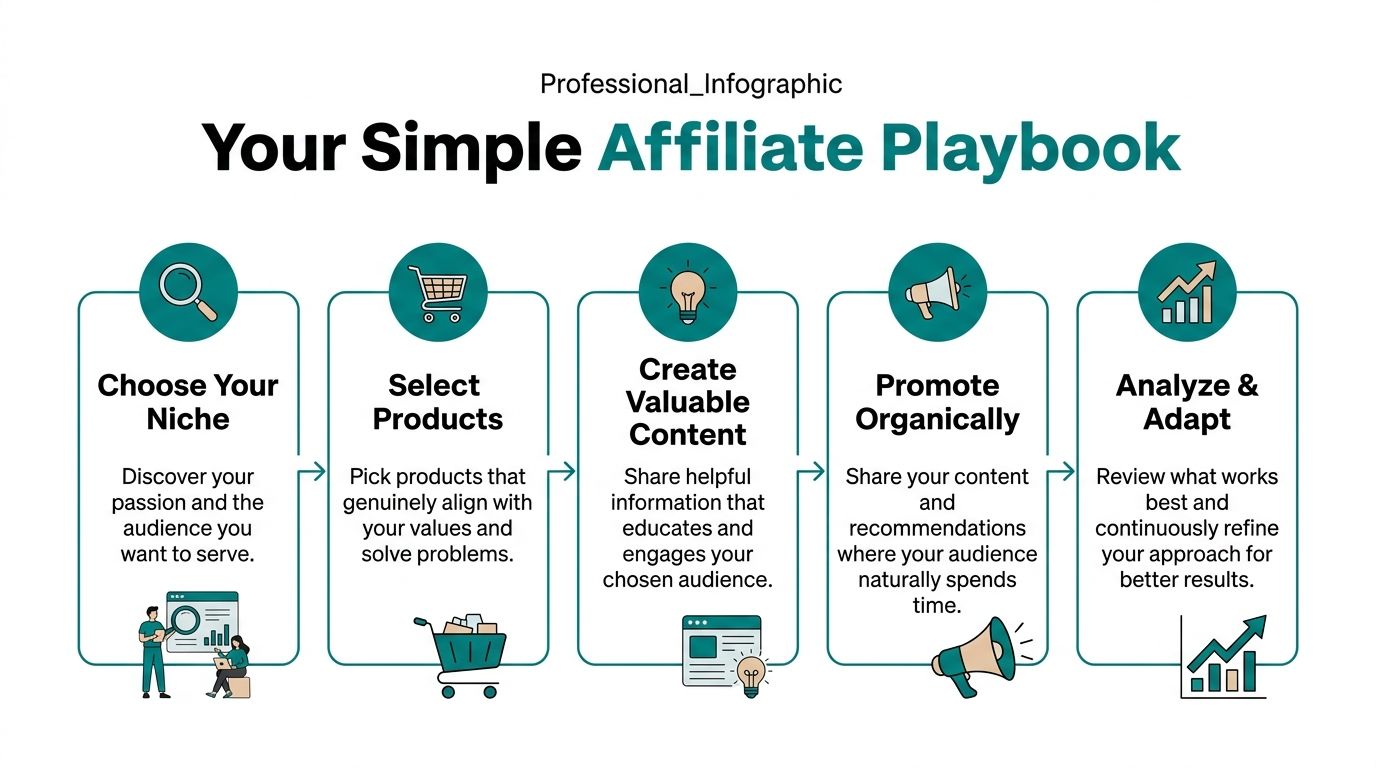
Pick one niche. Join one or two beginner-friendly programs. Choose one traffic channel. Learn by doing. That's enough for this week.
 Affiliate Marketing successfully." />
Start with a niche that matches your life
A niche is a topic and group of people you want to help.
Don't overcomplicate it. You don't need a perfect niche. You need one you understand well enough to speak about naturally.
Good beginner examples include:
- Healthy routines for women in midlife
- Home organization for busy families or downsizing households
- Gardening for beginners
- Budget-friendly kitchen tools
- Walking, stretching, and wellness support
- Empty-nest transitions
- Simple beauty or self-care
- Work-from-home tools for beginners
A strong niche often comes from lived experience.
If friends already ask you for advice in a certain area, pay attention to that.
Choose programs that welcome beginners
This is one of the best parts. You don't need a website to be accepted by major networks. Programs like ClickBank, ShareASale, and Amazon Associates have been onboarding affiliates without websites, and social media is now the primary traffic source for nearly 40% of affiliate marketers, according to Marketing LTB's Affiliate Marketing statistics.
That gives beginners real options.
A simple comparison helps:
| Program | Best for | What to know |
|---|---|---|
| Amazon Associates | Everyday products people already know | Broad catalog and familiar brand |
| ClickBank | Digital products and courses | Useful if you want non-physical offers |
| ShareASale | Many brands in one place | Good for exploring different niches |
| Awin or CJ Affiliate | Broader brand partnerships | Better once you know your audience a bit more |
Choose based on relevance, not excitement.
A modest commission on a product people want is better than a bigger commission on something you can't explain with confidence.
Pick one traffic channel, not five
A lot of new affiliates make this mistake. They open Instagram, Pinterest, YouTube, TikTok, email, and Facebook all at once. Then they feel scattered and stop.
Choose one place where you can show up calmly.
Here are beginner-friendly options for Affiliate Marketing without a website.
Email if you want the steadiest foundation
If writing feels easier than filming, email is a beautiful place to begin.
You can send simple notes like:
- a product you use and why it helps
- a short story about solving a problem
- a weekly roundup of useful finds
- a checklist or guide with a recommendation inside it
Email tends to feel more personal than public content. It also gives you direct access to your audience.
Facebook groups if you enjoy conversation
This works best when you participate sincerely.
Don't join a group and drop links right away. Answer questions. Share your own experience. Be useful. When a product naturally fits the conversation, mention it in a helpful way and follow the group rules.
Pinterest if you like visuals but not constant posting
Pinterest can suit people who enjoy making simple graphics or saving ideas around a topic. A clear image and helpful title can keep bringing attention to the same recommendation over time.
Instagram or short-form video if you want quick content
Short videos can work well when you keep them practical.
For example:
- show the product in use
- explain one problem it solves
- give one honest reason you like it
- invite people to learn more through your link
If you don't want to be on camera, this guide on Faceless Videos for Affiliate Marketing can help you think through a lower-pressure approach.
Keep your first content simple
You do not need to sound like a professional copywriter.
Try one of these formats:
- A mini review
"I've been using this meal planner for a few weeks. What I like most is that it makes grocery shopping less stressful." - A problem and solution post
"I used to forget my water bottle every day. This simple carrier made the habit easier." - A short list
"Three kitchen tools that make healthy lunches faster." - A gentle recommendation email
"If you're trying to walk more this season, this step tracker has been easy to use."
A clear voice beats a clever one.
Small reminder: Your job isn't to impress people. Your job is to help the right person make a useful decision.
Learn from one piece of content at a time
You don't need advanced analytics in week one.
Ask simple questions:
- Did I enjoy making this?
- Did anyone respond?
- Did the recommendation feel natural?
- Would I be comfortable making another one like it?
That reflection is enough to begin.
If you want more ideas for finding people organically before spending money, this guide on free traffic Affiliate Marketing is a useful next read.
A short video can also help if you learn better by watching someone walk through the concept:
Your first week checklist
You can keep it this small:
- Choose one topic you know or care about
- Join one affiliate program that fits that topic
- Pick one channel to use first
- Create one helpful piece of content
- Share one recommendation with honesty and disclosure
- Notice what felt manageable
This is how confidence grows.
Not by doing more than everyone else. By doing a few basic things consistently enough to understand them.
The Secret to Long-Term Peace of Mind An Owned Audience
Many beginners focus only on the commission.
That makes sense at first. You want proof that this works. But the deeper win isn't just earning from one link. It's building an owned audience you can reach again and again.
That usually means an email list.
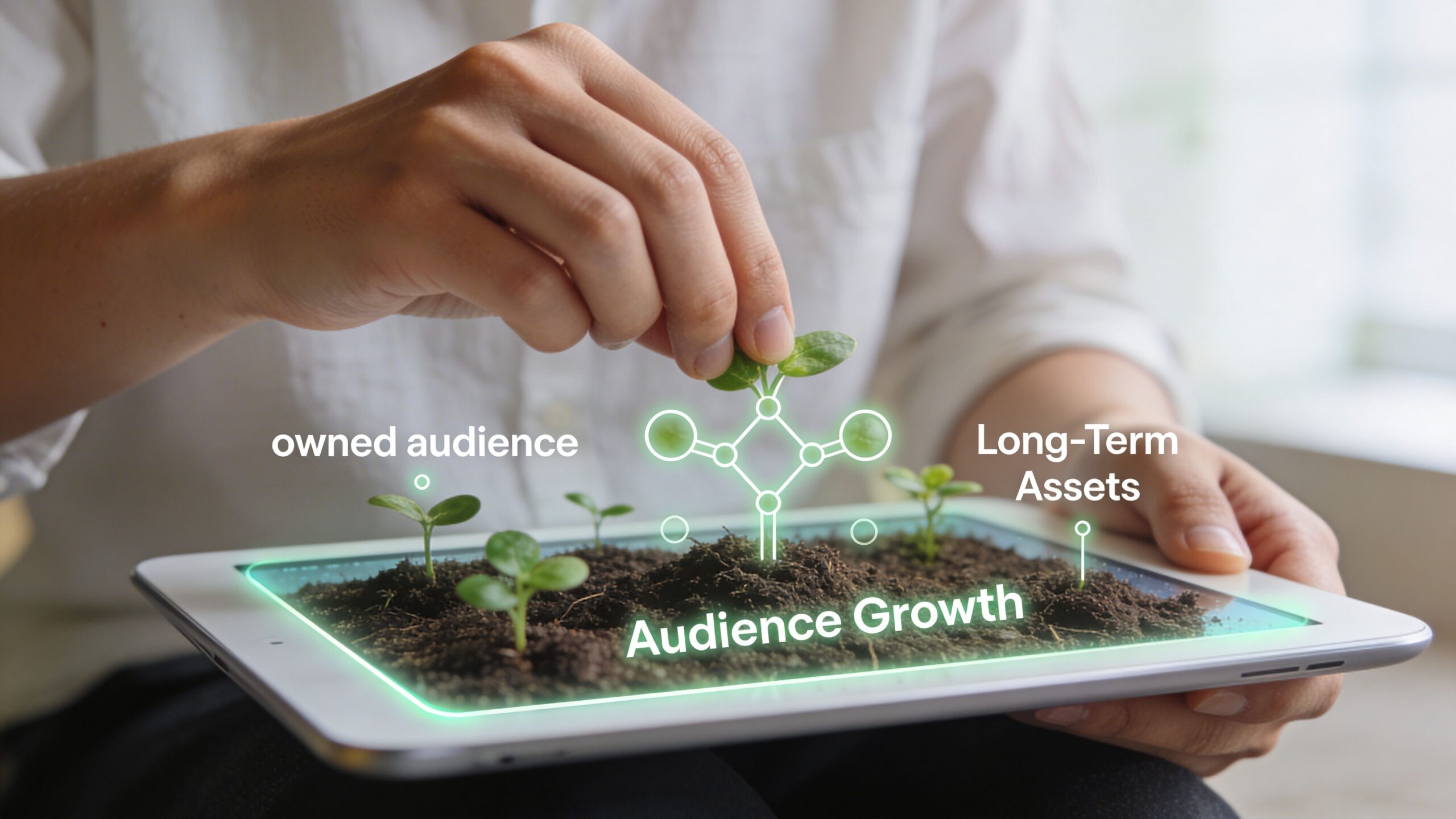
Rented attention versus owned connection
When you rely only on social media, you're building on borrowed ground.
A platform can change its rules. Posts can disappear in the feed. Your reach can shrink without warning. That's why a social account is useful, but it isn't the most stable asset.
An email list is different.
If someone joins your list, they've given you permission to contact them directly. You can write to them without hoping an algorithm shows your post. That creates more control, which often matters greatly for women building income later in life.
Why email fits this model so well
Email gives you room to be thoughtful.
You can explain why you like a product. You can tell a short story. You can recommend something at a slower, more natural pace than on many public platforms. That style often builds deeper trust.
For beginners starting from zero, the key is to bypass the need for existing traffic. Simple, organic methods like offering a helpful checklist in a relevant online community or collaborating on a giveaway can be the first step to building a list, as discussed in Leadenforce's guide to what really works without a website.
That matters because many people get stuck on the same question.
"How do I build an email list if no one knows me yet?"
A practical cold-start approach
You don't need a polished brand. You need a small reason for someone to join your list.
A few beginner-friendly ideas:
- A short checklist
Example: simple pantry staples for easy healthy meals - A one-page guide
Example: beginner walking essentials for women over 50 - A resource roundup
Example: favorite tools for organizing a small kitchen - A giveaway collaboration
Partner with another small creator serving a similar audience - Helpful community participation
Answer questions in a Facebook group or forum, then mention your free resource when appropriate
One useful freebie can be enough to begin.
Build for connection first. Commissions often follow trust more reliably than they follow visibility.
What to send once people join
This part scares some beginners, but it doesn't need to.
You can send simple emails like:
| Email type | Example |
|---|---|
| Welcome note | Why you started the list and what people can expect |
| Helpful tip | One practical idea related to your topic |
| Personal lesson | Something you tried, learned, or improved |
| Product recommendation | A tool or resource that helped |
| Curated roundup | A few useful finds with context |
You don't need to email every day.
You do need to be consistent enough that people remember why they signed up.
Why this becomes a real asset
A list is more than a marketing tool. It's a business asset.
You can recommend different products over time. You can learn what your readers care about. You can eventually create your own guide, workshop, or service if you want. That flexibility is one reason this strategy feels more secure than chasing trends alone.
If you'd like help with the practical first steps, this resource on how to build an email list from scratch is worth bookmarking.
For women who want long-term peace of mind, this matters.
You are not only learning Affiliate Marketing without a website. You are building a relationship-based asset that can support you for years if you treat it with care.
What Will You Build With Your Next Five Years
Five years will pass whether you build something or not.
That thought can feel heavy at first, but I find it encouraging. It means you don't need a dramatic reinvention. You only need to begin. With calm, steady effort. One skill, one platform, one piece of content, one email at a time.
Affiliate marketing without a website can be a good fit if you want a lower-tech way to enter online business. It lets you start small. It lets you learn by helping. And if you center your strategy on an owned audience instead of chasing every trend, you give yourself something more stable than a few random clicks.
That's especially important if you're thinking about Retirement, rising expenses, or the desire to have income that feels more under your control.
You don't need to know everything today.
You don't need a polished brand, a perfect niche, or a giant following.
You need a willingness to learn, a commitment to honesty, and enough patience to keep going through the awkward beginner stage. Everyone has one. No one skips it.
I still think often about those moments when people nearly quit because they assume confusion means they aren't capable. Usually it means they're learning. That's all.
If this path appeals to you, keep it simple:
- choose one topic you understand
- recommend products you respect
- start collecting email subscribers as early as you can
- focus on usefulness over speed
- let consistency do the heavy lifting
Peace of mind rarely arrives all at once. More often, it grows from small actions repeated long enough to become something solid.
The next five years will pass either way. The only question is whether you'll use them to build something that gives you more calm, more confidence, and more control.
If you'd like gentle, step-by-step help learning Affiliate Marketing and building a more secure online income stream, you can explore the training and resources available at Victoria OHare. There's no pressure. Just a place to keep learning at your own pace.





Pingback: Affiliate Marketing Without Social Media: A Calm Guide - Victoria OHare