
If you're over 50 and wondering whether it's too late to build something online, you're not alone. A lot of people feel behind when Retirement looks uncertain, tech feels noisy, and every new platform seems to change the rules again. That doubt doesn't mean you've missed your chance. It usually means you need a clearer path, one small step at a time.
A good how-to guide can be that path. It gives you structure when your energy is low, and it turns a vague idea into something you can finish. That matters if you're trying to make money online after 50, or if you want a second chapter that feels steady instead of chaotic.
The problem is usually not effort. It's that people sit down to write, then try to sound expert before they've even chosen a topic. They chase perfection, over-explain, or assume the reader already knows too much. A useful guide doesn't start with polish. It starts with clarity.
Why Most How-to Guides Never Get Finished
The blank page usually isn't the obstacle. The obstacle is the moment you start asking yourself whether you sound qualified enough, whether your topic is too small, or whether anyone will care. I've seen this happen over and over, especially with midlife creators who are already carrying a lot in their heads. They don't need more pressure. They need a simpler way to begin.
A how-to guide is not a performance. It's a repeatable process. That's why the history of instructional writing matters so much. The idea of breaking complex work into repeatable steps goes back to older procedural manuals, and the same logic shows up in the history of statistics, where raw records were turned into usable methods for other people to follow. John Graunt's work in 1662 is a strong early example, because he used bills of mortality to estimate London's population at 384,000, working from 13,000 funerals per year, a mortality pattern of 3 people per 11 families per year, and an average family size of 8. That wasn't just data collection. It was a method other people could replicate, which is exactly what a good guide should feel like. The history of statistics shows how this habit of making sense out of records became more formal over time.
Why clear guidance builds trust
The same pattern appears in modern instruction. By the time Historian's Guide to Statistics appeared in 1971, statistical teaching had already moved toward explicit methods instead of intuition alone, and statistical computing had become part of the work in the 1920s and 1930s as universities and labs used early punched-card tabulators for summary statistics and models like regression and analysis of variance. A history of the field makes the point plainly, the work got stronger when it became more repeatable.
That's the mindset that helps you finish a guide. You are not inventing wisdom from scratch.
Practical rule: Write the next guide as if someone else will need to follow it without asking you questions. That one shift keeps the draft grounded.
If you feel stuck, don't try to produce a masterpiece. Draft a useful sequence. Then revise for clarity. If you need a gentle starting point, the time-management approach in this simple guide for your next chapter is a good reminder that small routines can support bigger goals.
Choosing a Topic Your Reader Actually Needs
The easiest topic to write about is not always the best one to publish. A vague subject like email marketing sounds important, but it leaves too much room for confusion. A focused topic, like writing a welcome sequence for new subscribers, gives the reader something they can picture, use, and finish.
The simplest filter I use is three questions.
A three-question filter
- Who is this for? If you can't name the reader, the guide will drift. “New list builders” is clearer than “everyone online.”
- What problem does it solve? A topic should remove friction, answer a decision, or help someone complete a task. If the problem is fuzzy, the guide will be fuzzy too.
- What does success look like at the end? A good guide ends with a visible result, not just activity. For example, “set up a welcome email” is better than “learn about email strategy.”
The more specific the topic, the easier it is to write with confidence. A beginner who once felt intimidated by email automation can still write a strong guide about the first welcome email, because lived experience counts. You don't need to be the world's most advanced creator. You need to know one problem well enough to explain it clearly.
| Question to Ask | What Good Looks Like | Red Flag |
|---|---|---|
| Who is this for? | A clear reader with a real situation | “Anyone who wants to grow online” |
| What problem does it solve? | One focused pain point | A broad topic with no finish line |
| What does success look like? | A visible outcome the reader can recognize | A topic that ends in vague “better understanding” |
If you want a topic that stays useful, ask real readers what they're struggling with. The customer-feedback approach at this collection method page is a good reminder that plain questions often surface the most helpful ideas. You'll usually find that the topic you thought was “too small” is the one people needed most.
Outlining Your Guide Before You Write a Single Sentence
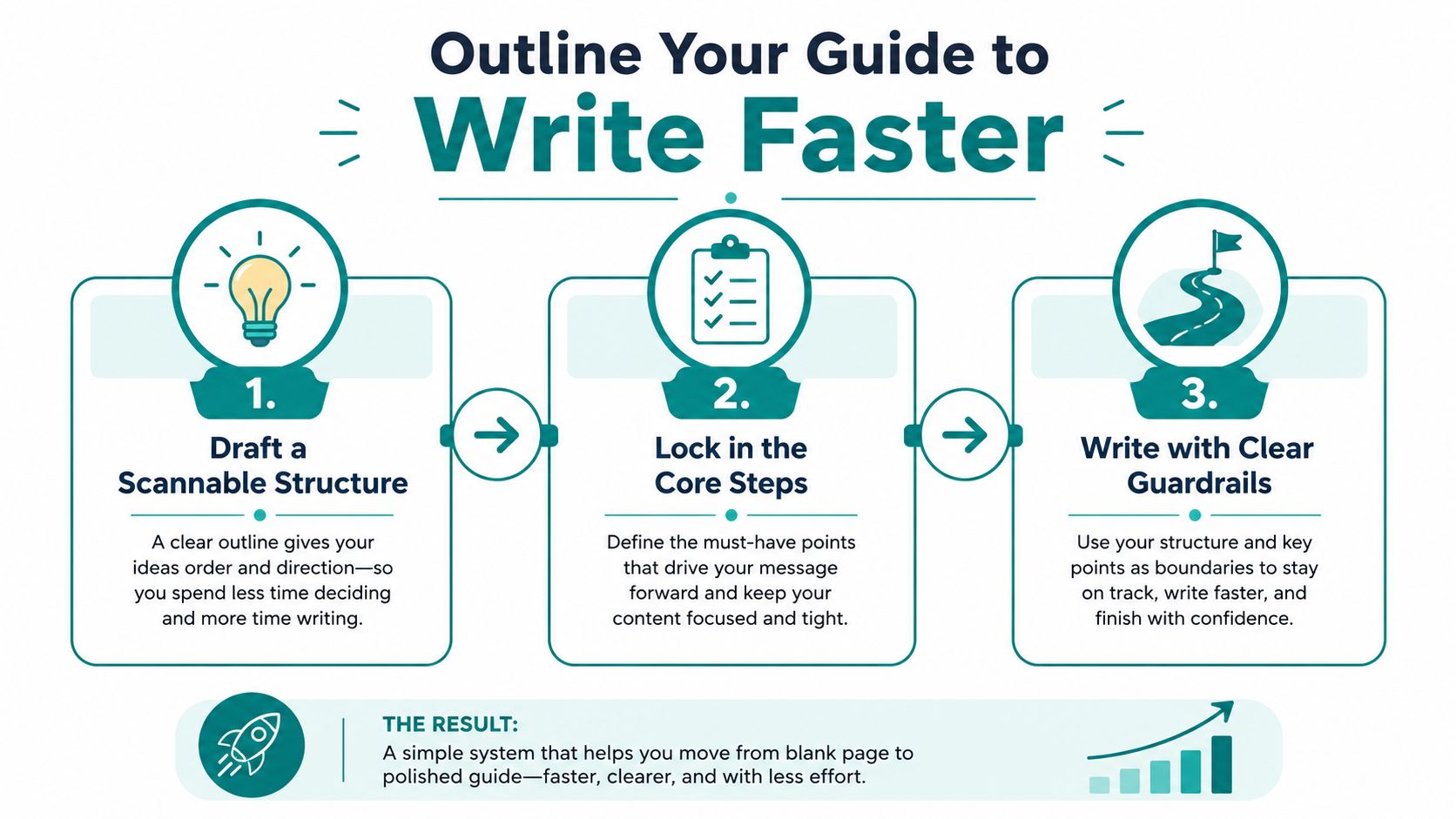
A short outline keeps the writing honest. It stops you from wandering into side stories, and it helps you see whether the guide has a beginning, a middle, and an ending. That matters when you're writing for someone who may be tired, skeptical, or reading on a phone between other tasks.
A simple structure that holds up
Start with three parts.
- Name the problem. Tell the reader what they're trying to do and why it feels hard.
- Give the steps. Keep each step narrow enough that it has one job.
- Close with a next move. That could be a checklist, a first test, or a reminder of what to do after the guide is done.
Here's what that looks like for a first welcome email.
- Opening: Why the welcome email matters for a new subscriber.
- Step 1: Define the reader's next action.
- Step 2: Write one clear subject line.
- Step 3: Draft the body in plain language.
- Step 4: Add one link or reply prompt.
- Close: Send a test email and check how it looks on mobile.
A good outline doesn't have to be long. It has to be complete enough that you can see the shape of the guide before you write the prose. That keeps you from repeating yourself later, and it makes it easier to spot missing pieces. If a step seems vague in the outline, it'll feel vague in the draft too.
Useful check: If you can't explain the step in one sentence, the reader probably can't follow it in one sitting.
I'd rather see a four-point outline that's clear than a sprawling page that tries to cover everything. You can always add detail later. For a creator writing affiliate or list-building content, that's often the safer choice.
Writing Steps That Are Easy to Follow
The best steps do one thing at a time. They use plain verbs, clear outcomes, and enough detail to keep the reader from guessing. If the reader has to stop and interpret your meaning, the step has already asked too much.
Before and after clarity
A weak step sounds like this.
“Optimize your welcome sequence so it improves engagement.”
That's broad, abstract, and hard to act on.
A clearer version sounds like this.
“Write one welcome email that introduces you, explains what the subscriber will get, and links to your most helpful resource.”
The second version gives the reader a job, not a slogan. It tells them what to write, what to include, and what the result should be.
That same pattern works across any how-to guide. Use short paragraphs. Use bullets when you're listing actions. Keep each step tied to a single outcome. A reader on a small screen should be able to scan without losing the thread.
Micro-habits that make instructions friendlier
- Use one verb per step. Start with write, check, send, compare, or save.
- Keep prerequisites visible. If the reader needs an account, a draft, or a login, say so early.
- Name the outcome. Tell them what success looks like when the step is done.
- Cut filler. If a phrase doesn't help the reader act, remove it.
- Read it aloud. If you stumble, your reader probably will too.
A guide on how to earn income before Retirement works best when the actions feel manageable. That doesn't mean the process is tiny. It means the language is clear enough to support the work.
The first time I wrote a step-by-step walkthrough, I over-explained everything because I wanted to sound thorough. The result was tiring to read. The cleaner version was shorter and more useful. That's usually the lesson for beginners, clarity is kinder than performance.
Adding SEO Without Sounding Like a Robot
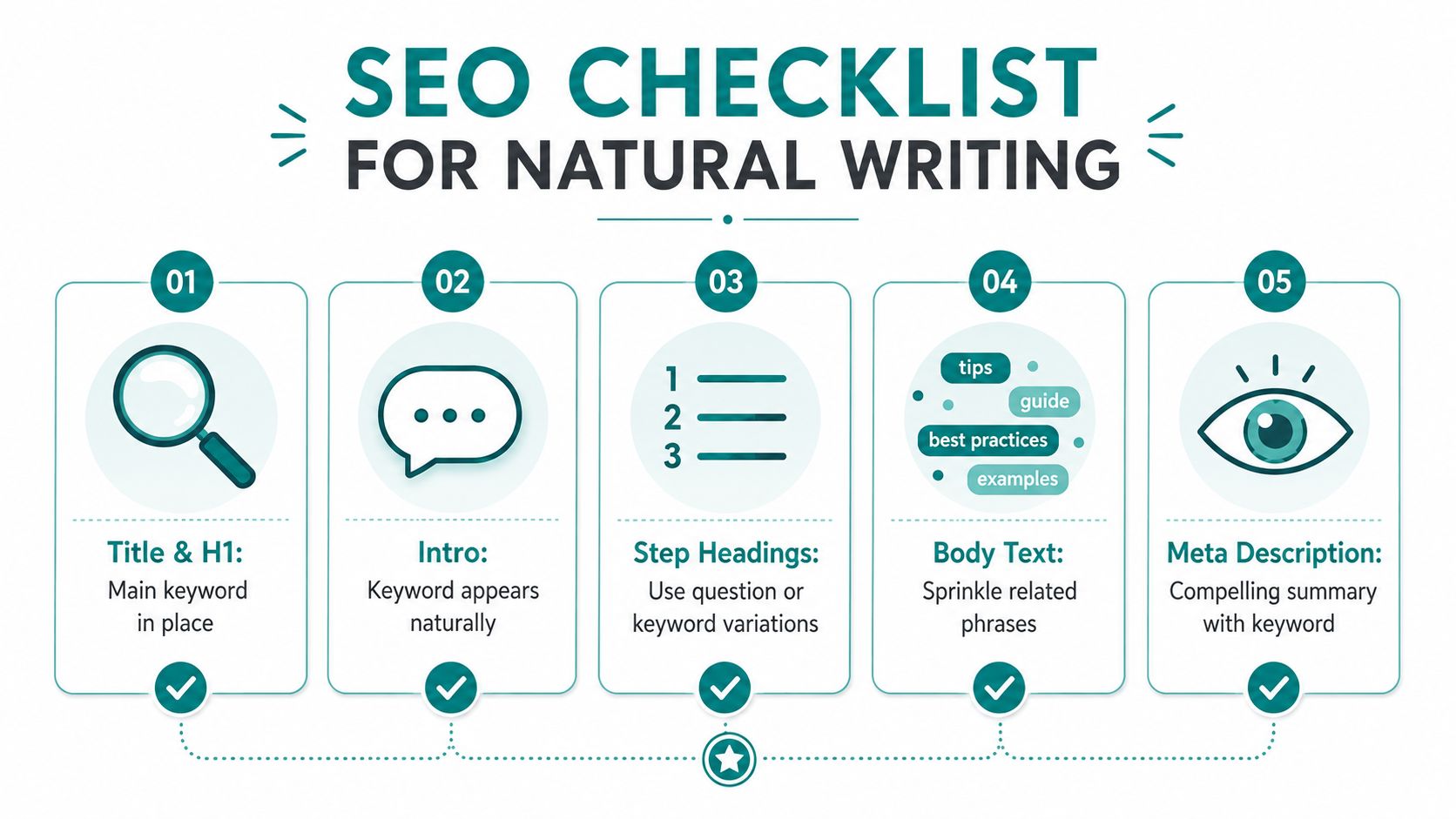
SEO doesn't need to feel mechanical. At its best, it just helps the right reader find the right guide. That means the title should say what the page is about, the intro should name the problem plainly, and the body should use related terms naturally instead of forcing them into every paragraph.
Keep the keyword useful, not loud
For a page about how to guides, the phrase belongs where a reader expects it, in the title, in the opening, and in a couple of body references where it fits naturally. That's enough. You don't need to repeat it constantly, and you definitely don't need to stuff it into every heading.
A practical way to think about on-page SEO is this.
- Title and intro: Say the topic clearly.
- Headings: Use phrases that describe the next step or answer the next question.
- Body copy: Include a few related phrases that match how a real person would search.
- Closing: Answer the follow-up question the reader is likely to have.
That is why good SEO and good writing usually agree. If you're helpful, specific, and easy to read, search engines have a cleaner page to understand. If you need a deeper process for assembling tutorials, Tutorial AI's tutorial creation guide is a useful reference because it stays focused on structure and clarity rather than hype.
The same is true when you're building broader page systems. A clean publishing setup, like the one outlined in done-for-you SEO support, only works well when the content itself is easy to read and easy to trust. SEO can't rescue a confusing guide. It can only help a clear one get discovered.
Repurposing One Guide into a Week of Content
One finished guide can do more than sit on your site. It can become an email, a few social posts, and a short video outline without needing a full rewrite. That matters when you're trying to build consistency without exhausting yourself.
I like to think of repurposing as translation, not repetition. You're saying the same helpful thing in different formats for different moments. A subscriber may read the email at breakfast. Someone else may see a short post in their feed. Another person may watch a quick video and decide they want the full guide later.
A simple reuse pattern
Start with the guide itself, then pull out the pieces that stand alone.
- One email summary: Share the core problem, one useful takeaway, and a link to the full guide.
- Three social posts: Use one as a tip, one as a question, and one as a short story or reminder.
- One LinkedIn-style article: Reframe the lesson for a more professional audience.
- One video outline: Turn the guide into three talking points and a closing invitation.
A short repurposing session is usually enough if the original guide is clear. If the guide is muddy, every extra format will be muddy too. That's why writing and promotion belong together. The cleaner the source, the easier the reuse.
If you want a practical frame for turning one idea into several formats, this format mapping guide can help you see what belongs in each channel. Once you know the shape, you spend less time guessing and more time sharing.
For a midlife creator, confidence starts to build. You're no longer asking, “Can I make content every day?” You're asking, “How many useful ways can I share one clear idea?” That's a much calmer question.
Your Pre-Publish Checklist and First Next Step
Before you publish, check the basics. Make sure the title is clear, the steps are easy to scan, and the reader knows what to do next. Read the guide aloud once, because awkward phrasing usually shows up faster that way.
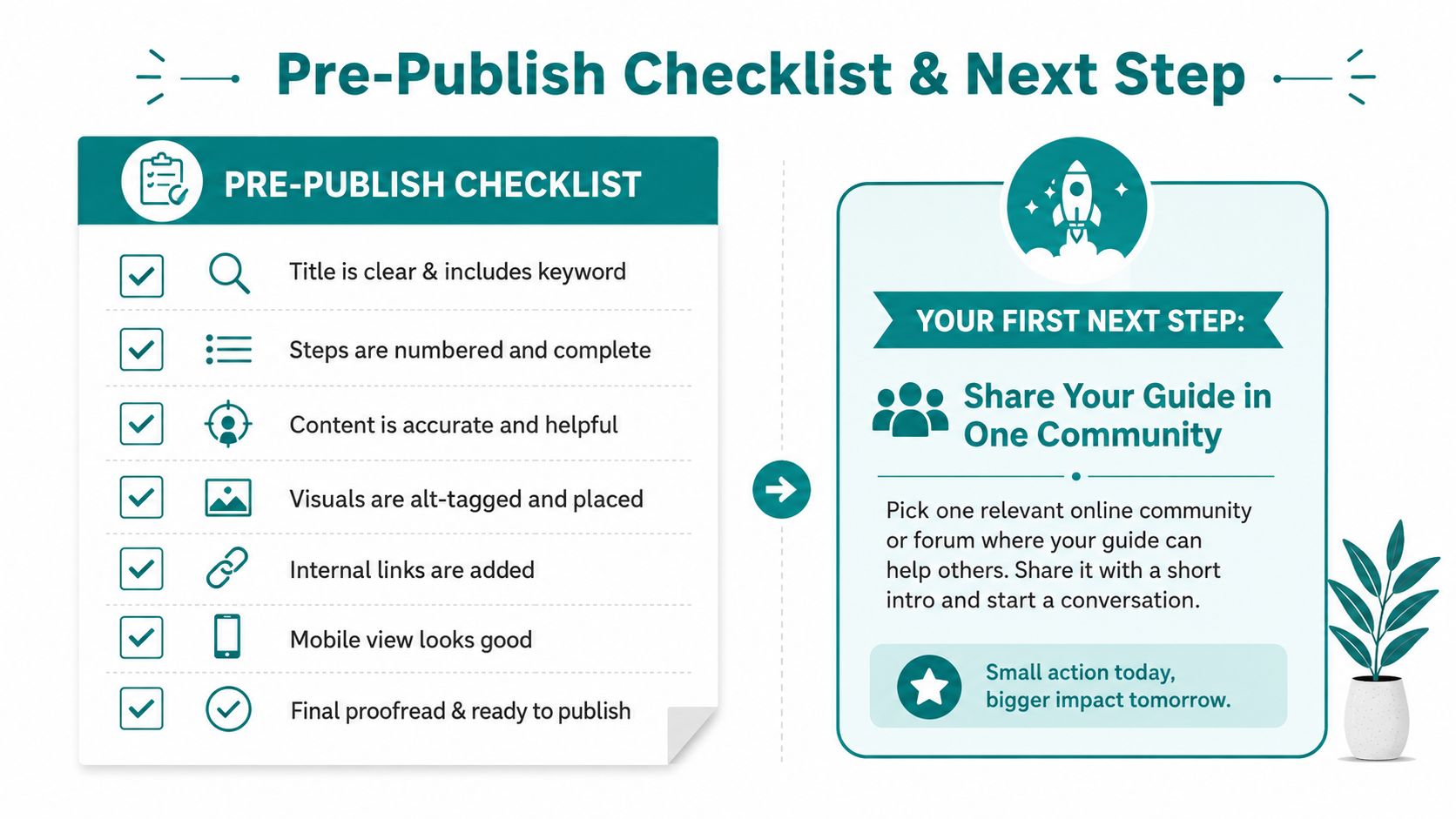
A calm final check
- Title clarity: Does the title tell the reader what problem the guide solves?
- Step flow: Can someone follow the order without jumping around?
- Next action: Is there one clear thing to do after the last step?
- Proofread aloud: Does the wording sound natural when spoken?
The first publish does not need to be perfect. It needs to be clear enough to help one person. That's enough to start building trust, and trust is what turns a first draft into a body of work.
If you want a simple first move, draft one guide this week and share it with one person you trust. Ask them where they slowed down, where they felt confident, and which step felt least clear. Then revise only what needs revision.
Victoria OHare offers beginner-friendly guidance for people who want to build sustainable income online without tech overwhelm. If you're ready for a calmer second chapter, visit Victoria OHare and look for the step-by-step support that fits where you are right now.