
If you're staring at business setup advice and feeling a little behind, you're not alone. A lot of people who want to make money online after 50 don't fear the work, they fear choosing wrong and making life harder than it needs to be. The good news is that the llc vs sole proprietor choice is simpler than it looks once you strip away the jargon.
What matters most is peace of mind. You do not need a law degree, and you do not need to “get everything perfect” before you begin. You just need a structure that fits where you are now, and where your business might go next.
| Feature | Sole Proprietorship | LLC |
|---|---|---|
| Legal status | You and the business are the same | The business is a separate legal entity |
| Liability | No legal separation | Can limit exposure to business debts and lawsuits |
| Setup | Usually no state filing | State filing is usually required |
| Cost | Typically $0 to start | Often $50 to $500+ in state fees |
| Tax treatment by default | Pass-through | Pass-through for a single-member LLC |
| Ownership | One owner only | One member or multiple members |
Why This Decision Feels Overwhelming and Why It Shouldn't
A lot of creators freeze here because the language sounds colder than the reality. “Articles of Organization,” “registered agent,” and “pass-through taxation” can make a simple decision feel like a legal exam, especially if you're already carrying the emotional weight of Retirement worries or a second-chapter business.
I remember how paralyzing that can feel. The first time I tried to sort out business structure language, I felt like every sentence came with a hidden trap, and I kept thinking I needed permission from someone smarter before I could move forward. What helped was realizing the choice wasn't about proving I knew everything. It was about choosing the simplest structure that protected my peace of mind.
That's why I like to keep this decision plain. A sole proprietorship is the automatic default when one person starts doing business. An LLC is a separate legal structure that adds a layer between you and the business. Neither choice means you've failed, and neither choice means you're late.
Practical rule: If the business is small, low-risk, and still being tested, simplicity has real value. If the business is starting to involve contracts, collaboration, or meaningful exposure, structure matters more.
If you build online, that matters fast. A creator business can start with content and grow into partnerships, affiliate offers, or joint projects before you expect it. That's why the decision deserves calm thinking, not panic.
The Core Difference Between LLC and Sole Proprietorship
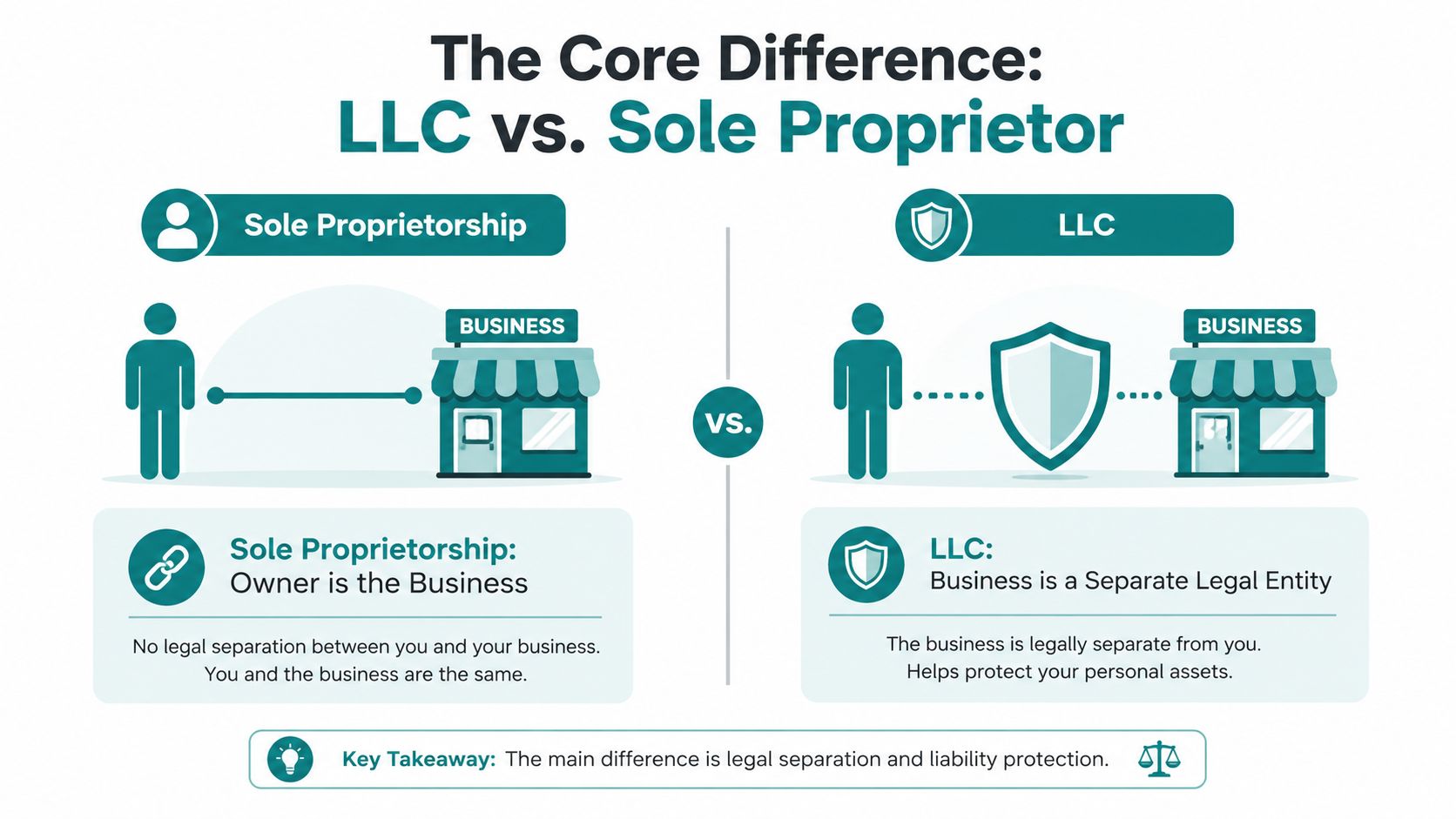
The heart of this choice is simple. A sole proprietorship has no legal separation between you and the business, while an LLC is a state-created legal entity that stands apart from you. That separation is why the same business activity can feel very different on paper.
Running as a sole proprietor is a bit like driving with no protective wall between your personal savings and what happens in the business. An LLC is closer to having a barrier in place, so business debts and lawsuits don't automatically land on your personal assets. That difference is exactly why people ask whether they should move from simple to protected as they grow.
Here's the other piece many beginners miss. A sole proprietorship is created automatically, so there's no formal setup in many cases. An LLC requires state formation, which means paperwork, state filing, and a little more admin. The tradeoff is clear, less friction now versus more separation and structure later.
Plain-English takeaway: If you want the easiest possible start, a sole proprietorship is the shortest path. If you want a stronger legal wall between your business and your personal life, an LLC is the better structure.
A helpful resource on the downside of going too simple is this piece on unlimited personal liability risks. It's a useful reminder that the “easy” option comes with a real tradeoff.
You may also find it useful to think about your content business through the lens of your creator business model, because structure becomes more important when your business isn't just a hobby anymore.
Real Costs You Need to Budget For
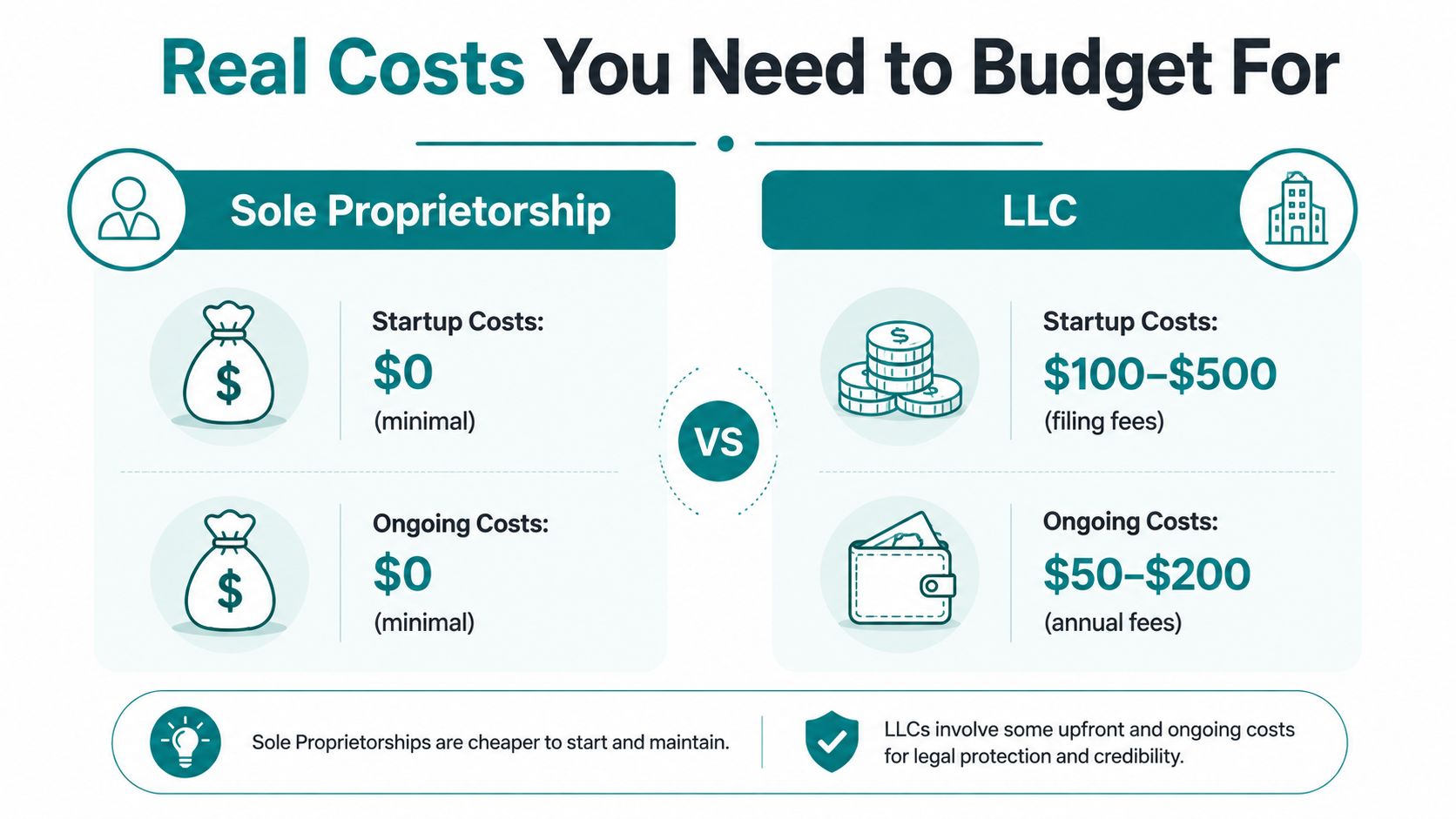
Money changes the tone of this decision fast, so let's keep it honest. A sole proprietorship usually has $0 startup cost beyond optional licenses or a DBA if you want to operate under a business name. An LLC, by contrast, usually means filing fees, and those state fees commonly range from $50 to $500, with first-year setup often around $300 to $1,000 and ongoing annual compliance costs often around $100 to $500 (InCorp's LLC vs. sole proprietorship guide).
That spread matters because it changes the question from “Which is better?” to “What am I paying for?” You're paying for formation paperwork, a registered agent, and continued compliance. You're also paying for a more formal legal structure, which is often worth it once the business is doing more than casual testing.
For a creator just trying to see if the model works, the no-cost path can be reasonable. For someone already signing contracts, handling sponsored work, or building something with real downside if something goes wrong, the LLC cost starts to look less like an expense and more like protection.
A solid budgeting mindset helps here. If you've already been reading about sba closing costs, you already know that business ownership comes with practical expenses that aren't always obvious at the start. Entity choice is part of that same reality.
The simplest rule is this. If you're still testing your idea and every dollar matters, starting as a sole proprietor can be smart. If the business is moving from experiment to real operation, the LLC fee is often the price of sleeping better at night.
You can also keep your early online plans organized by reviewing how to build an online business in a way that fits your budget and your pace.
How Taxes Work for Each Structure
For most solo creators, the tax difference is smaller than people expect. A single-member LLC and a sole proprietorship are both pass-through entities by default, so the business income flows onto your personal return. In practical terms, you usually file a Schedule C either way, and the structure you choose does not wipe out taxes or create a special break on its own.
That is the part that catches people off guard. An LLC is not a tax shortcut by itself. It is mainly a legal structure first, and a tax structure second. If you form an LLC, you may still be taxed like a sole proprietor unless you choose a different tax election later.
Important distinction: The LLC gives you structural flexibility, but it does not automatically change your tax bill.
There is one reason people sometimes choose an LLC anyway. An LLC can give you more tax flexibility, including the option in some cases to elect S corporation treatment (IRS S corporation election overview). That can matter once a business gets larger, but it is not the first move most new creators need to chase.
If you want to keep taxes simple, stay focused on clean records, separate banking, and knowing what you owe on your profits. A good place to start is understanding the standard deduction for small businesses, since that helps you see how your personal return fits into the bigger picture.
Keep the tax decision in perspective. For an online creator, the tax difference between these two structures is usually not the main reason to choose one over the other. Liability protection and future flexibility matter more, especially if you expect collaborators, shared ownership, or a business that may outgrow the solo setup.
The Hidden Factor Most Guides Miss
Most beginner guides act like you are choosing a structure for a business that will always stay solo. That is not how a lot of creator businesses grow. You may start alone, then bring in a spouse, a virtual assistant, a co-host, a collaborator, or a revenue-share partner.
That future matters. A sole proprietorship has one owner only, so it is not built for shared ownership. An LLC can have one member or multiple members, which makes it easier to define ownership, bring in another person, and sort out different contributions without rebuilding the whole business from scratch.
A key clue is ownership. The USC small business explainer makes that point plainly, because one-owner and multi-owner setups work differently in practice. That is the part beginner guides usually skip, and it is the part that saves a lot of future frustration. If you think your business might become collaborative, the LLC gives you room to grow with that change instead of fighting it.
That matters a lot for online entrepreneurs. A content business can move from “just me” to “me plus a partner” faster than you expect, and a simple structure can start to feel cramped. You can restructure later, but it is easier to set the right frame before the collaboration starts.
If your plan includes shared revenue, equity, or future partners, choose with that future in mind. You are not choosing for this month only.
Step-by-Step Formation Process for Each Option
If you want to keep this practical, start with the path that matches your current plan. A sole proprietorship is the faster route, and an LLC is the more formal one. Neither requires a lawyer for a straightforward setup, though it can be smart to get professional help if your situation is unusual or multi-owner.
For a sole proprietorship, the steps stay light:
- Choose your business name. Use your own name or a trade name that fits your brand.
- Register a DBA if needed. This matters if you want to operate under a different name.
- Get an EIN if you want one. It's not always required, but it can help with banking and organization.
- Open a separate business bank account. That simple move helps keep records cleaner.
For an LLC, the process has more moving parts:
- Choose the state of formation. The business will be registered.
- Appoint a registered agent. Someone has to receive official legal notices.
- File Articles of Organization. This is the core state filing.
- Create an operating agreement. Even single-member owners benefit from clear rules.
- Obtain an EIN. That lets you handle banking and tax paperwork.
- Set up business banking. Keep the business finances separate from day one.
A useful timeline check is simple. A sole proprietorship can begin immediately in many cases because there's no formal filing. An LLC usually takes a bit longer, often a few weeks, because state processing adds time (Xero's LLC vs. sole proprietor guide).
If you want a simple roadmap for getting started the right way, this step-by-step guide for women 50+ can help you keep the process grounded.
Making Your Decision with Confidence
Use this checklist and answer.
- Current income level? If you're still testing your idea and the business isn't yet carrying much weight, simplicity may be enough.
- Risk exposure? If you're signing contracts, dealing with clients, or creating work that could create legal or financial exposure, an LLC starts to make more sense.
- Future growth plans? If you may add partners, revenue-sharing collaborators, or a spouse, choose the structure that won't box you in.
- Comfort with admin? If you want the least paperwork possible, the sole proprietorship is easier to live with.
- Budget for setup? If the LLC fees fit your budget and buy you peace of mind, they can be money well spent.
Here's my clear opinion. Start as a sole proprietorship if you're testing the waters, have low risk, and want to move quickly with almost no setup friction. Choose an LLC from day one if you already know the business will involve contracts, collaboration, or a stronger need to protect your personal assets.
You can also start simple and convert later. That's not a failure, it's a normal business move. The key is to avoid staying too simple for too long once your business begins carrying real responsibility.
The next five years will pass either way. The only question is whether you'll use them to build something that gives you peace of mind.
If you want steady, beginner-friendly guidance for choosing a structure and building an online business with confidence, Victoria OHare offers clear next steps for women who don't want tech overwhelm or guesswork. Visit Victoria OHare and take the next calm step toward a business that fits your life.