

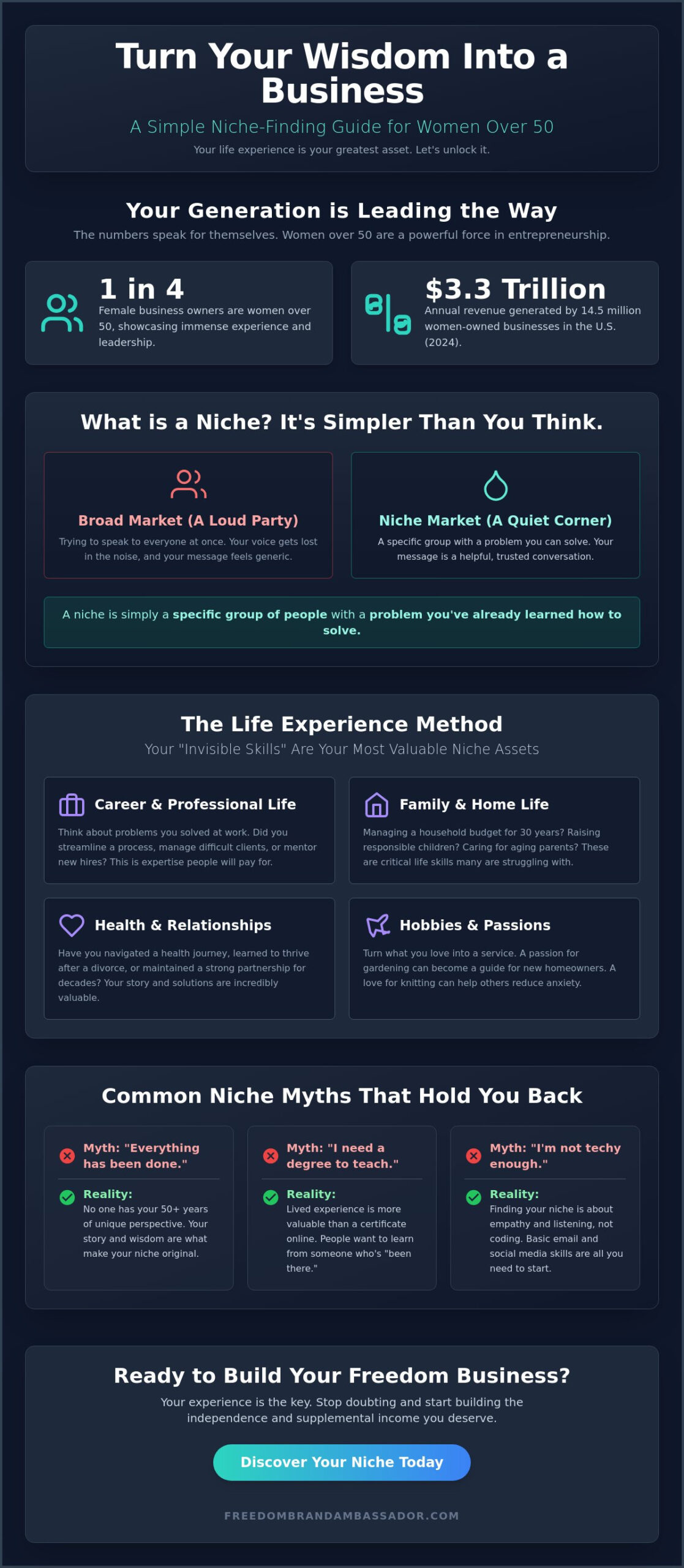
Did you know that as of November 2025, women over 50 account for one in four female business owners? With 14.5 million women-owned businesses generating 3.3 trillion dollars in revenue as of 2024, it’s clear that your generation is leading the way in entrepreneurship. Even so, it’s natural to feel a bit hesitant or worried about scams when you look at the technical side of the internet. If you’re feeling overwhelmed by how to find your niche market, please know that your life experience is actually your greatest business asset.
You don’t need to be a tech expert or risk your hard-earned savings to start. This guide provides a simple, step-by-step plan to help you turn what you already know into a helpful online presence. I’ll show you a realistic way to find a topic that people actually care about, so you can enjoy the independence and supplemental income you deserve in Retirement. We’ll start by looking at how your personal history can solve a specific problem for others today.
Key Takeaways
- Understand that a niche isn’t a complex mystery, it’s simply a specific group of people with a problem you’ve already learned how to solve.
- Discover how to find your niche market by looking at your “invisible skills” from decades of career, family, and life experience.
- Learn why focusing on high-value areas like Health or relationships is a more realistic path to supplemental income than just following a hobby.
- Follow a simple, scam-proof way to check if your idea will work by using basic search tools and listening to what people are asking for online.
- See how you can start helping others and building a simple list of people without needing to be a tech expert or building a complex website.
What is a Niche Market and Why Does It Matter for You?
Imagine you’re at a large party where everyone is shouting at once. It’s hard to have a meaningful conversation, right? That’s what the broad internet feels like. A niche market is like stepping into a quiet corner with one person who really needs your advice. To put it formally, What is a Niche Market? It’s a specific segment of a larger market where people share a common problem or interest. Understanding how to find your niche market starts with this simple shift in perspective.
Many people worry that “going small” will limit their income. In reality, it does the opposite. When you try to speak to everyone, you end up speaking to no one. By narrowing your focus, you become the go-to person for a specific group. This makes your marketing feel like a helpful conversation rather than a loud sales pitch. It’s also a much more realistic way to start. You don’t need a massive audience to create supplemental income; you just need a small, dedicated group that trusts your wisdom.
It’s important to distinguish between a hobby and a niche. A hobby is something you do for your own enjoyment, like knitting sweaters for your grandkids. A niche market is when you use that knitting skill to help others solve a problem, like teaching people how to knit weighted blankets to reduce anxiety. One is about you; the other is about them. Being over 50 gives you a massive advantage here because you’ve solved thousands of problems over the decades.
You might wonder if you’re qualified. Here’s a secret: you don’t need to be a world-class expert. You only need to be two steps ahead of the person you’re helping. If you’ve successfully managed a household budget for 30 years, you’re an expert to a 25-year-old who is struggling with debt. Your life experience is your credentials.
Common Niche Myths That Hold You Back
Many women feel they’ve missed the boat or aren’t qualified, but that’s simply not true. These myths often prevent talented women from sharing their gifts.
- Myth: “Everything has already been done.” Reality: No one has your 50+ years of unique perspective. There are 14.5 million women-owned businesses in the U.S. as of 2024, and each one is different because the owner is different.
- Myth: “I need a degree to teach something.” Reality: In the online world, lived experience is often more valuable than a certificate. People want to learn from someone who has actually “been there.”
- Myth: “I’m not techy enough.” Reality: Learning how to find your niche market is about psychology and empathy, not coding. If you can write an email or use Facebook, you have the technical skills needed to start.
The ‘Helper’ Mindset: The Secret to Legitimacy
The biggest fear for many is being seen as “scammy” or pushy. The best way to avoid this is to adopt a “helper” mindset. When your business is built on providing genuine solutions to real problems, you never have to worry about high-pressure sales tactics. A niche built on service is sustainable, dignified, and feels good at the end of the day. It allows you to build a legacy while helping others avoid the mistakes you’ve already made.
A niche is a helpful solution provided to a specific group of people who are looking for a way to overcome a particular challenge.
The Life Experience Method: Turning Your Wisdom into a Niche
You’ve spent more than five decades gathering knowledge that others are desperate to learn. In the online world, this is often called an “unfair advantage.” While younger entrepreneurs might have more energy for the latest social media trends, they lack the depth of lived experience that you carry. According to data from 2024, women started 49% of new businesses in the United States. A significant portion of this growth comes from women over 50 who are realizing that their “invisible skills” are actually valuable assets. Learning how to find your niche market is simply a matter of looking at the problems you’ve already solved during your 18,250 plus days of life.
Think about the “invisible skills” you use every day. If you raised a family while managing a career, you’ve mastered time management and negotiation. If you’ve navigated a Health journey or cared for an aging parent, you have specialized knowledge that can help others facing those same challenges. For example, if you’ve spent twenty years perfecting a budget-friendly garden, you aren’t just a hobbyist. You’re a guide for new homeowners who want a beautiful yard without spending thousands of dollars at a nursery. Your life is a library. People want to check out the books you’ve already written.
As you start to see these patterns in your own life, you might wonder how to organize them into a realistic business. A great first step is looking at simple ways to share your message with the right people. This isn’t about being “techy” or scammy; it’s about being helpful.
The ‘Three Pillars’ of Your Niche
To narrow down your ideas, look for the intersection of these three questions. First, what do friends and family always ask you for help with? This is usually a sign of a skill you take for granted. Second, what could you talk about for thirty minutes without any preparation? This shows your natural authority. Third, what significant hurdle have you overcome that others are currently struggling with? When you find a topic that fits all three, you’ve found a beginner-friendly path to how to find your niche market.
Real-Life Examples of Successful Mature Niches
These aren’t just theories; they’re realistic paths many women are taking today. One woman turned her love for family history into a service helping new grandmothers navigate digital photo sharing. Another used her experience with Retirement to help people organize and downsize their homes. These businesses provide dignity, independence, and supplemental income because they focus on helping people solve real, high-value problems.
Passion vs. Profit: Finding the ‘Sweet Spot’ Without the Hype
You’ve likely heard the advice to “follow your passion.” While it sounds lovely, it can be a dangerous path for someone looking for a realistic source of supplemental income. Passion is a great motor. However, it needs a road to drive on. A successful business happens where your interest meets a problem people are willing to pay to solve. When you’re researching how to find your niche market, it’s much safer to look for “High-Value” areas first.
Most successful online businesses fall into three big categories: Health, Wealth, and Relationships. These are high-value because they represent the things people care about most. For instance, helping someone manage their garden is great. Helping someone manage their garden specifically to grow their own healthy food after a Health scare is even better. By connecting your interest to one of these three pillars, you ensure there’s a real demand for what you have to offer. It moves your idea from a “nice to have” to a “need to have.”
How do you know if people are actually spending money? You can use a simple, tech-free method called the “Amazon Test.” Go to Amazon and search for your niche topic. If you see several books published within the last year, such as early 2026, and those books have dozens of recent reviews, you have proof of a market. People don’t just read about these topics; they invest in solutions. This is a scam-proof way to validate your idea before you spend a single penny or an hour of your time.
Scam-Proofing Your Niche Selection
It’s vital to stay alert as you explore these opportunities. If a niche sounds too good to be true, or if someone promises you can “get rich quick” without any effort, walk away. Legitimate Affiliate Marketing is simply about recommending products or services you truly trust to people who need them. You should never have to pay for “secret” niche lists or join schemes that guarantee specific income levels. Real business takes work and patience. Protecting your savings is just as important as growing them.
Balancing Interest and Demand
While profit is important, you don’t want your new venture to feel like a “grind.” The goal is to find a topic that keeps you engaged and proud. Try the “Kitchen Table” test. Could you sit across from a friend and explain your business idea with total confidence and dignity? If the answer is yes, you’re on the right track. Building a business you believe in makes it much easier to stay consistent. As you move forward, you can learn how to build trust in your personal brand to connect more deeply with your audience. Knowing how to find your niche market is the first step toward a lifestyle of independence and purpose.
3 Practical Steps to Validate Your Niche Idea Today
Once you have a few ideas based on your life experience, you need to make sure they’re viable. You don’t want to spend your precious time on a topic that doesn’t resonate with others. Validation is simply a realistic way to check if your “helpful solution” has an audience. It’s about finding proof before you commit. This part of how to find your niche market is beginner-friendly and requires zero technical skill.
Remember that you’re looking for real progress, not perfection. You don’t need a 50-page business plan or a complex spreadsheet. You just need to know that people are asking the questions you can answer. Between 2019 and 2024, the number of women-owned firms grew 44% faster than men-owned firms. This success comes from focusing on what works, which is exactly why learning how to find your niche market through validation is so important.
Step 1: Simple Online Research
Start with the tools you already use every day. Go to the Google search bar and type in your niche idea. Don’t press enter yet. Look at the suggestions that drop down. These are the most common searches people are making right now. Once you do search, scroll down to the “People Also Ask” section. This is a goldmine of real questions from real people. You don’t need expensive keyword tools that cost hundreds of dollars a month to get these insights.
- Look for questions that start with “How to” or “Why does.”
- Check YouTube comments for common complaints or requests.
- See if there are books on the topic with recent reviews from early 2026.
A burning question is an urgent problem that your audience is actively and repeatedly searching for a solution to solve.
Step 2 & 3: Connecting with Real People
Next, find where your potential audience hangs out. Facebook groups are a great place to start. Look for groups related to your topic and join a few. Don’t post any links or try to sell anything. Just read the posts. What are people struggling with today? You can even ask a simple, honest question like, “If you could solve one problem with [your topic], what would it be?” This is about listening and gathering “scam-proof” evidence that your idea is needed.
The final step is the “One-Person Test.” Find one person in your life who fits your niche description. Perhaps it’s a friend or a former colleague. Tell them your idea and ask for their honest feedback. If they say, “I wish I had that years ago,” you’ve found your winner. This stage is about listening, not selling. Once you have this validation, the next step is to start building your simple list of people to help. This keeps the process clear and manageable.
Building Your Freedom Business with Your New Niche
Now that you’ve identified your unique path, the focus shifts to connection. Building a business is really about gathering a simple list of people who value your perspective. If you’ve followed the steps on how to find your niche market, you already have the foundation. You don’t need a complex website with dozens of pages to begin; you just need a way to say “hello” to those who need your help.
Embrace the “Next Step” mindset to avoid feeling overwhelmed. Instead of worrying about a five-year plan, simply focus on the very next task in front of you. You aren’t behind in this digital world; you’re building a legacy using the wisdom you’ve gathered over the decades. Every successful entrepreneur started by helping one person solve one specific problem.
Tools to Help You Get Started Simply
An affiliate link is a simple tool that allows you to earn supplemental income by recommending products you already trust. When someone makes a purchase through your link, the company pays you a small commission for the referral. It’s a transparent and honest way to grow. To see this in action, you can see how a simple system can help you start right away. You can also explore Victoria OHare’s beginner-friendly resources for more practical guidance.
Your Invitation to the Journey
This is your invitation to join a community of women who are choosing a lifestyle of purpose and clarity. The Freedom Brand approach is about maintaining your dignity while building a realistic future. You have the skills and the life experience to succeed. Your journey into how to find your niche market was the first step toward a future of your own making.
Simple steps. Real progress. , Freedom Brand
Take Your First Step Toward Independence
You now have a realistic map for your new journey. We’ve explored how your decades of wisdom are the foundation of a helpful business. You’ve learned that how to find your niche market isn’t about chasing technical trends. Instead, it’s about matching your unique skills to the high-value problems others are facing today. With 14.5 million women-owned businesses already thriving in the U.S. as of 2024, you’re joining a powerful and successful community.
Starting doesn’t have to be complicated or scary. You can build a realistic path to supplemental income by following simple, beginner-friendly steps. There’s no need for technical jargon or expensive software. If you’re ready to turn your life experience into a helpful resource for others, we have a tool to help you stay organized and confident.
Ready to begin? Download our Simple Niche Discovery Checklist for step-by-step guidance designed specifically for you. You have everything you need to start helping people today. It’s time to live life on your own terms.
You’re not behind. You’re building. , Freedom Brand
Frequently Asked Questions
Is it too late for me to find a niche and start an online business at 60?
It is absolutely not too late. In fact, women over 50 are the fastest growing group of entrepreneurs today. Your life experience gives you a perspective that younger people simply don’t have. You’ve spent decades solving problems, and those solutions are exactly what a niche market needs. You’re not starting over; you’re starting from a place of deep experience and wisdom.
Do I need to be a computer expert to do market research?
You don’t need to be a tech expert to research your market. If you can type a question into a search bar or browse a Facebook group, you have all the skills required. Most research is just “listening” to what people are already saying online. You’re looking for patterns in human behavior, not writing code or managing complex databases. It’s a simple process of observation.
How do I know if my niche idea is a scam or a real opportunity?
A real opportunity focuses on providing value and helping people solve specific problems. If a program promises you’ll get rich quick with no effort, it’s a red flag. Legitimate Affiliate Marketing is based on trust and honest recommendations. Always look for transparency and avoid anyone who asks for secret fees to unlock guaranteed income. Real businesses are built on service, not shortcuts.
What if I pick the ‘wrong’ niche; can I change it later?
You can absolutely pivot or change your direction later. Many successful business owners start in one area and refine their focus as they learn more about their audience. Think of your first niche as a starting point rather than a permanent destination. The skills you learn about how to find your niche market will stay with you, no matter what topic you eventually choose to focus on.
Do I have to show my face on camera to have a successful niche?
No, you don’t have to be on camera if you’re not comfortable with it. While video is popular, many women build successful businesses through writing, email newsletters, or helpful guides. Your voice and your wisdom are what matter most to your audience. You can share your message in a way that feels dignified and comfortable for you, whether that’s through text, images, or audio.
How much money does it cost to start testing a niche idea?
Testing a niche idea can cost almost nothing. Most of the validation steps, like searching Google or joining forums, are completely free. You don’t need to buy a website or run expensive ads just to see if people are interested in your topic. This low-risk approach allows you to explore how to find your niche market without putting your hard-earned Retirement savings at any risk.
Can I find a niche even if I don’t think I have any ‘special’ talents?
Yes, because what feels ordinary to you is often a special talent to someone else. Skills like organizing a pantry, managing a household budget, or caring for a specific type of pet are highly sought after. You don’t need to be a scientist or a world-class athlete. You just need to be a few steps ahead of the person you’re helping and willing to share your path.
What is the difference between a niche and a target audience?
A niche is the specific problem you solve, while a target audience is the specific group of people you solve it for. For example, “natural skincare for women over 50” is a niche. The “women over 50” part is the audience, and the “natural skincare” is the niche topic. Understanding this distinction helps you create a clear and helpful path for your new business journey.