
If you're over 50 and wondering whether it's too late to build income online, you're not alone. A lot of women carry a quiet worry about Retirement, rising costs, and the feeling that everyone else learned technology sooner. That doesn't mean you've failed. It usually means life happened, responsibilities came first, and now you're trying to make wise decisions with the time you have.
I remember how disorienting it felt the first time I tried to make sense of online business tools. One dashboard led to another. New terms popped up everywhere. For a moment, I thought maybe this world was only for younger people who grew up online.
It isn't.
You can learn this slowly, clearly, and without becoming a tech expert overnight. One of the simplest places to begin is understanding Affiliate Marketing platforms, because they sit at the center of how many beginners start building income from content, recommendations, and trust.
It's Not Too Late to Build Financial Peace
There may be a part of you thinking, "I should have started years ago." That's such a common thought, especially when you're looking at Retirement with more questions than certainty. You may be working hard, doing your best, and still feeling like peace of mind keeps moving farther away.
That feeling deserves compassion, not shame.
Many women in midlife are carrying a full history behind that worry. Raising children. Caring for parents. Recovering from divorce, job loss, Health changes, or years of putting everyone else first. When you finally turn toward your own future, it's easy to feel behind.

A second chapter can start quietly
Building income online doesn't have to begin with a huge audience, a perfect brand, or complicated systems. It can begin with something much smaller. A simple email list. A blog. A Facebook group. A habit of sharing helpful things you've already learned.
That matters because income online often grows from trust, not speed.
You don't need to "catch up" to everyone. You only need to take the next clear step.
When I first started learning this world, I wasn't bold or polished. I was cautious. I read the same page twice. I clicked carefully because I didn't want to break anything. If that's you, you're in good company.
What peace of mind really looks like
For many women, the goal isn't flashy success. It's calmer than that.
- More breathing room when bills arrive
- More dignity in later life
- More independence if circumstances change
- More control over how you spend your time
Affiliate marketing can be one path toward that kind of second chapter. Not because it's magic, and not because it's instant, but because it gives ordinary people a way to turn recommendations, content, and relationships into a business asset over time.
If you're willing to learn patiently, this isn't closed to you. It's still available.
Why an Online Asset Matters More Than Ever
A paycheck helps in the moment. An asset keeps working beyond the moment.
That's one reason so many people in midlife are looking at online business differently now. They're not just asking, "How can I make a little extra money?" They're asking, "What can I build that belongs to me?"
Income is good. Ownership is better.
An online asset can be a blog, an email list, a small website, or a community you've built around a topic people care about. Unlike a job, it's something you can keep improving. Unlike social media alone, it's not entirely borrowed land.
If you're still exploring different directions, this list of LeadBlaze business ideas for agencies can help you think more broadly about where online opportunity exists. Even if you don't want to start an agency, it can spark ideas about problems people are willing to pay to solve.
For beginners, one of the most practical assets to build is an audience you own. That's why learning how to build an audience online for your next chapter matters so much. The audience often comes before the income.
This is part of a real economy
Affiliate marketing isn't a fringe corner of the internet. Recent industry estimates place global Affiliate Marketing at about $17 billion in 2025, with forecasts reaching $38.35 billion by 2030, and in the United States alone, spending is projected to cross nearly $12 billion in 2025, according to Electro IQ's Affiliate Marketing statistics.
That matters because it shows businesses aren't treating this as a hobby channel. Merchants, creators, and publishers use affiliate systems to manage a meaningful and growing part of online commerce.
Practical rule: If a business model keeps attracting serious companies, tracking tools, and budget, it's worth understanding carefully instead of dismissing it as a fad.
Why this matters for women over 50
You don't need a giant reinvention. You need a steady way to create value and keep some control.
An online asset can help you do that because:
- It can grow gradually as you learn
- It isn't limited to local geography if you're at home more
- It rewards consistency more than hype
- It can support peace of mind before and during Retirement
That's a very different picture from chasing one more paycheck. It's about building something with roots.
What Is Affiliate Marketing Really
At its simplest, affiliate marketing means recommending a product or service and earning a commission if someone buys through your link.
That's it.
If you've ever told a friend about a book you loved, a skin care product that worked for you, or a software tool that saved you time, then you already understand the basic behavior. Affiliate Marketing turns that everyday recommendation into a tracked business arrangement.
A simple example
Let's say you write emails for women who want to get organized online. You use an email tool, a course platform, or a planner you like. The company gives you a special link. When a reader clicks that link and makes a qualifying purchase, the platform records it and pays you based on that program's rules.
You're not getting paid for random posting. You're getting paid for a recommendation that leads to a result.
Is it a scam
It's wise to ask that question. The internet has plenty of noise, and some people present Affiliate Marketing in ways that sound unrealistic or pushy.
The model itself is legitimate. Affiliate Marketing is a mainstream business strategy, with roughly 81% of brands using affiliate programs to improve performance. For many businesses, it's also a meaningful channel, with 65% of retailers saying affiliates contribute up to 20% of their annual revenue, according to Rewardful's Affiliate Marketing statistics.
That doesn't mean every program is worth joining. It means the business model is real.
Being cautious is healthy. Good Affiliate Marketing is built on trust, clear disclosure, and products you'd feel comfortable recommending to someone you know.
What beginners often misunderstand
Many people think Affiliate Marketing is about posting links everywhere and hoping one works. That's usually where frustration begins.
A healthier way to see it is this:
- You help first by solving a small problem
- You recommend second when a tool fits that need
- You earn as a result of that helpful connection
That approach is slower than hype, but it's stronger. It also fits midlife creators especially well, because trust tends to be one of your biggest strengths.
Understanding How Affiliate Marketing Platforms Work
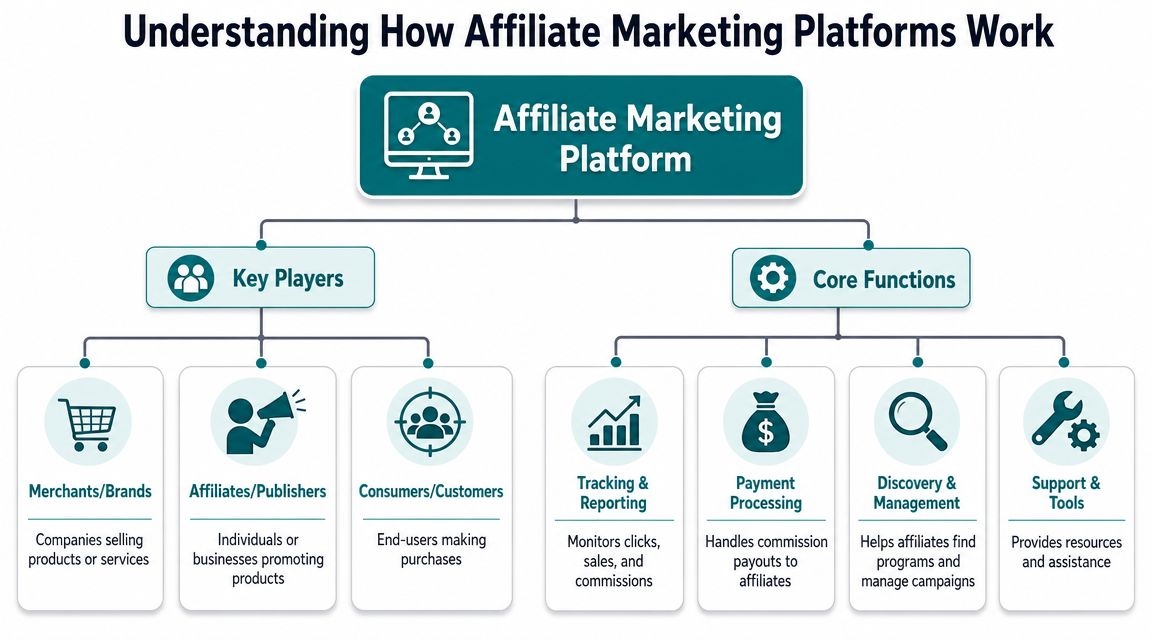
An affiliate link doesn't manage itself. Someone has to track the click, credit the sale, calculate the commission, and send the payment. That's the job of Affiliate Marketing platforms.
They act like the middle layer between the business selling something and the person promoting it.
 Affiliate Marketing platform." />
The simple job of a platform
Think of a platform as the record-keeper.
When you join a program, the platform usually gives you a dashboard, your unique tracking links, and a place to see clicks, sales, and payments. Behind the scenes, it helps make sure the merchant knows which affiliate referred the customer.
That may sound technical, but the practical meaning is simple. If tracking is weak, you can lose credit for sales. If reporting is confusing, you won't know what's working. If payouts are messy, your business becomes harder to trust.
The three common setup styles
Not every affiliate arrangement looks the same. Most beginners run into these types first:
Large affiliate networks
These are platforms that host many brands in one place. You create one account, then apply to individual merchants inside that system. This can be convenient if you want options and one central dashboard.In-house affiliate programs
Some companies run their own program directly. You apply on that company's site and manage everything inside its own portal. This can feel simpler when you only want to promote a few specific tools.Creator-focused marketplaces
These often lean toward digital products, software, courses, or subscription tools. They can work well if your audience is small but trust-based, because one well-matched recommendation can matter more than broad product variety.
If you'd like a wider beginner overview of business models and styles, this guide to 8 types of Affiliate Marketing can help place platforms in context.
How commissions actually work
Before you join a platform, look at how it pays.
Platforms offer different ways to earn, like pay-per-sale or recurring commissions for subscriptions. They also manage the cookie window, which is the time after someone clicks your link that you can still earn a commission. A longer cookie window gives you a better chance to be credited for the sale, which makes it a critical feature to check, as explained in Adobe's Affiliate Marketing guide.
A few plain-English examples help:
- Pay-per-sale means you earn when someone buys
- Pay-per-lead means you earn when someone completes a qualifying action, such as signing up
- Recurring commission means you may keep earning as long as the customer stays subscribed, depending on the program
- Cookie window affects how long your referral can still be recognized after the first click
A good platform doesn't just hand you a link. It gives you enough visibility to understand what happened after the click.
Here's a short walkthrough if you learn better by watching than reading.
What matters most for a small audience
If your traffic is modest, details matter more.
A small creator usually needs:
- Clear reporting so every click counts
- Fair payout terms so earnings don't feel out of reach
- Flexible links so you can match products to your content naturally
- Reliable support when you're confused or stuck
You don't need the most complicated platform. You need one you can understand and use consistently.
How to Choose Your First Platform Without Overwhelm
Most beginners don't need more options. They need a calm filter.
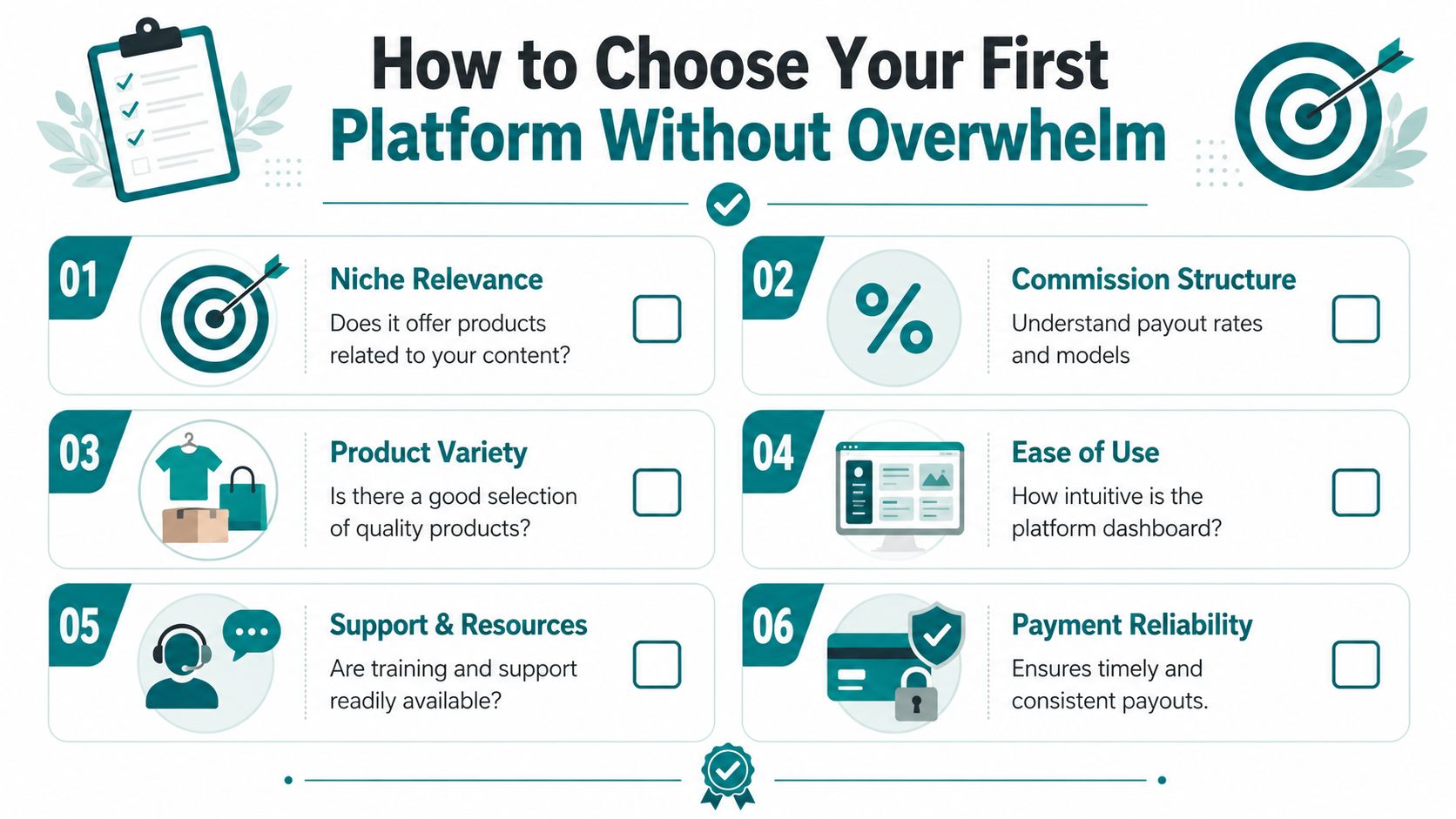
When you're looking at Affiliate Marketing platforms, try not to ask, "Which one is biggest?" A better question is, "Which one fits how I plan to build?"
Four questions that simplify the decision
Do I trust the products enough to talk about them naturally
If you have to force the recommendation, your audience will feel that. Start with products that solve a problem your readers already have.Can I understand the dashboard without feeling lost
Some platforms are clean and beginner-friendly. Others feel built for experienced media buyers. A simple dashboard is not a small detail. It's part of whether you'll keep using it.What do I need to earn before I can get paid
Payout threshold matters a lot when your audience is small. If it takes too long to receive earnings, it can feel discouraging even when you're doing the right things.Does this platform support the way I want to share links
Some creators write blog posts. Others use email newsletters, resource pages, or private communities. Make sure the platform fits your actual publishing style.
Why List Building changes everything
A lot of beginners go straight from a post to an affiliate link. That can work in some situations, especially if the offer page is already strong.
But for newer affiliates, a landing-page-first model can outperform direct linking over time. Creating a simple page to capture an email before sending someone to a product helps you build your own audience, which is a more sustainable asset than relying on one-time clicks, as noted in this video guidance on landing-page-first affiliate strategy.
That point is easy to miss, but it's one of the most important shifts you can make.
If someone clicks and disappears, you had a moment. If someone joins your list, you built an asset.
A gentle beginner checklist
Use this when comparing your first few options:
- Product fit: Does it match your niche, experience, or lived knowledge?
- Payout comfort: Is the threshold realistic for a beginner with modest traffic?
- Link flexibility: Can you use blog links, email links, and simple resource pages?
- Reporting clarity: Can you easily see clicks, conversions, and earnings?
- Support quality: Is there help available when you're unsure what to do next?
If you want a practical look at the systems that support this process, this roundup of affiliate marketing tools for beginners can help you think beyond the platform itself.
Keep your first choice small and reversible
Your first platform doesn't need to be your forever platform.
Choose one that lets you learn the rhythm of linking, tracking, and recommending without pressure. Once you understand the process, you'll make better decisions because you'll be choosing from experience rather than confusion.
Three Thoughtful Platform Examples for New Creators
A long list of affiliate platforms often creates more stress than clarity. It's easier to compare a few clear types and ask which one matches the business you're building.
One useful principle is this: the best platform for you is often not the one with the biggest brand names, but the one with low payout thresholds, strong reporting, and flexible link options so you can monetize a modest list without needing huge traffic volumes, as explained by Business of Apps in its overview of affiliate networks.
Beginner-friendly platform comparison
| Platform | Best For | Payout Threshold | Key Benefit |
|---|---|---|---|
| Amazon Associates | Bloggers and content creators recommending everyday physical products | Varies by program terms | Familiar products many readers already recognize |
| Rewardful | Creators promoting software or subscription-based tools | Depends on the merchant using the system | Often aligns well with recurring commission models for software |
| Victoria OHare all-in-one marketing platform offer | New creators who also want to explore List Building and marketing tools in one place | Check current offer terms directly on the site | Combines platform access with educational content for building an owned audience |
Example one with broad product familiarity
Amazon Associates is often where beginners start when they write about home, books, hobbies, beauty, kitchen tools, or practical products people already buy.
Its strength is familiarity. If you share content with a cautious audience, well-known products can feel easier to recommend because your readers already understand what they're clicking on. The challenge is that broad catalogs can tempt beginners to promote too many unrelated items.
This works best when your content has a clear theme, not when your links are scattered.
Example two with digital and subscription potential
Rewardful is a helpful example of the kind of platform newer creators may consider when they talk about digital tools or software. If your audience needs email tools, course platforms, membership software, or other subscription products, this category can make sense because digital offers often fit educational content well.
This can be especially useful if you teach rather than entertain. A midlife creator with a small newsletter may do better recommending one relevant software tool thoughtfully than posting many random links.
If social content is part of your promotion plan, this guide to PostOnce blog on social media solutions may help you think through how to stay consistent without making your business feel chaotic.
Example three with business-building alignment
A third option is choosing a platform connected to the kind of business you're learning to build. For some beginners, that means looking at an all-in-one tool environment rather than only a classic retail marketplace.
The Victoria OHare site includes content around Affiliate Marketing, List Building, and an all-in-one marketing platform offer, which makes it relevant for readers who want to understand both promotion and audience ownership in the same learning path. That won't fit everyone, and that's okay. It may fit someone who wants tools and education to live closer together.
How to think instead of what to copy
Rather than asking which platform is "best" in general, ask:
- Do my readers need physical products or digital solutions
- Will I be sharing through blog posts, email, or both
- Do I want quick simplicity or long-term audience building
- Can I explain why I recommend this product in one honest paragraph
Those questions usually lead to a wiser first decision than chasing the biggest marketplace.
Your Next Five Years and the Power of Starting Today
The next five years will pass whether you start or not. That's what makes a small beginning so powerful.
You don't need to become a different person. You don't need to master every tool this month. You only need to begin building something that gives you a little more control, a little more security, and a little more peace of mind.
If you're cautious, that's fine. If you're learning slowly, that's fine too. Slow and steady is still movement.
Choose one platform. Learn how the links work. Write one helpful email or one honest blog post. Let your first goal be understanding, not perfection. That is how confidence grows.
You're not behind. You're in your next chapter.
If you'd like gentle, step-by-step help as you learn, you can visit Victoria OHare and explore the beginner-friendly training and resources there. Take what helps, move at your own pace, and remember that starting small still counts.