
If you're over 50 and wondering whether it is too late to build income online, you're not alone. Many women feel behind financially, not because they failed, but because life happened.
Maybe Retirement feels closer than it used to. Maybe prices keep rising while your savings do not feel as steady as you hoped. Maybe the online world looks crowded, fast, and full of language that seems made for younger people.
That feeling can make you freeze.
The good news is simple. You are not behind. You do not need to become a tech expert overnight. You only need a clear, safe first step and a way to build something that belongs to you.
Is It Too Late to Build an Income Online?
I remember the first time I sat with a laptop and a notepad, trying to understand online income. I did not feel excited. I felt cautious.
There was a quiet fear underneath it all. Not fear of work, but fear of wasting time, making a mistake, or falling for something that sounded easy and turned out to be nonsense.
That feeling is common, especially when you are thinking about Retirement, part-time income, or what your next chapter might look like.

The fear is real, and it makes sense
If you have ever thought:
- I am too old for this
- I do not understand all this marketing talk
- I do not want to get scammed
- I just want something honest and manageable
You are thinking like a careful adult. That is not weakness. That is wisdom.
A lot of people online speak in extremes. They promise fast money, easy systems, or instant freedom. That style can make sensible people want to step back, and that is probably a healthy reaction.
What many women over 50 want is not hype. They want peace of mind, dignity, and a way to create a little more control over their future.
Why extra income matters now
For many households, Retirement does not feel as predictable as it once did.
You may still work. You may help family. You may want a cushion, not a fortune. You may want to know that if an unexpected bill shows up, you have another stream of income that is yours.
That is why learning how to build something online can matter.
Not because you need to become a full-time marketer.
Because building even a small online asset can give you more stability than depending on only one source of money.
Wanting extra income is not greed. It is a practical response to uncertainty.
Starting later can help you
You may feel late. In some ways, you may be better prepared than someone younger.
Life experience helps you spot nonsense faster. Patience helps you stay steady. Real-world judgment helps you ask better questions. Those are valuable skills in online business.
Affiliate marketing is one example of this. In plain language, it means recommending a product or service and earning a commission if someone buys through your link.
That can sound intimidating at first, but the heart of it is simple. You help someone solve a problem. If they choose to buy, you earn from the referral.
The important part is how you do it.
There is a big difference between chasing random traffic and building a real audience. There is a big difference between trying to force a sale and creating trust over time.
That is where low cost solo ads can fit in, if used carefully and ethically.
A steadier way to think about online income
Instead of asking, “Can I make money fast?”
A better question is, “Can I build something small, honest, and useful that grows over time?”
That shift changes everything.
It takes the pressure off.
It lowers risk.
It gives you room to learn.
And it moves your focus from panic to ownership.
You do not need to know everything today. You only need to understand the next piece clearly.
A Simple Path to Owning Your Audience
Affiliate marketing sounds more complicated than it is. At its core, it is a lot like recommending a book, kitchen tool, or course to a friend. If they buy through your recommendation, the company pays you a commission.
That part is straightforward. The part many beginners miss is this. The primary asset is not the link. It is the relationship.
When people talk about building income online, they often jump straight to social media. That can be useful, but social platforms are borrowed land. Rules change. Reach changes. Accounts can stall.
An email list is different.
When someone joins your list, you have a direct line to a person who asked to hear from you. That is why many experienced marketers treat an email list like a long-term asset, not a side detail.
Why ownership matters
If you build only on social media, you are building in someone else's space.
If you build an email list, you are creating something you can return to again and again. You can write to your subscribers, help them, and recommend products that fit their needs.
This is especially important for beginners who want a calmer, more dependable path.
There is also a real gap in the online advice aimed at midlife women. Many beginner guides skip the practical first steps, and 68% of beginners drop out due to list-building hurdles, according to seller feedback on WarriorPlus discussed in this YouTube source about beginner list-building challenges: ethical, beginner-friendly list-building strategies for midlife women.
That matters because it explains why so many good people give up early. Not because they are incapable, but because nobody slowed down enough to explain it clearly.
I understand being cautious. There are many confusing and misleading things online. That’s why we focus on simple, proven, and ethical strategies.
If tech scares you, start smaller
A lot of women worry that online business requires coding, funnels, dashboards, and a thousand moving parts.
It can become complex later if you want it to. It does not have to start that way.
If you can:
- Write an email
- Use a simple webpage builder
- Follow a checklist
- Learn by repeating small tasks
You can begin.
The first time many people log into an email platform or landing page builder, they feel clumsy. That is normal. Most skills feel awkward before they feel familiar.
Is this legitimate or is it a scam
That question deserves a direct answer.
Affiliate marketing itself is a legitimate business model. Scams happen when people use pressure, false promises, fake urgency, or poor products.
A healthy approach looks different:
| Unsafe approach | Ethical approach |
|---|---|
| Pushes people to buy immediately | Builds trust before making offers |
| Sends traffic straight to a sales page | Invites people onto an email list first |
| Promotes anything with a commission | Recommends only relevant, useful products |
| Hides risk | Explains expectations clearly |
That distinction matters with low cost solo ads too.
Solo ads are not magic. They are a traffic source. Like any traffic source, they can be used carelessly or responsibly. The safest way to use them is not to chase instant sales, but to add subscribers to your list so you can help them over time.
Your age is not the problem
Some women believe they missed the window.
They did not.
In fact, if your audience includes people like you, your age can become an advantage. You understand real concerns. You know what empty promises sound like. You know how to speak with warmth instead of pressure.
That kind of communication builds trust faster than flashy language ever will.
Owning your audience starts with that mindset. You are not trying to impress strangers. You are building a small community of people who want help, honesty, and guidance.
What Are Solo Ads and How Do They Work?
A solo ad is easier to understand than the name suggests.
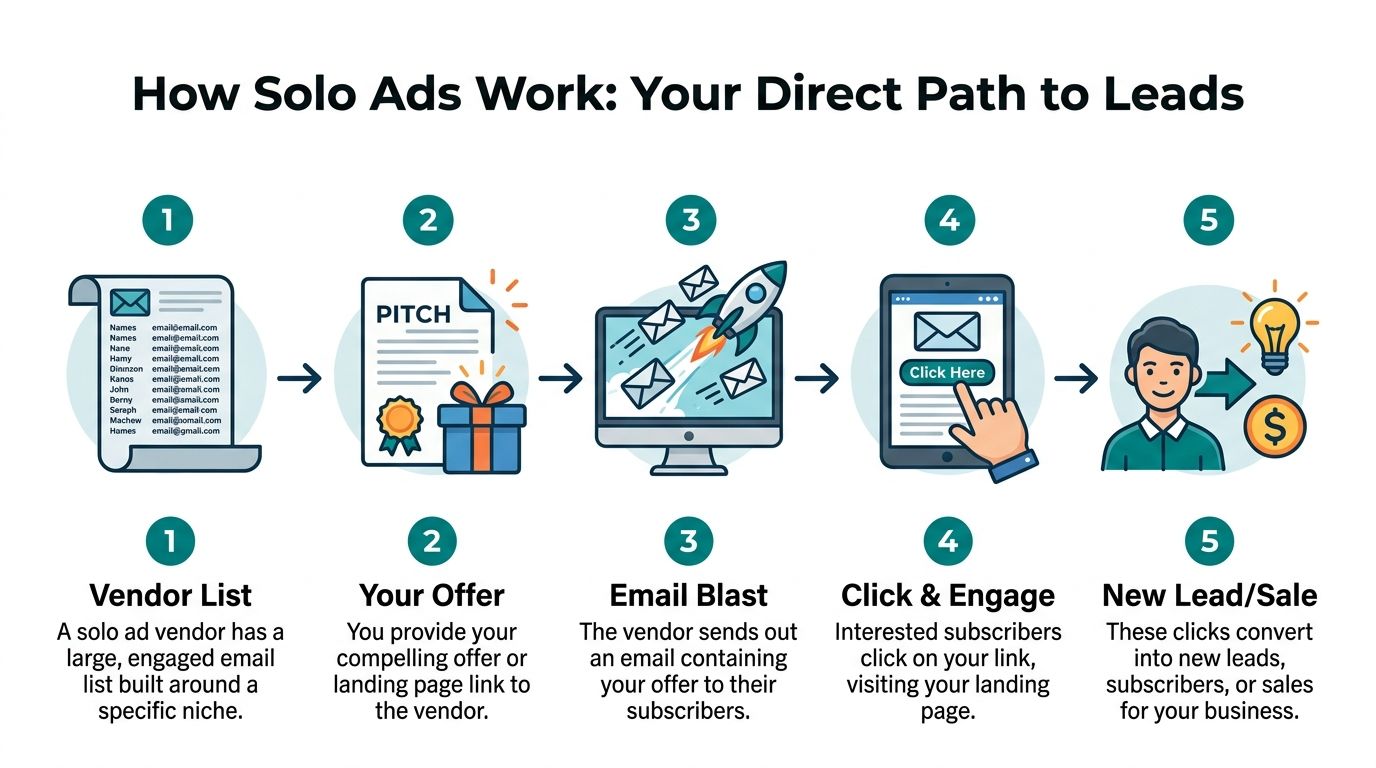
Consider it similar to paying to place your note inside someone else's trusted newsletter. The owner of that email list sends an email to their subscribers. That email includes your link. Interested people click, visit your page, and decide whether to join your list.
That is the whole idea.
The basic words in plain English
A few terms appear often with low cost solo ads. Here they are in simple language:
- Click means someone visited your page.
- Squeeze page means a simple page that asks for an email address.
- Opt-in means the visitor gave you their email.
- CPC means cost per click, or what you pay for each visitor.
Once you know those four terms, most of the confusion starts to lift.
A solo ad does not mean you are buying customers. You are buying a chance to put your page in front of a relevant audience.
What a beginner-friendly setup looks like
The safest setup is simple.
You create a small page offering something useful. This is often called a lead magnet. It could be a checklist, guide, short training, or helpful resource.
The solo ad seller sends traffic to that page.
Some of those visitors join your email list.
Later, you email them with value, stories, and relevant recommendations.
That approach matters because solo ads work better when used for List Building than for instant selling.
According to GetResponse’s guide to solo ads, solo ads can be a beginner-friendly way to build an email list, with an average cost per click between $0.30 and $0.90. The same source notes that a strong small campaign might see a 40% opt-in rate on a squeeze page and a 1% to 5% conversion rate on an initial offer.
Those numbers are not guarantees. They are useful benchmarks.
Why the cheapest traffic is not always the safest
Many beginners get tripped up at this stage.
“Low cost” sounds like “buy the cheapest clicks you can find.” That is usually the wrong move.
Cheap traffic can be untargeted. It can come from tired lists, low-quality lists, or people who were never a good fit for your offer in the first place.
A better way to think about low cost solo ads is this:
- Affordable enough to test
- Targeted enough to be useful
- Reliable enough to learn from
That last point is important. If the traffic is poor, you do not learn much. You just end up confused.
A good beginner campaign should buy clarity, not just clicks.
The flow from stranger to subscriber
Here is the process in a simple sequence:
- You choose a seller with an audience related to your niche.
- You give them your link, usually to a squeeze page.
- They email their list with your offer.
- Subscribers click and land on your page.
- Some opt in and become part of your list.
- You follow up by email and build trust over time.
That is why low cost solo ads can be useful for someone who wants to grow an owned audience without relying only on social media.
The heart of it is not speed. It is structure.
When you understand the flow, the process feels less mysterious. And when something feels less mysterious, it feels much safer to try.
How to Find Trustworthy Sellers Without Overspending
Finding a solo ad seller is not the hard part. Finding one you can trust is where much of the essential work happens.
That is good news, because careful buyers usually do better than impulsive ones.

A lot of beginners assume they need to become experts overnight. You do not. You need a short checklist, a few calm questions, and the willingness to walk away if something feels off.
Start with safety, not price
One of the biggest mistakes with low cost solo ads is chasing the lowest number instead of the safest fit.
According to SoloAdsHub’s discussion of traffic quality and vetting, ultra-low-cost providers around $0.04 per click often come with high bot traffic, while vetted sellers in the $0.40 to $1.00 per click range with positive ratings on platforms like WarriorPlus and lists older than 6 months are often much safer for beginners. The same source points to sellers with over 4.5 stars as a more reliable starting point.
That is a useful reminder. Cheap is not always low risk.
If you spend less but get poor traffic, you did not save money. You paid for confusion.
What to look for before you buy
Use this simple checklist before you spend anything:
Audience match: Ask whether the seller's list fits your niche. If your free offer helps beginner affiliate marketers, you want a list interested in marketing or home-based business, not a random general list.
Recent proof: Look for recent buyer feedback. Not vague praise. You want signs that people received real clicks and usable traffic.
Clear communication: Notice how the seller answers questions. A trustworthy seller usually responds clearly, without pressure or attitude.
Traffic source honesty: Ask whether the clicks come from their own list and how they handle quality. You do not need a perfect answer. You need a believable one.
Small starting option: Favor sellers who allow a modest test rather than pushing you into a large order immediately.
If you want a broader beginner walkthrough, this guide on buying traffic to build your list safely and easily can help you think through the process with less overwhelm.
A simple outreach message you can send
Many people get stuck here because they do not know what to say.
You do not need clever wording. You need something polite and direct.
You can send a short note like this:
Hi, I’m new to solo ads and looking for a small test. My audience is interested in [your niche]. Can you tell me a bit about your list, what kind of offers tend to do well, and whether you recommend starting with a smaller order first?
That is enough.
A real seller should be able to answer without making you feel foolish.
Where beginners often go wrong
A few patterns show up again and again.
Some people buy based on price alone. Others buy from a seller whose audience is too broad. Some send traffic to a page that is confusing, cluttered, or trying to sell too much too soon.
You can avoid a lot of trouble by remembering that solo ads are not just about traffic. They are about traffic fit.
Here is a simple comparison:
| Good sign | Warning sign |
|---|---|
| Seller asks about your niche | Seller says every niche works |
| Small test is welcomed | Large order is pushed right away |
| Reviews mention quality leads | Reviews sound vague or repetitive |
| Seller explains process calmly | Seller relies on hype or urgency |
This video gives a visual look at the topic if you prefer learning that way.
A calm rule to protect your budget
If a seller makes you feel rushed, confused, or embarrassed for asking basic questions, move on.
That one habit can save you money and stress.
The right seller for a beginner is not just affordable. They are patient, clear, and willing to let you test carefully.
Low cost solo ads work best when you treat your first purchase like research. You are not proving yourself. You are gathering evidence.
That mindset protects both your confidence and your wallet.
Your First Small Step A Gentle Action Plan
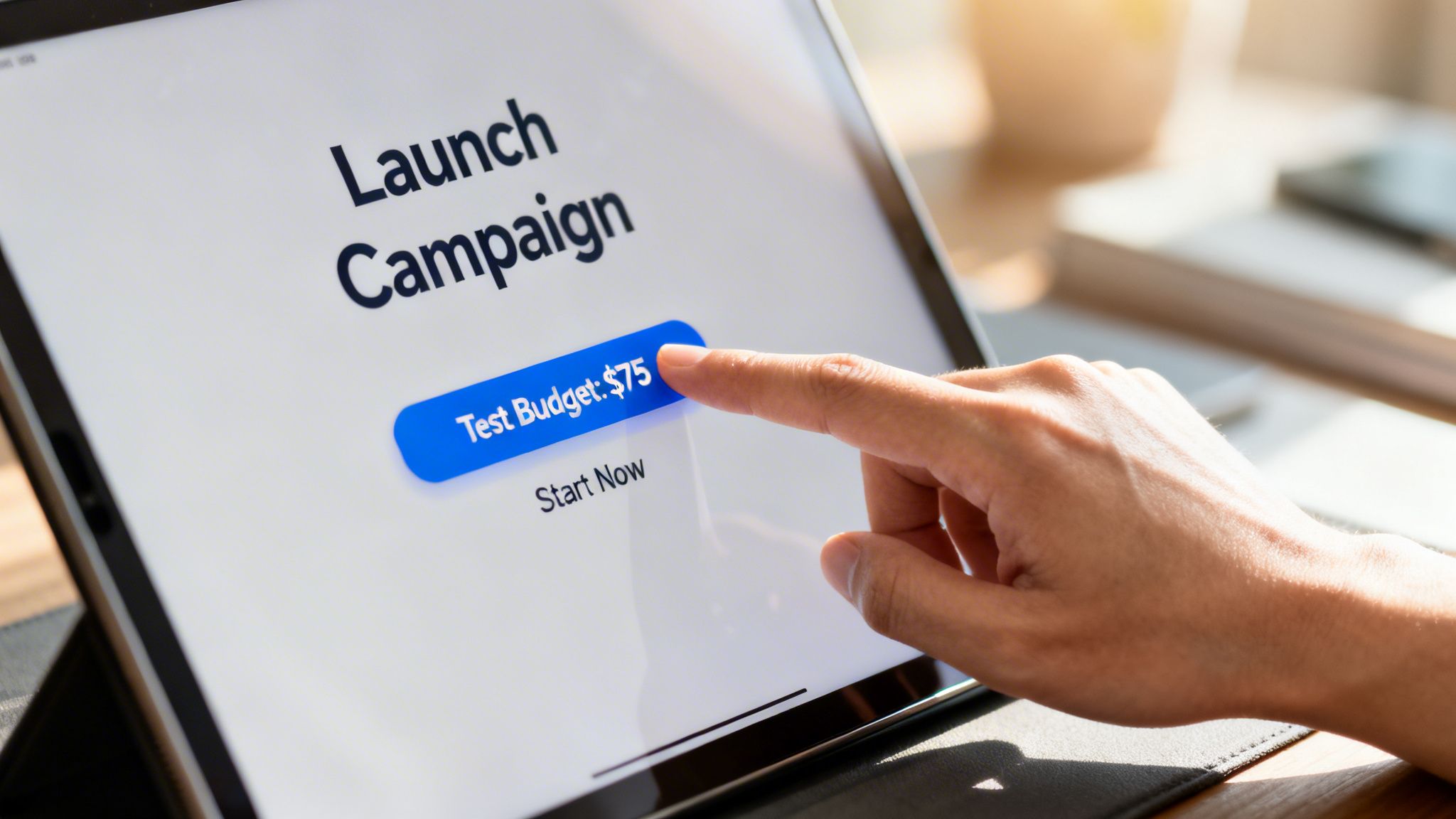
The first campaign should feel manageable.
Not exciting. Not dramatic. Manageable.
That is how you keep fear from taking over. A small test gives you something even more valuable than instant profit. It gives you feedback.
Keep the goal simple
For your first solo ad, your goal is not to master everything.
Your goal is to answer a few practical questions:
- Are the clicks relevant?
- Does your page make sense to visitors?
- Are people willing to join your list?
- Do you feel comfortable reading the results?
That is enough for a first round.
According to Post Affiliate Pro’s guidance on testing solo ad campaigns, experts recommend starting with small test campaigns of $100 to $300 to evaluate a seller. The same source suggests sending traffic to a squeeze page and aiming for an opt-in rate of 35% to 60% before investing more.
If that feels larger than you want to start, it is fine to begin with a gentler mindset and prepare carefully first. The lesson is the same. Test before you scale.
Step one: finish one simple squeeze page
Your page does not need to be fancy.
It needs:
- A clear promise: Tell people what they will get.
- A short explanation: Keep it plain and useful.
- An email box: Ask for their name and email if you want both, or email only if you want less friction.
- A calm tone: Avoid hype. Use normal language.
If you need help creating the free resource people will sign up for, this beginner guide on how to create a lead magnet is a practical place to start.
Done is better than perfect here. A simple page that is clear will usually beat a complicated page that tries too hard.
Step two: choose one seller, not five
Many beginners overcomplicate the first move by opening too many tabs and comparing too many options.
Pick one seller who meets your safety checklist.
Then commit to one test.
That keeps your mind clear. It also makes your results easier to understand.
Step three: decide what you will measure
Do not drown in numbers.
For your first campaign, pay attention to just two things:
| Metric | What it means |
|---|---|
| Opt-in rate | The share of visitors who joined your email list |
| Cost per lead | How much you spent to get one subscriber |
Those two numbers tell you a lot.
If people click but do not join, your page may need work.
If they join at a reasonable pace, your page and seller may be a good match.
If the quality feels poor, you may need a different seller.
Step four: let the test teach you
Once the campaign runs, resist the urge to panic over every click.
Check your results calmly.
Notice patterns such as:
- The page message felt clear and people signed up.
- The traffic clicked but did not opt in, which may mean the audience was not a fit.
- The seller delivered traffic, but the leads felt weak, which tells you to be more selective next time.
This stage is where confidence begins. Not because everything works perfectly, but because you can now see what happened.
A first campaign is not a final verdict on you. It is one small experiment.
Step five: improve one thing at a time
If you change everything at once, you never know what helped.
Instead, adjust just one part for the next test:
- Rewrite the headline on your page.
- Make your free offer more specific.
- Try a more targeted seller.
- Simplify the wording on the form.
That approach lowers stress. It also makes progress visible.
I have seen many beginners assume they are “bad at marketing” when really their first page was too vague or their seller was not a good match. Those are fixable problems.
You are not trying to become perfect. You are learning how to listen to what the market is telling you.
And that skill grows with repetition.
What to Do After They Subscribe
This is the point where many beginners lose momentum.
They work hard to get a subscriber, then sit there thinking, “Now what do I say?”
The answer is simple. You start a conversation.
An email list is not just a pile of addresses. It is a group of people who raised their hand and said, “Yes, I’m interested.”
That is why what happens after the opt-in matters so much.
According to SoloAdsHub’s explanation of why most solo ad users fail, 95% of solo ad users fail because they send cold traffic directly to a sales page. The same source says the 5% who succeed achieve over 700% ROI in some cases by using a trust-building email sequence first.
That is the key lesson. Do not rush the relationship.
A simple three-day welcome sequence
You do not need a giant funnel to begin. You need a warm first few emails.
Here is a simple pattern you can adapt.
Day one welcome and delivery
Send the promised freebie right away.
Thank them for joining. Tell them what to expect from your emails. Share a few lines about why this topic matters to you.
Keep it human.
Example structure:
- Welcome them by name if your system allows it.
- Deliver the checklist, guide, or resource.
- Share a short personal note about why you care about helping people in this area.
Day two one helpful win
Give them something useful that does not ask for money.
This could be:
- A quick tip
- A common beginner mistake
- A small mindset shift
- A tool you personally find helpful
The goal is to show them that opening your emails feels worthwhile.
Day three a gentle recommendation
Now you can introduce a relevant affiliate offer, but softly.
You are not forcing a sale. You are saying, in effect, “If you want extra help with this, here is something that may support you.”
That difference in tone matters.
Trust grows when readers feel helped before they feel sold to.
Keep the relationship simple and steady
After the welcome sequence, stay consistent.
Write like a real person. Use plain language. Share what you are learning. Offer practical help. Recommend only things that fit the problem your reader wants to solve.
If you want help improving that rhythm, these email newsletter best practices can help you write in a way that feels natural instead of forced.
A short personal story can help here too.
I remember feeling pressure to “sound professional” in my first emails. The result was stiff, distant writing. Things improved when I wrote the way I would speak to a friend over coffee. Clear. Warm. Honest.
That is often what your subscribers want most.
The main purpose of low cost solo ads
Used well, low cost solo ads are not about chasing quick wins.
They are one way to build an audience you own, one subscriber at a time.
That is why safety matters.
That is why trust matters.
That is why follow-up matters.
You are not buying miracles. You are building a foundation.
And foundations are allowed to grow slowly.
If you’d like calm, beginner-friendly help as you learn this step by step, you can visit Victoria OHare. The next five years will pass either way. The only question is whether you’ll use them to build something that gives you peace of mind.




Pingback: John Crestani Scam? A Calm Guide for Women Over 50 - Victoria OHare