

If you're staring at Retirement and wondering whether you're already too late to build something steady online, you're not alone. A lot of women feel behind, not because they failed, but because life got full. Tech can feel noisy at first, and that's enough to make anyone hesitate. You're not behind, and you can learn this.
The good news is that Affiliate Marketing doesn't ask you to become a different person. It's recommending products and earning a commission, which means your lived experience can matter more than flashy tactics. The question is whether your niche can support enough content, enough buyer interest, and enough patience to carry you through the first 6 to 12 months without burning out.
Choosing a niche is where that stability starts. In a market that was valued at $20+ billion and is projected to reach $40 billion by 2031 source, the people who do best usually aren't the ones chasing whatever looks trendy that week. They're the ones building around durable demand, commercial intent, and a topic they can still talk about next year.
Why Your Niche Choice Shapes Your Online Income
A weak niche choice creates a lot of invisible stress. You can spend weeks publishing posts, checking analytics, and still feel like nothing is landing because the topic is either too broad to own or too narrow to support steady content. That is discouraging at any age, and it hits harder when you are trying to build a second chapter with limited time and a real need for peace of mind.
The stronger path starts with a simple filter, can this topic support real buying behavior and enough content depth to last. A broad market like health and wellness shows that demand can be huge, but “health” by itself is too wide to compete in effectively. Aim for specificity instead, so the topic gives you room to speak clearly, solve real problems, and keep publishing without running out of angles.
Practical rule: if your niche cannot support dozens of useful articles, it cannot support a long-term affiliate site.
That is why how to pick a niche for Affiliate Marketing is really a question about runway, not just interest. You want a topic with room for reviews, comparisons, beginner guides, mistakes to avoid, and product-focused posts. If you cannot picture a steady publishing rhythm, the niche is probably too thin.
I also keep one eye on realistic income expectations without getting pulled in by big promises. A grounded planning lens matters more than hype, and Victoria OHare's realistic affiliate income guide fits that mindset well. The goal is a topic that can hold your attention long enough to build something useful, while still giving you enough content runway to stay consistent for the months ahead.
Finding Your Niche Through Life Experience and Interests
Start with what you already know. Not because “follow your passion” is magic, but because familiarity gives you faster content ideas, clearer judgment, and less friction when it's time to write. A niche becomes easier to sustain when you don't have to invent authority from scratch.
I remember how overwhelming it felt to sort through all my interests at once. The pressure to choose one perfect lane can make you freeze, especially if you've spent years being practical for everyone else. The better move is to notice patterns in what you naturally return to.
Look for repeatable topics, not just hobbies
Write down the things you already talk about without forcing it.
- Problems you've solved: budgeting, caregiving, organizing a home, working from home, or learning a skill the hard way.
- Products you already trust: tools, services, books, software, kitchen items, wellness products, or practical gear.
- Questions people ask you: what to buy, how to start, what worked, what didn't, and what you'd do differently now.
- Situations you understand: Retirement planning anxiety, career change, empty nesting, aging parents, or starting over.
What you're really looking for is overlap. If a topic connects your lived experience, your curiosity, and products people already buy, it deserves a closer look.
A useful test: if you can talk about the topic in plain language for a long time without pretending, you probably have the seed of a good niche.
That's why many midlife creators do better when they stop trying to sound like a generic marketer and start sounding like themselves. The site's own advice about choosing an Affiliate Marketing niche based on products you already use and love lines up with that approach, and so does its guidance on finding your niche as a woman over 50. Authenticity isn't a slogan here. It's a practical way to avoid burnout.
The most useful niches often come from what you've already lived through. You don't need a dramatic personal brand. You need a topic you can return to again and again without running out of words in month three.
Testing Market Demand and Profitability Before You Commit
Once you have a shortlist, stop guessing and look for evidence. A niche can feel exciting and still fall flat if people are not searching for it in a way that leads to buying. Demand and monetization need to sit alongside personal interest, not secondary to it.
The affiliate market itself is still growing, which is one reason niche selection matters so much. That growth creates room, but it also creates competition. A broad topic without a clear angle usually gets buried.
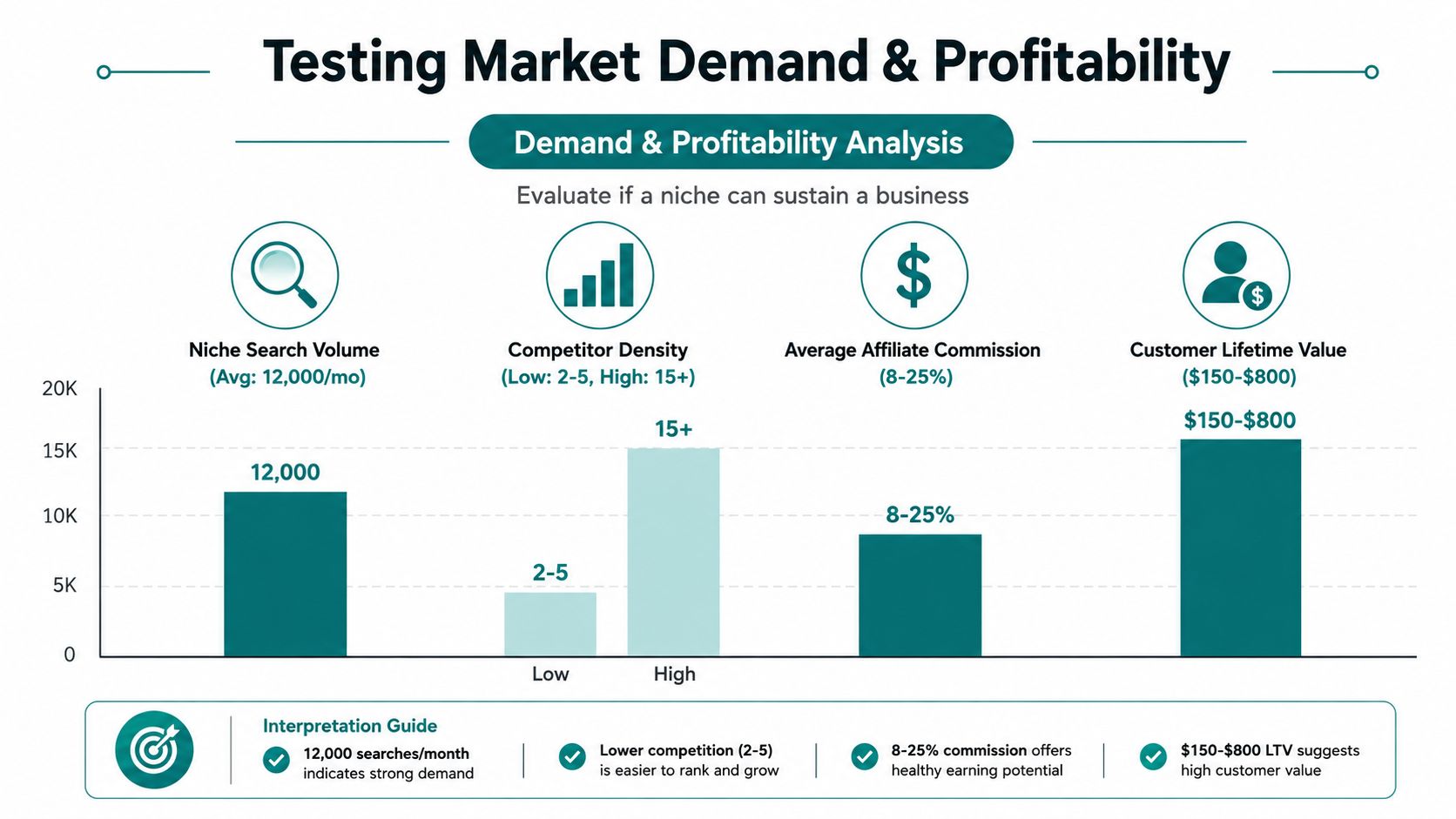
A practical filter is whether you can build 50 content ideas before you commit, because a niche that runs dry after 10 ideas is usually too thin to support a full site. The same check helps you see whether a niche has one obvious product or a whole ecosystem of offers. Recurring commissions can also matter. In one SaaS example, a program offers 20% recurring commissions, and the average customer lifetime is about 3 years. That kind of structure can raise the income floor compared with a one-time payout.
If you want help narrowing to terms that people are ready to act on, finding low-volume high-intent keywords can be a smart place to start. The point is not to chase every search term, it is to find words that signal a real buying question.
Market Demand Indicators for Affiliate Niches
| Indicator | What to Look For | Why It Matters |
|---|---|---|
| Search demand | Stable or rising interest over time | Shows the niche is not just a passing spike |
| Buyer language | Words like best, review, alternative, top 10, and vs | Signals commercial intent |
| Affiliate offers | Several active programs in the space | Confirms there is money flowing in the niche |
| Content runway | Enough topics for months of publishing | Prevents burnout and topic exhaustion |
If you want a simple next step, compare your shortlist against a practical framework for choosing a profitable niche. That often turns a hesitant maybe into a clear yes or no.
Understanding Your Audience and the Competition
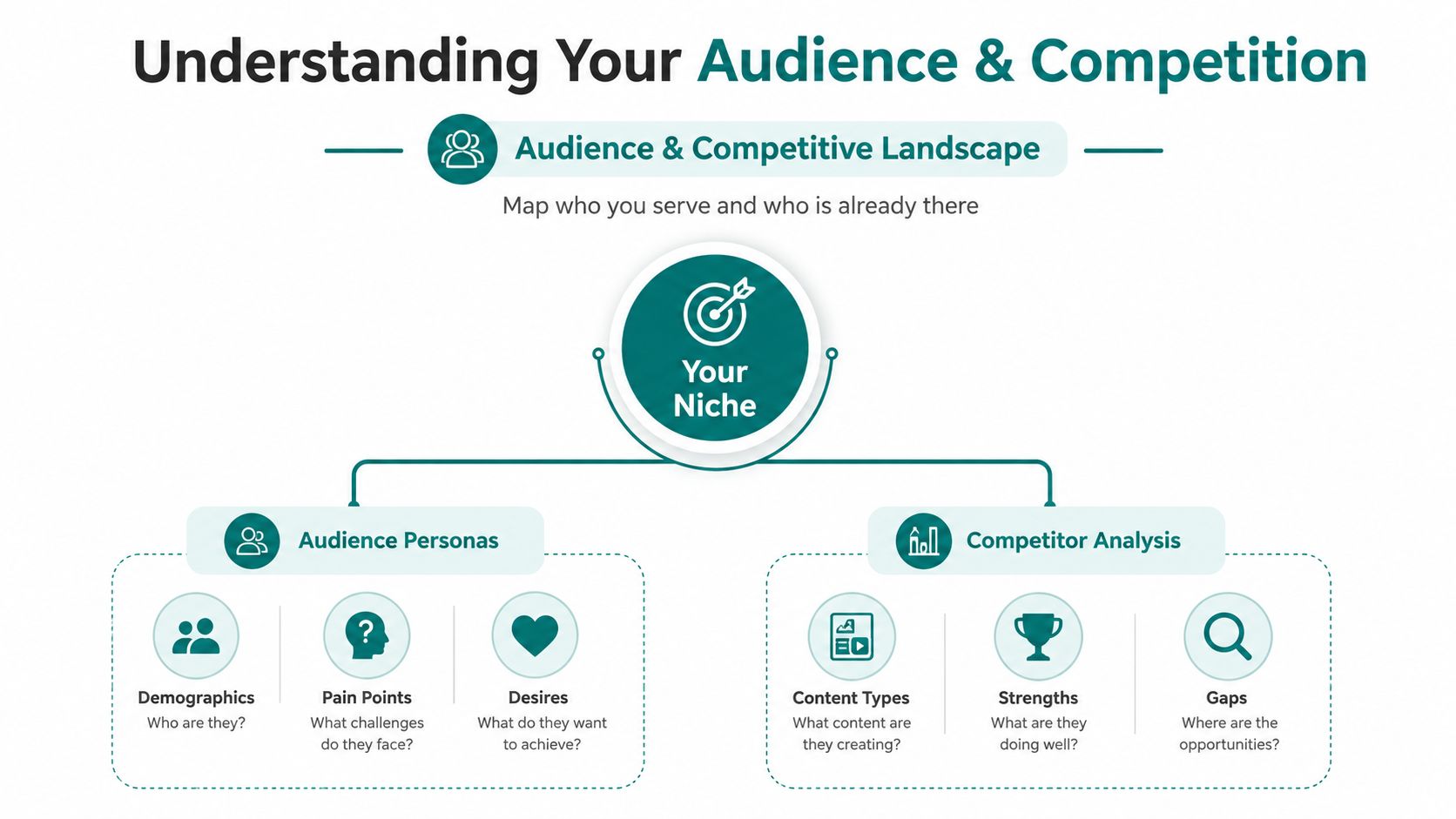
A niche only works when you know who you're talking to. “Women 50+” is still too broad on its own. A better audience picture sounds more like the person who wants simple home workouts, the person who needs help choosing affordable tools, or the person who's nervous about starting an online income stream and doesn't want to be sold to.
The competition matters for the same reason. You don't need an empty field, you need a field with gaps. If everyone is publishing the same generic advice, there's room for a clearer voice, a more specific angle, or better product matching.
A practical decision matrix keeps the emotion from taking over. One framework weights market demand at 25%, personal interest at 20%, competition at 20%, profitability at 20%, and long-term sustainability at 15% source. That weighting makes sense because a niche that thrills you but collapses under competition won't help much.
Weighted Decision Matrix for Niche Evaluation
| Criteria | Weight | Score 1-10 |
|---|---|---|
| Market demand | 25% | |
| Personal interest | 20% | |
| Competition | 20% | |
| Profitability | 20% | |
| Long-term sustainability | 15% |
For keyword validation, one useful benchmark is to look for at least 20 to 30 keywords per surviving niche, combined monthly search volume above 5,000, and at least 3 affiliate programs with commissions above 5% or $10 per sale source. Those numbers don't guarantee success, but they help you avoid a niche that looks nice and can't support content.
The competition check doesn't have to be fancy. Open the page-one results, read what's ranking, and ask whether you can contribute something more specific, more reassuring, or more practical. Neutral guides also point out that a strong niche usually has a specific audience, a clear pain point, and active community discussion source. That's a better test than relying on excitement alone.
Putting Your Niche Through Real Validation Tests
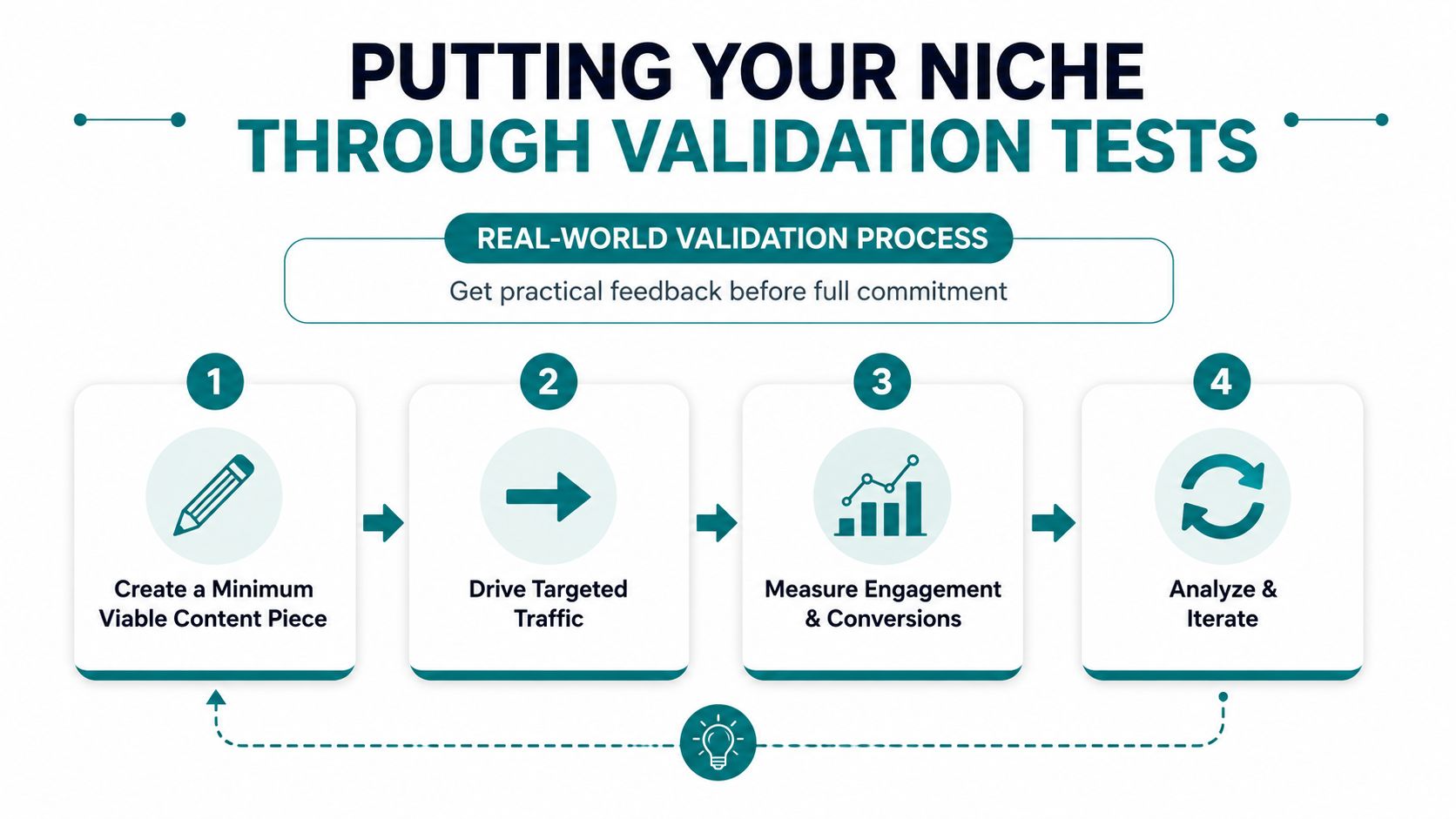
Once the shortlist feels promising, test it in the world. The goal is to get feedback before you spend months building content around a wrong assumption. Validation doesn't need a big budget or advanced tech skills. It just needs honesty.
Google Trends is a sensible first check because it shows whether interest is stable or rising rather than tied to a temporary spike source. If interest drops off sharply, that doesn't always kill the niche, but it does mean you should slow down before committing. I'd rather see modest, steady demand than a flashy spike that disappears as quickly as it came.
A simple validation rhythm
- Check the trend line. Look for steady interest over time, not just a short burst.
- Publish a small batch. Write a few pieces aimed at real buyer questions and see what people click.
- Inspect page-one results. Notice whether the ranking content is thin, broad, or very specialized.
- Review the response. If nobody seems interested, adjust the angle before going deeper.
The commercial-intent keywords matter here too. Words like best, review, alternative, top 10, and vs often show that a person is close to a buying decision source. That's useful because affiliate content usually works best when the reader already has a problem and is comparing options.
You can also use simple traffic tests. A tiny ad campaign or a focused post shared in a relevant community can show whether people care enough to click, stay, and act. That's more informative than staring at your own excitement.
What you're trying to learn: whether the niche attracts real people with a real need, not just your own attention.
For some creators, a toolset or a guidebook helps them stay organized. Victoria OHare's content on affiliate foundations can fit alongside other practical resources, but the core idea stays the same, test before you build too much.
Your Niche Readiness Checklist and Next Steps
At this point, the decision should feel clearer, even if it isn't perfect. A ready niche is not the one with zero risk. It's the one that has enough evidence to justify the next six months of work. That's a much calmer standard, and it's the one that keeps you moving without second-guessing every post.
The strongest signs are usually simple. You know enough about the topic to speak plainly. There are enough products to recommend. People are already searching for the subject in ways that suggest buying intent. And you can imagine enough article ideas to keep going without scraping the bottom of the barrel.
Green flags and yellow flags
- Green flag, clear audience: you can describe one specific reader and their main frustration.
- Green flag, real content runway: you can map out months of articles without repeating yourself.
- Green flag, active monetization: affiliate programs exist and the niche supports comparison-style content.
- Yellow flag, vague audience: the topic sounds broad but doesn't point to a clear person.
- Yellow flag, thin content ideas: you struggle to get beyond a handful of posts.
- Yellow flag, weak buying signals: the search terms are interesting, but not clearly commercial.
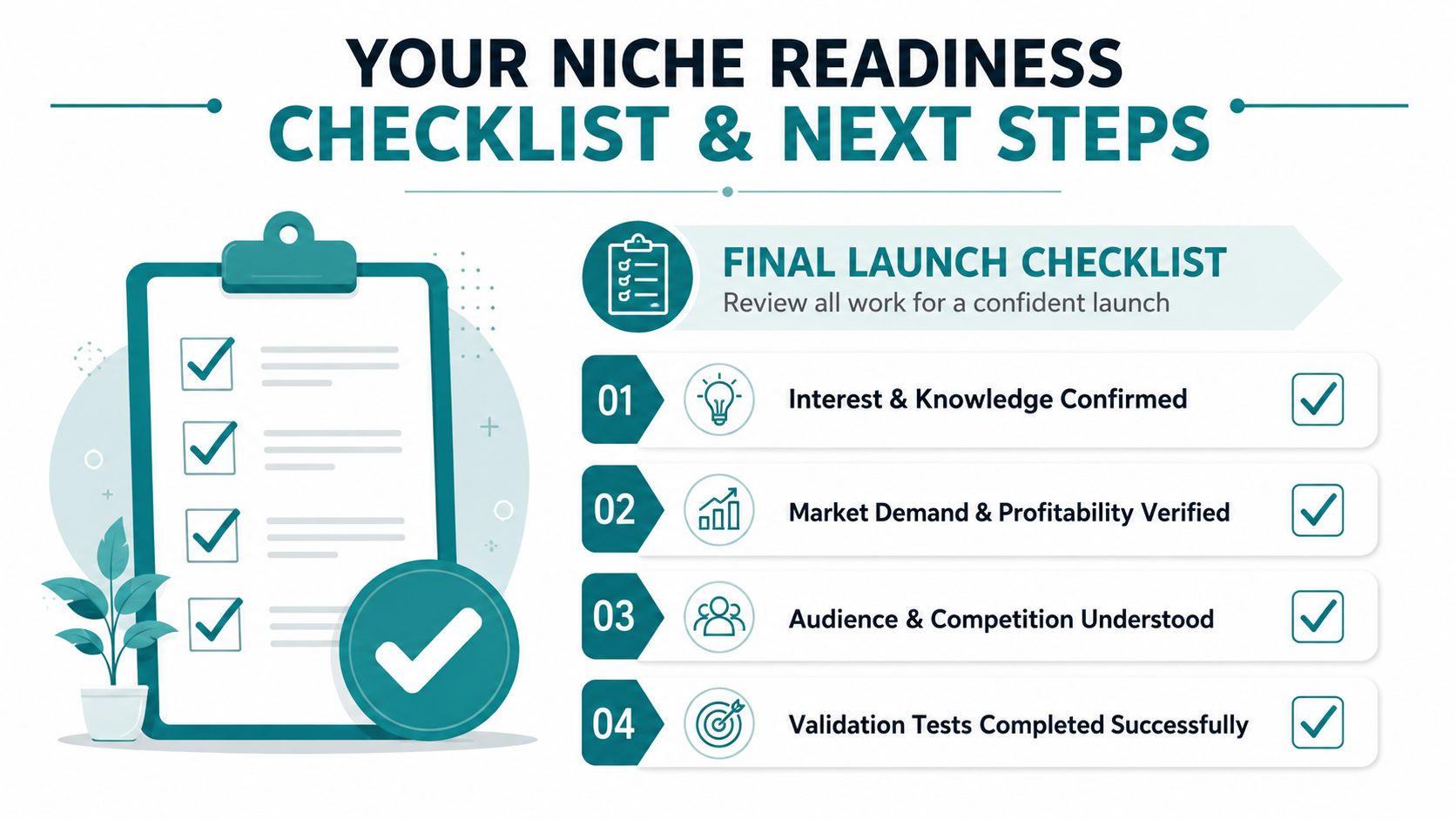
The final check is emotional as much as practical. If the niche feels like a burden before you've even started, that matters. You don't need to choose the most exciting topic on earth. You need one that supports dignity, independence, and a steady pace you can live with.
A good next move is to pick one niche, one reader, and one content cluster. Then publish, learn, and adjust. You're not trying to solve your whole future in a single afternoon. You're building an asset, one useful page at a time.
Victoria OHare offers practical guidance for people who want to build income online without unnecessary tech overwhelm, and that includes choosing a niche you can sustain. If you want a calm, step-by-step place to keep learning about Affiliate Marketing, List Building, and simple online business foundations, visit Victoria OHare and start with the topics that fit your life right now.