

If you're over 50 and wondering whether it's too late to build income online, you're not alone. The thought of choosing new technology can feel paralyzing, especially when terms like "email marketing" sound complicated. Many women feel behind financially — not because they failed, but because life happened.
That feeling of tech overwhelm isn't a sign to stop; it’s a natural part of starting something new and meaningful. The truth is, you don't need to be an expert to build an asset that creates security. I remember feeling completely lost the first time I tried to set up an email list, almost quitting before I even started.
But here’s the reality: Social Security and traditional Retirement plans may not be enough to provide the peace of mind we all hope for. Building a small online business can help fill that gap, and email is a core part of that. It's a way to connect with people and recommend helpful products, earning a commission in the process. This is often called Affiliate Marketing.
I understand being cautious. There are many scams online, and it's wise to be skeptical. That’s why choosing the right tools and getting proper education is so important. This article is a calm, patient guide to the best email marketing platforms for small business. We'll walk through them together so you can find one that feels right for you. It's not too late to learn this, and you are not behind.
Each review will explain who the tool is for and what it costs. We’ll look at pros and cons with honesty, and you'll find screenshots and direct links to make getting started simple. If you're still weighing your options after this, exploring other comprehensive guides to the best email marketing platforms can provide additional insights. My goal is to help you make a confident choice. You can learn this. Let's begin.
1. MailerLite
MailerLite stands out as one of the best email marketing platforms for small business owners, creators, and those just starting their online journey. Its clean, modern interface feels calm and approachable, which is a welcome relief if you’ve ever felt overwhelmed by complicated tech. You won't need a technical background to get started, making it a patient and encouraging partner for building your audience.
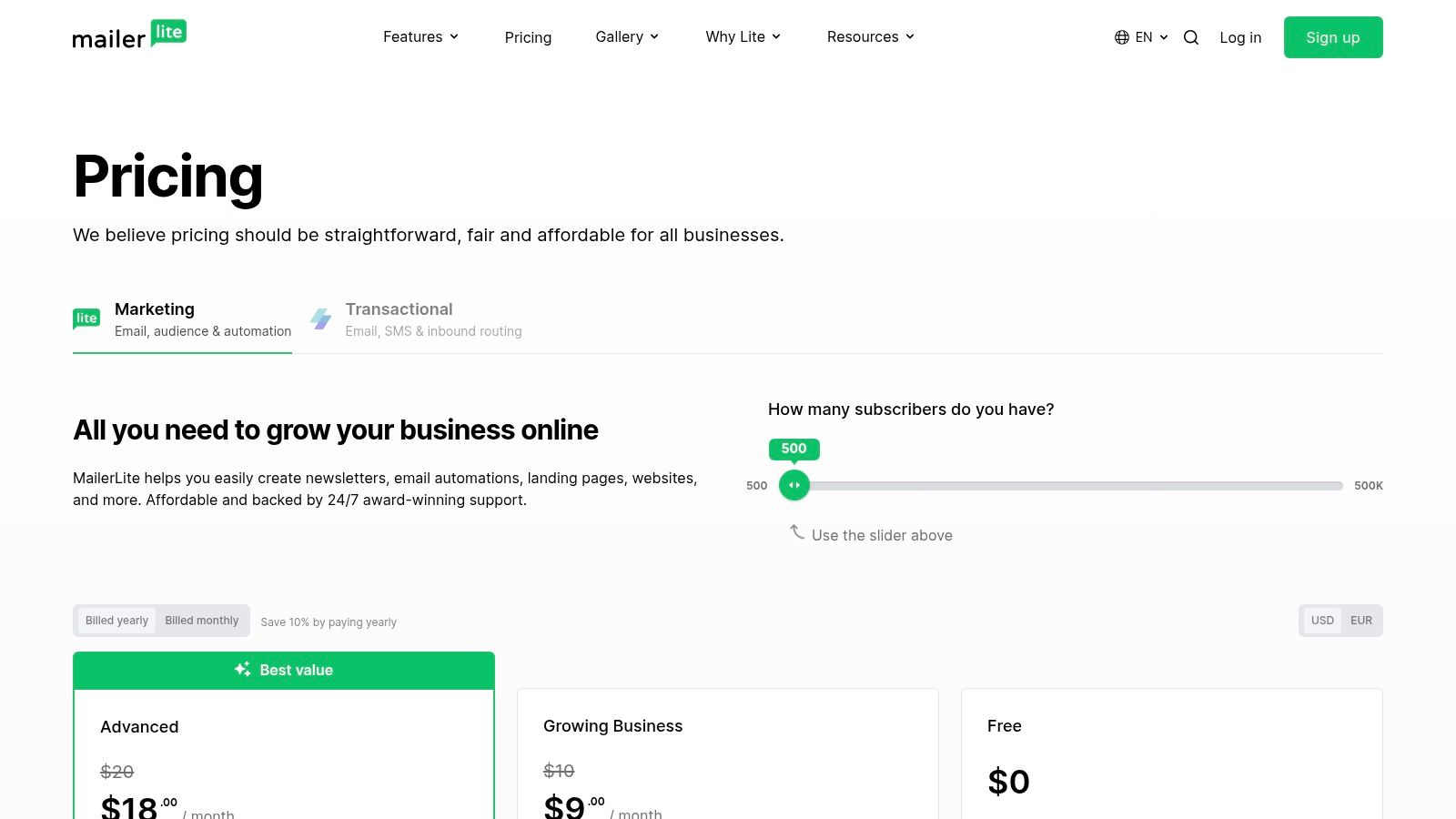
The platform offers a generous free plan that includes up to 1,000 subscribers and 12,000 monthly emails, along with access to its drag-and-drop editor, website builder, and landing pages. This free tier provides more than enough runway to get your email list off the ground. If you're wondering how to begin, exploring a simple guide on how to build an email list from scratch can provide a solid foundation.
Key Features & User Experience
MailerLite focuses on simplicity without sacrificing essential functions. The visual automation builder allows you to create welcome sequences or other email series by simply connecting blocks on a canvas. This visual approach demystifies a process that can often feel complex.
- Pros: The user interface is exceptionally clean, setup is straightforward, and the free plan is robust. Its reputation for good email deliverability means your messages are more likely to reach your audience’s inbox. They also offer a 30% discount for non-profit organizations.
- Cons: While great for core email marketing, it has fewer built-in integrations than larger, more expensive competitors. Its analytics and A/B testing features are also more basic compared to enterprise-level tools.
2. Kit (formerly ConvertKit)
Kit, formerly known as ConvertKit, is built from the ground up for creators. If you’re a writer, blogger, artist, or coach, this platform speaks your language. It’s designed to help you not just build an audience but also earn a living from your work, making it one of the best email marketing platforms for small business owners who are also creators. The interface focuses on turning your subscribers into a community, which can feel incredibly encouraging.
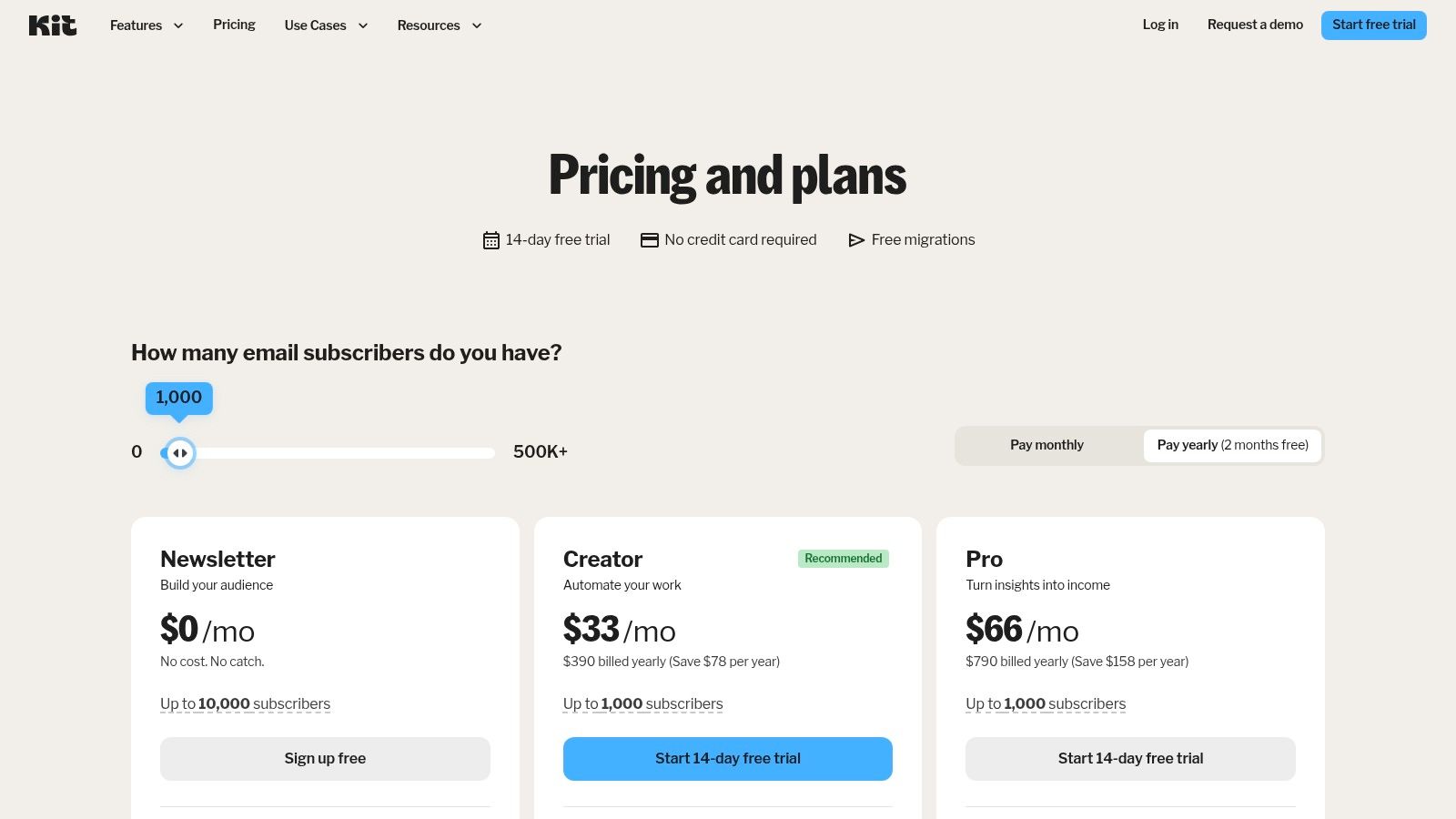
The platform has a generous free plan for up to 1,000 subscribers, making it accessible if you're just starting and feel unsure about investing. It includes unlimited landing pages and forms, which gives you the tools you need to begin growing your list without an initial cost. This removes a common barrier and allows you to focus on creating and connecting with your audience first.
Key Features & User Experience
Kit’s strength lies in its powerful tagging and segmentation system, which is surprisingly straightforward. You can easily tag subscribers based on their actions, like clicking a link or downloading a file, allowing you to send highly relevant content. The visual automation builder makes it simple to map out entire customer journeys, from a welcome sequence to a product pitch.
- Pros: It’s designed specifically for creators, with strong monetization features like paid newsletters and digital product sales. The tagging system provides deep segmentation capabilities, and the platform offers free migrations from other services.
- Cons: The pricing can become steep as your list grows into higher tiers. It has fewer all-in-one CRM features, so businesses needing advanced sales pipeline management may find it limited.
3. Mailchimp
Mailchimp is often one of the first names that comes to mind when you think about email marketing, and for good reason. It has been a long-time staple for small businesses, offering a familiar interface and a vast ecosystem of tools. If you’ve ever felt like you're playing catch-up with technology, Mailchimp's widespread use means there are countless tutorials and guides available, which can be incredibly reassuring.
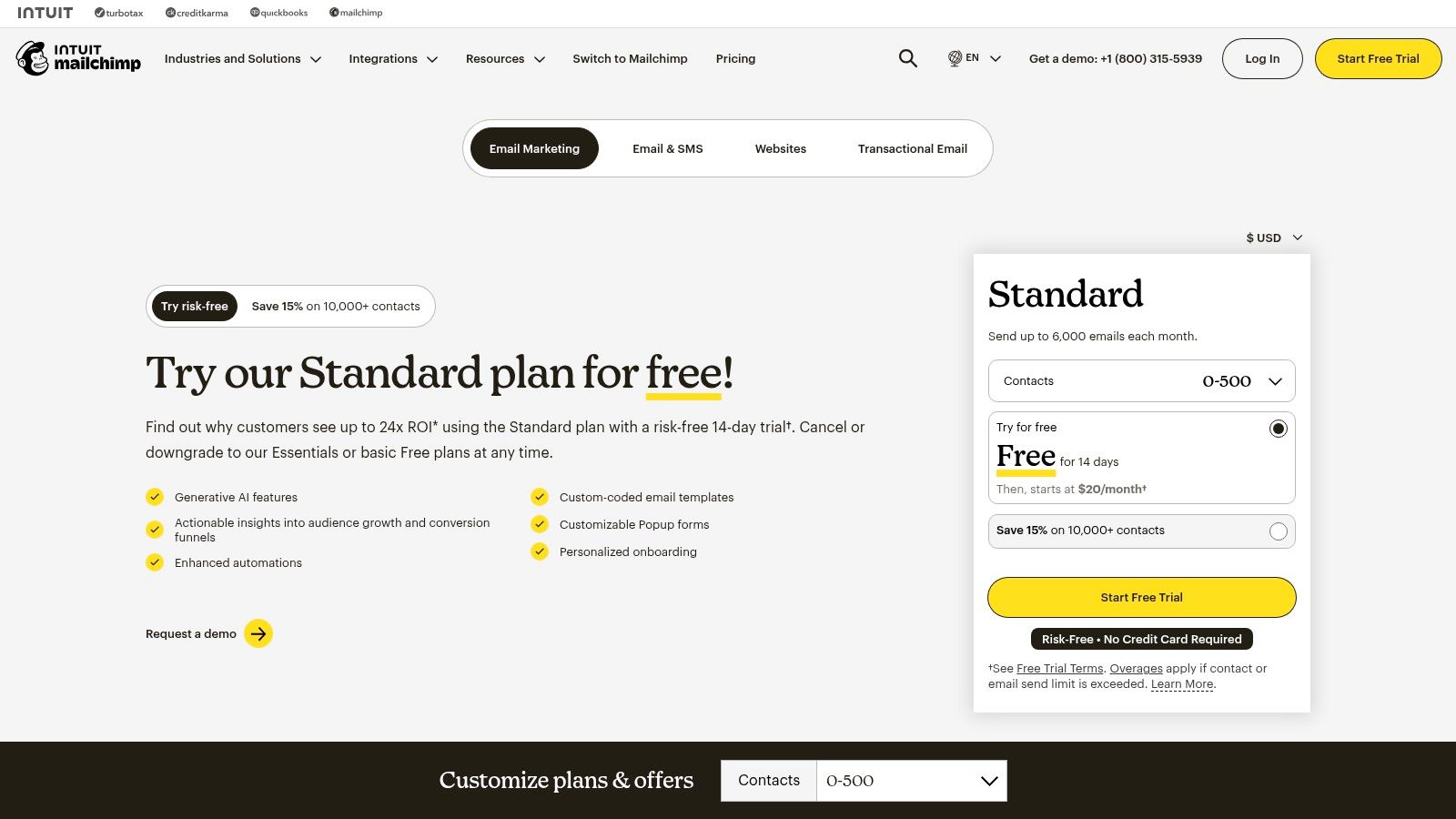
Its strength lies in its ability to serve as a general, all-in-one marketing hub. For those sending newsletters infrequently, the pay-as-you-go credit option is a standout feature, allowing you to pay only for what you use without a monthly commitment. This flexibility can be a financial relief when you're just starting. For more consistent strategies, you can explore various email marketing tips for small business to make the most of your efforts.
Key Features & User Experience
Mailchimp has expanded beyond simple emails, now offering landing pages, basic website builders, and customer journey automations. Its AI-assisted tools can help you write subject lines and generate content, which is helpful if you ever feel stuck staring at a blank screen. The platform’s template library is extensive and professionally designed, giving your emails a polished look from day one.
- Pros: It integrates with almost every app imaginable, making it one of the most connected platforms available. Its brand recognition means there is a huge community and knowledge base to learn from.
- Cons: The free plan became very restrictive in 2024, now limited to just 250 contacts and 500 monthly sends. It can become one of the more expensive options as your contact list grows, so it's important to keep an eye on costs.
4. Brevo (formerly Sendinblue)
Brevo, previously known as Sendinblue, carves out its space by offering a different approach to pricing. If you have a large audience but only send emails occasionally, this platform could be a very cost-effective choice. It moves beyond just email to include SMS, WhatsApp, and even a lightweight CRM, making it a solid all-in-one marketing hub for businesses that want to consolidate their tools without a massive budget.
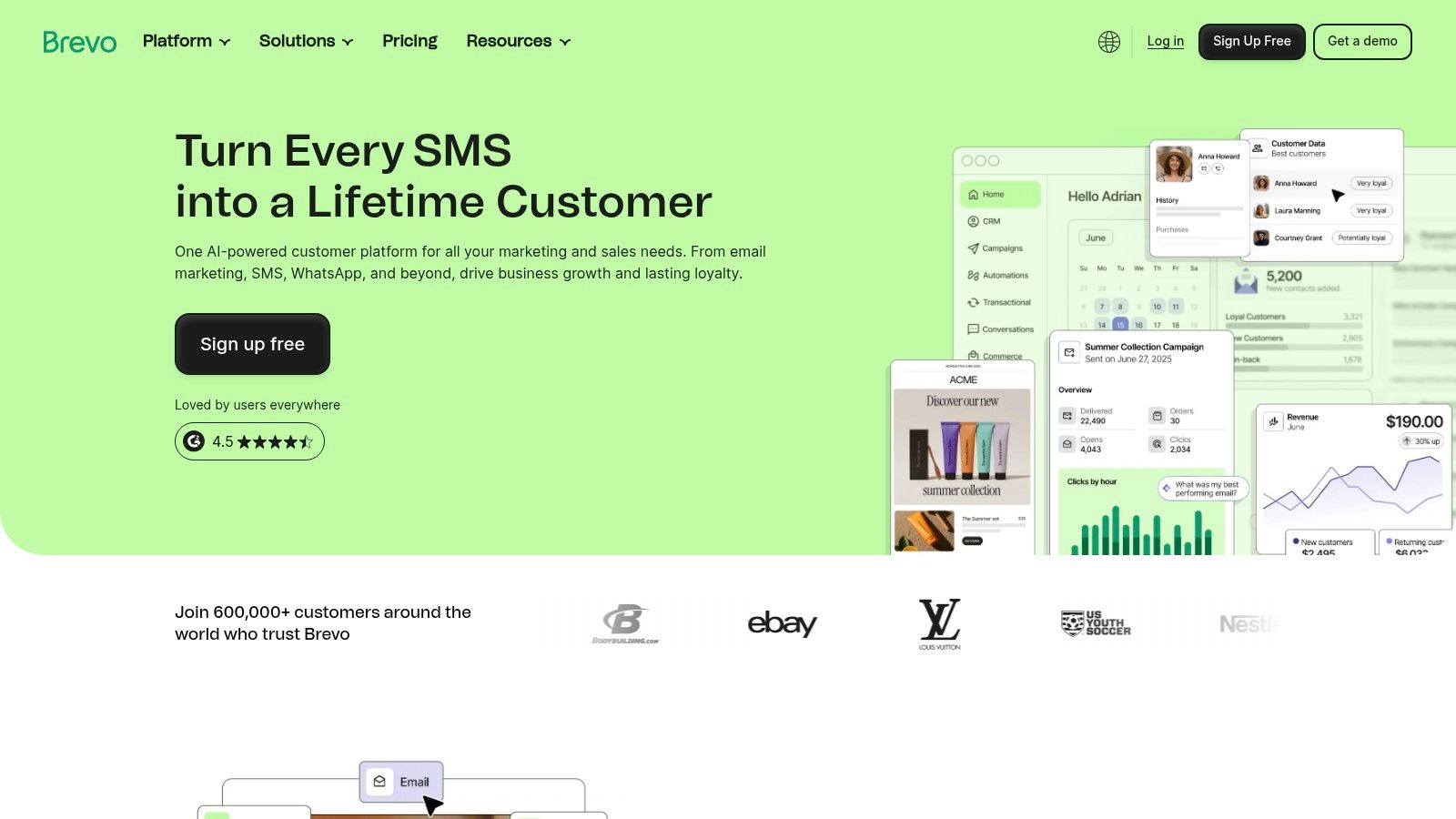
The platform’s model is built around email volume rather than contact count, which is a significant difference from most competitors. Their free plan is quite practical for testing, allowing you to store unlimited contacts and send up to 300 emails per day. This makes it one of the best email marketing platforms for small business owners who are carefully managing their startup costs while growing a large subscriber base.
Key Features & User Experience
Brevo provides a surprisingly wide array of tools, even on its lower-priced plans. Its unique pricing can be a major advantage, especially if you have a large list but only send a monthly newsletter. The interface is functional, though some users may find it slightly less intuitive than more modern, streamlined designs.
- Pros: The send volume-based pricing is potentially much cheaper for those with large lists and low sending frequency. Having email, SMS, and WhatsApp marketing in one place simplifies your outreach efforts and provides a more unified customer view.
- Cons: The automation features on the Starter plan are limited to 2,000 contacts. To remove Brevo branding from your emails, you may need a higher-tier plan or a specific add-on. The platform's recent rebranding and plan changes can sometimes make it a bit confusing to find the exact features you need.
5. ActiveCampaign
ActiveCampaign is for the small business owner who is ready to move beyond simple newsletters and build a truly intelligent marketing system. If you've ever thought, "I wish I could automatically send a message when someone visits a specific page on my site," this is the platform for you. It's an automation-first tool that helps you create personalized experiences based on your audience's actual behavior, making your marketing feel more like a helpful conversation.
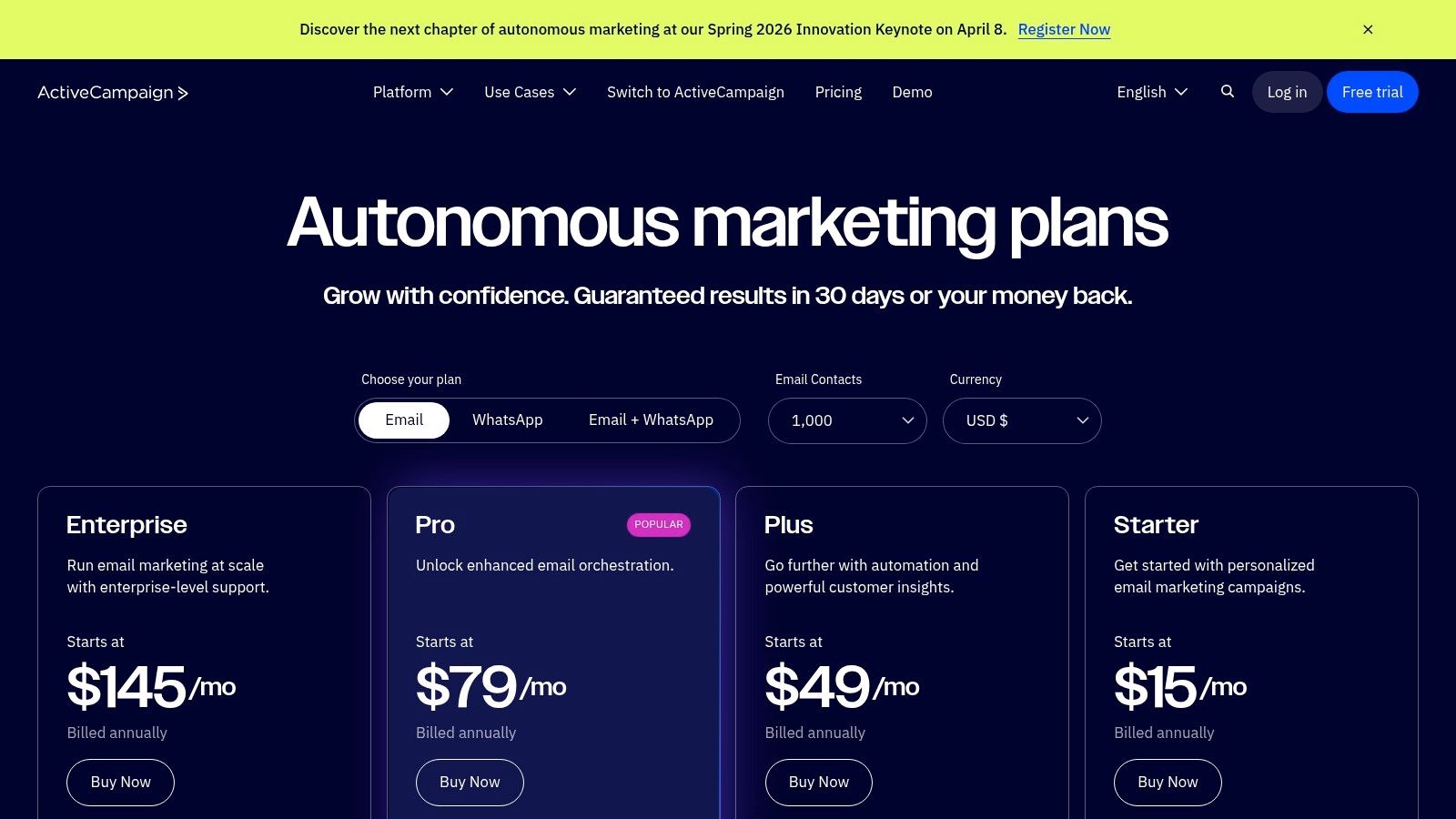
The platform’s real strength lies in connecting actions to emails. This power is essential when you're trying to nurture leads effectively. For instance, you could tag a contact who downloads a specific freebie, which you can create by learning how to create a lead magnet that truly resonates with your audience. ActiveCampaign then lets you send a targeted follow-up sequence just for them. Pricing is based on contacts and features, with plans scaling as your business grows.
Key Features & User Experience
ActiveCampaign is famous for its visual automation builder, which allows you to map out complex customer journeys with triggers, actions, and conditions. You can track site visits, score leads based on their engagement, and even integrate a full CRM to manage sales pipelines. While this sounds complex, it’s a system you can grow into.
- Pros: The automation capabilities are incredibly powerful for the price, offering features typically found in much more expensive tools. It scales well from a single user building a side hustle to a small team managing sales and marketing.
- Cons: There is a steeper learning curve compared to simpler email platforms. The pricing structure can become more complex as you add more contacts and require add-on features, so it's important to watch your costs.
6. Constant Contact
Constant Contact is a long-standing name in the email marketing world, often seen as a reliable and straightforward choice for small businesses, local organizations, and nonprofits. If you find most tech platforms intimidating, its simple onboarding and clear interface provide a welcoming starting point. It's designed for business owners who need effective tools without a steep learning curve, making it one of the best email marketing platforms for small business owners who prioritize simplicity and support.
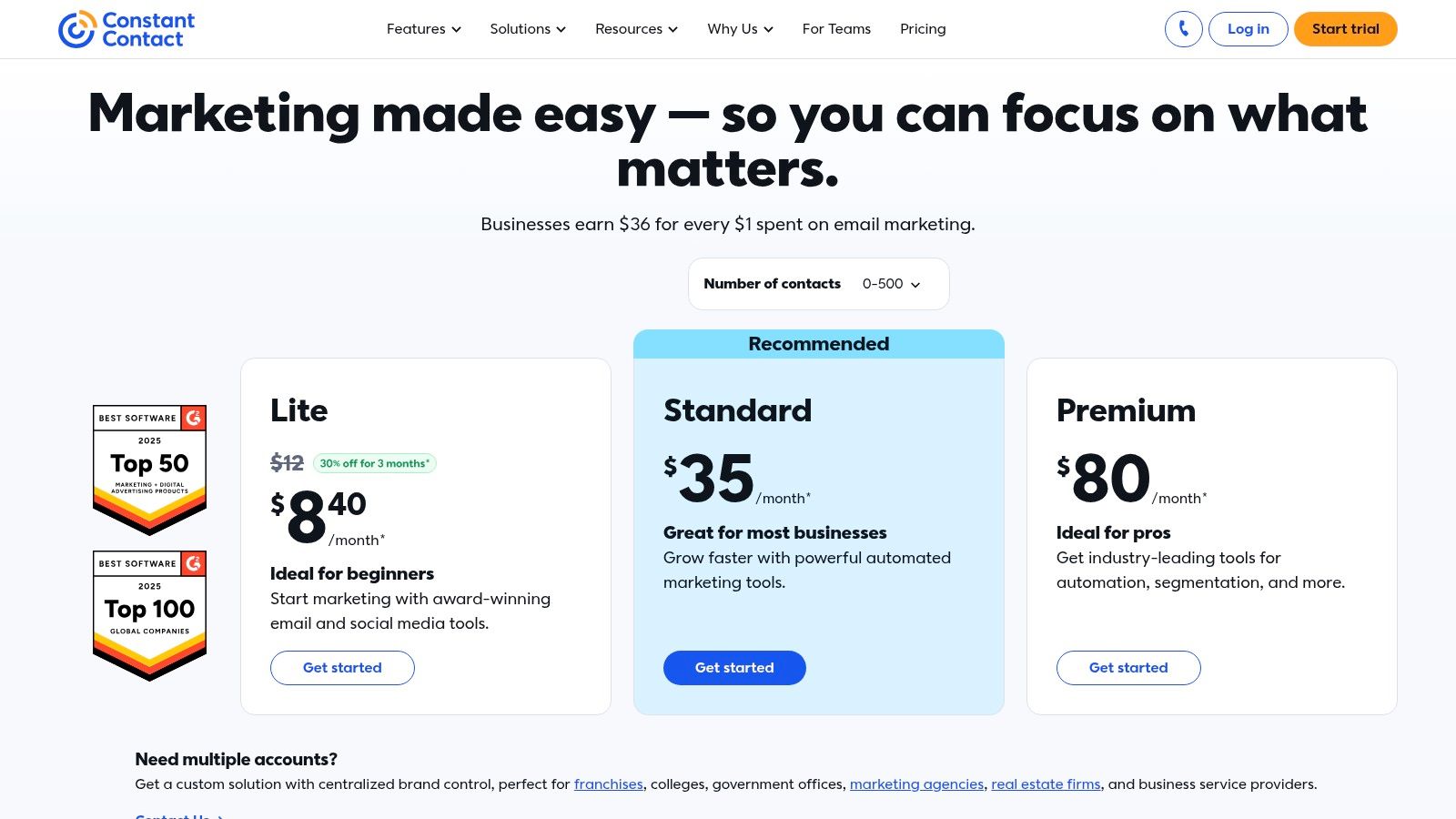
The platform doesn't offer a permanent free plan but provides a 60-day free trial (in the US & Canada), which is ample time to test its features. Paid plans are tiered based on your number of contacts, and you can find detailed information on their pricing at https://www.constantcontact.com/pricing. Its reputation for strong customer support can be particularly reassuring when you're just starting out and might need a helping hand.
Key Features & User Experience
Constant Contact excels at making core marketing tasks accessible. The drag-and-drop editor is easy to use, and a vast library of over 200 templates helps you create professional-looking emails quickly. It also includes event management tools, which are perfect for businesses hosting workshops or local gatherings, and list-growth features like sign-up forms.
- Pros: The platform is known for its user-friendly setup and award-winning customer support, available via phone and live chat. It’s a popular choice for local businesses and nonprofits that value direct assistance.
- Cons: It lacks the advanced automation capabilities of more specialized tools, and the pricing can become costly as your contact list grows. The absence of a permanent free plan may be a drawback for those on a very tight budget.
7. GetResponse
GetResponse positions itself as more than just an email tool; it's an all-in-one marketing platform designed for creators and small businesses who want to consolidate their tools. If the idea of managing separate services for email, webinars, and landing pages feels complicated, GetResponse offers a unified solution. It combines these functions into a single dashboard, which can simplify your workflow and save you time. This makes it a strong contender among the best email marketing platforms for small business owners who are scaling up.
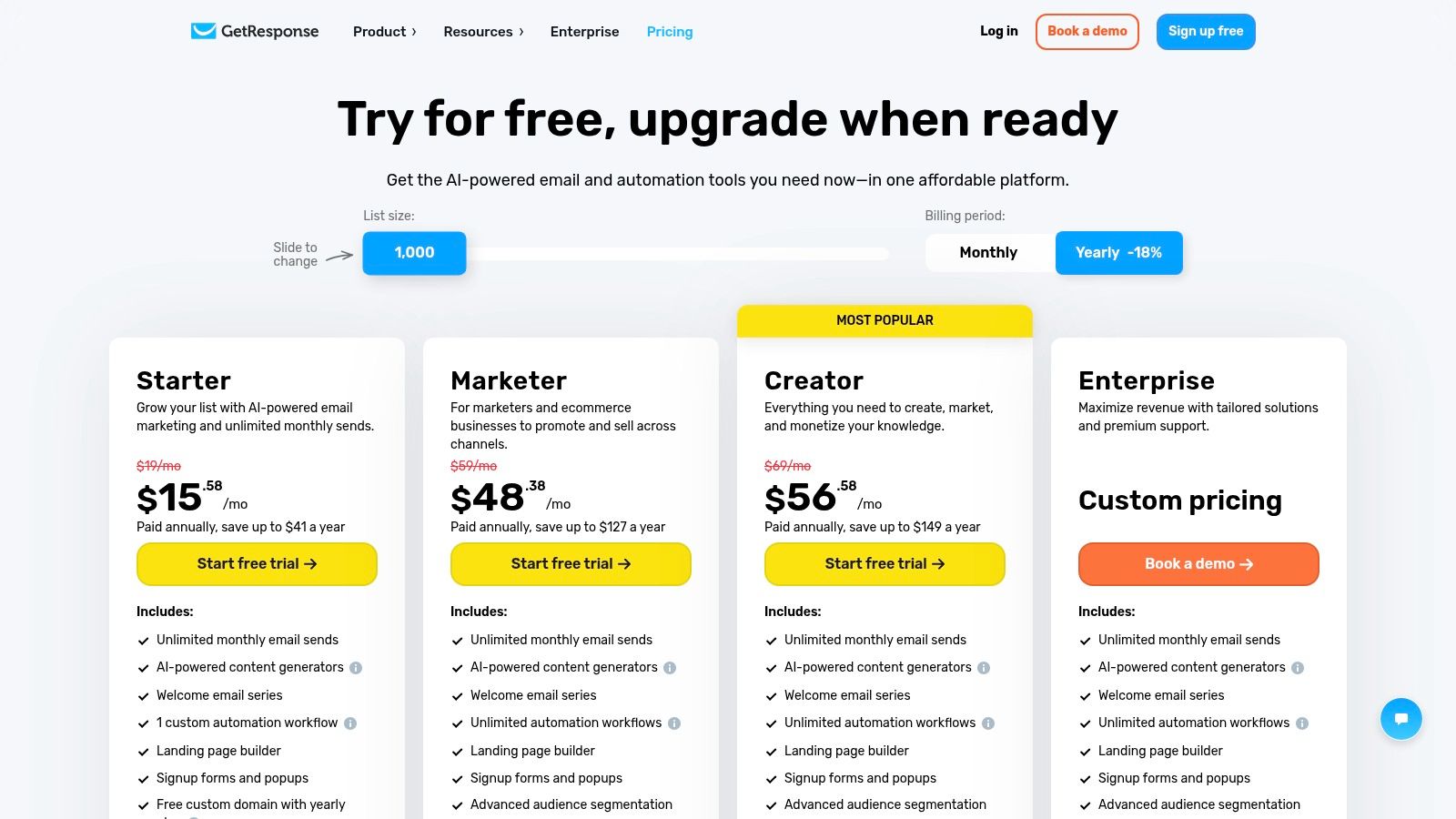
While there is a free-forever plan for up to 500 contacts, its real power is unlocked in the paid tiers. The platform shines for those who need integrated webinar hosting, a feature that often requires a costly third-party service. It also includes tools for building sales funnels and even uses AI to help generate content, making it a robust partner for growing an online business.
Key Features & User Experience
The platform’s strength lies in its extensive feature set. You can create complex automation journeys, build complete sales funnels, and host live webinars without leaving the GetResponse ecosystem. This integration is its main selling point. However, because it does so much, the interface can feel busy for a brand-new user who only needs basic email campaigns. It’s best suited for those ready to use its wider marketing capabilities.
- Pros: The all-in-one approach is excellent value if you need its specific features, especially the built-in webinar functionality. The sales funnel builder and AI tools add significant power for creators and course sellers.
- Cons: The interface can feel overwhelming compared to simpler platforms. To access the most valuable features like webinars and advanced automation, you'll need to subscribe to one of the higher-priced tiers.
8. AWeber
AWeber is a long-standing and respected name in the email marketing world, making it one of the best email marketing platforms for small business owners who value dependability. If you feel overwhelmed by flashy new tools and simply want a platform that works without constant surprises, AWeber offers a sense of stability. It’s a reliable partner that has been helping creators and entrepreneurs connect with their audiences for decades, proving it’s never too late to start building your own community.
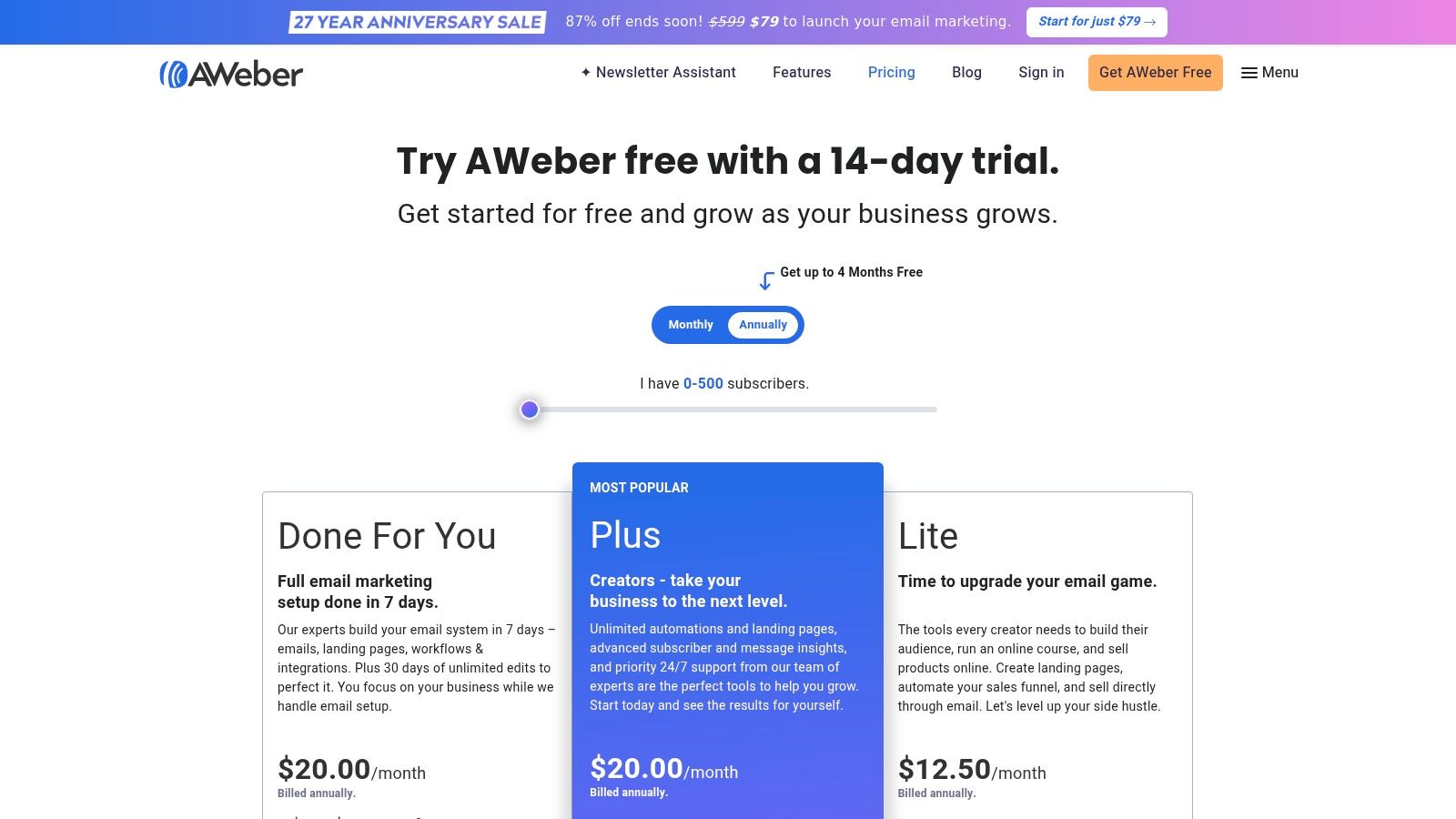
The platform offers a free plan for up to 500 subscribers, which is perfect for getting started without a financial commitment. As you grow, its paid plans (Lite, Plus, and Unlimited) are based on clear subscriber counts, so you can easily predict your costs. This straightforward approach removes the guesswork from budgeting, giving you one less thing to worry about. For more information, you can review their pricing directly at https://www.aweber.com/pricing-plans.htm.
Key Features & User Experience
AWeber focuses on providing the core tools you need to succeed, backed by excellent customer support. Its automations are straightforward, allowing you to set up welcome emails by tagging subscribers when they join your list. This makes creating a nurturing first impression feel manageable, even if you're new to the process. The platform also has a vast library of integrations, connecting easily with many other tools small businesses use.
- Pros: The pricing tables are predictable and easy to forecast, which helps with financial planning. AWeber is known for its helpful support and extensive library of resources, making it a great choice for beginners who may have questions along the way.
- Cons: Its user interface feels more functional and less modern compared to some newer platforms. Certain advanced analytics and testing features are also limited to the higher-priced tiers, which may be a consideration as you grow.
9. Omnisend
If you run an e-commerce store and the idea of combining email and SMS marketing feels daunting, Omnisend is designed to quiet that feeling. Built specifically for online sellers on platforms like Shopify, BigCommerce, or WooCommerce, it’s one of the best email marketing platforms for small business owners who need to generate sales, not just send newsletters. It focuses on saving you time with practical, pre-built workflows that get to work immediately.
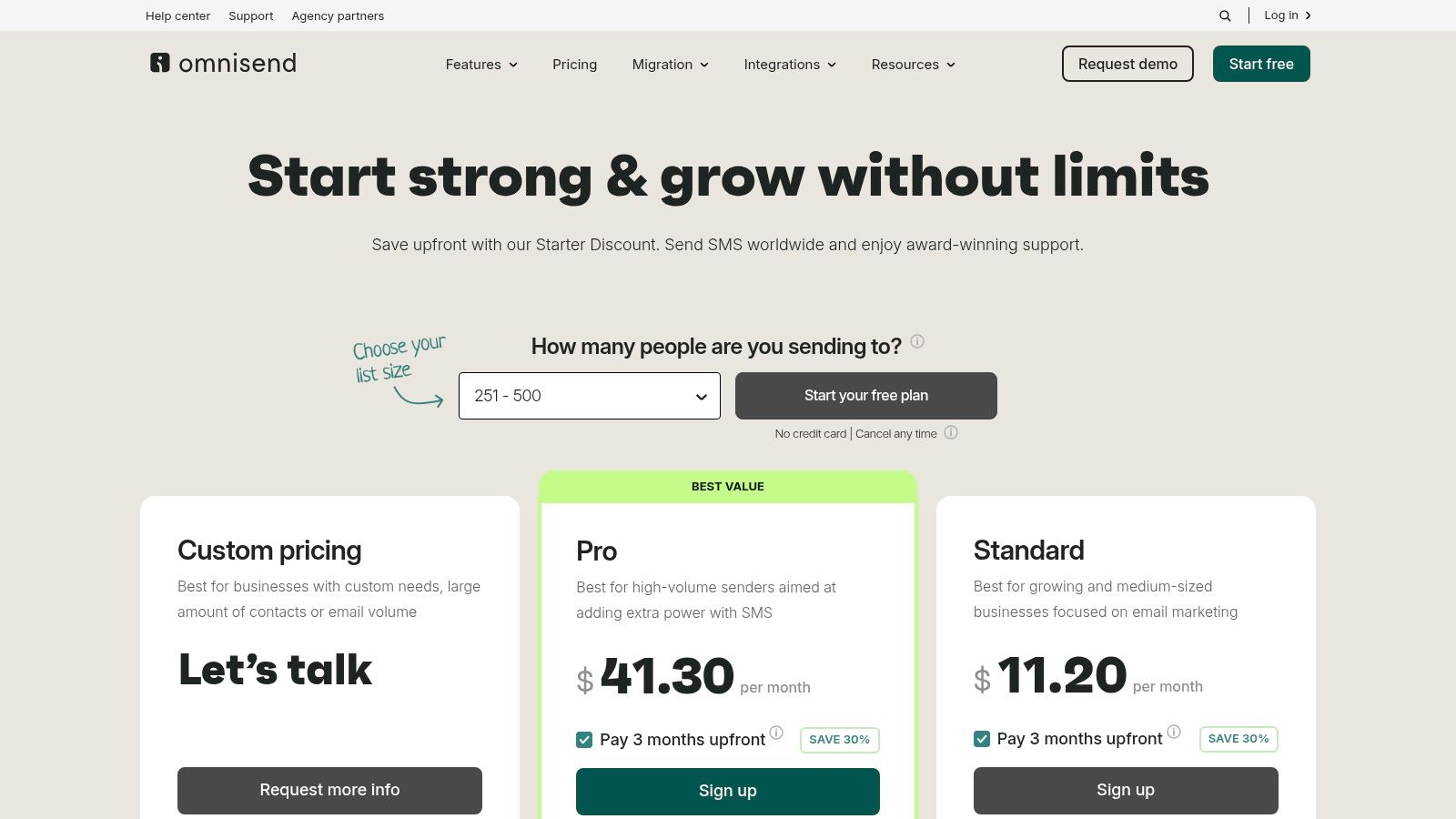
The platform provides a free plan for light testing, while its paid tiers are based on your contact count, allowing the service to scale with your store's growth. Higher-tier plans include valuable monthly SMS credits, which helps make a multichannel marketing strategy feel more attainable by offsetting some of the costs. This integrated approach means you can manage both email and text message campaigns from a single, unified dashboard.
Key Features & User Experience
Omnisend shines with its plug-and-play e-commerce automations. You can set up abandoned cart reminders, browse abandonment notifications, and welcome series in minutes using templates that are already proven to work. The drag-and-drop editor includes special blocks to pull products directly from your store into your emails, a feature that drastically speeds up campaign creation.
- Pros: The setup for an e-commerce store is exceptionally fast, and the templates are practical for driving sales. The inclusion of SMS credits on the Pro plan is a significant benefit for anyone wanting to explore text marketing without a separate tool.
- Cons: The free plan includes Omnisend branding on your emails. Phone support is limited, which could be a drawback if you prefer voice-based help. It's also less suited for non-e-commerce businesses, like bloggers or service providers, compared to creator-focused platforms.
10. Drip
For small businesses rooted in ecommerce, Drip offers a powerful engine designed specifically to turn browsers into buyers and buyers into repeat customers. If your business is selling products directly online, especially through platforms like Shopify or WooCommerce, Drip provides a level of data-driven marketing that simpler platforms can't match. It moves beyond basic newsletters to help you understand customer behavior and automate communication based on what people do on your site.
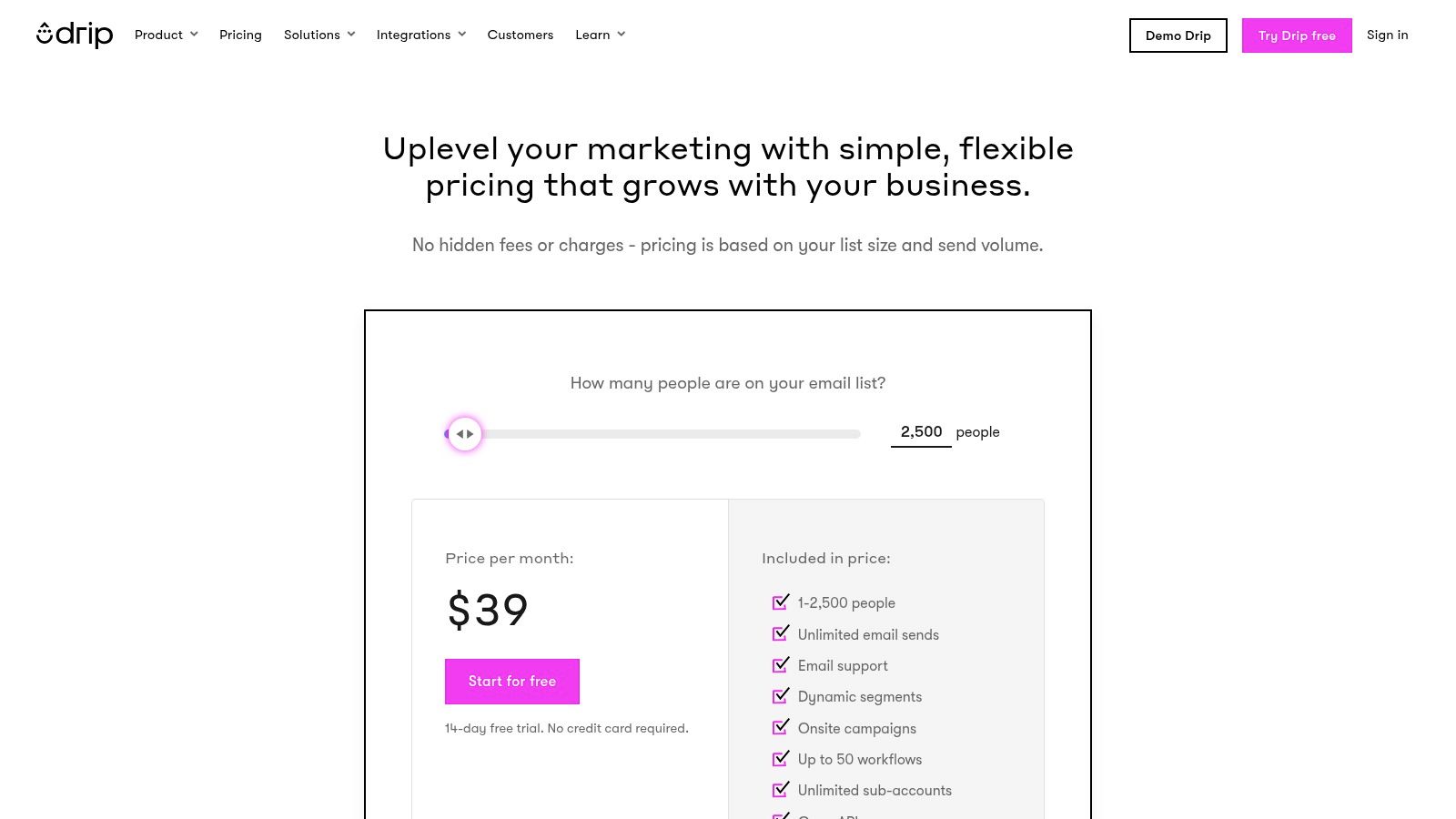
This platform is built for growth-focused online stores that want to connect actions, like viewing a product or abandoning a cart, directly to revenue. It's one of the best email marketing platforms for small business owners who are ready to get more advanced with their sales funnels and customer lifecycle marketing. Pricing starts at $39/month for up to 2,500 contacts, with costs scaling based on list size and feature usage.
Key Features & User Experience
Drip's strength lies in its deep ecommerce integrations and visual automation workflows. You can build complex, branching sequences based on triggers like a customer’s first purchase, their last visit date, or the specific products they’ve viewed. This allows for highly personalized communication. The platform also combines email and SMS marketing, giving you two channels to reach customers from a single dashboard.
- Pros: Its revenue dashboards and attribution reporting are excellent, showing you exactly which emails are making money. The segmentation capabilities are first-rate for ecommerce, and it scales well as your store grows.
- Cons: For a simple blog or service-based business, Drip is likely overkill and more expensive than necessary. The focus on ecommerce means it lacks some features that non-retail businesses might find more useful.
11. beehiiv
If you see yourself as more of a writer or creator than a marketer, beehiiv might be the platform you’ve been looking for. It was built specifically for newsletter creators who want to focus on writing great content while also having powerful, native tools to grow and monetize their publication. This focus on media-style newsletters makes it one of the best email marketing platforms for small business owners centered on content creation.
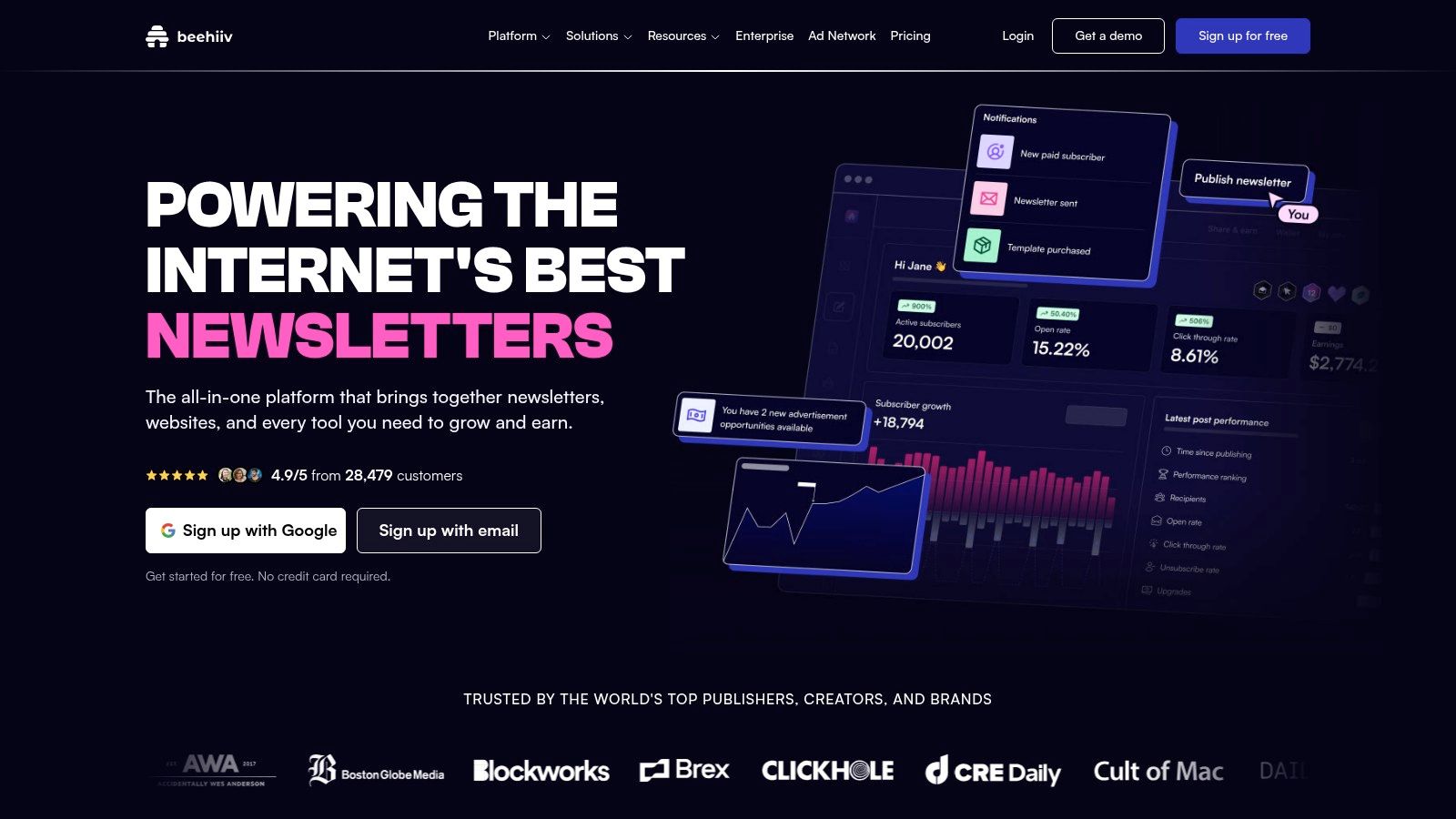
The platform’s free plan is quite generous, allowing up to 2,500 subscribers and unlimited email sends, which is an excellent starting point for new creators. This lets you build a substantial audience before you ever have to consider a paid plan, giving you the time and space to find your voice without financial pressure.
Key Features & User Experience
beehiiv’s most compelling features are its built-in growth and monetization tools, which are usually handled by third-party software on other platforms. You can create a referral program or participate in "Boosts," where you pay other newsletters to recommend you, all from your dashboard. It also includes a native ad network, simplifying the process of finding sponsors for your publication.
- Pros: The integrated growth and monetization features are exceptional for creators. The user interface is clean, modern, and focused on the writing experience. Its free plan provides a significant runway for new publications to get started.
- Cons: Because it's designed for newsletters, it's less suited for complex e-commerce automations. Advanced website customization and some of the more powerful features are reserved for paid tiers.
12. Sender
Sender is a strong contender if your primary goal is to find an affordable, no-frills email marketing platform that just works. For many small business owners, especially those watching every dollar, the complexity of advanced platforms can be more of a hindrance than a help. Sender cuts through the noise with a straightforward approach, focusing on core email and SMS marketing features without overwhelming you with bells and whistles you may never use. It’s an excellent choice if you need a predictable, low-cost solution to grow your audience.
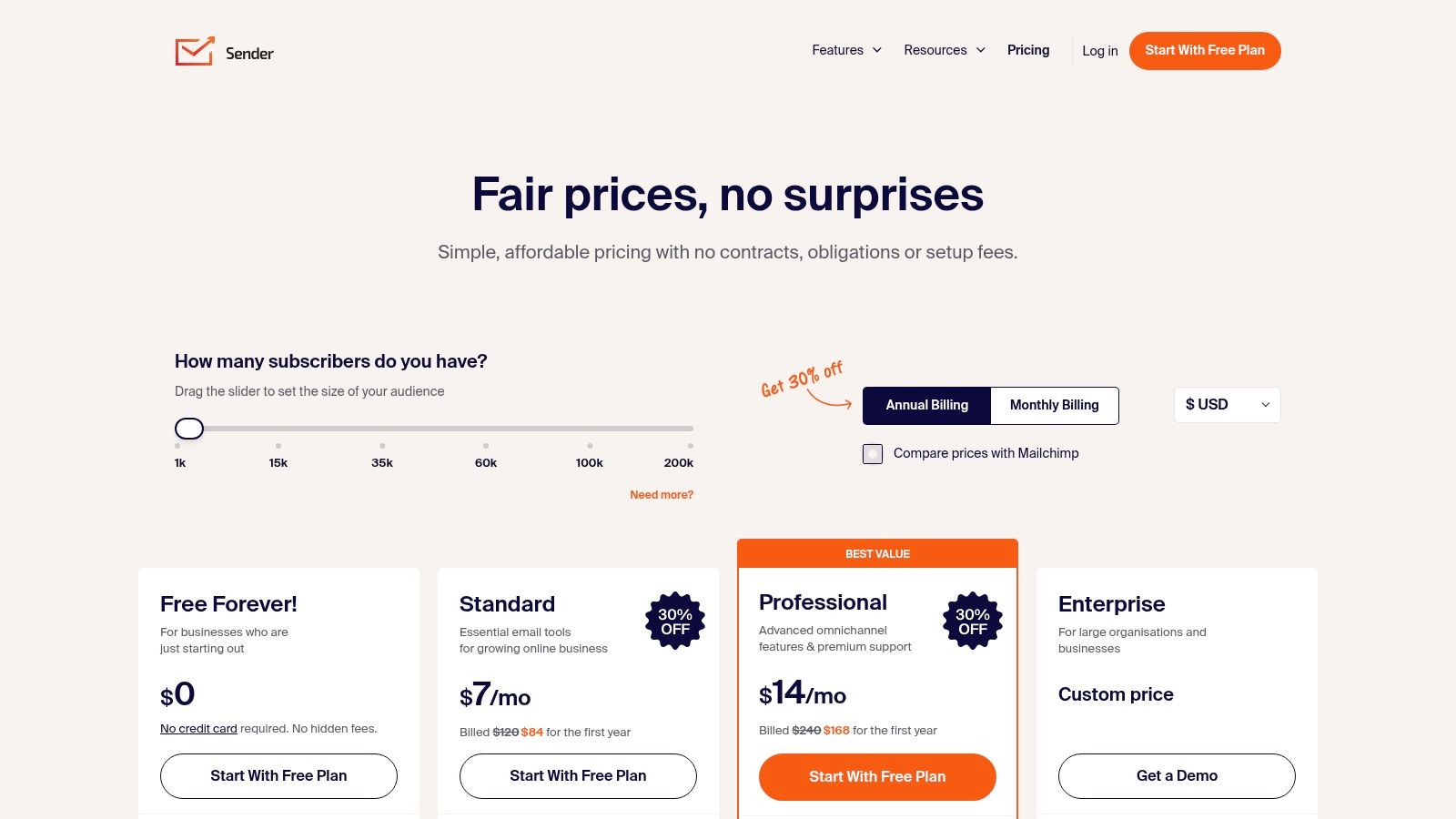
The platform’s free plan is one of the most generous available, offering up to 2,500 subscribers and 15,000 monthly emails. This gives you a significant amount of room to build your list before needing to upgrade. Its paid tiers are also very competitively priced, making it one of the best email marketing platforms for small business owners who prioritize budget and simplicity. You can find more details about their offerings on the Sender pricing page.
Key Features & User Experience
Sender provides all the essential tools you need, including a drag-and-drop editor, pre-made templates, and simple automation workflows for welcome series or abandoned cart reminders. The user interface is clean and easy to navigate, so you can set up and send your first campaign without a steep learning curve. The optional SMS marketing add-on also provides another way to connect with your audience.
- Pros: The pricing structure is extremely competitive, and the free tier is one of the most generous on the market. Its feature set is straightforward and perfect for small teams or solo entrepreneurs who need fundamental email marketing tools without unnecessary complexity.
- Cons: Sender offers fewer native integrations with other apps compared to larger platforms like Mailchimp. Its community and support ecosystem are also smaller, so finding third-party tutorials or advanced guides can be more challenging.
Top 12 Email Marketing Platforms Comparison
| Tool | ✨ Core features | ★ UX / Quality | 💰 Pricing & Value | 👥 Best for | 🏆 Standout |
|---|---|---|---|---|---|
| MailerLite | Drag‑and‑drop, automations, landing pages, simple sites | Clean UI; strong deliverability ★★★★ | Subscriber‑based scaling; nonprofit discount 💰 | Solo creators & small businesses 👥 | Easy setup for non‑tech users 🏆 |
| Kit (formerly ConvertKit) | Visual automations, product checkout, 100+ integrations | Creator‑focused UX; strong tagging ★★★★ | Generous free tier; grows with list size 💰 | Creators, newsletter authors, course sellers 👥 | Native monetization tools ✨ 🏆 |
| Mailchimp | Automations, AI tools, landing pages, commerce features | Broad ecosystem; mature docs ★★★ | Pay‑as‑you‑go option; free plan limited 💰 | SMBs and generalists needing many integrations 👥 | Largest integration library 🏆 |
| Brevo (Sendinblue) | Email, SMS, WhatsApp, lightweight CRM; send‑volume pricing | Good for light sending; multichannel ★★★ | Volume‑based pricing can be cheaper for big lists 💰 | Large lists with low send frequency; cost‑sensitive 👥 | Multichannel value & send‑volume model 🏆 |
| ActiveCampaign | Deep automations, site/event tracking, optional CRM | Powerful but steeper learning curve ★★★★ | Strong automation value; add‑ons increase cost 💰 | SMBs building behavior‑based journeys 👥 | Automation depth and tracking 🏆 |
| Constant Contact | Templates, event management, basic automations, SMS | Simple onboarding; responsive support ★★★ | No permanent free plan; scales with contacts 💰 | Local businesses, nonprofits, events 👥 | Event tools + hands‑on support 🏆 |
| GetResponse | Funnels, automations, landing pages, built‑in webinars | Feature‑rich; can feel complex ★★★ | Broad features for price; higher tiers for advanced tools 💰 | Creators wanting native webinar + email combo 👥 | Built‑in webinar support 🏆 |
| AWeber | Templates, automations, landing pages, solid deliverability | Dependable, utilitarian UX ★★★ | Predictable pricing bands; beginner‑friendly 💰 | Beginners and small nonprofits 👥 | Reliable deliverability & support 🏆 |
| Omnisend | Ecommerce automations, product blocks, email+SMS | Fast ecommerce setup; practical templates ★★★ | Free testing; Pro adds SMS credits 💰 | Small online stores (Shopify/WooCommerce) 👥 | Prebuilt ecommerce flows & SMS credits 🏆 |
| Drip | Visual workflows, revenue dashboards, product data | Advanced ecommerce targeting ★★★★ | Pricing scales with list and features 💰 | D2C merchants needing attribution & revenue tracking 👥 | Deep ecommerce attribution & lifecycle flows 🏆 |
| beehiiv | Referral Boosts, ad network, sponsorship tools, web builder | Newsletter‑centric UX; growing features ★★★★ | Competitive free/entry tiers; paid unlocks ✨ 💰 | Media‑style creators & publishers 👥 | Native monetization & growth tools 🏆 |
| Sender | Email campaigns, automations, SMS add‑on, generous free plan | Simple, budget‑friendly UX ★★★ | Very generous free tier; low‑cost scaling 💰 | Small teams and cost‑sensitive businesses 👥 | Best budget option with big free plan 🏆 |
Your Small, Simple Next Step
We've covered a lot of ground. Seeing all those names and features laid out can feel overwhelming, especially if technology isn’t your comfort zone. I remember that feeling well; the first time I looked at a list like this, I almost closed the browser.
Take a deep breath. You are not behind. The goal wasn’t to memorize every detail but to show you that there are tools designed for people just like you, no matter your budget or technical skill level. A solution exists to help you connect with your audience with simplicity and peace of mind.
Here is a small, manageable action step you can take today. Don't try to pick the "perfect" platform for the next ten years. Just choose one to start with.
- If you're starting with zero budget and feel overwhelmed: Begin with the free plan from MailerLite. It's calm, simple, and allows you to learn the basics without financial pressure.
- If you're a writer or creator: Look at Kit (formerly ConvertKit). It's built with your needs in mind, helping you connect directly with your readers.
- If you plan to sell products online: Consider Omnisend. Its features are designed to help you generate income from an online store.
Remember, this platform is just a tool. The real asset is the relationship you build with your subscribers. This is about creating security and independence for your second chapter, on your own terms. Each email you send is a small step toward a business that can provide peace of mind for years to come.
The next five years will pass either way. The only question is whether you’ll use them to build something that gives you true independence. Don’t let doubt tell you it’s too late. It’s not. Your journey is just beginning.
If you’d like to see the training I used to learn how to connect these pieces step-by-step—from choosing a platform to building a real online business—you can check it out here. It provided the mentorship I needed to move forward with confidence. You can learn more about it here.





Pingback: How to Clean an Email List Without Feeling Overwhelmed - Victoria OHare
Pingback: Best Autoresponder for Affiliate Marketers: A 2026 Guide - Victoria OHare