
If you're over 50 and wondering whether it's too late to feel safe about money, you're not alone. A lot of women carry a quiet fear that Retirement won't be enough, that they should've started earlier, or that tech has moved on without them. I remember feeling that same knot in my stomach the first time I logged into a training dashboard, staring at buttons and tabs like they were written in another language.
That feeling doesn't mean you failed. It usually means life happened, money got tight, caregiving took time, or no one showed you a simple path that fit a real woman's life. Financial freedom for women is not about becoming flashy or hustling harder, it's about building enough control that you can breathe again.
You're Not Behind and It Is Not Too Late
A lot of women think their fear means they're starting from zero. I'd frame it differently. You're starting from experience, and experience counts for a lot more than people admit.
I've talked to women who were raising kids, helping parents, recovering from divorce, or working jobs that left no room for extra brain space. They weren't lazy. They were carrying too much. The World Bank's Global Findex 2021 shows that account ownership is now much more widespread, with 78% of men and 74% of women worldwide holding an account, and the gender gap in access to financial services down to 4 percentage points for the first time in a decade, though the gap in developing economies is still wider at 6 percentage points (World Bank Global Findex 2021). That matters because access is the starting point, not the finish line.
Practical rule: If you have been telling yourself you're late, replace that thought with, “I'm building from here.”
There's also a bigger truth underneath the worry. Women's financial lives are often shaped by lower earnings and less control inside households, not just personal habits. In the EU, women in relationships earn one third less than their partner's earnings on average, and 7% of women say a partner forbids them to work or controls family finances and expenses (EIGE). That's not a character flaw. That's structure.
The first time I tried to learn online income systems, I almost quit because every tab looked important and every step felt technical. What helped was hearing someone say, “You don't need to know everything. You need a first next step.” That changed everything.
If you want a grounded place to begin with the emotional side of starting over, starting over at 50 financially can help you see this season with more dignity and less shame.
What Financial Freedom Actually Means in Real Numbers
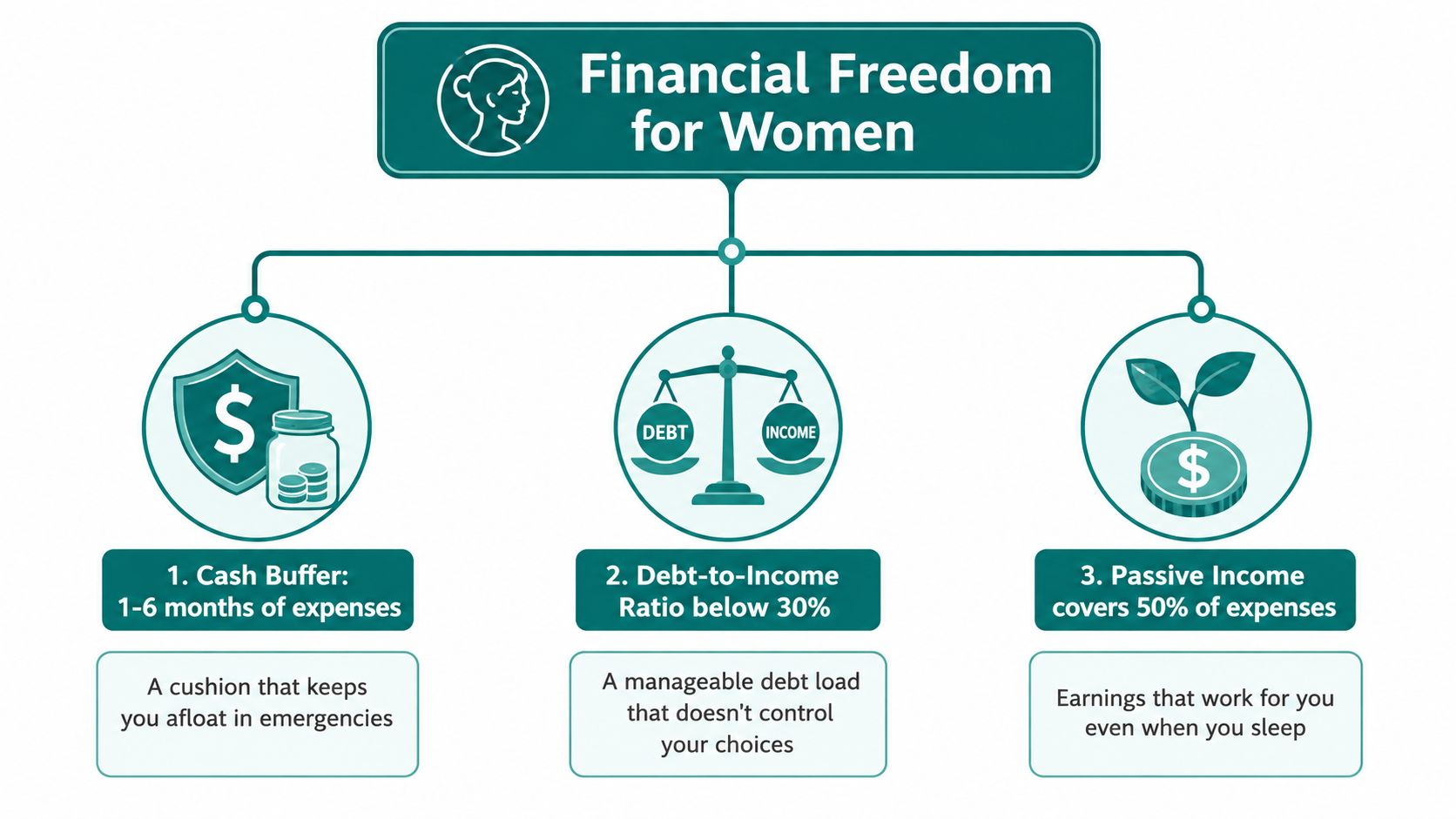
Financial freedom gets talked about like a feeling, but women usually need a picture they can measure. For me, it comes down to three checkpoints, not one giant finish line.
First, you need a cash buffer. The Barbados Central Bank says to aim for at least one month of expenses readily accessible, with three to six months set aside for emergencies, and it suggests starting by separating income from expenses before making cuts (Central Bank of Barbados). That buffer is what keeps a flat tire, a bill spike, or a slow month from turning into panic.
Second, you need income that doesn't depend on one source. That can mean a mix of work, affiliate earnings, or brand work. The point isn't to replace your whole life overnight. The point is to stop leaning on one paycheck, one person, or one platform.
Third, you need an owned audience. An email list is the simplest example. Social media can disappear, but your list is more like a room you own. It's not glamorous, but it's sturdy.
A lot of women hear the phrase “financial freedom” and think it means early Retirement or a big investing account. Sometimes it does. More often, it means having choices. It means saying yes to a family need without derailing yourself. It means not panicking every time life gets messy.
Plain version: Freedom is not a lifestyle. It's a set of options.
If you like seeing the bigger picture laid out in simple terms, what is financial freedom can help you compare the idea of freedom with what it looks like in real daily life.
Here's the simplest summary. Cash buffer. Diversified income. Owned audience. Those three pieces give you peace of mind, room to move, and more control over your next chapter.
Savings Targets and Emergency Funds Made Simple
A lot of money advice fails because it starts too high. Women look at the ideal version and feel defeated before they begin. That's why I like simple starting points better than perfect ones.
The Barbados Central Bank's guidance is straightforward. It says ideally to save about 30% of income, but if that feels too steep, start with 10% (Central Bank of Barbados). That matters for midlife women, because many of us are working with caregiving, debt, uneven months, or part-time income. Starting small isn't failure. It's strategy.
A simple way to think about it is this. If 30% feels impossible, 10% is still a respectable starting point. If 10% still feels heavy, start by separating what comes in from what goes out, then choose one line item to trim. That's often enough to create movement.
For the emergency fund, the same source says to aim for at least one month of expenses that's easy to reach and three to six months set aside for emergencies (Central Bank of Barbados). You do not need to build the whole thing in one sweep. You need a starter number you can track.
| Realistic Starting Points for Midlife Women | ||
|---|---|---|
| Stage | Target | Why It Matters |
| First step | 10% of income | Easier to keep going when money feels tight |
| Starter buffer | One month of expenses | Helps with small surprises |
| Stronger cushion | Three to six months of expenses | Gives room for bigger interruptions |
If you want a practical guide to the mechanics of the buffer itself, the idea behind build an emergency fund is simple. The fund exists so one bad week doesn't knock over the whole month.
A useful habit is writing two numbers on a sticky note. One is your weekly savings target. The other is your starter emergency-fund goal. Keep both small enough that you won't avoid looking at them.
Three Income Streams You Can Learn at Any Age
A lot of women think making money online means becoming an influencer with perfect lighting and endless energy. It doesn't. Some of the most realistic paths are quiet, simple, and built around trust.
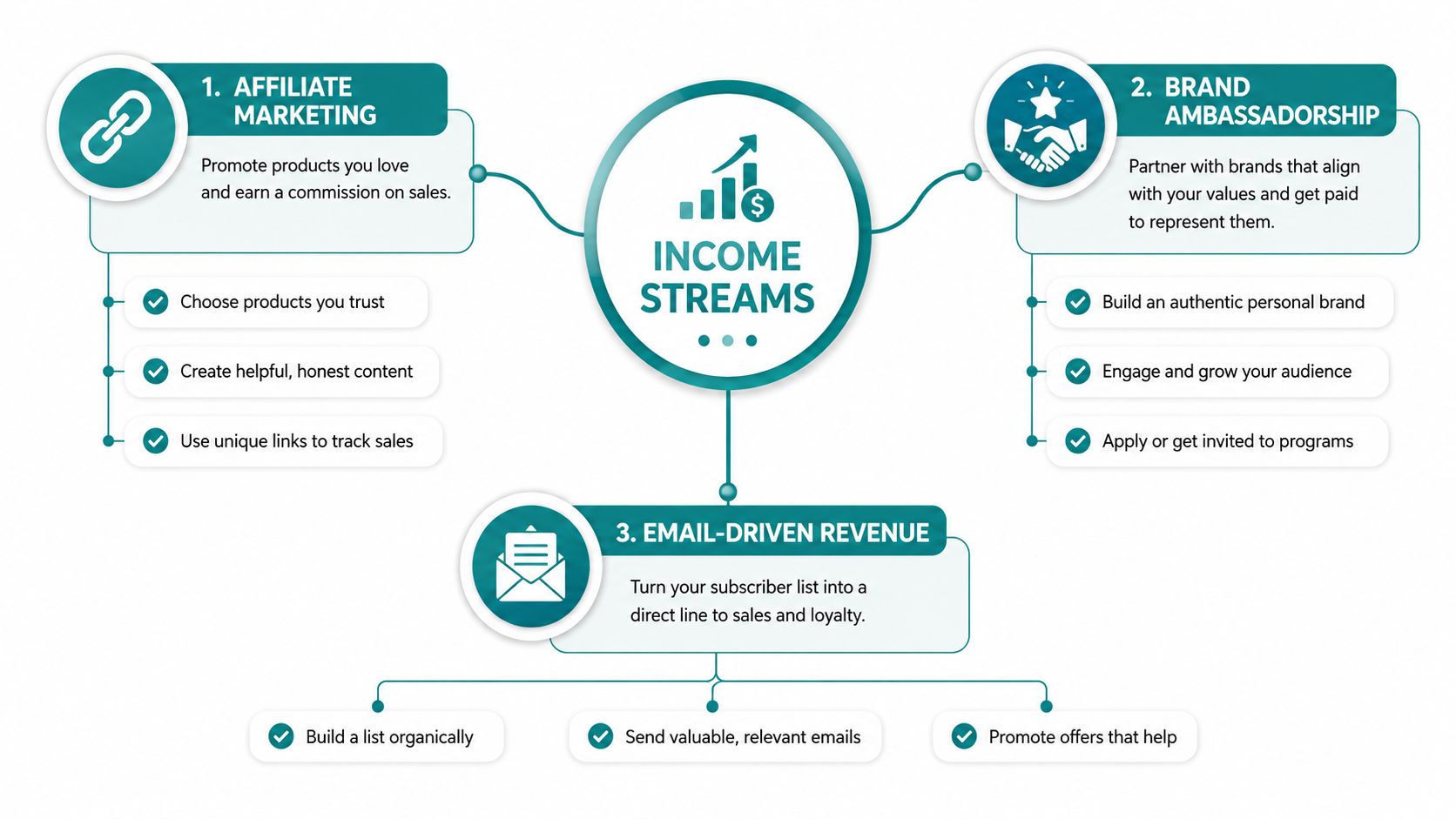
Affiliate marketing is the easiest to understand. It's recommending products and earning a commission. If you already use a planner, a camera, a skincare product, or a home tool, you're not starting from scratch. You're sharing what you trust. For a step-by-step starting point, multiple streams of income ideas shows how beginners can think about stacking income without making life chaotic.
Brand ambassadorship is a little different. You become a trusted face for a brand whose values fit yours, and the brand pays you to represent it. That might look like testing products, writing simple posts, or showing how something fits into real life. It works best when your voice feels steady and genuine, not salesy.
Email-driven revenue is the part most beginners underestimate. You build a small list of people who want your help, then share useful emails that point them toward products, offers, or content. Your list becomes a direct line to people who asked to hear from you.
 Affiliate Marketing, brand ambassadorship, and email-driven revenue." />
These three streams work well together because each one supports the next. Your email list helps you share affiliate links. Affiliate content can show brands that you understand an audience. Brand work can deepen trust with the same subscribers who already like your voice.
The list is the asset. The content is the bridge. The income follows the trust.
If you're curious whether blogging can still make sense in the years ahead, blogging income potential in 2026 is a useful reminder that the model still has room for people who teach clearly and consistently.
You don't need to know everything about each stream on day one. You just need to know what each one is. That alone removes a lot of fear.
A Realistic Six-Phase Roadmap
The fastest way to get overwhelmed is to treat this like a giant reinvention project. It's better to think in phases. That keeps the work humane.
Phase one, stabilize the cash buffer
Start by separating income from expenses and naming your first savings target. The goal isn't perfection, it's a little breathing room. If you can keep one month of expenses accessible, you've already made life less fragile.
Phase two, choose a niche from lived experience
Pick a topic you already understand well enough to explain clearly. That might be family budgeting, helping women over 50 start online, home organization, caregiving life, or practical product reviews. A clear niche makes your message easier to trust.
Phase three, set up the small tech stack
Keep it light. You need a landing page, one freebie, and an email tool. Nothing else. I know that can sound intimidating, but this is the point where many women discover the tech is simpler than they feared.
Phase four, publish the first helpful pieces
Write or record content that answers real questions. One post can solve one problem. One video can explain one step. That's enough to start building familiarity.
Phase five, join affiliate programs and apply for small brand partnerships
Income begins to connect to your content. If bookkeeping is your lane, attract your first bookkeeping clients shows how a service offer can be framed clearly. If your lane is recommendations and partnerships, keep the offers relevant to what your audience already needs.
Phase six, build the retention loop
This is the part many people ignore. You keep people interested by sending useful emails, checking what they still want, and re-engaging the subscribers who drift away. That's how a list stays healthy instead of becoming a forgotten pile of names.
Fidelity's 2024 Women and Money study reported that 53% of women felt financially independent, up from 45% in 2022 and 51% in 2023, while 17% still did not feel financially independent, and 51% of that group said it limited their life choices (Fidelity International). That's a reminder that confidence grows when the system underneath you gets stronger.
The next five years are going to pass whether you start or not. The question is whether you use them to build a little more control each year.
Addressing the Three Fears That Stop Most Beginners
I understand being cautious. There are scams online, and women have every reason to be careful with money and trust. But caution is different from freezing.
Is Affiliate Marketing a scam? No, not by itself. It's a standard way creators earn by recommending products, but the scam risk comes from hype, bad training, and anything that promises easy money with no work. Good education is boring in the best way. It teaches you what to say, what to share, and what to avoid.
Do I need tech skills? Not deep ones. You need enough skill to open an email tool, paste links, and publish simple content. The World Bank notes that supply-side data can be collected through administrative reporting, and some central banks already require sex-disaggregated reporting on women-owned SMEs, deposits, and electronic services (World Bank). That's a reminder that systems are built in pieces. You don't need to master everything at once.
Am I too old? No. You're in a life stage where clarity matters more than trend-chasing. The OECD says women often have lower financial knowledge and confidence than men in many countries, and that young women, elderly widows, less well-educated women, and low-income women need financial knowledge the most (OECD). That doesn't read like a deadline to me. It reads like an opening.
The core question isn't whether you can learn. It's whether you're willing to learn one calm step at a time.
Retention, Mindset, and Your First Small Action
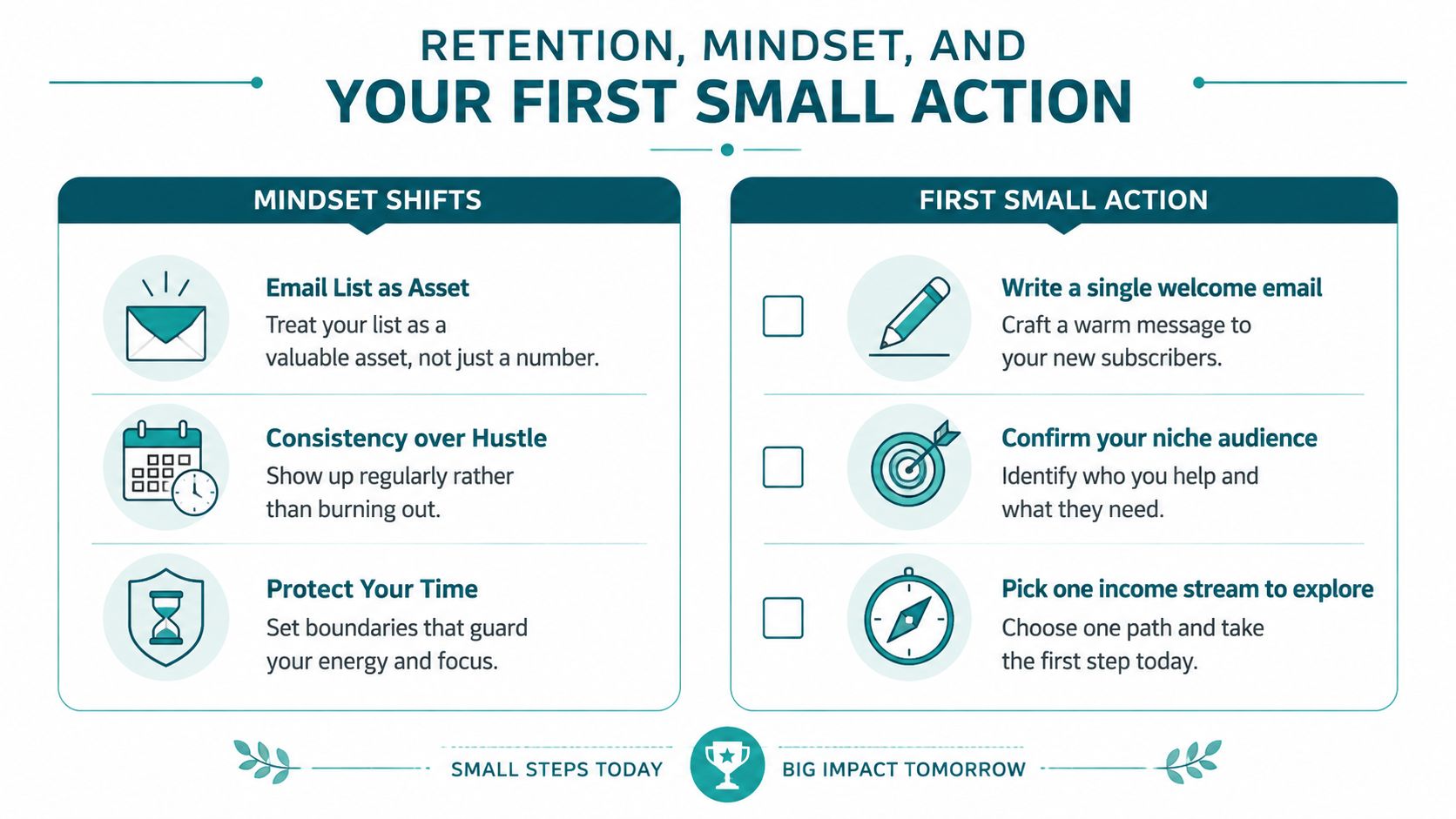
The women who make this work usually stop treating their email list like a vanity metric. They treat it like an asset. That shift changes everything.
Retention is simpler than people think. You send useful emails on a regular rhythm, you separate readers by what they care about, and you check in with the ones who stop opening. That kind of steady care builds trust. It also helps you protect your time, which matters when you're juggling caregiving, work, and your own energy.
 email list growth and business success." />
A few mindset shifts make the work lighter.
- Email List as Asset: Treat your list as something you own, not something that depends on algorithms.
- Consistency over Hustle: Show up on a rhythm you can keep.
- Protect Your Time: Build around your real life, not a fantasy schedule.
A few first actions keep it practical.
- Write a single welcome email: Send one warm message to new subscribers.
- Confirm your niche audience: Name who you help and what they need.
- Pick one income stream to explore: Choose Affiliate Marketing, brand work, or email-driven revenue.
Small rule: If a task takes more than one sitting to understand, break it in half.
If you want a calm place to keep learning, Victoria OHare offers beginner-friendly guidance on Affiliate Marketing, brand ambassadorship, List Building, and simple automation for women who want flexible income without the noise.
The next five years will pass either way. The only question is whether you'll use them to build something that gives you peace of mind.