
If you're over 50 and wondering whether it's too late to build income online, you're not alone. A lot of women feel that quiet pressure, especially when Retirement feels uncertain and the internet seems to move faster than they do. None of that means you've failed. It means you're human, and you're looking for a steadier path.
Tech overwhelm can make everything feel harder than it should. So can the thought that younger people have already figured it out while you're just trying to keep up. You're not behind. You can learn this, one calm step at a time.
Word of mouth marketing is one of the gentlest places to begin because it's already part of how people make decisions. You probably trust a friend's recommendation more than a polished ad, and so does almost everyone else. That same simple human behavior is also the quiet engine behind affiliate income, brand ambassadorship, and honest online recommendations.
If You're Over 50 and Wondering If It's Too Late
I remember what it feels like to sit at the kitchen table, stare at a laptop, and wonder if everybody else got a head start. You can feel that worry in your body, especially when Retirement doesn't feel as secure as it used to and your plan depends on more than one paycheck. That kind of pressure can make even simple online tasks feel heavy.
But word of mouth has always belonged to ordinary people, not just marketers. It shows up when a neighbor says which doctor she trusts, when a sister tells you which vitamins helped her sleep better, or when a friend shares the podcast that made her feel understood. That's why it's such a comfortable path for midlife women who want a second chapter without pretending to be someone else.
A woman doesn't need to be loud to be influential. She needs to be helpful, consistent, and honest. Those qualities don't expire.
You're not learning a trendy trick. You're learning how trust moves between people, and that's a skill that only gets stronger when life has given you more experience.
For women who want to make money online after 50, that matters. You don't need a huge audience to start. You need a clear way to recommend what you know, so your words can do the quiet work of building trust.
What Word of Mouth Marketing Means
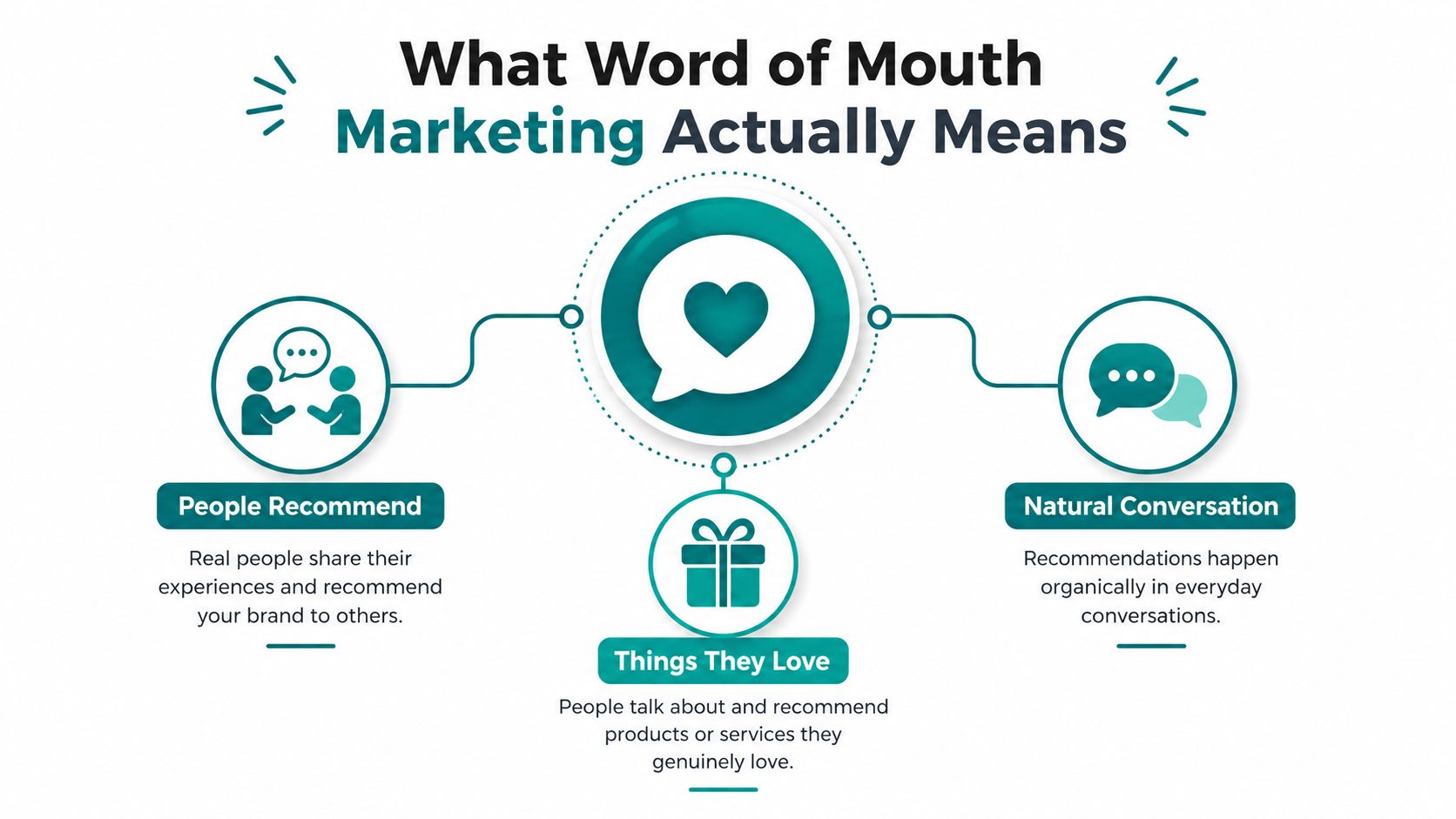
At its simplest, word of mouth marketing happens when one person recommends something to another person because it helped them. It feels like the kind of conversation you might have over coffee with a friend. There is no script, no hard sell, no pressure. One person simply says, “This worked for me, so I thought I'd tell you.”
That is also why it feels so different from a paid ad. A paid ad interrupts. Word of mouth arrives through trust. Nielsen's 2021 Trust in Advertising Study found that 88% of consumers globally trust recommendations from people they know, based on 40,000 respondents across 56 countries. Buyapowa's summary of Nielsen's study makes that clear in plain language, and it is a strong reminder that familiar voices still shape buying decisions (Buyapowa's summary of Nielsen's study).
For a midlife creator, that is encouraging. You do not have to become a performer. You only need to be clear about what you like, what it helps with, and who it is for. Resources like Refgrow on WOM marketing can help when you are learning how recommendations spread in practical ways.
The everyday version and the marketing version
In daily life, word of mouth looks like a friend texting you about a skin cream, a book, or a program she tried. In marketing, the same behavior becomes a repeatable way to share products, ideas, or services. The message still feels personal, but it can also be tracked through links, referrals, and sign-ups.
That is the bridge to Affiliate Marketing. Affiliate Marketing uses the familiar habit of recommending something useful and turns it into a digital income path. You are still giving a recommendation. You are just doing it in a way that can support income too.
Why it works so well
People trust people more than they trust polished brand language. That is the reason word of mouth marketing has stayed relevant for so long. When a recommendation feels sincere, it lowers the fear of making a bad choice.
A good recommendation works like a trusted neighbor pointing you toward the right aisle in a store. You still choose for yourself, but you waste less time and feel less unsure. That same feeling is what makes referrals so effective in Affiliate Marketing, because the purchase starts with trust instead of pressure.
Practical rule: if you would not recommend it to a friend over tea, it probably does not belong in your affiliate content.
Why Word of Mouth Outperforms Paid Ads
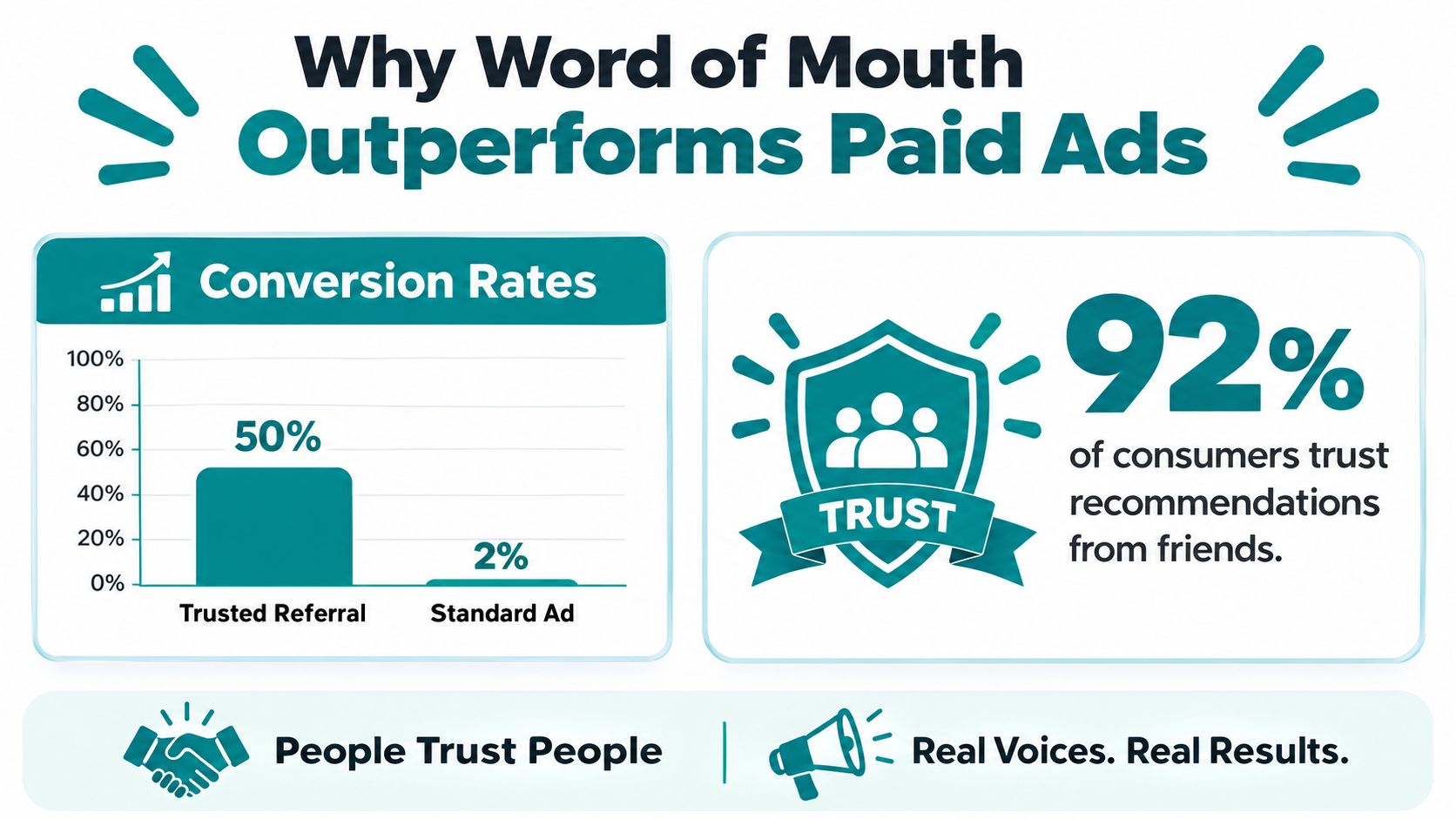
There's a simple reason recommendations often outperform ads, trust travels farther than attention. A paid impression can be seen and forgotten. A recommendation from someone people know tends to feel personal, relevant, and safer to act on.
Industry summaries cited by GrowSurf say WOM impressions can generate 5 times more sales than a paid media impression, and people have about 90 brand-related conversations per week (GrowSurf's word-of-mouth marketing statistics). That combination matters. If people are already talking, then your job is not to force conversation. Your job is to join the conversation in a way that feels useful.
The trust gap changes the outcome
Many readers assume paid ads are the more professional route. They aren't always the more effective route, especially for smaller creators. A recommendation from a real person carries the weight of lived experience, while an ad often has to overcome skepticism before it can do any work.
Related summaries also note that word of mouth can be the primary factor behind 20% to 50% of purchasing decisions (Buyapowa's summary). That doesn't mean every purchase starts with a friend's advice, but it does show how often people lean on social proof when they feel unsure.
Good experiences spread differently than bad ones
Word of mouth isn't only about praise. Keller Fay-based reporting says positive experiences are shared with 9 people on average, while dissatisfied customers tell about 15 people (Gitnux's summary of word-of-mouth statistics). That's a quiet reminder that integrity matters. People remember how a purchase made them feel, and they talk when something disappointed them.
For creators, that means your best marketing asset is still the experience you create. If your recommendation feels honest, timely, and helpful, it can travel in a way that a standard ad can't.
How Affiliate Marketing Is Modern Word of Mouth
A friend says, “I tried this and it helped,” and you pay attention. Affiliate Marketing uses that same human habit, then adds a link so the recommendation can be tracked and credited. It is recommending products you already know and love, and earning a commission when someone buys through your link. No warehouse, no packing boxes, no customer service desk. It is a way to turn helpful recommendations into an income stream you can measure.
For many women, that feels easier to trust than other online business models. You are not creating demand from scratch. You are guiding someone toward something useful. If a product solves a real problem, your recommendation can feel like care instead of pressure.
The scam worry comes up quickly, and it should. There are plenty of bad actors online. Legitimate affiliate programs are commission-based partnerships, so the ethics stay simple, share clearly, disclose when needed, and recommend only what you would stand behind in real life.
A good beginner resource is this guide to Affiliate Marketing for women over 50, especially if you want the basics in plain language. You can also read a creator affiliate revenue guide to see how content creators structure recommendations without making the process feel forced.
Why it fits midlife creators so well
You already know how to notice what helps people. That matters. Years of buying products, solving problems, and hearing friends talk about what worked for them have already trained your judgment.
Affiliate marketing gives that judgment a place to work online. You are not starting from zero. You are turning experience into a digital asset, the same way a well-used recipe card becomes more valuable each time someone asks for it.
A simple way to think about it
- Word of mouth is the human behavior.
- Affiliate marketing is the tracked version of that behavior.
- Trust is what makes both of them work.
If you want a deeper look at the standards that keep this kind of marketing honest, ethical business standards are worth reading before you start sharing links.
Five Ethical Tactics That Spark Real Referrals
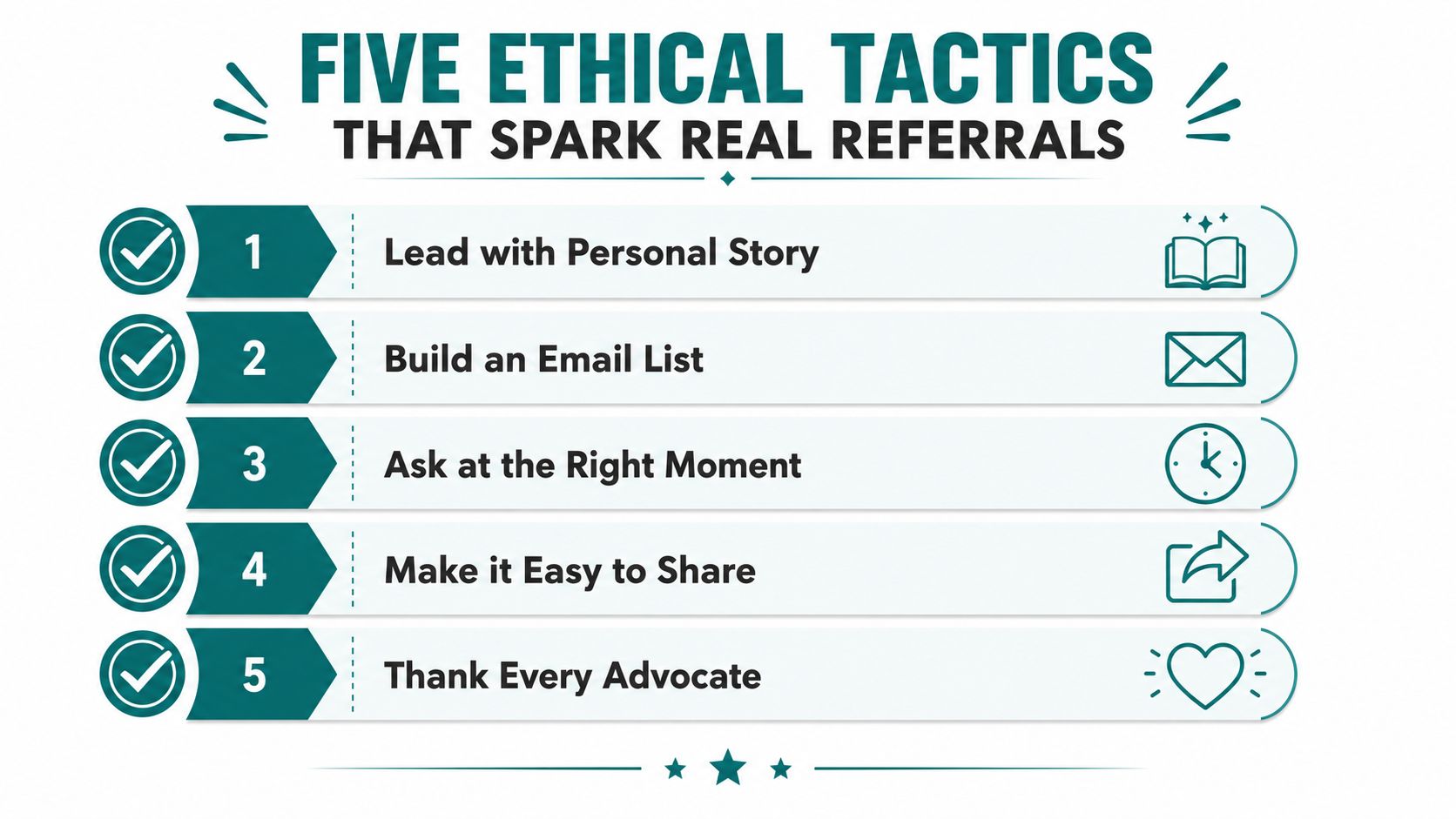
You don't need pressure tactics to get people talking. You need good manners, clear language, and a reason for people to feel helped rather than sold to. Ethical referrals are usually the result of small, thoughtful habits repeated over time.
1. Lead with personal story
People remember stories more easily than feature lists. Instead of saying a product is “great,” explain what problem it solved for you. That makes your recommendation feel real.
Try this prompt. “I used this because I was struggling with ____. What surprised me was ____.” You can say that in an email, on social media, or in a voice note to a friend.
2. Build an email list
An email list is your owned audience. Social platforms can change, but your list is something you control. That matters when you're building income with more dignity and less chaos.
If you're unsure how to think about the boundaries of sharing online, this overview of ethical business standards gives you a solid reference point. The main idea is simple, be clear, be honest, and don't pressure people.
Copyable line: “If you'd like more tips like this, you can join my email list and I'll send them straight to your inbox.”
3. Ask at the right moment
Timing matters. People are more open when they've just had a good experience, solved a problem, or thanked you for a recommendation. That's the moment to ask for a share, a reply, or a review.
A gentle script works better than a pushy one. “If this was helpful, feel free to send it to someone who might need it too.”
4. Make it easy to share
Don't make people translate your message for you. Give them a short summary, a clear link, or a simple sentence they can pass along. The easier it is, the more likely they are to do it.
One small habit I like is creating a three-line share note. It can be as simple as what the product is, who it helps, and why you mentioned it in the first place.
5. Thank every advocate
People notice appreciation. A thank-you message, a reply, or a public note can turn a one-time sharer into a repeat advocate. Gratitude isn't fluff. It's part of relationship building.
I also recommend a quick reminder from brand loyalty definition and growth strategies, because loyalty grows when people feel seen, not managed. That's true whether you're talking about customers or email subscribers.
Real Stories From Women Who Built Income Through Recommendations
A woman in her late fifties started by sharing honest reviews of products she already used. She didn't try to sound like a marketer. She wrote like a friend, saying what worked, what didn't, and who each product might suit. Over time, those simple reviews gave her a small email list, and that list became the place where her recommendations had the most consistency.
Another woman turned everyday wellness conversations into a referral stream. She wasn't pushing people to buy. She just kept mentioning the tools and habits she used, then followed up when someone asked for more details. That steady pattern made her feel trustworthy, and trust is what made the referrals repeat.
What both women had in common was patience. Neither one built momentum by being flashy. They built it by staying useful, staying honest, and letting repetition do its work.
What you can borrow from their approach
- Start with what you already use. If you know a product well, you can speak about it naturally.
- Keep your language plain. The goal is clarity, not performance.
- Stay consistent. People need to hear a useful idea more than once before they act on it.
These aren't dramatic stories, and that's the point. Most sustainable online income starts small. It grows because someone keeps showing up with helpful recommendations.
Measuring Word of Mouth Without Tech Overwhelm

Measurement doesn't need to feel like a dashboard contest. For most solo creators, the useful question is simple, “Did people act on what I shared?” That's easier to track than many women think.
The easiest signals are human ones. Referral clicks, email replies, repeat purchases, and direct messages all tell you something about which recommendations are landing. If people keep asking follow-up questions, that matters. If they forward your email to a friend, that matters too.
McKinsey distinguishes experiential, consequential, and intentional forms of word of mouth and proposes word-of-mouth equity as a way to estimate sales impact, while also noting that attribution is a stronger gap in most how-to guides (McKinsey's article on measuring word of mouth). That's useful because it reminds you that not every helpful recommendation shows up neatly in a spreadsheet.
Organic advocacy and paid amplification
Organic advocacy is when people share because they want to. Paid amplification is when a post, link, or message gets extra reach through spend or incentives. Both can exist in the same business, but they're not the same thing.
That difference matters because a small, trusted recommendation loop can do more than a loud but shallow campaign. If a few people trust your recommendation, they may be more valuable than a bigger audience that doesn't know you well.
A simple weekly feedback ritual
- Check your replies. Notice which topics prompt real responses.
- Review your link clicks. Use the link data you already have.
- Listen for repeated questions. The same question usually points to a useful topic.
- Note where people came from. Ask casually, not mechanically.
If you want a beginner-friendly way to track the link side of things, this step-by-step guide to affiliate link clicks can help without overwhelming you.
You Are Not Behind and It Is Not Too Late
Word of mouth is a second-chapter skill, and that matters more than people realize. It doesn't depend on youth, trends, or pretending to be a tech expert. It depends on lived experience, good judgment, and the willingness to speak plainly about what helps.
That's good news for women who want security, dignity, and independence. Those are not flashy goals, but they're meaningful ones. They're also the kinds of goals that make an online business feel worth building.
I've watched women relax once they understand that they don't need to sell hard. They can help. They can recommend. They can build income from trust instead of noise. That shift brings peace of mind because it feels aligned with who they already are.
The next five years will pass either way. The only question is whether you'll use them to build something that gives you more control, more calm, and more room to breathe. You're not too late for that. You're exactly on time for a quieter, steadier way forward.
Victoria OHare offers beginner-friendly training and resources for people who want to turn helpful recommendations into an online income stream. If this topic speaks to you, visit Victoria OHare and explore the step-by-step support for starting with word of mouth, Affiliate Marketing, and simple audience building.