
If you're over 50 and wondering whether it's too late to build income online, you're not alone. Many women feel behind financially, not because they failed, but because life happened. Careers changed, caregiving took time, savings didn't grow the way you hoped, and now every new online term can feel like one more reminder that the world moved faster than you did.
I remember the first time I opened a marketing dashboard and thought, “I am not the person for this.” Too many buttons. Too many acronyms. Too many people acting like everything should be obvious. If that's where you are, take a breath. You do not need to become a tech expert overnight to learn how to create a sales funnel.
What you need is a simple path. A calm one. One that helps you build an asset, not just chase a paycheck. That matters, especially if Retirement doesn't feel as secure as it once did. A small online system that brings in leads, builds trust, and makes offers can become part of your peace of mind.
You Are Not Behind It Is Not Too Late
A lot of women arrive at this point discreetly.
Maybe you're lying awake doing mental math. Maybe you're looking at Retirement and realizing you want more control than a pension, savings account, or one income stream can give you. Maybe you've heard people talk about online business and thought, “That sounds fine for younger people, but not for me.”
That thought is more common than you think.
Starting now is still starting. It still counts. And learning a simple funnel is not about becoming a flashy marketer. It's about creating a gentle system that helps people find you, trust you, and take a next step.
Why this matters more than it used to
For many midlife women, the issue isn't ambition. It's security.
You want options. You want dignity. You want to know that if expenses rise, work changes, or Retirement feels tighter than expected, you have something of your own that can support you. A funnel can help with that because it turns scattered effort into a process.
Instead of posting randomly, hoping someone notices, you build a path.
- A stranger finds you
- They get something helpful from you
- They join your email list
- They hear from you consistently
- They eventually buy when the timing is right
That's not hype. It's structure.
You do not need to do everything at once. You only need to understand the next step well enough to take it.
My coffee table version of the truth
When I first started learning this world, I almost quit because it all sounded more complicated than it needed to be. I thought funnels were for big companies with teams, software budgets, and paid ads.
They're not.
A solo creator can build one with a simple landing page, one free resource, a small email sequence, and one clear offer. That's enough to begin. In fact, simple is often better because you can manage it without stress.
If you've been searching for ways to make money online after 50, or wondering whether Affiliate Marketing for beginners over 50 is still realistic, this is one of the most useful skills you can learn. Not because it's trendy, but because it helps you build an owned system you control.
You're not behind. You're at the point where clarity matters more than speed.
What a Sales Funnel Really Is and Why It Is Not Scary
You sit down on a quiet afternoon, open your laptop, and wonder whether a sales funnel is about to drag you into a maze of tech, pressure, and complicated marketing language. For many solo creators, especially women building something steadier in midlife, that fear makes perfect sense.
A sales funnel is much simpler than it sounds.
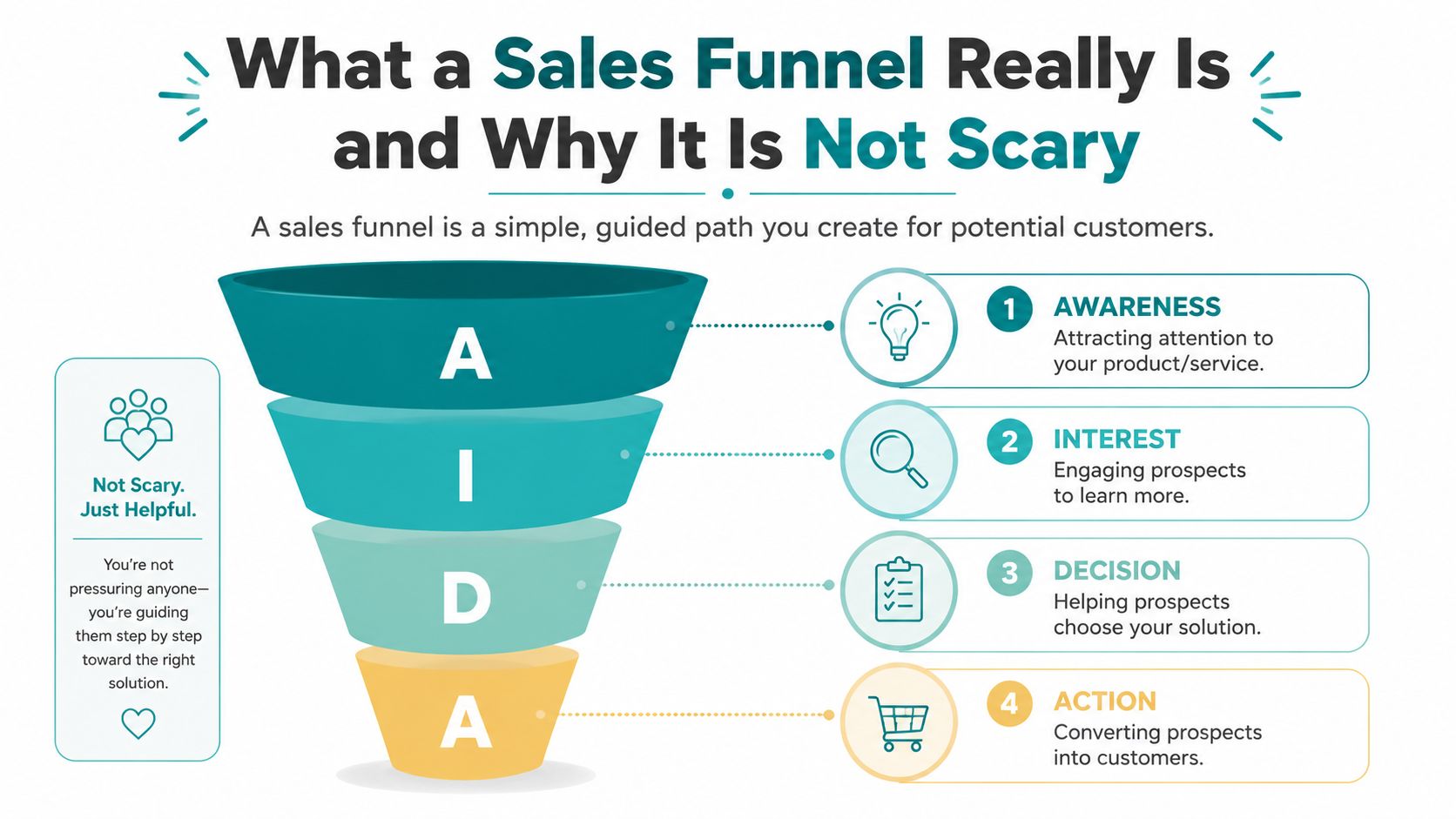
It is a guided path that helps someone go from first noticing your work to understanding your offer well enough to make a clear decision. The classic AIDA model stands for Awareness, Interest, Desire, Action, and it remains useful because it describes the stages people move through before they buy, as explained in Amplitude's overview of sales funnel analysis.
A funnel works like a calm, natural conversation
When someone meets you for the first time, they usually need context before commitment. They want to know who you are, what problem you help with, and whether your style feels trustworthy. Online buyers are no different.
That is why a funnel can bring peace of mind. Instead of trying to say everything at once, you give the right amount of information at the right time. For a solo creator, that often means fewer tools, fewer moving parts, and less emotional strain.
| Funnel stage | What it means in real life | A simple creator example |
|---|---|---|
| Awareness | Someone notices you | They read a Facebook post or blog article |
| Interest | They want to learn more | They download a checklist |
| Desire | They begin to trust your solution | They read your emails and see how you can help |
| Action | They take the next step | They buy a guide or use your affiliate link |
You do not need a giant business to use this.
A midlife creator with a blog, a free resource, and a short email series already has the bones of a funnel. If you want a more design-focused example of how site owners turn WordPress into a revenue engine, that walkthrough can help you see how these pieces fit together on a real website without making the process feel overly technical.
The fears people usually have
These concerns come up often, and they are reasonable.
- Is this a scam? No. A funnel is a communication system. It becomes a problem only when someone uses it unethically, just as email, advertising, or sales calls can be used well or poorly.
- Do I need coding skills? No. Many beginners build simple funnels with drag-and-drop tools or basic WordPress pages.
- Am I too old to learn this? No. A funnel is a sequence of choices and messages. It rewards clarity and patience more than speed.
- Do I need paid ads? No. Many solo creators begin with blog content, Pinterest, Facebook, or search traffic, then follow up through email.
A funnel gives people a clear next step. That clarity helps you sell with less pressure and more honesty.
What makes it work
A good funnel respects timing.
A new reader needs reassurance and a small reason to stay connected. Someone who has read your emails for two weeks may be ready for an offer. When you match the message to the stage, your marketing starts to feel less like performing and more like helping.
That is why funnels feel less scary once you see them clearly. They are not a trick. They are a simple way to guide attention, build trust, and create a steadier path to income without adding more hustle to your life.
Mapping Your Simple Funnel The First Step to Clarity
Before you choose software, colors, or templates, take out a piece of paper.
Many people skip ahead and create confusion for themselves. A strong funnel starts with clear stage definitions tied to the buyer's journey. Pipedrive recommends mapping the customer's buying process first and then translating those decision points into internal stages so your messaging stays relevant at each step, as described in their guide to building a sales funnel.
Start with one person and one problem
Don't build a funnel for “everyone who wants to make money online.”
That's too broad. Build it for one kind of person with one pressing problem. For example:
- A woman near Retirement who wants a beginner-friendly online income stream
- A new affiliate marketer who feels overwhelmed by tech
- A blogger who wants to grow an email list without paid ads
Then write one sentence:
I help [person] solve [problem] with [simple solution].
A few examples:
- I help women over 50 learn simple Affiliate Marketing without tech overwhelm.
- I help solo creators turn blog readers into email subscribers.
- I help beginners create a simple funnel they can manage on their own.
That sentence becomes your compass.
Draw the journey in four boxes
Fold your paper into four sections and label them with the buyer journey you want to create.
Awareness
Where does someone first meet you?Interest
What free value will make them want to stay in touch?Desire
How will you build trust over time?Action
What do you want them to do next?
Here's a simple version for a solo creator:
- Awareness might be a Pinterest pin, Facebook post, short YouTube video, or blog post.
- Interest could be a free checklist, cheat sheet, mini guide, or short training.
- Desire often happens inside email through helpful stories, tips, and examples.
- Action could be buying a low-cost digital product or clicking through to an affiliate offer.
Practical rule: If you can't explain your funnel on one sheet of paper, it's probably too complicated right now.
A sample funnel for a midlife beginner
Let's make this more tangible.
Suppose you teach women how to start Affiliate Marketing easily.
Your funnel map might look like this:
| Stage | Asset | Message |
|---|---|---|
| Awareness | Blog post | “How to start Affiliate Marketing when you feel behind” |
| Interest | Free checklist | “Your first simple online income plan” |
| Desire | Welcome emails | Encouragement, beginner tips, common mistakes |
| Action | Entry offer or affiliate recommendation | A beginner training or tool |
This is also where beginner-friendly education can help. If you want a practical walkthrough for the freebie part, how to create a lead magnet can help you turn your idea into something useful and simple.
A short video can make the process feel even clearer if you like seeing examples instead of only reading about them.
Keep your first version plain
Your first funnel does not need multiple branches, advanced automation, or endless follow-up sequences.
It needs one path.
One audience. One free resource. One email sequence. One offer.
That kind of simplicity creates calm. Calm makes it easier to follow through. And follow-through is what turns a good idea into a real asset.
Building Your Funnel's Front Door The Lead Magnet and Landing Page
A good front door feels clear and welcoming.
In a funnel, that front door has two parts. Your lead magnet gives someone a useful first step. Your landing page gives them a calm, focused place to say yes. For solo creators, especially midlife women who do not want a pile of complicated tools, these two pieces can stay very simple and still work well.
Choose a lead magnet that solves one specific problem
A lead magnet should help your reader get a small result quickly.
That matters because people join your list when they believe you understand what is bothering them right now. They are not usually looking for a giant course in disguise. They want relief, direction, or a starting point they can trust.
Good beginner-friendly options include:
- A checklist for setting up an email list
- A resource guide with tools you use
- A short tutorial video showing one task
- A worksheet to help choose a niche or offer
- A template for a welcome email or social post
The narrower the promise, the stronger the offer. “Everything you need to know about online business” feels heavy and vague. “Your first 5 steps to start Affiliate Marketing after 50” feels doable.
If you want extra help shaping your freebie, this practical guide to creating a lead magnet that attracts the right subscribers can help you choose something useful without overcomplicating it.
Build a landing page with one clear job
Your landing page has one task. It helps a visitor decide whether your free offer is worth their email address.
That single focus is what makes landing pages work. Zendesk explains in their sales funnel guide that each stage of a funnel performs better when people have one clear next step, and they note that simple forms and clear calls to action support better conversion quality.
A calm landing page usually includes:
What to include
A clear headline that names the benefit
A short sentence explaining who it's for
A few bullets about what they'll get
A simple form
One button with a direct call to action
That is enough for a strong first version.
A simple page formula you can borrow
Many beginners freeze here because they assume a landing page needs polished design, fancy branding, or clever copy. It does not. It needs clarity.
Here is a simple structure that fits a low-tech business:
Headline
“Free Checklist for Women Over 50 Starting Affiliate Marketing”Short promise
“A simple guide to help you stop overthinking and start with clarity.”Bullet points
- What to focus on first so you do not waste time
- What tools you need as a beginner
- What to avoid if tech feels overwhelming
Form
Name and email only, or just email if you want less frictionButton
“Send Me the Checklist”
If you are building this between work, family, and the rest of life, plain is fine. Plain often converts better because it feels easier to trust.
Common mistakes that make the front door harder to walk through
Landing pages usually get messy for one reason. The creator gets nervous and adds too much.
Here are a few patterns to watch for:
Too many choices
A freebie page works best when it is not competing with menus, social links, and multiple offers.Too much form friction
Asking for extra details can make a simple decision feel like work.A vague promise
“Join my newsletter” does not tell people what they are getting. “Get the checklist” does.A mismatch between the content and the offer
If the blog post is about List Building and the freebie is about branding, the path feels disconnected.
A clean page lowers mental clutter. That matters more than fancy design.
Low-tech tools are enough
You can build a landing page with ConvertKit, MailerLite, Systeme.io, WordPress page builders, or other simple tools. A custom site is optional.
What matters is that your page feels trustworthy, easy to read, and aligned with the problem your reader wants solved. If your front door feels calm, your business starts to feel calmer too. And that kind of peace of mind makes it much easier to keep going.
Connecting with Your Audience Through Email and Simple Offers
Once someone joins your list, your job shifts.
Now you're not trying to get attention. You're building relationship.
This is the part many beginners miss. They create a freebie, collect a few subscribers, and then go silent because they aren't sure what to say next. But the post-opt-in stage matters. Email remains a major revenue channel, with reports of about $36 for every $1 spent in Salesforce's discussion of funnel economics and nurturing. That's why the economics of a funnel are often won or lost after the signup.
Your welcome sequence should feel human
You do not need a giant automation maze.
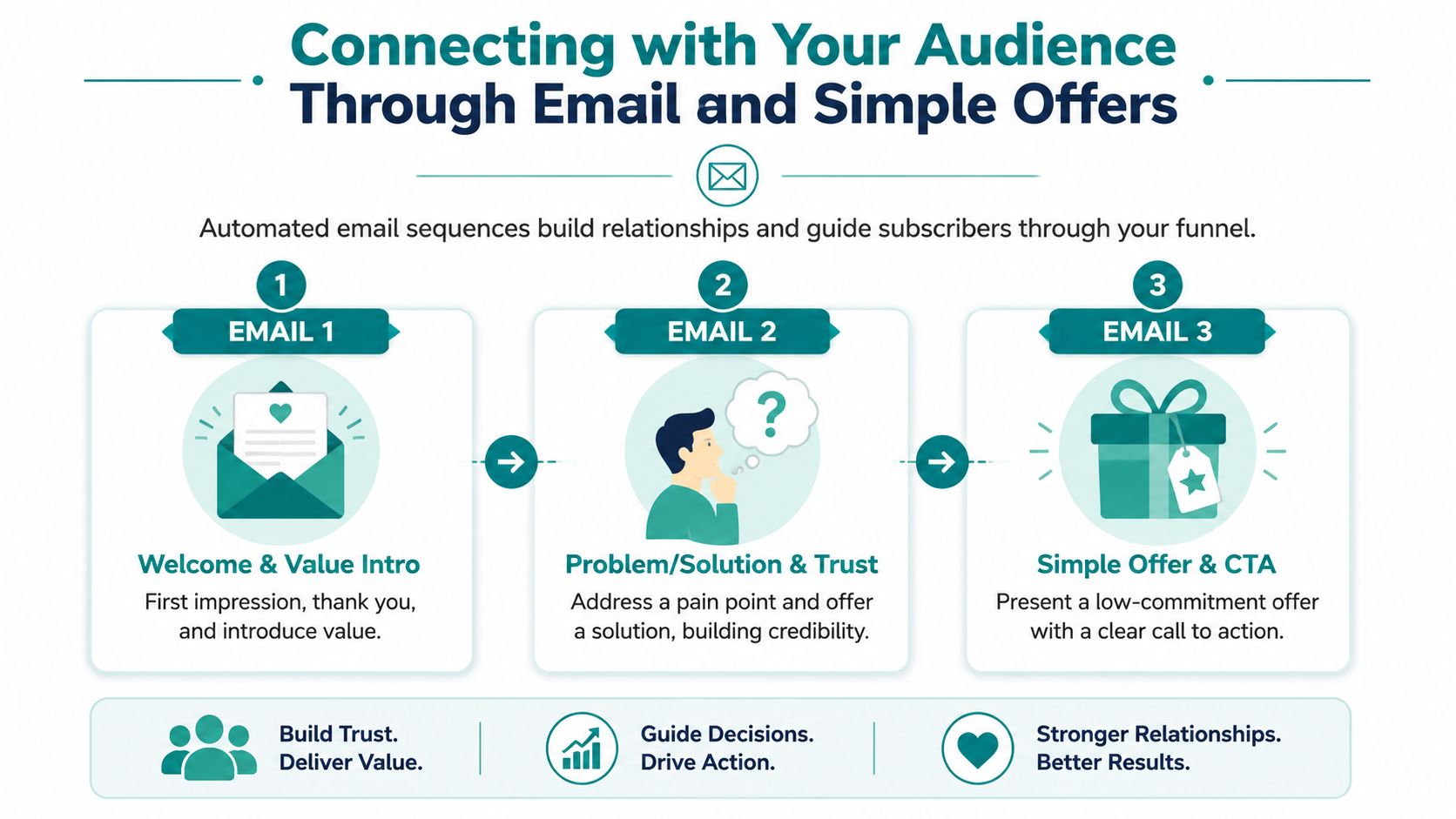
A simple 3 to 5 email welcome sequence is enough for most beginners. The goal isn't to impress people with clever marketing. It's to help them feel understood and guided.
Here's a gentle structure:
Email one
Deliver the freebie. Thank them for joining. Tell them what to expect.Email two
Talk about the problem they're facing. Share a small insight or personal story.Email three
Offer practical help. This can be a blog post, checklist tip, or short lesson.Email four
Address a common fear or objection. This is a good place to acknowledge skepticism.Email five
Introduce a simple offer or recommendation that fits what they already asked for.
A welcome sequence like that creates continuity. The subscriber doesn't feel dropped into a random list. They feel accompanied.
What to write if you freeze up
Many women worry they have nothing valuable to say. Usually, that isn't true. They just need a simple frame.
Try writing emails around these themes:
- A mistake you made and what it taught you
- A beginner question you hear often
- A belief shift that helped you stop overcomplicating things
- A small win the reader can get this week
- A tool or resource you use and why
If you want help organizing those first messages, creating a welcome email sequence a simple guide for your new journey is a useful reference.
People don't stay on lists because the software is advanced. They stay because the emails feel relevant and kind.
A simple offer can be enough
Some creators like to include a low-cost starter offer right after signup. You may hear this called a tripwire or one-time offer.
The idea is simple. After someone joins your list, they see a small paid offer that helps them take the next step. It could be:
- A short guide
- A template bundle
- A mini workshop
- An affiliate product that solves the exact problem your freebie introduced
This isn't about pressure. It's about momentum.
A simple offer helps you learn who wants free information and who is willing to invest in solving the problem. For a solo creator, that can make your funnel feel more sustainable.
Keep your list healthy as it grows
Deliverability matters. If your emails don't reach the inbox, even the kindest sequence won't help. That's why it's worth learning the basics of list hygiene, sending consistency, and subscriber engagement. If you want a straightforward primer, How to Improve email deliverability is a practical resource.
You also don't need to hard-sell in every email.
A good rhythm is value first, invitation second. Teach, encourage, share, then offer. One option some readers explore for education is Victoria OHare, which publishes beginner-focused articles on Affiliate Marketing, List Building, and simple automation for new creators.
That balanced approach tends to feel better for both you and your reader.
Keeping Your Funnel Healthy and Measuring What Matters
A funnel gets less intimidating when you stop treating data like a test.
Data is feedback. That's all.
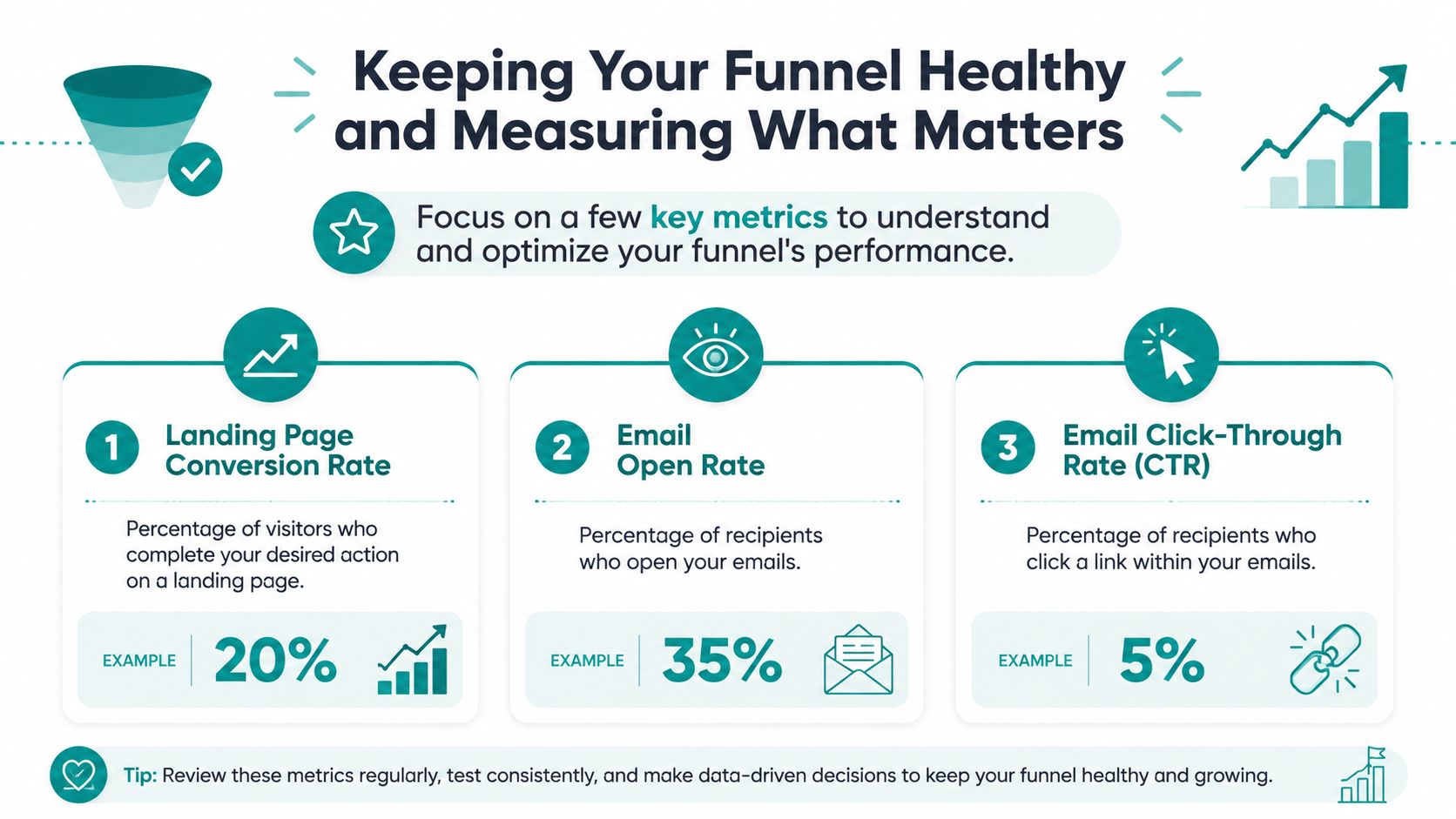
A successful funnel is built around measuring conversion rates between stages so you can spot bottlenecks, track user actions, and understand where people move forward or drop off, as explained in VWO's guide to sales funnel reporting.
Watch a few signals, not everything
You do not need a giant dashboard. Start with a few simple questions:
Are people signing up on your landing page?
If not, your message may be unclear or your free offer may not feel specific enough.Are people opening your emails?
If not, your subject lines may need work, or your subscribers may not remember why they joined.Are people clicking your links?
If not, your email may need a clearer next step.
That's enough to begin.
Use the numbers to reduce stress
When you measure a funnel, you stop guessing. You can make one calm adjustment at a time.
If subscribers are joining but not engaging, list care matters. This guide to unsubscribe management and list Health can help you think about engagement in a healthier, less fearful way.
And if you eventually want a broader look at optimization ideas, especially from a conversion perspective, 2026 CRO strategies for agencies offers a useful outside view. You don't need agency complexity to benefit from the basic principle, which is to improve one step at a time.
Small improvements in clarity often matter more than big changes in technology.
Learning how to create a sales funnel is not about becoming someone else. It's about building a calm, useful system that supports your second chapter. You can learn this. You can do it slowly. And every piece you build gives you a little more control, a little more independence, and a little more peace of mind.
If you'd like calm, beginner-friendly help as you build your own funnel, Victoria OHare offers step-by-step guidance on Affiliate Marketing, List Building, and simple automation for midlife women and new creators. The next five years will pass either way. The only question is whether you'll use them to build something that gives you peace of mind.