
If you're over 50 and wondering whether it's too late to build income online, you're not alone. A lot of women look at Retirement savings, rising costs, and the speed of the internet and privately think, "I missed my chance." You didn't. Life happened, responsibilities piled up, and now you're looking for a steadier second chapter.
The good news is that learning how to build a personal brand doesn't require fame, perfect tech skills, or a loud online personality. It means giving your experience a clear shape so people can understand how you help. Done well, it becomes a digital asset you can build slowly, with dignity, purpose, and peace of mind.
Your Next Chapter Starts Now
You may be sitting at your kitchen table with too many tabs open, trying to understand online business, social media, email lists, and branding all at once. That kind of overwhelm is real. So is the fear of starting late.
A personal brand can sound like something for influencers, not for thoughtful women who want more security and a little more control over the future. But that idea is outdated. Modern guidance now treats personal branding as a repeatable digital strategy built around clarity, niche, narrative, and consistency, with similar advice across institutions including Harvard Business School, Berkeley Executive Education, Northeastern, and Intuitive. Their shared framework is simple: define your purpose and values, identify your niche and audience, tell a credible story, and stay consistent over time, as summarized in Intuitive's guide to building a personal brand.

A personal brand is not about attention
It helps to strip the idea down to plain language.
Your personal brand is:
- What you want to be known for
- Who you want to help
- How people recognize your voice and values
- Why someone would trust your guidance
That's all.
If you're exploring platforms where professionals share ideas and build credibility, this guide to LinkedIn personal branding is a useful example of how personal branding looks in practice without needing to feel flashy or self-promotional.
You don't need to become a different person online. You need to become easier to understand.
Why this matters in midlife
At this stage of life, most women aren't chasing internet fame. They're looking for something steadier. A personal brand can support consulting, Affiliate Marketing, a small service business, digital products, coaching, speaking, or a clearer online presence that opens doors.
I think of it this way. Your life has already given you raw material. Skills. Stories. Hard-earned judgment. A personal brand helps you organize that material so it can support your next chapter.
If building something of your own has been tugging at you, this reflection on the real benefits of being your own boss after 50 may help you picture what that freedom can look like in a grounded, realistic way.
Laying Your Foundation Who You Are and Who You Serve
It's common to get stuck by starting with logos, platforms, or content ideas. The stronger place to begin is quieter. You start by asking, "What do I know, who do I help, and why does that matter?"
Berkeley Executive Education recommends a practical foundation for personal branding that includes self-assessment, a Personal SWOT analysis, a mission statement, and an ideal audience profile. The purpose is to turn your strengths, values, and passions into a concise brand promise, as described in Berkeley Executive Education's article on purpose-driven personal branding.

Start with your real life
You do not need a dramatic backstory. You need honesty.
Ask yourself:
What problems have I solved more than once?
Maybe you've simplified healthy cooking, rebuilt finances after divorce, organized chaotic households, or learned how to start over professionally.What do people naturally ask me about?
Friends often reveal our strengths before we do.What values matter most to me?
Calm. Independence. Faith. Simplicity. Stability. Creativity. Service.What kind of person do I most want to help?
This matters more than trying to help everyone.
I remember how tempting it was, early on, to say, "I can help anyone who wants to improve their life." That sounds generous, but it's too broad. Clarity feels narrower at first, but it makes you easier to trust.
A gentle way to do a Personal SWOT
A Personal SWOT sounds corporate, but it doesn't have to.
| Area | Simple question |
|---|---|
| Strengths | What comes naturally to me? |
| Weaknesses | What drains me or slows me down? |
| Opportunities | Where do I already have useful experience? |
| Threats | What might distract me, discourage me, or pull me off course? |
You might discover that your strength is explaining confusing topics with clarity. Your weakness might be overthinking technology. Your opportunity might be helping women in a season you've already lived through. Your threat might be comparing yourself to younger creators.
That's valuable clarity.
Write a one-sentence mission statement
Try this fill-in-the-blank:
I help [specific person] do [specific result] in a way that feels [specific value or quality].
Examples:
- I help women in midlife build simple online income streams in a way that feels calm and honest.
- I help busy grandmothers learn beginner-friendly wellness habits without pressure or perfection.
- I help new creators over 50 turn life experience into helpful content and trusted recommendations.
Practical rule: If your sentence sounds vague, make the person more specific before you make the offer bigger.
If your work leans professional or service-based, resources on how to build B2B thought leadership can also help you see how experience becomes authority when it's shared clearly and consistently.
Crafting Your Message and Simple Identity
Once you know who you are and who you serve, the next step is deciding how you'll look and sound online. At this stage, many beginners freeze. They assume they need a designer, a fancy logo, or a polished brand package.
You don't.
What you need is a simple identity that feels coherent. Imagine welcoming someone into your home. The furniture doesn't have to match perfectly, but the space should feel like it belongs to one person.
A useful reminder sits underneath all of this. 90% of consumers say they buy from brands they trust, and 33% of businesses report that consistent brand presentation contributes to revenue growth, according to the U.S. Chamber of Commerce on key elements of branding. For a personal brand, that means your bio, profile photo, and content themes should align.

Keep your message easy to repeat
Your message should answer three questions quickly:
- Who do you help
- What do you help them do
- What makes your approach feel different
That doesn't need to sound clever. It needs to sound clear.
Here is a simple example:
"I help women over 50 learn how to build a calm online income stream through content, email, and ethical recommendations."
That works because someone can understand it quickly.
If writing your summary feels harder than expected, this guide on how to write a compelling personal bio can help you turn your experience into a short, readable introduction.
Choose a visual style you can maintain
Use restraint here. A brand you can repeat is better than one you can't manage.
Try this checklist:
Profile photo
Use a clear, warm photo where people can see your face.Colors
Pick 2 or 3 colors. Soft teal, navy, cream, or muted rose can work well if they feel like you.Fonts
Choose 1 easy-to-read font for most things and 1 optional accent font.Tone of voice
Decide how you want people to feel when they read your words. Reassured. Informed. Encouraged.
A short video can help make these ideas more visual.
Consistency builds familiarity. Familiarity makes trust easier.
You are not creating a performance. You're creating recognition.
Creating Content That Connects and Builds Assets
Content feels intimidating until you stop treating it like a constant demand for new ideas. It becomes much simpler when you decide on a few themes and repeat them with fresh examples.
I learned this the hard way. I once opened a blank document and tried to think of "something valuable to post." Nothing came. The problem wasn't a lack of wisdom. The problem was a lack of structure.
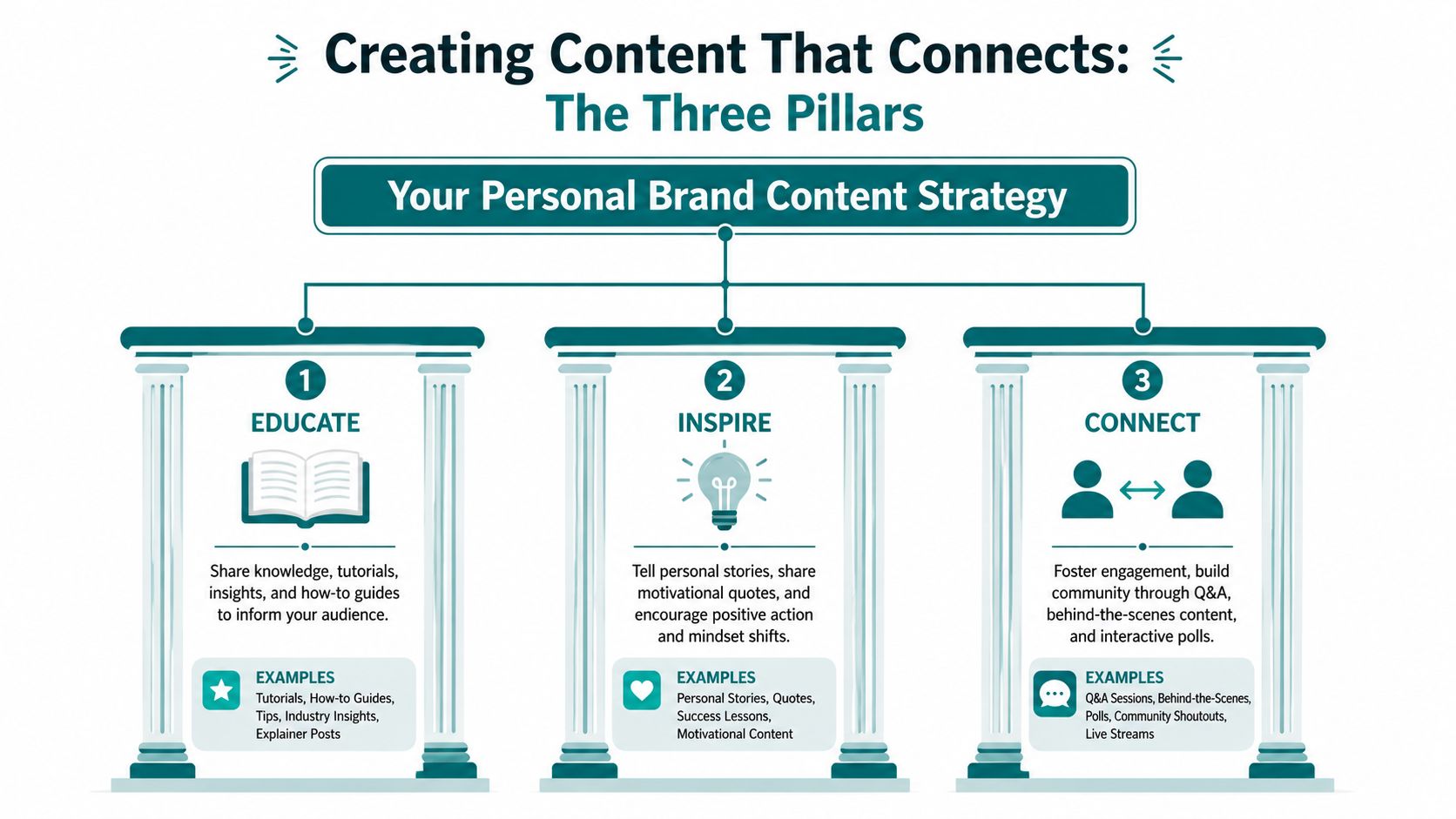
That's why content pillars help.
Choose three themes and stay there for a while
One practical framework from creator guidance is to limit yourself to three content pillars and build a large idea bank early. The same guidance suggests generating 30 content ideas in 30 minutes to make consistency easier. That's noted in the earlier Berkeley-based discussion and keeps your brand recognizable without making you repetitive.
For a midlife creator, your pillars might be:
Educate
Teach what you know. This could be budgeting basics, Affiliate Marketing terms, decluttering routines, confidence after career change, or healthy habits.Inspire
Share a story, a turning point, or a lesson learned later in life.Connect
Ask questions, respond to common fears, or talk openly about what you're learning.
Study what works without copying
A more advanced way to improve your content is to study strong examples and reverse-engineer their structure. Dan Koe recommends reviewing 20 to 30 strong examples, and also spending one hour a day over a week looking at 5 to 10 admired creators to document the patterns behind engagement. The idea is not to copy topics, but to notice structure such as hooks, framing, tension, and proof, as explained in Dan Koe's essay on building a better personal brand.
That sounds technical, but it can be simple.
Notice things like:
- Opening lines that name a real problem
- Stories that make the lesson feel human
- Specific examples instead of vague encouragement
- Clear endings that invite reflection or action
Think of each post as a small asset
This matters if you're trying to build peace of mind, not just stay busy online.
A thoughtful post, a helpful email, or a short teaching video can keep working after you publish it. Someone may find it days or months later. That is why content is more than self-expression. It can become part of an asset base that supports your future business.
If no one is listening yet, speak to one person anyway. Most trusted brands begin in small rooms, not crowded ones.
Start with one platform. Keep your promises to yourself. Helpful beats perfect every time.
Building Your Owned Audience and Income Paths
You post something thoughtful on social media. A few people respond. Then the platform gets quiet, your post disappears, and you have no simple way to reach the people who cared.
That is why owned audience matters.
For midlife creators, this can be a relief. You do not need to chase attention all day. You need a quieter, steadier way to stay connected to the right people and earn from work that fits your values. Social platforms can introduce people to you, but your email list gives you a place to continue the relationship on your own terms.
A borrowed audience works like renting a market stall for the day. People may stop by, but the space is not yours. An owned audience is closer to keeping a real contact list of people who raised their hand and said, "Yes, I want to hear from you."
| Type | What it means | Why it matters |
|---|---|---|
| Borrowed audience | Followers on social platforms | Good for discovery, but the platform controls what people see |
| Owned audience | Email subscribers | You can reach people directly and build trust over time |
If you are new to this part, this beginner-friendly guide to building an email list can help you get started without making it complicated.
An email list is not only a marketing tool. It is a trust tool. It gives you a simple way to share lessons, offers, invitations, and updates with people who chose to hear from you. That matters if your goal is financial peace of mind, because steadier relationships often lead to steadier income.
Income usually grows from a few clear paths. You do not need all of them at once.
Affiliate marketing
You recommend a product or service you use or respect. If someone buys through your link, you may earn a commission.Digital products
A short guide, checklist, workshop, template, or recorded training can turn your experience into something useful and repeatable.Services
Coaching, consulting, freelance help, or small group teaching can be a natural first offer, especially if people already ask for your advice.Brand partnerships
Some creators work with companies that fit their audience and values. This works best when the partnership feels like a helpful recommendation, not a random ad.
Many beginners feel cautious here, and that caution is healthy. If you have seen online hype before, you are not being negative. You are being discerning.
Keep your income paths simple and honest:
Recommend only what you trust
If it would feel uncomfortable suggesting it to a friend, leave it out.Explain why it is useful
Specific context builds confidence. Vague praise does not.Tell people when you may earn money
Clear disclosure shows respect.Match the offer to the problem
A good offer helps the reader do something they already want to do.
You also do not need a huge audience before you start earning. A small group of the right people can be enough. If they trust you, understand what you help with, and see a clear next step, your brand can begin to support both your income and your sense of purpose.
That is a strong place to build from, especially in midlife, when clarity matters more than noise.
Simple Habits for Calm and Measurable Growth
A lot of online advice makes growth sound exhausting. Post everywhere. Build faster. Be constantly visible. That pace doesn't suit everyone, and it isn't the only way.
A calmer approach usually lasts longer.
Small habits that keep your brand moving
Try a weekly rhythm that feels manageable:
Write one helpful piece
A post, email, short video, or simple reflection.Reply to real people
Answer comments, emails, or messages with care.Save ideas as they come
Keep a running note on your phone for stories, questions, and lessons.Review what felt natural
Notice which topics you can speak about without forcing it.
You can also keep one simple tracking list. Not fancy analytics. Just note what you published, what people responded to, and what questions came back more than once.
Use simple automation, not complicated systems
Automation doesn't need to mean funnels and dashboards that make your head spin.
Start with one small step. A welcome email for new subscribers is enough. It can say hello, share what you talk about, and offer one helpful resource. That's not cold or robotic. It's a warm first handshake that happens automatically.
Your systems should reduce stress, not create more of it.
If you're over 50 and still worried you're behind, I want to say this plainly. You're not behind. You're beginning with more wisdom than you had before. That matters.
Building a personal brand isn't about becoming louder. It's about becoming clearer, more useful, and more connected to the people you can effectively help. If you stay steady, your brand can become a source of dignity, independence, and peace of mind in the years ahead.
The next five years will pass either way. The only question is whether you'll use them to build something that gives you more peace of mind.
If you'd like gentle, beginner-friendly help for building income online in your second chapter, you can explore Victoria OHare for step-by-step articles on Affiliate Marketing, email lists, and creating simple digital assets without tech overwhelm.