
If you're over 50 and wondering whether it's too late to build income that feels steadier, you're not alone. A lot of women look at Retirement savings, rising costs, and the pace of online business and think, “I should understand this by now.” That feeling doesn't mean you've failed. It usually means you've been carrying real responsibilities for a long time.
I remember the first time I sat with a notebook, a calculator, and that heavy question in the back of my mind: “Is this enough?” Not enough for luxury. Just enough for peace of mind. Enough to stop feeling like every future decision depends on a paycheck.
That's why the conversation around passive income vs residual income matters. Not because the terms are trendy, but because clear language helps you make calmer decisions.
Is It Too Late to Build an Income That Lasts
Late at night, money worries can sound louder than they should. You look at your accounts, think about Retirement, and feel pressure to make smart choices fast. Then you see words online like “passive income,” “residual income,” “digital assets,” and “affiliate marketing,” and suddenly it feels like everyone else got a handbook you never received.
You didn't miss your chance. You just need someone to explain it plainly.

The feeling of being behind is common
Many women in midlife aren't starting from zero. They're starting from experience. They've managed households, solved problems, supported families, worked jobs, learned new systems, and adapted more times than they can count. Those strengths matter in online business, even if the tools are new.
Sometimes the hardest part isn't learning a new model. It's believing you're still allowed to begin.
You are not behind. You're at the point where clarity matters more than speed.
A friend once told me that opening her Retirement statement felt like opening a school report card she was afraid to read. That hit home. It's not just about numbers on a page. It's about dignity, choice, and not wanting to feel dependent later.
Why this conversation matters now
Retirement planning isn't only about what you've saved. It's also about whether you can build additional income streams that support your life with less strain. For many people, that starts with understanding what kind of income they're trying to create.
If financial independence after 50 has been on your mind, this realistic guide to your next chapter is a helpful place to keep learning in a calm, practical way.
You don't need to become a finance expert this week. You just need to understand the difference between two terms that get mixed up all the time.
An Introduction to Income for Peace of Mind
When people talk about building more security, they often use the words passive income and residual income as if they mean the same thing. They don't, which often confuses a lot of good people.
Here's the simplest way to think about it.
| Term | Plain meaning | Best way to use it | Simple example |
|---|---|---|---|
| Passive income | Money from a revenue stream that continues with little ongoing effort after setup | To describe how income is earned | Dividends, rent, royalties, interest |
| Residual income | Money left after living expenses and obligations are paid | To judge cash flow and affordability | What remains after bills are covered |
According to SmartAsset's explanation of passive income and residual income, in personal finance residual income is best treated as a cash-flow metric, while passive income is a revenue stream that continues with little ongoing effort.
Think of one as a tree and one as a leftover balance
A helpful analogy is this.
Passive income is like planting a fruit tree. You spend time, money, or effort getting it planted. Later, it may keep producing.
Residual income is what's left in your basket after you've already used what you need for dinner.
They answer different questions.
- Passive income asks how money is coming in.
- Residual income asks what money is left after life takes its share.
That difference matters more than it sounds.
Why people mix them up
A person can have passive income and still feel financially squeezed. That can happen when living costs, debt payments, taxes, or other obligations eat up most of what comes in. In that situation, the income source may be passive, but the residual income is still low.
Practical rule: If you're trying to reduce Retirement stress, don't ask only, “Can this earn money?” Also ask, “After my real-life expenses, what will actually remain?”
Online conversations can become misleading. Someone may say they “have passive income,” and that sounds comforting. But if their bills rise or the income stream slows, their day-to-day breathing room may still be limited.
Why this matters for midlife beginners
If you're exploring ways to make money online after 50, these terms can guide your decisions.
You might build something that creates passive income, such as a digital product or a content asset. Or you might focus on a model that helps improve your residual income, meaning your monthly life has more margin after expenses are paid.
Both can support peace of mind. They just do different jobs.
That's why this isn't just vocabulary. It's decision-making. When you understand the difference, you stop chasing labels and start choosing income streams that fit your life.
Passive Income vs Residual Income The Real Difference
For creators, small business owners, and people building a second chapter online, the biggest difference isn't the wording. It's the business model behind the wording.
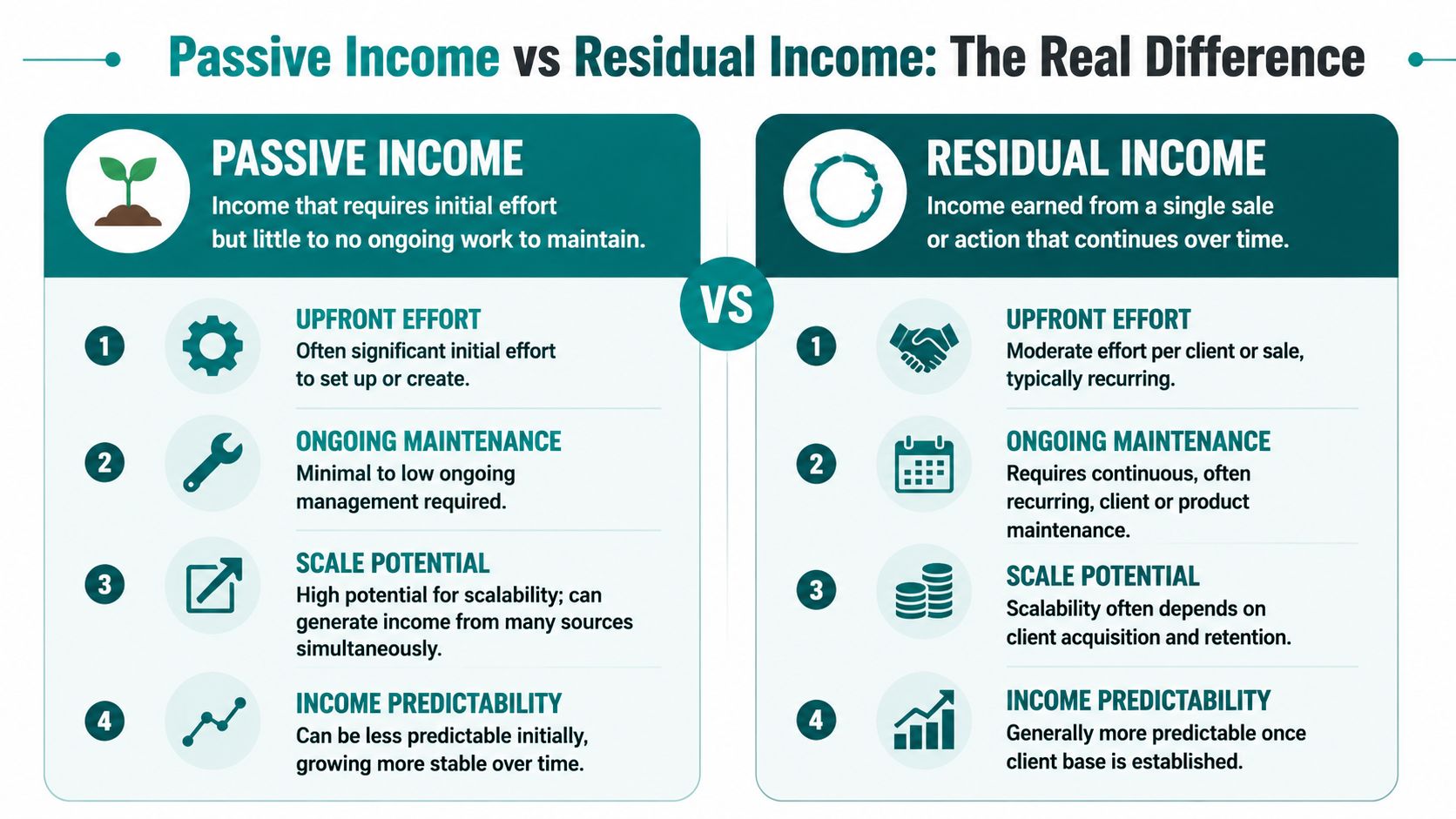
A useful way to compare passive income vs residual income is to look at what each one asks from you at the start, what it needs later, and how it grows over time.
The setup cost looks different
For creators, Beacon Payments' breakdown of residual income vs passive income notes that passive income streams often have a high upfront setup cost in time, capital, or expertise, while residual income typically scales by expanding the customer base that produces repeat payments.
That sounds technical, so let's make it human.
If you write an ebook, create a course, design printables, or build a small niche website, you often do a lot of the work upfront. That's the passive side. You build first, then earn later.
If you recommend a service with recurring commissions, run a membership, or grow a base of customers who stay and renew, that's closer to a residual model. You build relationships and a recurring base.
A side by side view
| Question | Passive income | Residual income |
|---|---|---|
| What do you build first | An asset, product, or investment | A customer base or account base |
| What grows the income | Yield, reach, and efficiency | Retention and account growth |
| What kind of work matters most | Creation, setup, positioning | Support, consistency, relationship building |
| What can disrupt it | Market shifts, platform changes, asset risk | Customer churn, weak retention, service gaps |
For creators, the cleanest distinction is this. Passive income comes from an asset you set up. Residual income grows from a base you keep.
The maintenance myth matters
A lot of people hear “passive” and imagine no more work. That usually leads to disappointment.
A digital course still needs updates. A blog post may need refreshing. Affiliate content may need new links, clearer explanations, or better email follow-up. Even rental and investment examples can carry oversight, risk, or changing returns.
Residual models also need care. If your recurring income depends on people staying subscribed, remaining happy, or continuing to use a product, then retention matters. That doesn't make it bad. It just means the income isn't magic. It's supported by trust and service.
A helpful companion read is this simple guide to passive income vs active income, especially if you're also sorting out the time-for-money side of the picture.
Which one feels more stable
Many beginners assume passive income is automatically safer. Not always.
An asset-based model can be exposed to things outside your control, such as search traffic changes, shifts on a social platform, or movement in a market. A residual model may feel steadier once you have a loyal customer base, but it depends on keeping that base healthy.
Later in the article, you'll see examples where people combine both.
If you prefer video, this short overview can help make the distinction easier to see:
How This Works for Creators and Midlife Entrepreneurs
You may be 45, 55, or 65, looking at your skills and wondering whether they can still become income that keeps helping you later. They can. The key is matching the kind of income to the kind of work you want to do.
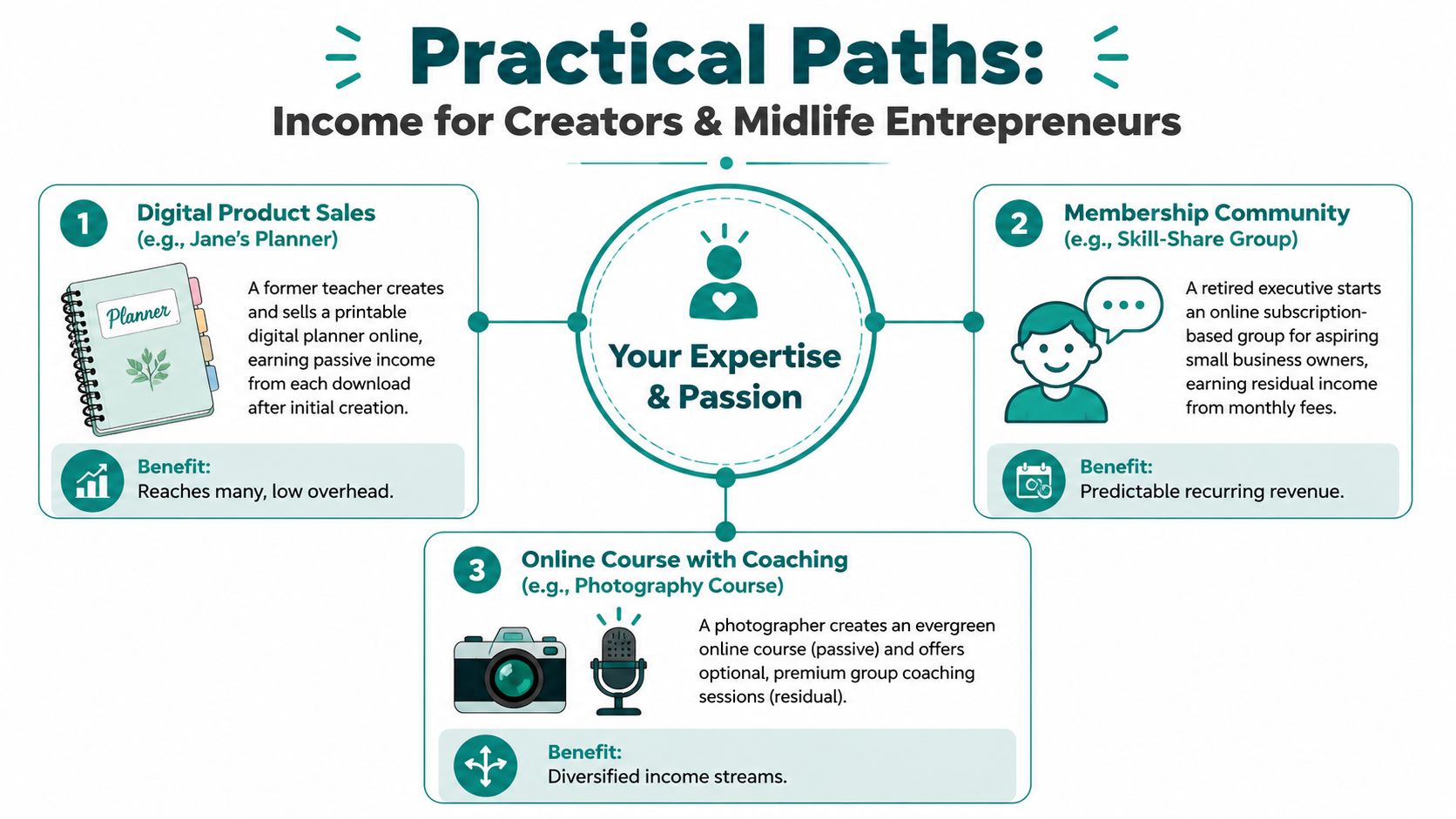
A creator business often grows in layers. One layer is something you make once and sell many times. Another layer is income that continues because people keep buying, renewing, or staying subscribed. If the terms have felt abstract so far, this is the practical version.
A few simple examples
Jane spent years as a teacher. She turns what she already knows into a printable planner for caregivers and sells it online. That income leans passive because the planner is an asset. She builds it once, then improves it now and then.
Susan loves helping people sort out travel details. She joins a company as a Brand Ambassador and earns commissions as long as her customers keep using the service. That income leans residual because it continues through ongoing customer activity.
A photographer might do both at once. Her beginner course acts like a bookshelf product. It sits there ready to help the next buyer. If she also runs a monthly feedback group, that part works more like a garden. It needs regular care, but it can keep producing month after month.
That mix is common.
Where Affiliate Marketing fits
Affiliate marketing means recommending a product or service and earning a commission when someone buys through your referral link.
The confusing part is that affiliate income can land in either camp. A one-time payout from a single sale feels closer to passive income. A recurring payout from a software subscription or membership feels closer to residual income.
The label matters less than the mechanics. Ask a simple question. Do you get paid once, or do you get paid as long as the customer stays?
That one question clears up a lot.
What this can look like in real life
Creators in midlife often do well with income models that grow out of experience they already have. A former manager might sell templates, training guides, or workshops. A wellness coach might recommend tools she already uses and trust. A longtime hobbyist might build a small paid community around a shared interest.
None of that requires you to become a finance expert.
It requires choosing an income stream that fits your energy, your strengths, and how involved you want to stay after the first sale. If you want more examples, this guide on how to create passive income walks through beginner-friendly options in plain language.
If you're skeptical, that's a good sign
Caution can protect you.
Many midlife creators are not afraid of work. They are afraid of wasting time on something confusing, overhyped, or built for people with more tech confidence than they have right now. That concern makes sense.
A calmer way to evaluate an opportunity is to ask, “Would I still feel good about maintaining this six months from now?” A digital product needs updates. A recurring offer needs relationships. A content library needs occasional refreshes. Peace of mind usually comes from choosing work you can realistically keep doing.
If you want to see how creator income works on a different platform, Cloud Present on Twitch revenue gives a useful example, even if Twitch is not your path.
What many midlife creators already have
Midlife creators often underestimate their advantage. They may not move as fast as younger beginners on every trend, but they often have something more durable. Judgment.
They know how to explain things clearly. They know what people ask for help with. They know how to follow through. Those strengths matter because sustainable income is rarely built on noise alone. It is built on trust, usefulness, and steady care over time.
That is good news if Retirement is on your mind.
You do not need ten income streams. You need one or two solid ones that make sense for your life and can keep serving people without draining you.
Choosing Your Path A Simple Framework for Getting Started
At this point, the right question isn't “Which label sounds better?” It's “Which model fits my season of life?”
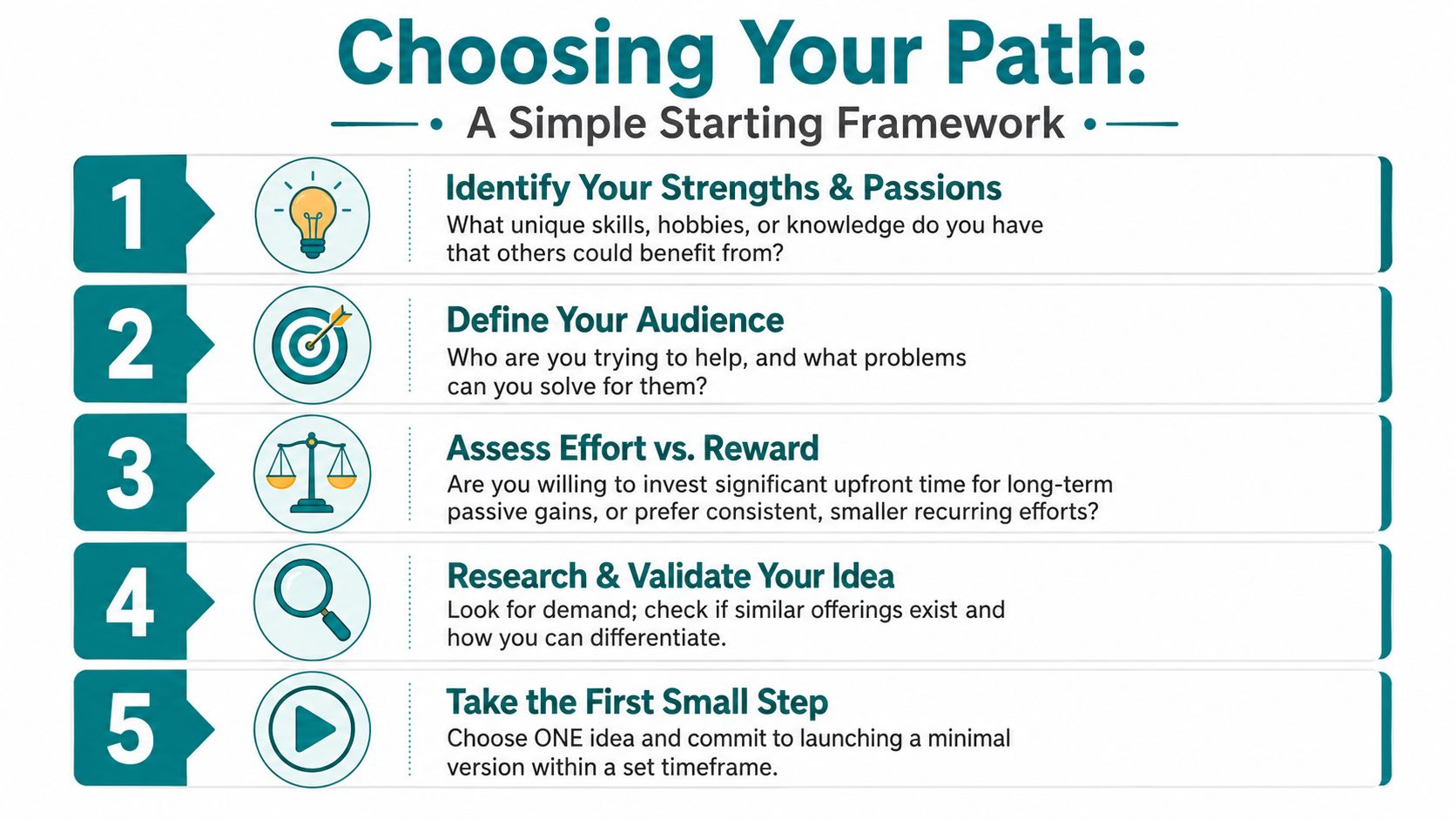
Ask yourself these gentle questions
Do you prefer building once and improving slowly?
If yes, you may enjoy passive-style assets like digital products, blog content, templates, or a course library.
Do you enjoy staying connected to people over time?
If yes, a residual-style model may suit you better. Think memberships, recurring affiliate offers, or ambassador programs built around ongoing use.
What do people already ask you for help with?
That question matters more than most beginners realize. Your next income stream often starts with something you explain naturally.
Your first small step
Don't start with a website if that feels overwhelming.
Start here instead:
- Write down three topics you know well enough to explain easily.
- Circle one audience you care about helping.
- Choose one format that feels manageable, such as a short guide, a recommendation list, or a recurring offer you trust.
- Test the idea small before trying to build everything at once.
That kind of start protects your energy.
A tax note that clears up confusion
One reason passive income vs residual income feels muddy is that the words aren't always used the same way in daily conversation, business, and tax language. Indeed's explanation of passive income vs residual income notes that “residual income” is often a personal finance or sales term, not an official IRS tax category like passive activity income.
That doesn't mean you need to panic. It just means you shouldn't assume a casual online definition tells you exactly how income will be treated legally or for taxes.
If you earn through affiliate links, rentals, royalties, or courses, learn the business definition first, then confirm the tax treatment separately.
One practical way to explore
If you're curious about recurring or affiliate-style opportunities, look at real program structures before joining anything. For example, you can explore Quso.ai opportunities to see how one affiliate program presents its model, terms, and fit. You don't have to choose that route. The point is to train your eye to read offers carefully.
Small steps build confidence. Clarity comes before momentum.
Your Next Five Years Start Now
If Retirement worries have been sitting heavily on your chest, take a breath. You do not need to solve your whole future this month. You only need to begin understanding the types of income that can support more peace, more flexibility, and more control.
Passive income and residual income are not magical labels. They are tools for thinking clearly. One helps you understand how income is generated. The other helps you see what money remains for your actual life.
You can learn this.
You can learn the tech slowly. You can ask careful questions. You can build one asset, one audience, one stream at a time. And if you've been telling yourself that everyone else is ahead, please hear this kindly. A steady second chapter is still available to you.
Maybe your first step is a list of ideas in a notebook. Maybe it's learning Affiliate Marketing for beginners over 50. Maybe it's choosing one offer, one topic, and one platform instead of trying to master everything.
What matters is movement, not perfection.
The next five years will pass either way. The only question is whether you'll use them to build something that gives you peace of mind.
If you'd like to see the training and support available through Victoria OHare, you can explore it at your own pace. No pressure. Just a simple next step if you're ready to learn how Affiliate Marketing, brand ambassadorship, and List Building can fit into your next chapter.