
If you're over 50 and wondering whether it's too late to build income online, you're not alone. Many women feel behind financially, not because they failed, but because life happened. Retirement can feel less secure than it once did, and all the talk about content, algorithms, and AI can make the internet seem like a young person's game.
It isn't.
You can learn this. You are not behind. And one of the gentlest ways to build a real online business is not by shouting louder, posting harder, or chasing trends. It's by becoming someone people trust.
More Than a Link Sharer Becoming a Trusted Guide
A lot of beginners start in the same place. They join an affiliate program, get a special link, and think, "Now what?"
So they post a product link on Facebook. Then another. Maybe they try a few Pinterest pins or a quick email. After a while, it starts to feel like tossing flyers into the wind.
That feeling can be discouraging, especially if what you really want isn't hype. You want security, dignity, and a second chapter that gives you peace of mind.

The shift that changes everything
A link sharer says, "Here, buy this."
A trusted guide says, "I've used this approach; I can explain what helped, what to be cautious about, and why I recommend it."
Those two people may be promoting the same product. But they don't feel the same to the reader.
One feels like advertising. The other feels like help.
That difference matters if you want income that lasts. Quick clicks can come and go. Trust stays. Trust brings people back. Trust makes someone remember your name when they're finally ready to buy.
You don't need to become louder online. You need to become clearer and more helpful.
A simple real-life example
Think about a woman who wants to help others with meal planning on a budget. She could post links to storage containers, cookbooks, and planners all day long. That might earn a little now and then.
But if she writes about how she stretched grocery money during stressful seasons, how she planned meals when caring for aging parents, or how she simplified weeknight cooking after work, people start seeing her differently. She becomes believable.
That's the beginning of thought leadership content.
It's not corporate. It's not fancy. It's the online version of being the person others trust for sensible advice.
If you're building a personal brand in this season of life, this kind of trust matters even more. A gentle guide to building a personal brand people trust can help you see how your voice becomes part of the business asset you're creating.
Why this matters for peace of mind
When you're nearing Retirement or trying to create extra income before Retirement, random posting feels exhausting because it is exhausting.
Building trust is slower at first, but steadier over time. It gives your work meaning. It helps you create an online business that feels aligned with who you are, instead of turning you into someone you're not.
That's a much calmer way to grow.
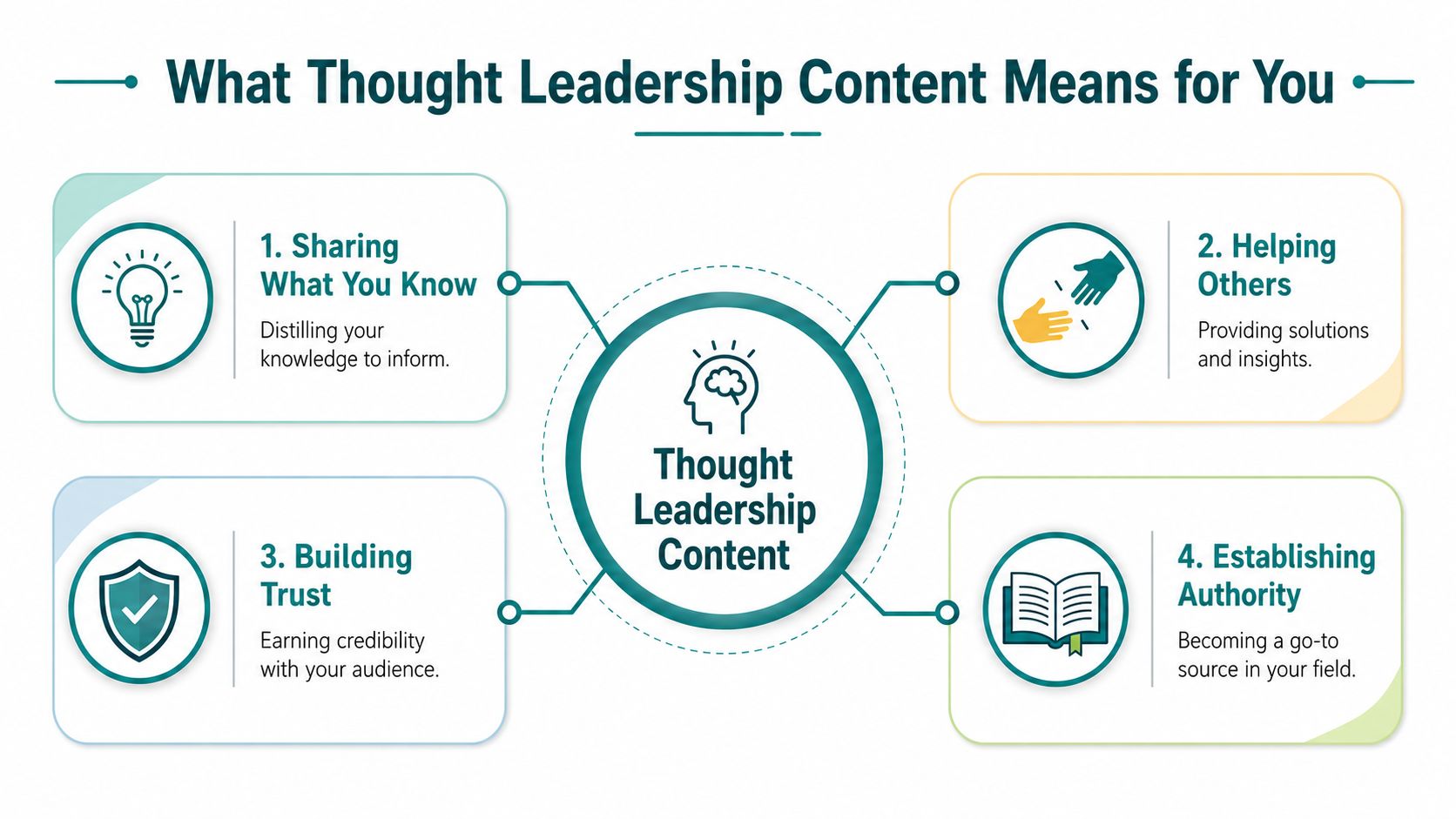
What Thought Leadership Content Means for You
The phrase thought leadership content can sound stiff and corporate. It really isn't.
In plain language, it means sharing what you know in a way that helps other people think better, choose better, or solve a problem with more confidence.
Think of the go-to friend
Every family or friend group has one.
She's the person people text when they need help organizing a move, managing a budget, dealing with a garden problem, or choosing a simple tech tool. She may not call herself an expert, but others trust her judgment because she's thoughtful, practical, and generous.
Online, thought leadership content works the same way.
It can look like:
- A blog post that answers a question beginners keep asking
- An email that shares a lesson you learned the hard way
- A short video where you explain why one tool felt easier than another
- A social post that helps someone avoid a common mistake
None of this requires a title, a degree, or a corner office.
What makes it different from ordinary posting
Regular posting often says what happened.
Thought leadership content says what happened, why it matters, and what someone should do next.
That extra layer is what makes people remember you.
One useful way to think about it comes from guidance on developing a thought leader's book. The same principle applies even if you're not writing a book. Strong thought leadership usually starts with a clear point of view, a specific audience, and a helpful idea you can explain with both personal insight and practical evidence.
Practical rule: If your content could have been written by anyone, it won't build much trust. If it reflects your experience and helps someone act, it starts to matter.
A simple formula
Here is a beginner-friendly version:
| Part | What it means |
|---|---|
| Who you're helping | A specific person with a real frustration |
| What you believe | Your honest view about what works |
| What you've seen | Your experience, stories, or observations |
| What they can do now | One small next step |
If you can do those four things, you're already creating thought leadership content.
For women building an online business for older women, this is good news. You don't need to sound polished. You need to be useful. That's how trust starts.
How Building Trust Creates Sustainable Income
In Affiliate Marketing, it's easy to fixate on links, clicks, and commissions. But sustainable income rarely grows from a string of one-off transactions. It grows from a relationship where people believe your guidance is worth listening to.
That's true at every level of business.
A foundational benchmark shared in these thought leadership statistics found that nearly 60% of business decision-makers said a piece of thought leadership had directly led them to award business to an organization. That same research also noted that 58% said they read at least one hour per week of thought leadership content. In other words, people don't just consume helpful expertise. They make decisions because of it.
Why this matters for Affiliate Marketing
You may not be selling consulting contracts to executives. But the buying behavior is similar.
When someone is deciding whether to trust your recommendation for an email tool, a budgeting resource, a course, or a kitchen product, they ask quiet questions in their mind:
- Does this person understand my situation
- Are they trying to help me or just sell me
- Have they thought this through
- Do I want to hear from them again
If your content answers those questions well, income becomes more stable because your audience stops seeing you as a stranger.
Trust turns content into an asset
A product link is temporary.
A body of useful content is an asset.
It keeps working after you publish it. It helps a new reader understand your values. It makes an email subscriber more likely to stay. It gives your recommendations context.
This is one reason many beginners feel disappointed when they only post promotions. Promotions ask for trust before trust has been built.
A better rhythm looks like this:
- Share helpful guidance
- Explain your reasoning
- Show your lived experience
- Recommend a tool when it fits
That sequence feels natural because it is natural.
If you're curious about using modern tools without losing that personal feel, this guide on how to make AI personal finance videos is a helpful example of blending technology with educational content. The important part is that the tool supports your message. It shouldn't replace your judgment.
The income side of peace of mind
When trust grows, you don't have to constantly start over.
People open your emails because they expect something useful. They return to your blog because your content helps them think clearly. They click your recommendations because you've earned the right to recommend.
That's a calmer business model. It doesn't promise overnight results. It offers something better: a foundation you can keep building on.
You Are Already an Expert Find Your Unique Voice
The most common thought that stops people is simple.
"I'm not an expert."
That sentence has ended many good ideas before they ever had a chance.

Expertise isn't only formal
You don't need a certification to know something useful.
If you've managed a household budget through hard seasons, learned to cook for a family, cared for aging parents, changed careers, homeschooled children, recovered from financial mistakes, or figured out how to use confusing tools one step at a time, you have knowledge other people need.
Your expertise may look ordinary to you because you've lived it.
To someone a few steps behind you, it can feel like a lifeline.
I understand being cautious here. The internet is full of gurus, borrowed opinions, and polished promises. That can make a thoughtful beginner shrink back and assume she has nothing worth saying.
Why your human voice matters more now
Public skepticism about machine-made content is growing. A 2024 Reuters Institute finding discussed here reported that 59% of people were uncomfortable with news produced mostly by AI. That matters because readers are becoming more sensitive to content that feels flat, generic, or detached from real experience.
Your stories don't have that problem.
When you say, "I remember the first time I opened an email platform and nearly clicked out because it looked so confusing," people relax. They recognize a human being. They feel less alone.
That kind of honesty builds trust in a way generic summaries can't.
Here's a helpful video if you need a little encouragement as you think about your own voice:
A better definition of expert
Try this definition instead.
An expert is not someone who knows everything. An expert is someone who can help another person make progress.
That might mean:
- A former teacher explaining how to break big topics into simple lessons
- A home gardener sharing what finally worked after several failed seasons
- A beginner with one year of experience helping a complete beginner avoid the first wave of overwhelm
Your lived experience is not a side note in your business. It's often the very reason someone trusts you.
If you're exploring Affiliate Marketing for beginners over 50, your age is not a disadvantage. Your steadiness, perspective, and realism can become your edge.
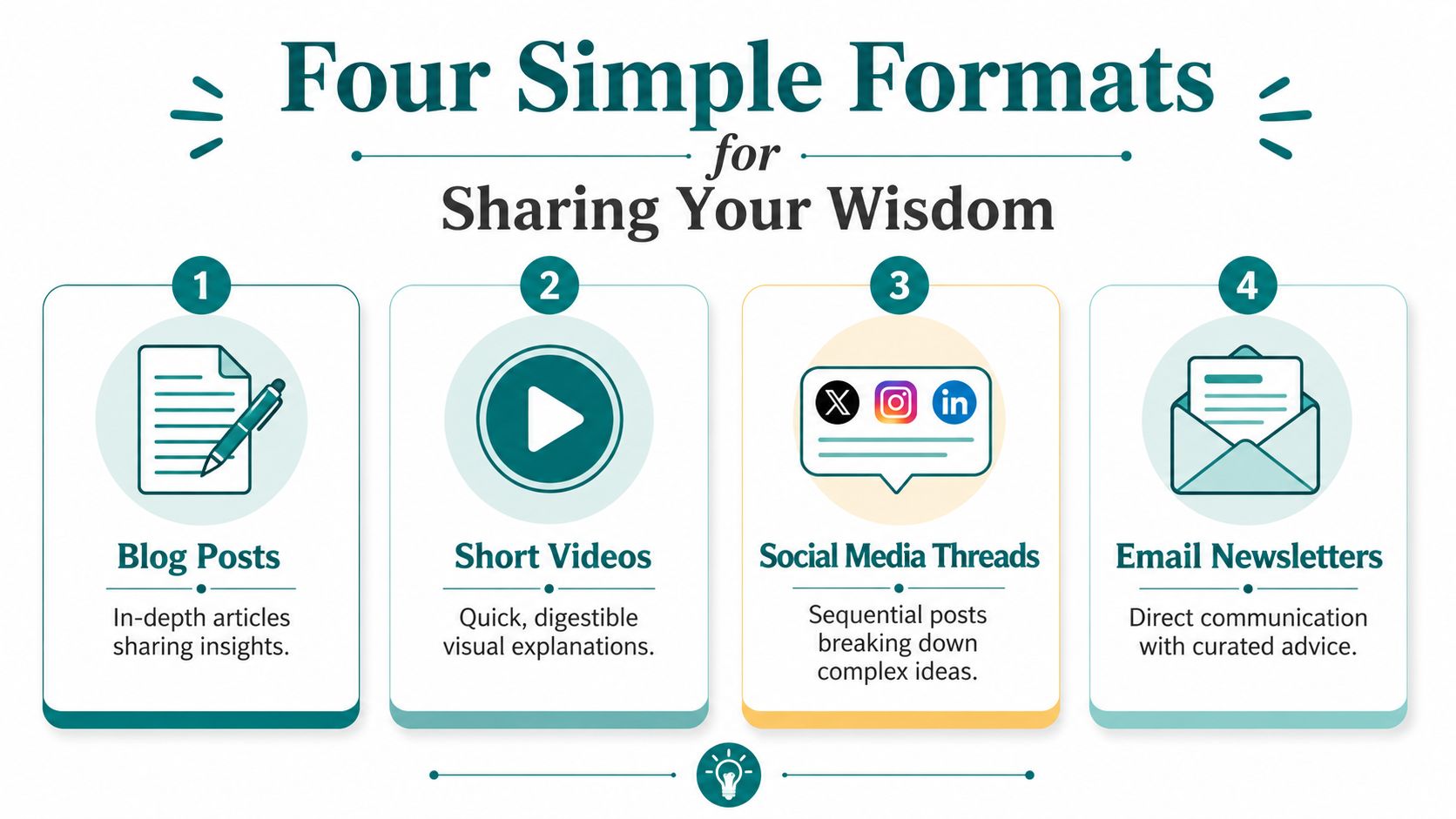
Four Simple Formats for Sharing Your Wisdom
Many people assume thought leadership content needs a polished website, studio lighting, and a complicated strategy.
It doesn't.
You can start with one small piece of useful content. What matters most is the mix of personal insight and practical help. Guidance on data-led thought leadership points out that effective content often combines qualitative data like stories and interviews with quantitative data like steps, simple metrics, or structured points. In everyday terms, that means your experience becomes stronger when you pair it with clear takeaways.
The story format
Start with a memory.
"I remember when I bought the cheapest gardening tool set I could find and ended up replacing it all within months."
That single sentence does a lot. It sounds human. It creates curiosity. It opens the door to a recommendation that doesn't feel pushy.
This format works well if you're warm, reflective, and better at talking from experience than teaching from a script.
The quick tip list
Some readers want a fast answer.
A simple post like "3 things that helped me start an email list without tech panic" can be powerful because it respects the reader's time. It also gives your content structure.
For example:
- Pick one platform so you don't get scattered
- Write a welcome email first before worrying about a full sequence
- Invite replies so your list feels like a conversation
That kind of post is easy to save, share, and revisit.
The question and answer post
This is one of the easiest formats for beginners.
Take a real question someone asks, such as "Is Affiliate Marketing legit?" Then answer it plainly. You can acknowledge that scams exist, explain that Affiliate Marketing means recommending products and earning a commission, and describe how education and honest recommendations make the difference.
This style is especially useful if you like writing in a calm, teacherly voice.
The behind-the-scenes explanation
People trust your recommendations more when they understand how you decide.
If you chose ConvertKit over another email platform, or a simple tripod over a more advanced setup, explain why. Share what felt easier, what fit your season of life, and what you would tell a beginner.
Helpful content becomes memorable when you show both the lesson and the reasoning behind it.
If talking feels easier than writing, you can record yourself speaking and later convert podcasts into blog posts. That's a practical way to reuse your thoughts without starting from a blank page every time.
And if you'd like a beginner-friendly way to practice showing up consistently, this virtual business challenge can spark ideas for what to share first.
How to Share Your Content and See It Work
A lot of beginners think the hard part is writing the content.
Often, the harder part is wondering whether anyone cares.
That's where simple sharing and simple measurement help. You don't need to be on every platform. You need to put your content where real people can see it, then watch for signs that trust is growing.
Start small and close to home
Choose one or two places.
That might be:
- An email newsletter where you send one helpful note each week
- A Facebook group where your audience already asks questions
- A simple blog that gives your ideas a home you own
If email feels important but intimidating, a gentle guide on how to build an email list can help you start.
What to look for instead of obsessing over numbers
Thought leadership can be hard to measure neatly, especially for smaller creators. That's one of the big gaps in the advice people often get. Still, the value is clear. In this discussion of thought leadership and trust, 71% of decision-makers said thought leadership is a more trustworthy way to judge a company's capabilities than its own marketing materials.
For a solo creator, that means your helpful content may be your strongest marketing.
Look for signs like:
- Replies that say, "This helped me"
- Follow-up questions that show people want your opinion
- Shares sent to a friend or family member
- Return readers who keep coming back to your emails or posts
These are trust signals.
A calmer way to measure progress
You don't need to chase vanity metrics to know you're moving forward.
Ask yourself:
| Question | Why it matters |
|---|---|
| Are people responding | Response shows connection |
| Are they asking for more | Curiosity shows trust |
| Are my recommendations easier to make | Trust makes offers feel natural |
This is slower than chasing trends. It's also steadier. And steady is what gives you peace of mind.
Your Next Chapter Is Your Most Powerful Asset
Feeling behind is real. But it isn't the same as being behind.
Your years did not disappear. They became perspective. They became judgment. They became the calm voice you now carry into rooms, conversations, and content.
That matters online more than many people realize.
Your business can grow from what you've already lived
If you've been telling yourself that you need to reinvent yourself from scratch, take a breath.
You probably don't.
You may need to learn new tools. You may need to practice writing, emailing, or speaking online. But the heart of the business, your insight, values, and ability to help, may already be there.
Thought leadership content is a way of turning that lived wisdom into something useful for other people.
That's why this approach feels so sustainable. It isn't built on pretending. It isn't built on hype. It's built on service, clarity, and trust.
A quiet kind of momentum
I remember how easy it was to think everyone else online knew exactly what they were doing. The first time I looked at a training dashboard, I felt the old fear rise up. Too much information. Too many tabs. Too many moving parts.
But small steps change that.
One helpful post becomes two. One email becomes a simple rhythm. One honest recommendation becomes the start of real income. Over time, you stop feeling like you're dabbling and start feeling like you're building.
The goal isn't to become famous. The goal is to become trusted by the people you're here to help.
If Retirement doesn't feel guaranteed, building assets matters. To earn income before Retirement, trust is an asset. If you're looking for an online business for older women, your experience is an asset. If you want more peace of mind, a business rooted in genuine help can become part of that stability.
The next five years will pass either way. The only question is whether you'll use them to build something that gives you peace of mind.
You can learn this. It's not too late to begin.
If you'd like a calm, beginner-friendly place to learn how to build an online business step by step, you can explore Victoria OHare. It's a helpful resource for midlife women and new creators who want to build sustainable income with more clarity, confidence, and peace of mind.