

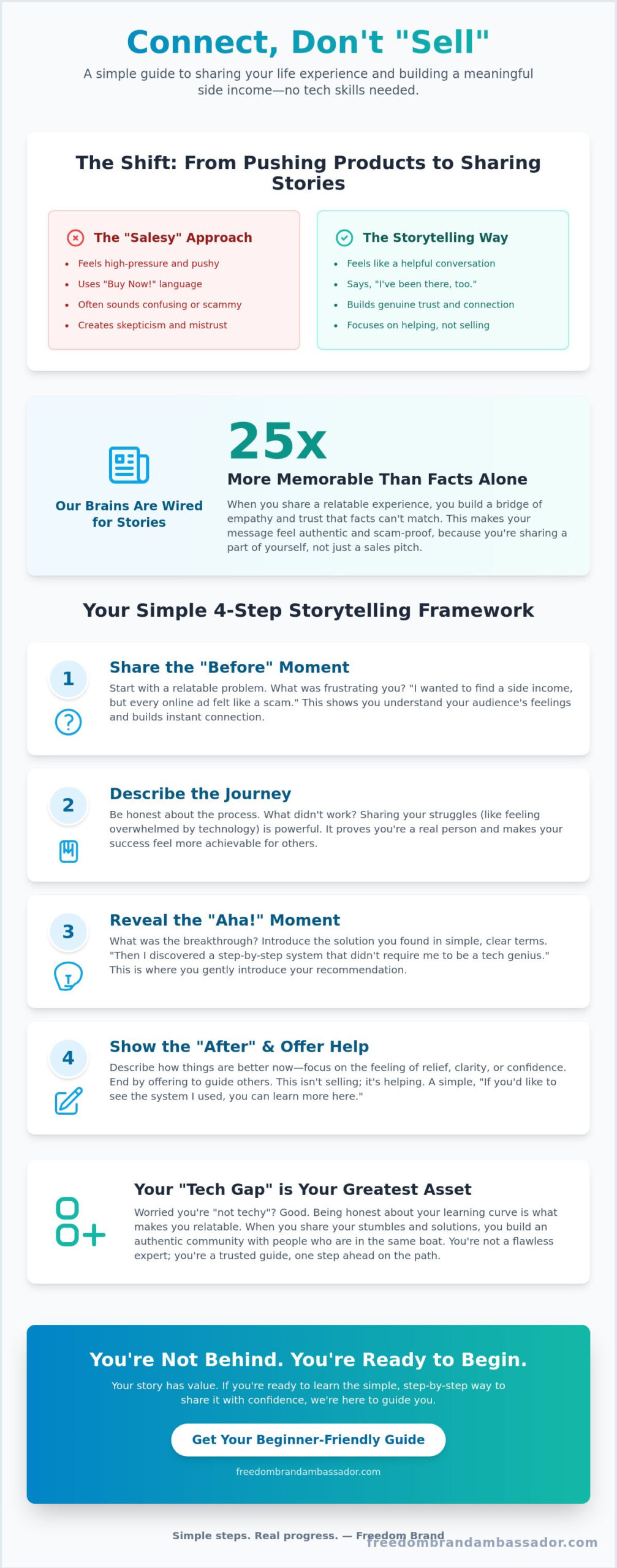
Have you ever felt like you have a lifetime of wisdom to share, but the thought of “selling” it online makes you want to close your laptop forever? You aren’t alone. Most of us cringe at the idea of being “salesy” or sounding like those loud, high-pressure ads that flood our screens. You want to help people, not pester them. The good news is that your most powerful tool isn’t a complex technical skill. By looking at real-world storytelling in marketing examples, you’ll see that your own honest story is the key to connecting without the hype. In fact, research shows that narrative-structured ads are 25 times more memorable than those based on facts alone.
We agree that building a side income in Retirement should feel like a natural conversation across a kitchen table, not a scammy sales pitch. This article will show you how simple, honest stories can help you connect with others and build a meaningful supplemental income. We’ll look at how to share your journey step-by-step so you can finally post online with total confidence and clarity. It’s time to transform your experience into an opportunity for growth and independence.
Key Takeaways
- Shift your mindset from “selling” to “connecting” by simply sharing relatable experiences that help others solve everyday problems.
- Explore professional storytelling in marketing examples to see how focusing on the journey makes your message more memorable and trustworthy.
- Use a beginner-friendly 4-step framework to turn your personal “before and after” moments into engaging posts that don’t feel salesy.
- Discover why being honest about your own “tech-gap” challenges can actually be your greatest strength when building an authentic community.
- Gain the confidence to share your journey as a Freedom Brand Ambassador, using your story to guide others toward simple, scam-proof solutions.
What is Storytelling in Marketing? A Beginner-Friendly Definition
Storytelling in marketing is simply the act of sharing a relatable experience to help someone else find a solution. It isn’t about writing a long book or having a degree in literature. It’s about being human. When you look at successful storytelling in marketing examples, you’ll see they don’t feel like ads at all. They feel like a warm conversation with a trusted neighbor over a cup of tea. This approach moves you away from “pitching” a product and toward “connecting” with a real person who has the same frustrations you once had. It’s a way to be helpful while building a little extra income on your own terms.
This method works because stories naturally bypass the skepticism we’ve all developed toward flashy, high-pressure internet ads. You aren’t trying to trick anyone or use “get rich quick” language. You’re just being a guide. Many women worry they aren’t “techy” enough to start an online business, but storytelling requires zero technical skill. If you can tell a friend about a great book you read or a helpful gardening tool you discovered, you already have the skills you need. You’re not too old to start; in fact, your years of life experience make you a better storyteller than most people half your age.
Moving Away from the “Salesy” Approach
Traditional ads usually scream “buy this now!” but storytelling takes a softer, more effective path. It says, “I understand exactly how you feel because I’ve been there too.” Sharing a mistake or a moment where you felt stuck actually makes people trust you more. It proves you’re a real person, not a polished corporate machine. This is the “Helpful Friend” mindset. Instead of being an aggressive salesman, you’re acting as a supportive mentor. When you’re honest about your journey, including the bumps in the road, you create a scam-proof environment where people feel safe to learn from you.
The Simple Science of Connection
There’s a practical reason why we remember stories so much better than lists of facts. Our brains are actually wired to process narratives. When we hear a story, we don’t just listen; we imagine ourselves in that situation. This is a core part of modern Marketing communications because it builds a solid bridge of empathy. Your personal story is uniquely yours, which makes it impossible for anyone else to copy. This authenticity is exactly what people are looking for today. Storytelling is the bridge that turns a stranger into a friend through the power of shared experience.
3 Famous Storytelling in Marketing Examples (and What They Teach Us)
It’s one thing to define a concept, but seeing it in action makes everything click. You might think these massive companies have nothing in common with a woman starting a side project from her home office, but the core logic is exactly the same. They succeed because they stop acting like a faceless corporation and start acting like a person. By looking at these storytelling in marketing examples, you’ll see how you can apply the same “human-first” approach to your own journey.
Nike and the Power of the Struggle
Nike rarely spends time talking about the rubber on their soles or the fabric in their shirts. Instead, they talk about the effort. They focus on the sweat, the early mornings, and the moments when you want to quit. They know that focusing on the “struggle” makes the “victory” feel earned and real. This is powerful because it makes the customer the hero of the story, while the brand is just a helpful tool along the way.
You can apply this same logic to your own online presence. Don’t feel like you have to lead with a polished, perfect image. Instead, share your “first day” frustrations. Talk about the afternoon you spent trying to figure out a new password or the moment you felt overwhelmed by a new piece of software. When you eventually find a solution, your success feels relatable. It proves to your audience that you’re a real person who understands their hurdles. If you are looking for a realistic way to navigate these early steps, our simple, beginner-friendly guide can help you get started without the tech-headaches.
Dove and Shared Values
Years ago, Dove changed the conversation by moving away from airbrushed models. They started showing real women with real lives and real bodies. They tapped into a shared value: that beauty is about realness, not perfection. This shift created a community of loyal followers who felt seen and respected. They weren’t just buying soap; they were supporting a brand that shared their worldview.
As a woman over 50, your authenticity is your greatest asset. You have a lifetime of values and experiences that younger marketers simply don’t have yet. You don’t need to hide your age or pretend to be someone else. When you are honest about what you believe, you become “scam-proof” to your peers. They will trust you because they see their own values reflected in your stories. It’s about being a helpful guide rather than a high-pressure salesperson.
Airbnb follows a similar path by letting real hosts and travelers share their own experiences. They don’t just list rooms; they share the stories of the people inside them. The key takeaway from all these brands is simple: you win by acting like a real person. You don’t need a big budget or a marketing degree to be effective. You just need the courage to be yourself and the willingness to help others along the way.
Relatable Storytelling Examples for Your Personal Brand
While it’s helpful to see how billion-dollar companies use narrative, those big-budget campaigns can feel a world away from your own life. You aren’t trying to sell millions of sneakers or bars of soap. You’re simply trying to share a solution that worked for you. The most effective storytelling in marketing examples for women in our stage of life are the ones that feel small, personal, and grounded in reality. You don’t need a film crew; you just need your own honest voice.
The “Kitchen Table” Story
Think about how you’d explain a new discovery to a dear friend over a cup of tea. This is the “Kitchen Table” approach. It’s safe, dignified, and completely free of pressure. You might say, “I was so tired of feeling like I was falling behind financially, until I found this simple way to build a side income.” By framing your message this way, you aren’t “pitching” a product. You’re sharing a piece of your life. This creates a sense of relief for the person listening because they realize they aren’t being sold to; they’re being helped by someone who understands their situation.
The “Tech-Gap” Narrative
One of the most powerful storytelling in marketing examples you can use is being honest about your own learning curve. Admitting, “I was terrified of the computer,” or “I didn’t know what a ‘funnel’ was two weeks ago,” makes you incredibly relatable. Your vulnerability is actually a superpower. When you share how you overcame a technical hurdle, you give permission to other women to try it too. It proves that you don’t need to be a computer genius to succeed. If you’re worried about sounding too forward, learning How to Sell Without Being Pushy can give you the extra confidence to share your story authentically.
Your years of experience also provide what I call “Grandmother Wisdom.” This isn’t about being old; it’s about being wise. You have a perspective that younger people lack, and you can use that to guide others through the noise of the internet. Another great way to build trust is the “Honest Review” story. If you tried a tool and found it confusing at first, say so. Being transparent about what you didn’t like makes your praise for what actually worked much more believable. This honesty is what makes your personal brand “scam-proof” in a world full of empty promises.
Sharing these small, real moments is how you build a community. You aren’t an aggressive salesman; you’re a helpful guide. Each story you tell is a step toward building a meaningful supplemental income while maintaining your dignity and independence. You’re not just posting online; you’re reaching out a hand to someone else who’s looking for a way forward.
How to Craft Your Own Story: A Simple 4-Step Framework
Creating your own narrative doesn’t have to be a daunting task. You don’t need to be a novelist or a high-tech marketing guru to share your journey effectively. By following a simple, four-step framework, you can turn your personal experiences into powerful storytelling in marketing examples that resonate with others. This process is about being honest, helpful, and human. It’s about showing someone else that if you can do this, they can too.
Step 1 & 2: Finding Your “Aha!” Moment
The first step is identifying your “Before.” Think back to a specific moment of frustration. Perhaps you were sitting at your computer, staring at a screen full of confusing terms, and feeling like the world was moving too fast for you to keep up. Be detailed. Describe the worry you felt about your Retirement savings or the fear that you were “too old” to learn something new. This vulnerability is what makes you relatable to other women who are currently in that same spot.
Next comes the “Discovery.” This is the moment you found a simple solution that actually made sense. It’s your “Aha!” moment. Describe the relief you felt when you realized you didn’t need to be a computer whiz to succeed. You found a path that was beginner-friendly and realistic. By sharing this transition, you’re acting as a guide for others who are still stuck in the frustration phase. You’re showing them that there is a way out that doesn’t involve complex jargon or scams.
Step 3 & 4: Sharing the Progress
Step three is the “After.” This is where you share the realistic progress you’ve made. Be completely honest about the effort required. You don’t need to claim you’ve made a fortune overnight. Instead, talk about your small wins. Maybe you finally understood how to set up a simple page or you sent your first helpful email to a subscriber. These tangible steps build massive trust because they feel achievable. Your audience is looking for dignity and a steady path, not high-pressure hype.
Finally, there is the “Invitation.” This is a gentle, soft call for others to join you. It shouldn’t feel like a hard sales pitch. Instead, frame it as a conversation between friends. This invitation is often shared through a “funnel.” While that sounds like a techy word, a funnel is simply a series of easy steps that guide a visitor from first hearing an idea to making a decision. It’s like a digital path that keeps the conversation organized. Within this path, you might share an “affiliate link.” This is just a special web address that lets a company know you made the recommendation so they can thank you with a small commission.
If you’re ready to see how this works in practice, you can explore our simple, step-by-step system here to begin your own journey. Using this framework allows you to be an advocate for others. You’re not just “marketing”; you’re providing a source of clarity and hope. You’re building a meaningful side income by being the supportive friend you wish you had when you first started.
Becoming a Freedom Brand Ambassador: Sharing Stories for Success
Building a supplemental income in Retirement shouldn’t feel like a confusing technical puzzle or a high-pressure sales job. It should feel like an extension of who you already are. Our approach focuses on turning your lived experience into a beacon for others who are looking for a way forward. When you look at the storytelling in marketing examples we’ve discussed, you’ll see that the most successful people are simply the most helpful. You are uniquely qualified for this work because you have decades of real-world wisdom that younger generations haven’t lived yet. Your perspective is valuable; it’s exactly what people are searching for in a crowded online world.
There is a deep sense of dignity in earning extra money by being your authentic self. You aren’t chasing “get rich quick” schemes or bothering your friends with products they don’t need. Instead, you’re acting as a mentor. You’re showing other smart, capable women that they aren’t “too old” to start something new and that they don’t need to be computer geniuses to find success. This isn’t about being a salesperson. It’s about being a guide who has already walked the path and is now reaching back to help the next person in line.
Helping Others Through Your Experience
Affiliate marketing often gets a bad reputation because of “bro marketing” tactics, but at its heart, it’s just “recommendation marketing.” You find a tool or program that genuinely helped you, and you share that story with others. To do this, you’ll use an ambassador link. This is essentially an affiliate link, which is a unique web address that tracks your helpful recommendations so you can receive a commission. You don’t need to be “techy” to do this effectively. You can share your journey naturally within a simple email or a helpful blog post. By joining the Freedom Brand Ambassador program, you’ll learn how to use storytelling as a tool for connection.
Your Next Step: Building Your Story Today
You already have everything you need to start right now. Your life experiences, your hurdles, and your “aha” moments are the raw materials for your future. To share these stories, we use a simple system called a funnel. Think of a funnel as a clear, step-by-step digital path that guides your readers from hearing your story to seeing your recommendation. It keeps everything organized so you don’t have to worry about the technical details. These storytelling in marketing examples prove that authenticity and honesty win every time. If you’re ready for a clear, scam-proof path forward, the ClickBank Super Funnel provides a simple way to begin. It’s a realistic path toward the independence and supplemental income you deserve. It is never too late to begin a new chapter.
Simple steps. Real progress. Freedom Brand
Start Your New Chapter with Confidence
You’ve seen that the most effective way to share your journey is to be a helpful guide. The storytelling in marketing examples we’ve covered prove that people don’t want a polished sales pitch; they want a real connection. You have the wisdom and the voice to make that happen. It isn’t about being techy or having a marketing degree. It’s about being your authentic self and reaching out to help others who are where you used to be.
This path offers a dignified way to earn supplemental income while helping others avoid the same hurdles you faced. Our training is beginner-friendly and designed specifically for your generation, so you can move forward with total clarity. You aren’t too old to start, and you certainly aren’t behind. Take that first step today and see how simple it can be to build your own story while maintaining your independence.
Download our simple, step-by-step guide to starting your journey today.
You’re not behind. You’re building. Freedom Brand
Frequently Asked Questions
Is storytelling in marketing a legitimate way to earn income?
Yes, storytelling is a legitimate and time-tested method for building a supplemental income. It’s the foundation of authentic Affiliate Marketing, where you recommend products you truly trust. Instead of using high-pressure tactics, you share how a specific solution helped you overcome a hurdle. This builds real trust with your audience. It’s a scam-proof way to earn because it relies on your genuine experience rather than hype or trickery.
Do I need to be a professional writer to use storytelling?
You don’t need any professional writing experience or a background in journalism to be a successful storyteller. In fact, people often prefer “unpolished” stories because they feel more authentic and real. If you can write an email to a friend or explain a gardening tip to a neighbor, you have all the skills required. Your natural voice is your greatest asset in making meaningful connections.
Will I have to show my face or be “famous” to tell a story online?
You absolutely don’t need to be “famous” or even show your face to share your journey. Many successful women use written blogs, simple emails, or social media posts without ever stepping in front of a camera. You can maintain your privacy while still being a helpful guide. What matters most is the heart of your message, not your celebrity status or a polished headshot.
How do I know if my life story is interesting enough for marketing?
Your story is interesting enough because it is relatable to others in your same situation. You don’t need a dramatic or “exciting” life to be effective. Most people are looking for someone who understands their everyday frustrations, like feeling technologically behind or worrying about Retirement savings. By sharing how you solved a common problem, you provide immense value to those still looking for a solution.
Is this storytelling approach too complicated for someone who isn’t tech-savvy?
This approach is actually the least technical part of building an online presence. You can look at many storytelling in marketing examples to see that the best ones are just simple text. You don’t need to learn complex software or coding to tell your story. If you can type on a keyboard, you can share your journey and start helping others in a beginner-friendly way.
How can I tell if a storytelling opportunity is a scam?
A legitimate opportunity will always be transparent about the effort required and will never guarantee specific income. Scams usually promise “fast money” with zero work. Look for programs that focus on teaching you a skill, like List Building or sharing honest recommendations. If a program feels high-pressure or uses “bro marketing” language, it’s best to step away and look for something more realistic and dignified.
What is the most important part of a marketing story?
The most important part of your story is honesty. You aren’t trying to be a perfect hero; you’re acting as a helpful guide for someone else. When you’re open about your struggles and the simple, step-by-step actions you took to overcome them, you build a bridge of trust. This clarity is what helps your audience feel confident enough to take their own next step toward independence.