
If you're over 50 and wondering whether it's too late to build income online, you're not alone. Many women feel behind financially, not because they failed, but because life happened. Retirement questions get louder at this stage, and so does that quiet fear that technology has passed you by.
I know that feeling. The first time I looked at online business options, I felt like everyone else had received instructions I somehow missed. The language sounded technical, the promises sounded suspicious, and part of me wondered if this kind of thing was only for younger people.
It isn't.
Passive income with Amazon can be a gentle place to start because you're not trying to invent a whole new system from scratch. You're learning how to build a small asset inside a platform people already use and trust. The goal isn't flashy success. It's steadier than that. It's peace of mind, more control, and the dignity of knowing you can still build something meaningful in this chapter of life.
You Can Build Financial Peace of Mind Online
You may be sitting at the kitchen table after dinner, looking at the numbers in your head more than the ones on paper. Retirement. Groceries. The next home repair. Helping family. Wanting a little margin so one surprise bill does not throw off the whole month.
That kind of pressure wears on you.

Why this feels so personal
Money is rarely only about money. For many women over 50, it touches safety, independence, and the comfort of knowing you have options. It affects how you sleep, how confidently you make decisions, and whether everyday life feels steady or fragile.
A small online income stream can help create that steadiness. It may not change everything quickly, but it can reduce the feeling of being stuck and give you a way to build something of your own, one piece at a time.
You do not need a huge online business to improve your future. You need a small asset that can keep helping you after the first round of work is finished.
Amazon attracts beginners for a simple reason. People already know the platform, and that lowers one major hurdle. You are not starting by convincing strangers to trust an unfamiliar website. You are learning to place something useful where buyers already spend time, whether that is a product recommendation, a short book, a design, or a physical item.
That can feel much less intimidating, especially if technology still feels a little foreign.
A calmer way to look at this
It helps to stop viewing online income as a race and start viewing it as building a shelf in your home. You put in the work once, carefully and patiently. After that, the shelf keeps doing its job.
Your digital asset might be:
- A helpful product guide that points readers to items they already need
- A short book or workbook based on knowledge you already have
- A simple design for a shirt, mug, or tote
- A product listing for an item Amazon can help ship
These paths are not equal, though, and that is important for this stage of life. Some cost very little to start. Some ask for more comfort with tech. Some are closer to "set it up and maintain it" than others. If your goal is peace of mind, those differences matter more than hype.
You do not have to be young to learn this. You do not have to be highly technical either. You only need a willingness to learn one small skill, then the next one, like following a new recipe the first few times until it becomes familiar.
That is how financial confidence often returns. It develops through simple, repeatable steps.
A Realistic Look at Amazon Income Paths
The phrase passive income can set the wrong expectation, especially if you are hoping for something steady and trustworthy. With Amazon, a more honest description is this: you put in focused work at the beginning, and later that work can keep helping you earn with lighter maintenance.
An effective way to understand this is to compare it to planting a garden.
At first, there is real effort. You choose what to grow, prepare the soil, and give it attention before anything appears. After that early stage, the work often becomes simpler and more routine. Amazon income follows that same pattern. The setup comes first. The quieter, more passive phase comes later, if you choose a model that fits your time, budget, and comfort with technology.
That distinction matters a lot after 50.
At this stage, many women are not looking for another stressful project. They want something that feels manageable, something they can learn without feeling foolish, and something that supports a greater sense of security over time. That is why it helps to look at Amazon income paths with clear eyes instead of hype.
Here is the practical truth. These paths are not equally passive, equally affordable, or equally beginner-friendly.
Some methods ask you to write or create something once and improve it now and then. Some ask you to recommend products through content. Some involve physical inventory, suppliers, and customer demand. Each path can work, but each one asks something different from you.
What Amazon income usually includes
Amazon income options usually fall into three broad groups:
Recommending products
You share useful products through affiliate links and earn a commission when someone buys.Creating digital or print-on-demand assets
You publish a book, workbook, journal, or design that Amazon can list and deliver.Selling physical products
You source or create items and use Amazon's marketplace and fulfillment system to reach customers.
If you are worried that you are "not technical enough," pause there for a moment. You do not need to master everything. You only need to choose one model that matches your starting point. A woman who enjoys writing may find KDP much easier than product sourcing. Someone who likes recommending helpful products may feel more at home with affiliate content than with inventory.
That is why the word realistic matters here.
A realistic choice is one you can afford to start, understand well enough to keep going, and maintain without turning your life upside down. For many beginners, the best Amazon model is not the one with the biggest upside on paper. It is the one you will stick with long enough to grow.
"Passive" is usually semi-passive
For beginners, semi-passive is the more accurate term.
An affiliate article may need fresh links. A journal on KDP may need a better cover or keywords. A product listing may need updated photos, pricing, or packaging. That does not mean you failed. It means you built something real, and real assets need occasional care.
That can be comforting.
You are not depending on luck. You are creating small income pieces that can keep working in the background, with check-ins from time to time. For women who want more calm around money, that is a much healthier goal than chasing fast results or internet promises.
And if part of you still wonders, "Can I really learn this at my age?" the answer is yes. Slowly counts. Simple counts. Starting with the right model counts most of all.
Comparing Amazon's Top Income Methods
When women ask me about passive income with Amazon, they're usually not asking for every possible option. They're asking a more practical question: Which path is simplest, lowest risk, and most realistic for me?
That depends on three things:
- Startup cost
- Comfort with technology
- How hands-off it becomes after setup
Amazon passive income methods at a glance
| Method | Startup Cost | Tech Skills | Passivity Level (After Setup) |
|---|---|---|---|
| Amazon Associates | Low | Beginner-friendly | Medium to high |
| Kindle Direct Publishing (KDP) | Low | Beginner-friendly to intermediate | Medium to high |
| Merch on Demand | Low | Beginner-friendly to intermediate | Medium |
| Fulfillment by Amazon (FBA) | Medium to high | Intermediate | Medium |
Which one feels most manageable
Amazon Associates is often the gentlest starting point. You don't need to create a physical product. You don't need to hold inventory. You recommend products through content such as blog posts, emails, videos, or resource pages.
KDP works well for women who have useful knowledge, teaching experience, hobbies, or life wisdom they can turn into a short guide, journal, or workbook. You don't have to write a long novel. A focused, helpful book can be enough.
Merch on Demand is a creative option if you enjoy phrases, simple graphics, or niche ideas. Amazon handles production and shipping after someone orders.
FBA can become efficient later, but it's the least beginner-friendly for someone who wants low stress and low capital exposure.
A simple decision filter
If you're deciding where to begin, use this filter:
- Choose Associates if you like recommending products and explaining what helps.
- Choose KDP if you enjoy teaching, organizing ideas, or turning knowledge into something useful.
- Choose Merch if you like slogans, themes, or simple visual ideas.
- Choose FBA if you're comfortable treating this as a more active business with inventory, cash flow decisions, and ongoing management.
The best Amazon model isn't the one that sounds the most exciting. It's the one you'll actually stick with long enough to learn.
What readers often misunderstand
Many beginners assume the most profitable-looking option must also be the smartest first move. That's not always true.
A lower-pressure model can be far better because it gives you room to learn without panic. When you're building in midlife, emotional fit matters. A model that feels simple and sustainable is often more valuable than one that feels complicated and draining.
If technology worries you, start where the moving parts are few. If your budget is tight, avoid models that tie up money early. If confidence is shaky, choose the path that lets you practice in public a little at a time.
That isn't thinking small. It's building wisely.
Start Here Amazon Associates for Recommending Products
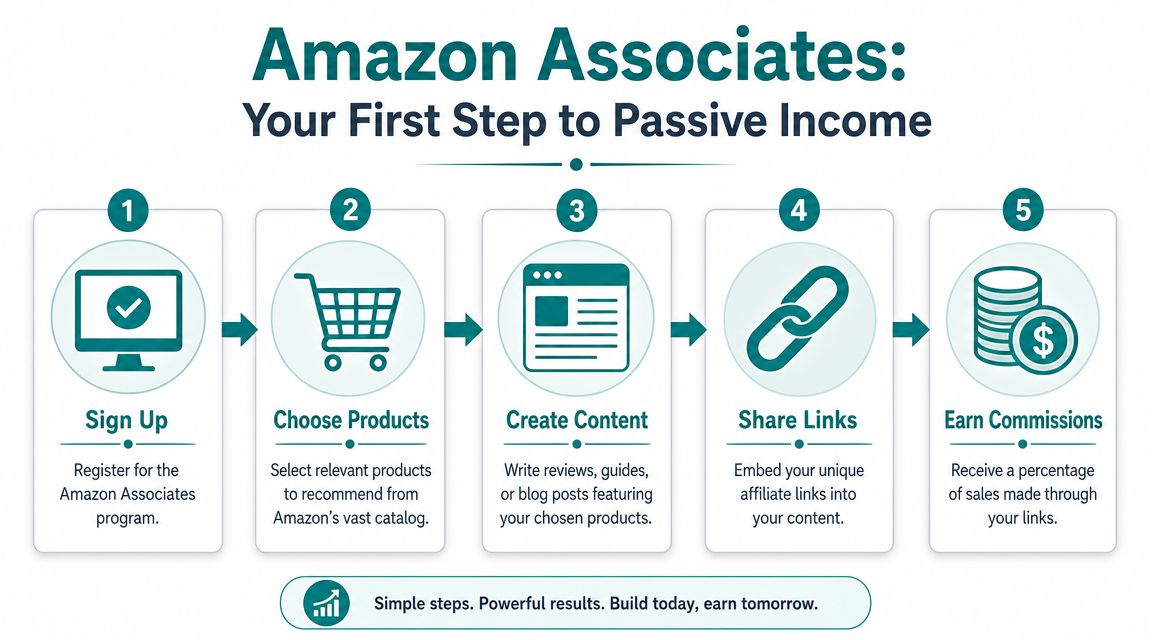
If you want the simplest introduction to passive income with Amazon, this is usually where I would point you first. Affiliate marketing sounds technical, but the basic idea is very simple. You recommend a product, someone buys through your special link, and you may earn a commission.
Amazon itself says associates can earn up to 10% in commissions from qualifying purchases, and that recommendation model sits on top of a marketplace doing about $1.75 billion per day in revenue, according to these Amazon statistics. For a beginner, that means you're plugging into an existing customer engine rather than trying to create demand from nothing.
Here's a visual overview of how the process works.
Why this feels less intimidating
You're probably already recommending things in everyday life. A favorite air fryer. A gardening tool. A skin cream that didn't irritate your skin. A book that helped you through a hard season.
Amazon Associates turns that natural helpfulness into a business model.
I remember how awkward it felt the first time I thought about sharing a product link. It sounded so formal in my head. Then I realized it was really just digital word-of-mouth. That shift made it feel human again.
What the process looks like
- Join the program so Amazon can give you your own tracking links.
- Choose products that fit a real need instead of grabbing random items.
- Create useful content like reviews, gift guides, how-to posts, or email recommendations.
- Place your affiliate links naturally where they help the reader.
- Let the content keep working as people continue to find it over time.
If you want a practical example, a gift guide can be a very approachable format. Something like 30 highly-rated men's gifts shows how curated recommendations can solve a specific problem for readers who don't know what to buy.
For readers who want beginner-friendly articles around this model, the Amazon Associates tag at Freedom Brand Ambassador gathers related content in one place.
A quick video can also make the whole idea feel less abstract.
What makes someone good at this
You don't need to be flashy.
You need to be:
- Observant enough to notice what people need
- Honest enough to recommend only what fits
- Clear enough to explain why something helps
- Consistent enough to keep publishing useful content
That's learnable. All of it.
Share Your Creativity with KDP and Merch on Demand
Some women don't want to recommend products. They want to create something of their own. If that's you, Amazon offers two appealing paths that don't require you to store boxes in your home.
KDP for your knowledge and life experience
Kindle Direct Publishing, often called KDP, lets you publish ebooks and print books for readers around the world through Amazon's platform, as noted in this overview of passive income on Amazon from Threecolts. That doesn't have to mean writing a long memoir.
It can look much simpler than that.
You might create:
- A recipe collection based on family meals people always ask about
- A practical guide on container gardening, budgeting, caregiving, or decluttering
- A journal or workbook that helps readers stay organized
- A short teaching resource built from experience you already have
This is one of my favorite models for women over 50 because your life experience becomes an asset. The very things you've lived through can become useful to someone else.
For a broader beginner-friendly view of asset building beyond Amazon alone, this guide on how to create passive income can help you think in the right direction.
Merch on Demand for simple creative ideas
Merch on Demand is different. Instead of publishing a book, you upload designs for apparel and similar products. Amazon handles printing after the sale, along with shipping and customer service.
That means you don't need inventory.
You also don't need to be a professional designer to start brainstorming. Some of the strongest ideas are simple. A clear phrase for dog lovers. A funny line for retired teachers. A niche design for gardeners, grandmothers, or pickleball fans.
If you'd like examples of how print-on-demand businesses work more broadly, this guide to on-demand merch can help you understand the model.
Your creativity doesn't have to be grand to be valuable. It just has to be useful, relatable, or memorable to a specific group of people.
Why these models feel lighter
With KDP and Merch, Amazon takes care of the physical logistics after the setup is done. That removes one of the biggest mental barriers for beginners.
You can focus on the part that matters most. The idea.
For many women, that's a relief. No packing tape. No spare room full of stock. No post office runs.
A Gentle Introduction to Selling Products with FBA
FBA stands for Fulfillment by Amazon. In simple terms, you source products, send inventory to Amazon's warehouses, and Amazon handles storage, packing, shipping, customer service, and returns for those orders.
That sounds wonderfully passive at first. And parts of it can become more hands-off than doing your own shipping.
Still, at this point I want to be especially honest.
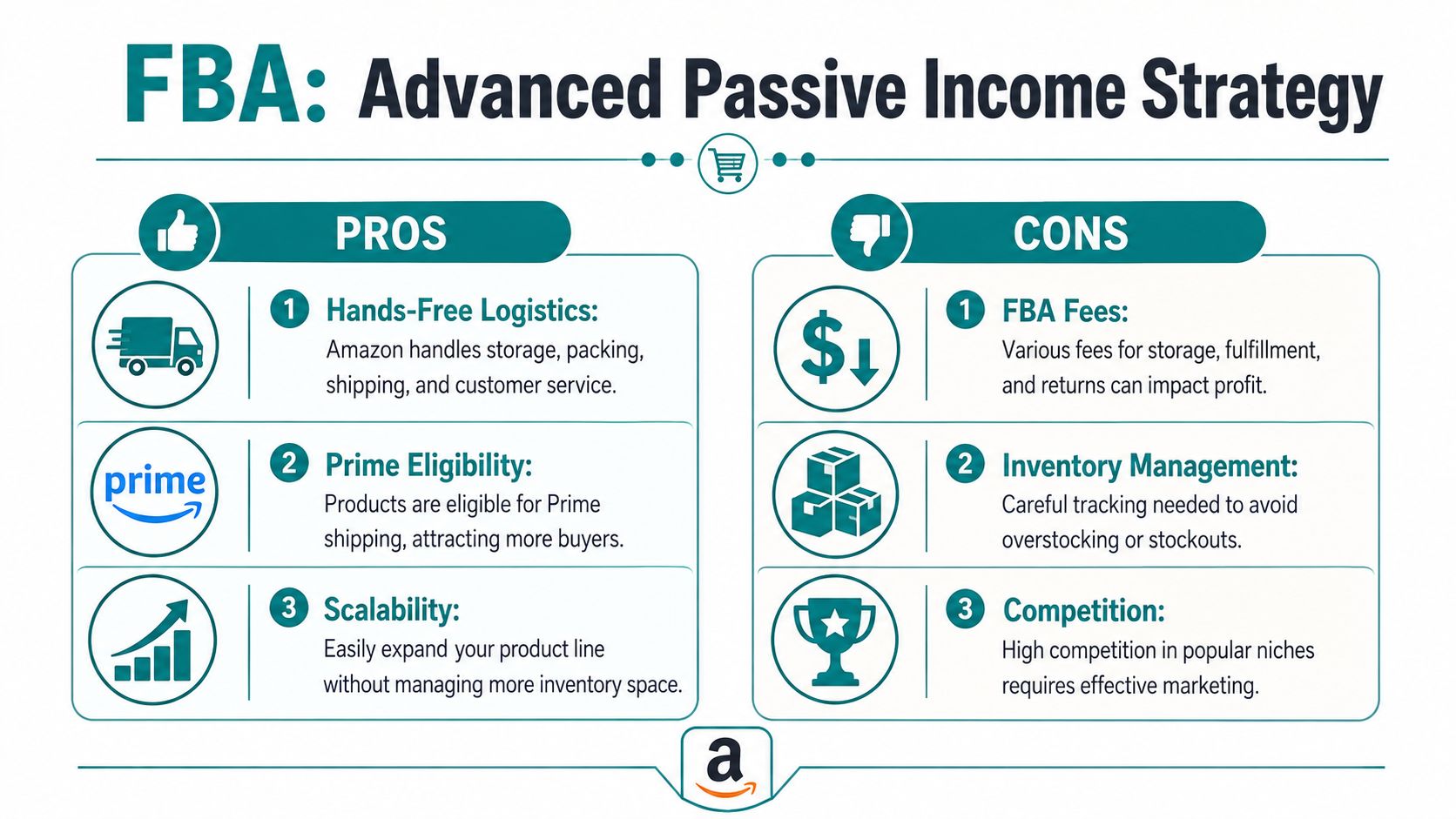
Why beginners should move carefully
A lot of online content makes FBA sound easier than it is. Amazon's own seller guidance presents multiple ways to make money, but neutral guidance also points out that many discussions oversimplify the cash-flow and operational risk of FBA. That same guidance emphasizes a front-loaded process and the growing importance of brand-building rather than simple product flipping, as discussed in Amazon's sell-on-Amazon guidance.
What that means in plain language is this:
- You can tie up money in inventory before you know whether the product will sell well
- You have to manage fees and margins carefully
- You still need product research and positioning
- Competition can push you toward better branding, not just cheaper sourcing
When FBA makes sense later
FBA may fit you better after you've already built confidence with a simpler model. For example, maybe you've learned how to spot demand through content or Affiliate Marketing, and now you want to explore a physical product opportunity with more experience behind you.
That is very different from jumping in cold.
I understand why FBA attracts people. Amazon handles a lot of the logistics, and that is appealing. But if your goal is peace of mind, not stress, this usually isn't the first path I'd hand to a cautious beginner.
If you're still exploring broader home-based online business options before choosing your lane, this article about starting an online business from home may help you think through the bigger picture.
A grounded question: Which Amazon path gives me the most learning with the least financial pressure?
That's the question I wish more beginners asked.
Your First Small Step Toward Financial Peace
You do not need to choose your entire future this week. You only need to begin noticing where opportunity already exists in your daily life.
One of the most practical insights from Amazon-focused creator guidance is that strong creators don't just guess. They notice emerging demand and turn it into content. In simple terms, that means paying attention to what people keep asking about and what problems they want solved, as described in this SellerLogic article on passive income with Amazon.
A simple exercise for this week
For the next seven days, keep a small notebook beside you and write down:
- Products you naturally recommend to friends or family
- Questions people ask you often about hobbies, home life, work, or caregiving
- Topics you know well because you've lived them
- Small frustrations people mention that could point to a useful product, guide, or piece of content
This tiny habit does something important. It helps you stop seeing yourself as someone who's behind and start seeing yourself as someone who has insight.
Why this matters more than rushing
You don't need to be highly technical. You don't need to be young. You don't need to have it all figured out.
You need a starting point that feels calm enough to continue.
For many women, Amazon Associates is that starting point. For others, it may be KDP or Merch. The right first step is the one that helps you build confidence while keeping risk low and learning high.
The next five years will pass either way. The only question is whether you'll use them to build something that gives you more peace of mind.
If you'd like gentle, step-by-step help as you learn what online income could look like in this season of life, you can explore Victoria OHare. It's a resource for aspiring online entrepreneurs, especially midlife women and beginners, with practical guidance on Affiliate Marketing, simple automation, and building sustainable digital assets without tech overwhelm.