
If you're over 50 and wondering whether it's too late to build income online, you're not alone. Many women feel behind financially, not because they failed, but because life happened. Careers shifted, caregiving took time, savings didn't grow the way you hoped, and now the digital world can look like a crowded room where everyone else got there early.
You're not behind.
You're standing at the beginning of something learnable. Affiliate Marketing isn't magic, and it isn't instant. But it can be a simple way to build an income stream with more dignity, flexibility, and peace of mind than another part-time job that wears you out.
Is It Too Late to Build an Income for Retirement
Many women reach this stage.
They don't announce it. They just sit at the kitchen table with coffee, open their banking app, and do the math again. They wonder whether Retirement will feel restful or stressful. They ask themselves if they missed their chance to do something smart online.
I know that feeling.
The first time I started looking into online income, I didn't feel excited. I felt suspicious, tired, and a little embarrassed that I didn't understand the language. Funnels, links, platforms, dashboards. It all sounded like something for younger people with marketing degrees and lots of spare time.

The quiet worry many women carry
Maybe your version looks like this:
- You have some savings, but not enough to feel relaxed.
- You'd like extra income, but you don't want another job with a boss and a schedule.
- You know the internet matters, but the tech side makes you freeze.
- You want something honest, not flashy, pushy, or full of hype.
That last part matters.
Most women over 50 are not looking for hustle culture. They're looking for steadiness. They want to build something useful. If that's you, you're thinking about this the right way.
You don't need to become a different person to build income online. You need a simple model, a little patience, and room to learn.
Retirement security isn't as simple as it once seemed
For many households, the old picture of Retirement no longer feels solid. A pension isn't guaranteed for everyone. Costs keep showing up. Family needs don't stop just because you hit a certain birthday.
That's why more women are exploring assets instead of depending only on a paycheck.
An asset can be a blog, a newsletter, a small audience that trusts you, or content that keeps helping people after you publish it. If you're curious about whether age is really a barrier, this thoughtful piece on starting an online business over 50 may reassure you.
If writing feels intimidating, remember that content doesn't have to mean long articles only. Some women begin with simple audio. If that appeals to you, SparkPod's small business podcasting tips offer a practical look at how speaking can become part of a simple online business.
A better question to ask
Instead of asking, "Am I too late?"
Try asking, "What small asset can I start building now?"
That question changes everything. It shifts you from regret to action. And that's where Affiliate Marketing can become a gentle place to begin.
What Affiliate Marketing Really Is (and What It Is Not)
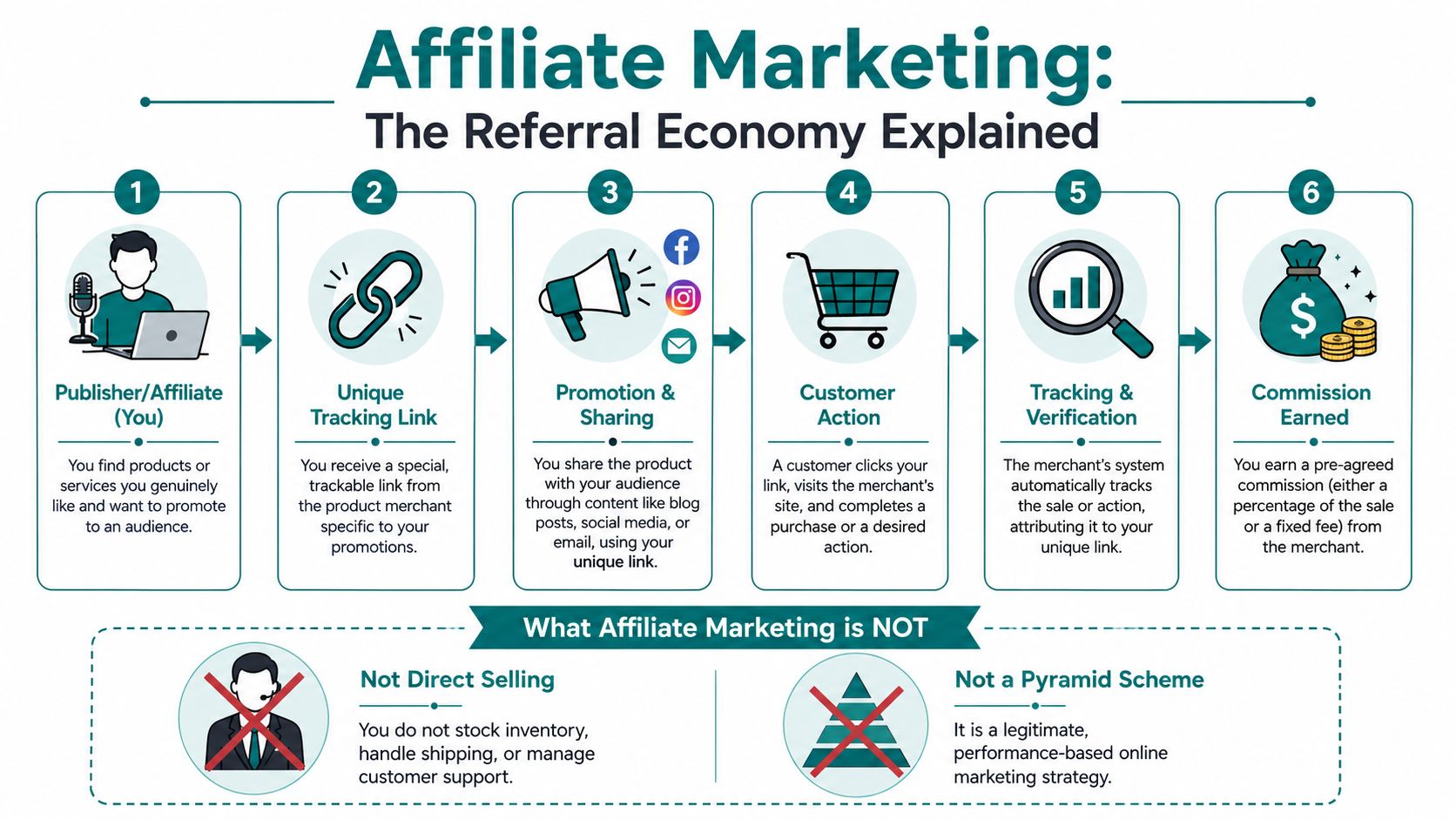
At its simplest, affiliate marketing means recommending a product or service through a special link. If someone buys through your link, you earn a commission.
All done.
Imagine telling a friend about a book you loved, a skin cream that helped, or a tool that solved a problem. In everyday life, we make recommendations all the time. Affiliate Marketing just adds a trackable link so the company knows the customer came from you.
 Affiliate Marketing works for online business owners." />
How the basic process works
- You join a program for a company or brand.
- They give you a unique link tied to your account.
- You share that link in a blog post, email, video, or social post.
- A reader clicks and buys if the offer fits their needs.
- The sale is tracked, and you receive a commission.
If you ever get tangled in the language, a plain-English guide to common affiliate terms can make the process feel much less intimidating.
What it is not
Many beginners get confused at this point, especially if they've seen bad online offers before.
Affiliate marketing is not:
- Not direct selling. You don't stock products, ship boxes, or manage customer service.
- Not creating your own product. You can begin by recommending something that already exists.
- Not a pyramid scheme. You are paid for a tracked sale or action, not for recruiting people beneath you.
- Not a shortcut to easy money. It takes trust, useful content, and consistency.
- Not pushy sales behavior. Good Affiliate Marketing feels like helping, not pressuring.
Practical rule: If you wouldn't recommend it to a friend you care about, don't promote it online.
Why many people now take it seriously
It helps to know this isn't some fringe internet idea. The Affiliate Marketing industry is valued at over $17 billion, with further growth projected, which is one reason many people now see it as a legitimate part of online business, not a passing fad, according to Post Affiliate Pro's industry overview.
That doesn't mean every program is good. It means the model itself is real.
For a woman over 50, that matters. You don't need more noise. You need something simple enough to learn and grounded enough to trust.
A calm way to think about Affiliate Marketing is this: you build helpful content, you recommend useful things, and you earn when your recommendation leads to action. No inventory. No cold calling. No pretending to be someone you're not.
Common Worries About Starting Affiliate Marketing Over 50
Most hesitation comes down to three questions.
Is this a scam?
Do I need tech skills?
Am I too old?
Those are reasonable questions. You don't need to feel bad for asking them.
Is this a scam
There are scams online. That's real. Caution is wisdom, not negativity.
But Affiliate Marketing itself is a mainstream business model used widely by brands and publishers. 81% of advertisers and 84% of publishers use Affiliate Marketing to acquire customers and monetize content, as noted earlier in the article's industry discussion. That doesn't make every individual offer trustworthy, but it does answer the bigger fear that the model itself is fake.
Here is the difference that matters:
| Concern | Red flag | Healthy sign |
|---|---|---|
| Money promises | Fast cash language | Clear explanation of how commissions work |
| Product quality | Vague or exaggerated claims | A product with a real use and audience |
| Teaching style | Pressure and urgency | Patient, step-by-step education |
| Business model | Focus on recruiting people | Focus on recommending products |
If you want a grounded look at that question, this guide on whether Affiliate Marketing is legitimate for women over 50 is worth reading.
Do I need to be good with tech
No. You need to be willing to learn a few basic tasks.
That might mean:
- Copying a link into an email or post
- Logging into a dashboard to check clicks or sales
- Writing a short recommendation in plain language
- Using one platform at a time instead of trying everything at once
I remember the first time I logged into a training dashboard. I almost quit. There were tabs everywhere, strange labels, and too many options. What helped was realizing I didn't need to understand the whole room. I only needed to learn the next button.
Learn one tool, one task, and one habit at a time. That's how people become "good at tech."
Am I too old
No. In many ways, your age is an advantage.
You likely know how to listen, how to communicate clearly, and how to tell the difference between a useful product and empty marketing. Younger creators may have speed. You have judgment.
That matters in Affiliate Marketing because trust matters.
Many beginners assume success comes from being trendy. Often, it comes from being credible. A woman who has solved a problem, tested a product, and can explain it calmly has something valuable to offer.
What often works better after 50
- Depth over speed. You don't need to post constantly if what you share is thoughtful.
- Experience over performance. Real-life insight is more persuasive than hype.
- Trust over traffic tricks. People return to creators who sound honest and steady.
If you've been worried that you missed the moment, try turning that thought around. Maybe this stage of life is the first time you care less about impressing people and more about helping them. That's a strong place to build from.
How to Choose a Niche That Feels Natural to You
One of the biggest mistakes beginners make is choosing a niche that sounds profitable but feels foreign. That usually leads to burnout.
A better niche is one you can talk about without pretending.

Start with your lived experience
A niche is a focused topic and audience. Not "health" in general. Maybe healthy meal planning for busy grandmothers. Not "beauty" in general. Maybe skincare for women with mature skin.
That focus matters. Affiliates who focus on a clear niche report 3 to 5 times higher conversion rates than generalists, according to Post Affiliate Pro's niche discussion. In plain terms, focused trust tends to work better than broad advice.
Try writing down answers to these questions:
- What do people already ask me about? Friends often reveal your niche before you do.
- What problem have I solved in my own life? Weight changes, caregiving systems, budgeting, gardening, organization, menopause support, downsizing.
- What could I talk about for an hour without needing notes?
- What kind of person do I understand well? New retirees, women after divorce, beginner crafters, dog owners, home cooks.
Look for usefulness, not just passion
Passion is nice. Usefulness is better.
You don't need a glamorous niche. You need one where people are actively looking for help, tools, products, or guidance. That could be simple and practical.
Here are examples of niche directions that often feel natural for women over 50:
- Home and organization for downsizing or simplifying
- Health routines for midlife women
- Hobbies such as quilting, sketching, gardening, or baking
- Money tools for budgeting and planning
- Technology for beginners if you've learned to simplify it for others
If you want a simple framework for thinking through topic selection and content planning, these strategies for affiliate income can help you see how a niche turns into an actual business.
A quick filter for your niche ideas
Use this short checklist:
| Question | If yes | If no |
|---|---|---|
| Can I speak about this honestly? | Keep considering it | Drop it |
| Do people have a real problem here? | Good sign | Keep digging |
| Are there products or services that help? | Possible affiliate fit | Harder to monetize |
| Would I still care about this in six months? | Strong candidate | Risk of burnout |
A deeper walkthrough on how to choose a profitable niche can help if you're between a few ideas and need to narrow them down.
Here is a simple video if seeing the process explained out loud helps more than reading alone.
Give yourself permission to begin small
You do not need to choose your forever niche today.
You can start with a micro-niche. That means a smaller, more specific version of a bigger topic. This is often easier, calmer, and more realistic for beginners.
A niche isn't a prison. It's a starting point that helps people understand what you can help with.
If you pick something grounded in your real life, your content will sound human. And human is what people trust.
Your Simple Starter Guide to Taking Action
This is the point where many women freeze. They understand the idea, but they don't know what to do first.
The answer is not "do everything."
The answer is to do a few simple things in the right order.
Choose programs you can trust
Start with products or services you already know, use, or respect. Trust matters more than chasing the highest commission.
When you look at an affiliate program, check for:
- A clear product fit. Does this help the audience you want to serve?
- A professional website. If the brand feels confusing or sloppy, your readers may feel that too.
- Simple affiliate details. You should be able to understand how links, commissions, and approvals work.
- Good alignment with your values. If it feels manipulative, skip it.
Some beginners also hear the term EPC, which means earnings per click. You don't need to obsess over it on day one, but it can help you compare offers later. In simple terms, EPC tells you how much affiliate earnings are generated from clicks. Higher EPC can make a program more attractive to affiliates because it signals stronger earning potential, as explained in Partnerize's guide to affiliate KPIs.
Create helpful content before you worry about scale
You don't need a giant website. You need helpful content.
That content might be:
- A short blog post about a product you use
- An email sharing a useful resource
- A simple review comparing two beginner-friendly options
- A how-to article that naturally includes a recommendation
The goal is to answer a real question.
If someone asks, "What's the easiest meal planner for women trying to simplify dinner?" and you've used one you like, that can become affiliate content. You're not "selling." You're helping someone make a decision.
Write as if you're helping one friend who asked for advice, not performing for the internet.
Build your email list early
If social media disappeared tomorrow, what would you still own?
That question matters.
An email list is one of the most stable assets you can build because it gives you a direct connection to people who want to hear from you. You don't need thousands of subscribers to begin. You just need to start collecting the names of people who care about your topic.
A very simple setup looks like this:
- Pick an email platform with beginner-friendly forms.
- Create one useful free resource such as a checklist, guide, or short tip sheet.
- Invite people to join if they want more help on your topic.
- Send useful emails consistently with stories, tips, and occasional affiliate links.
Victoria OHare is one example of a resource that teaches Affiliate Marketing, List Building, and simple automation for beginners who want a calmer approach.
Keep your first month small on purpose
Your first steps do not need to be impressive. They need to be doable.
Try this starter list:
- Choose one niche
- Join one or two programs
- Publish one helpful piece of content
- Set up one email signup form
- Send one welcome email
Affiliate marketing already influences a meaningful share of online shopping decisions, powering 16% of all e-commerce orders, as noted earlier in the industry discussion. That tells us something important. Helpful recommendations matter. Your calm voice can matter too.
Three Gentle Reminders to Avoid Common Pitfalls
Most mistakes in Affiliate Marketing don't happen because a woman isn't capable. They happen because she gets discouraged, distracted, or pressured into doing too much too soon.
A few gentle reminders can save you months of frustration.
Don't wait until everything looks perfect
Perfectionism often dresses itself up as responsibility.
It says, "I just need a better logo."
"I should wait until I understand the platform completely."
"I'll start once my website looks more polished."
But most of the time, that delay isn't preparation. It's fear.
A simple post that helps someone is more useful than a beautiful draft no one sees. Let your first work be ordinary. That's how skill grows.
Don't promote products you wouldn't use yourself
This one matters more than beginners realize.
Trust is your real asset. Once people sense that you're recommending things just for a commission, the relationship changes. You may earn a quick sale, but you weaken the foundation you're trying to build.
Before sharing an offer, ask:
- Would I feel comfortable sending this to my sister or close friend?
- Do I understand what it does and who it's for?
- Does the sales page feel honest?
- Would I still mention it if there were no commission?
If the answer is no, step back.
The longer your affiliate business lasts, the more valuable trust becomes.
Don't assume slow progress means failure
Affiliate marketing can feel quiet at first. You write something. You share it. Nothing dramatic happens.
That doesn't always mean it's not working.
Early on, you're building skills that are easy to overlook:
- You learn how to explain a product clearly
- You begin noticing what questions people ask
- You start finding your voice
- You create pieces of content that can keep working later
A slow start can still be a strong start.
Some women quit because they expected immediate proof. A steadier approach is to treat the beginning as a season of learning. If a post doesn't perform, it taught you something. If a link gets no clicks, you can adjust the wording. None of that is wasted.
Keep your standards honest, but keep them kind. You're building for peace of mind, not applause.
A Calm 30-60-90 Day Plan for Getting Started
A simple timeline can help when your mind starts spinning. This isn't a strict deadline. It's a gentle rhythm.
The goal is progress, not pressure.
Your simple 30-60-90 day starter plan
| Timeframe | Primary Focus | Simple Actions to Take |
|---|---|---|
| First 30 days | Clarity and setup | Choose one niche, identify your audience, research a few affiliate programs, create a simple content plan, and open an email platform account |
| Days 31 to 60 | Content and connection | Publish a few helpful pieces of content, join selected affiliate programs, place links naturally where they fit, and create a freebie or signup form for your email list |
| Days 61 to 90 | Sharing and learning | Share your content regularly, send simple emails, notice which topics get attention, review your clicks and responses, and refine what feels most helpful to your audience |
What each phase should feel like
The first month may feel a little messy. That's normal. You're making decisions and learning the language.
The second month often feels more real. You begin to see your topic take shape. You stop thinking only in terms of "Can I do this?" and start asking, "How do I want to help?"
By the third month, the goal isn't mastery. It's momentum.
A few ways to stay grounded
- Keep a simple notebook for content ideas, questions, and lessons learned.
- Track effort, not just results. Did you publish, send, test, and learn?
- Limit your platforms so you don't scatter your energy.
- Return to your reason. Security, dignity, flexibility, peace of mind.
You do not need to build a huge business overnight to change your future. You need to start building something you own. A list. A body of content. A trusted voice. A small stream of income that can grow over time.
The next five years will pass either way. The only question is whether you'll use them to build something that gives you peace of mind.
If you'd like a calm next step, Victoria OHare offers step-by-step guidance on Affiliate Marketing, List Building, and simple online business strategies for women who want to start without hype or tech overwhelm.