
If you're over 50 and wondering whether it's too late to build income online, you're not alone. Many women feel behind financially, not because they failed, but because life happened. Careers changed, families needed care, Retirement savings didn't grow the way you hoped, and now the internet can feel like a noisy room where everyone else somehow knows the rules.
I remember the first time I tried to understand online business. I stared at a dashboard full of buttons and tabs and felt my shoulders tighten. I almost closed my laptop and decided this world was for younger people, or more technical people, or people with more confidence than I had that day.
But that wasn't true. It isn't true for you either.
Learning how to stop trading time for money isn't about becoming someone else. It's about taking what you already know, your judgment, your work ethic, your life experience, and turning it into something more stable. Something that supports your dignity, your independence, and your peace of mind.
Introduction You Have More to Offer Than You Think
A woman in her late 50s sits at the kitchen table after dinner, bills stacked beside her reading glasses. She's worked hard for decades. Maybe she was a teacher, a nurse, an office manager, a hairdresser, a consultant, a caregiver, or all of those things in different seasons of life. She isn't lazy. She isn't careless. She's just tired of feeling like security keeps moving farther away.
If that sounds familiar, take a breath.
You are not behind. You are standing at the beginning of a second chapter, and second chapters often begin subtly. Not with a grand announcement. Just with a question like, "What else is possible for me now?"

Wisdom is an asset
One of the biggest misunderstandings about making money online after 50 is thinking you have nothing special to offer. That usually isn't true. Often, what feels ordinary to you is useful to someone else.
You may know how to:
- Solve practical problems: organize a home, manage a budget, cook for dietary needs, care for aging parents, or simplify a routine
- Guide beginners: explain confusing things in a calm way because you've already lived through them
- Recommend helpful tools: books, products, services, routines, software, or systems that made life easier
- Encourage people: which is a real skill, especially online where so many people feel overwhelmed
That knowledge matters. Online income often starts there.
You don't need to invent a new personality. You need to recognize the value in what you've already lived.
The fear is real, but it isn't final
Some women worry they're too old. Others worry they'll get scammed, waste money, or never understand the tech. Those are reasonable concerns. Caution is healthy.
But caution doesn't have to become paralysis.
The women who build steady online income usually don't start as experts. They start as learners. They ask questions. They make one small decision, then another. Over time, confusion turns into familiarity, and familiarity turns into confidence.
If you're looking for an online business for older women that feels grounded instead of flashy, this path can fit. Not because it's easy, but because it can be learned.
The Gentle Truth About Trading Hours for Dollars
Many good people were taught to work hard, be dependable, and earn money through effort. That's honorable. The problem isn't hard work. The problem is the structure.
When your income depends on your presence, your earnings have a ceiling.
According to this explanation of active and passive income, in active income models, your earning potential is mathematically capped by the number of hours available in a day. If you charge $100 per hour and work 8 hours daily, your maximum daily income is fixed at $800. For service professionals, that cap becomes especially painful because many never learn how to move beyond time-for-money work.
Why this feels so exhausting
This is the quiet trap of active income.
You can get better at your job. You can raise your rates. You can fill your schedule. But if you need to be personally present for every dollar, then time off becomes expensive. Rest feels costly. Illness becomes scary. Family needs can interrupt income.
A simple way to think about it looks like this:
| Income type | How money is earned | Main limit |
|---|---|---|
| Active income | You work, then you get paid | Your time and energy |
| Asset-based income | You build or own something that can keep earning | Setup effort, patience, and systems |
That doesn't mean active income is bad. It often funds the next step.
The better question to ask
Many people ask, "How can I earn more per hour?" That's understandable, but it keeps your thinking tied to the clock.
A more useful question is, "How can I create value that continues helping people after I've done the first round of work?"
That's how your effort multiplies. A guide, a course, an email series, a recommendation list, a membership, a digital template, or a piece of content can keep working after you press publish.
If you'd like a beginner-friendly comparison, this overview of active income and passive income can help make the difference feel more concrete.
Practical rule: Keep your active income if you need it, but stop asking it to carry your whole future by itself.
This isn't about hustle
Some readers hear phrases like passive income and immediately picture hype, pressure, and unrealistic promises. That isn't what I mean.
I mean building assets. I mean creating something once that can be shared many times. I mean using your current effort more wisely so your future doesn't depend on your constant output.
If Retirement doesn't feel as secure as you'd like, this matters. A paycheck can stop. An asset can continue.
Four Paths to Income That Works While You Rest
The shift out of hourly thinking usually happens in stages. According to this three-phase framework for moving beyond hourly work, people first make a mindset shift away from hourly rates, then focus on higher-value work, and then use active income to build scalable assets such as digital products, training programs, or membership sites that can earn without direct time for each sale.
That sounds abstract at first, so let's make it simpler.
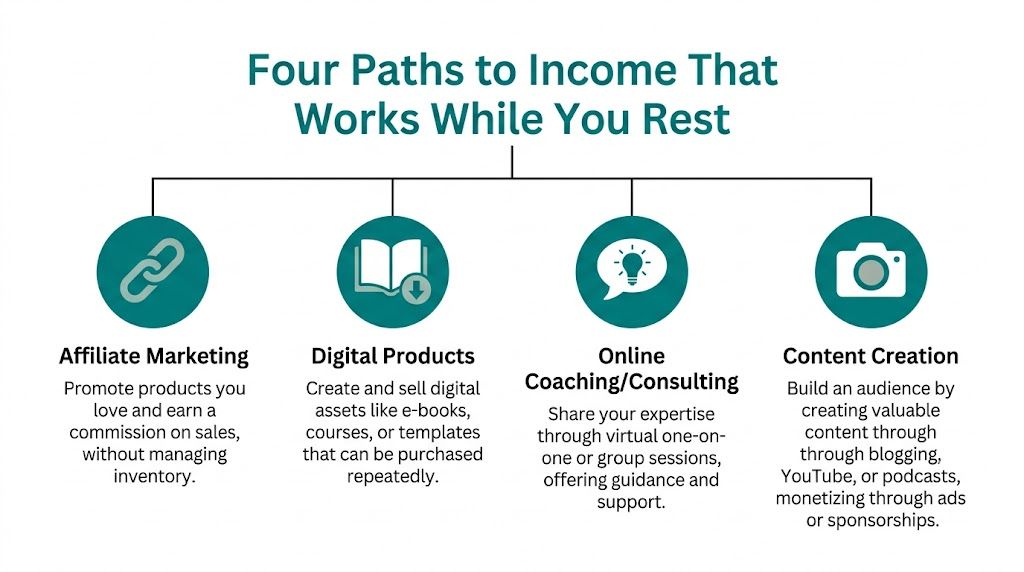 Affiliate Marketing, digital products, online coaching, and content creation." />
Affiliate marketing
Affiliate marketing for beginners over 50 doesn't need to be complicated. At its heart, it's recommending a product or service and earning a commission if someone buys through your link.
Imagine being a trusted friend who says, "This tool helped me. If you want to try it, here's where I found it."
You don't create the product. You don't ship anything. You don't manage inventory or customer support. Your job is to help people make informed decisions.
This works well for women who enjoy teaching, reviewing, comparing, or sharing what they've learned. If you've ever told someone which kitchen tool is worth buying, which skincare product worked, or which software made a task easier, you already understand the instinct behind Affiliate Marketing.
A few good fits include:
- Practical blogs: sharing tutorials, reviews, checklists, or resource lists
- Email newsletters: recommending tools, books, courses, or services to subscribers
- Simple videos: talking through what you use and why
- Niche websites: serving one specific audience with clear guidance
If you want more ideas for realistic at-home options, this guide on how to make passive income from home offers a helpful starting point.
Digital products
A digital product is something you create once and sell more than once. It might be an ebook, printable planner, checklist, workshop replay, swipe file, recipe collection, template, or short course.
This path is especially useful if people often ask for your help with the same topic.
For example, if friends always ask how you organize medications for an aging parent, you could turn that system into a printable guide. If people ask how you started affiliate links in a blog, you could create a beginner checklist. If you've learned how to meal plan on a tight budget, that can become a small product too.
You do the work upfront. Then each new customer gets the same value without needing a private hour of your time.
A digital product doesn't need to be big to be useful. It needs to solve one real problem clearly.
Online courses and memberships
Courses and memberships are a natural next step if you enjoy teaching.
A course is more structured. It helps someone move from point A to point B. A membership is more ongoing. It offers regular support, training, resources, or community.
This doesn't mean you need to become a polished internet personality. A calm teacher often does better than a flashy one, especially with beginner audiences. People value clarity.
Examples might include:
- A starter course: how to set up a simple newsletter, start Affiliate Marketing, or organize a downsizing project
- A support membership: monthly lessons, Q&A sessions, and resource guides for a specific life stage
- A workshop series: short trainings around one practical topic
If you've spent years helping people in real life, online teaching may feel more natural than you expect.
Brand ambassadorships and content creation
Brand ambassadorship is a close cousin of Affiliate Marketing. You build trust with an audience, then work with brands whose products align with your niche and values. Sometimes that relationship includes affiliate links. Sometimes it includes sponsored content or long-term partnerships.
Content creation supports this whole system. Blog posts, emails, videos, podcasts, or social posts attract people who need what you know.
If video feels intimidating, remember that content creation doesn't mean dancing on camera. It can be thoughtful and quiet. A woman sharing gardening advice, budget meals, caregiving routines, or product tutorials is creating content.
For readers curious about video income, this explanation of how YouTube sponsorship works is useful because it shows how partnerships can grow from audience trust rather than celebrity status.
A practical option in this category is structured education. Victoria OHare provides beginner-focused content about Affiliate Marketing, brand ambassadorship, email List Building, and simple automation for people who want to turn experience into online income.
How to choose your first path
You do not need to do all four.
Use this simple filter:
| If you enjoy… | Start with… |
|---|---|
| Recommending useful tools | Affiliate marketing |
| Organizing knowledge | Digital products |
| Teaching step by step | Courses or memberships |
| Sharing stories and advice regularly | Content creation and brand ambassadorships |
The right first model is the one you can stick with calmly. Consistency matters more than complexity.
Quietly Answering Your Biggest Doubts
Doubt often shows up right after possibility. That's normal.
A woman reads about online income and thinks, "This sounds sensible, but what if it's all a scam?" Then another thought arrives. "What if I spend weeks trying and still don't understand the technology?" Then the deepest one. "What if I'm just too late?"
I've had all three thoughts.
The first time I joined an online training platform, I clicked around nervously and wrote down every step on paper because I was sure I'd forget where anything was. I felt embarrassed by how slow I was. Later I realized slowness isn't failure. It's just the beginning of learning.

Is this a scam
Some parts of the online world are absolutely unreliable. I understand being cautious. There are scams online. That's why education and mentorship matter.
A legitimate path usually has a few signs:
- Clear explanation: you can understand what the business model is and how money is made
- Real product or service: there is something useful being sold or recommended
- No pressure tactics: nobody is rushing you with fear or shame
- Transferable skills: you're learning writing, communication, email, audience building, or product creation
If something feels secretive, manipulative, or too good to be true, step back. A sound business model should still make sense in plain language.
Do I need tech skills
You need some basic digital skills. You do not need to be a tech genius.
Most beginners can start with a short tool list:
- An email platform: Mailchimp or ConvertKit
- A writing space: Google Docs or Notion
- A simple design tool: Canva
- A website or landing page tool: often built into beginner platforms
- A willingness to practice: which matters more than talent
Tech overwhelm usually comes from trying to learn everything at once. You don't need to master webinars, funnels, automation, video editing, and branding in one weekend. You need one skill at a time.
If you can learn online banking, grocery pickup, or video calls with family, you can learn the early steps of online business too.
Am I too old
No. In many niches, your age helps you.
People trust calm judgment. They trust lived experience. They trust someone who doesn't sound desperate. Midlife women often communicate with more patience, more honesty, and more perspective than younger creators who are still finding their voice.
This is especially true in topics like Health routines, caregiving, budgeting, Retirement planning, home organization, confidence, grief, relationships, lifestyle simplification, and starting over.
Your age does not disqualify you. It often sharpens your relevance.
What if I have nothing to sell
You may not need to create a product right away. You can begin by helping people choose.
That might mean:
- Recommending tools: software, books, household items, supplements, planners, or services
- Curating options: comparing what works for a beginner and what doesn't
- Explaining steps: turning your experience into useful guidance
- Documenting your journey: sharing what you're learning as you go
People often think they need an original invention. They don't. They need a helpful point of view.
If you've been asking how to earn income before Retirement, many women begin this way. They stop trying to become internet performers and start becoming useful guides.
Your First Asset The Audience You Own
If you build online income on social media alone, you're building on rented land. A platform can change its rules, reduce your visibility, or disappear from your daily life faster than you'd expect.
An email list is different. It's closer to owned land. Not in the legal sense, of course, but in the practical business sense. You have a direct line to people who asked to hear from you.
That matters because your audience becomes an asset.
According to this discussion of email-centric passive income, creators who prioritize an email list over social media see 4x higher lifetime value per person, and 35% reach a point where passive income makes up more than half of their total earnings within 24 months, largely through affiliate and brand ambassadorship automation sent to their list.
Why email feels more secure
Followers scroll past you. Subscribers invite you in.
That's the emotional difference, but there's also a business difference. A list gives you more control over how and when you communicate. If you write a helpful email about a product, a checklist, or a new guide, you can send it directly to people who already care.
For women who want peace of mind, control is not a small thing. It's the foundation.
If you'd like a broader overview of practical ways to build email lists that actually grow your business, that resource can help you think through the basics without adding pressure.
A simple way to start
You do not need a complicated funnel.
Start with these steps:
- Choose an email provider. Mailchimp and ConvertKit are common beginner choices.
- Pick one narrow topic. Help one kind of person with one kind of problem.
- Create a simple freebie. A checklist, short guide, resource list, or template is enough.
- Set up a signup page. Keep the language clear and plain.
- Write a welcome email. Thank them, deliver the freebie, and tell them what to expect from you.
A beginner guide like this simple step-by-step approach to building an email list can make that first setup feel much less intimidating.
What you send after someone joins
This part confuses many beginners. They worry they'll run out of things to say.
You probably won't.
Here are a few easy email ideas:
- A lesson you learned: something practical from your own experience
- A tool you use: and why it helps
- A common mistake: and a gentler way to handle it
- A recommended resource: book, article, product, or service
- A short story: what happened, what you noticed, and what the reader can take from it
You aren't writing to impress. You're writing to help.
Your email list is not just a marketing tool. It's a relationship you can build at a pace that feels humane.
A Simple 90-Day Plan for Your Second Chapter
Starting small is not a weakness. It's often the smartest way to protect your confidence.
Many women quit before they begin because the whole idea feels too big. So let's make it smaller. Think in terms of one season, not one lifetime.

According to industry benchmarks cited here, 75% of successful online creators transition from hourly services to digital products within 12-18 months. That shift often brings 3-5x income growth while reducing active work hours by as much as 60%, mainly through automating sales and delivery. You do not need to accomplish that in 90 days. But you can lay the foundation.
Days 1 to 30 choose your lane
The first month is for clarity.
Pick one topic that fits these three questions:
- What do I know from real life?
- Who do I want to help?
- What problem can I talk about repeatedly without getting bored?
Your niche does not need to be perfect. It needs to be specific enough to guide your next steps.
Some examples:
- women over 50 starting Affiliate Marketing
- simple meal planning for empty nesters
- beginner tech confidence for seniors
- organizing paperwork for caregiving families
- budget-friendly home routines
During this first month, keep a notebook or document with content ideas. Write down questions people ask you. Save phrases you hear yourself repeating.
Days 31 to 60 build your base
Now you create a basic home for your work.
That means:
- Start an email list
- Create a simple freebie
- Write one helpful piece of content each week
- Choose one platform where you're willing to show up consistently
Your content could be a blog post, email, short video, or social post that points people back to your email list. The format matters less than the clarity.
A good rhythm for beginners is one useful lesson each week. Not perfect. Useful.
The video below offers another perspective on making this shift in a practical way.
Days 61 to 90 introduce income gently
Once you have a little clarity and a simple audience asset, you can begin monetizing without pressure.
Choose one of these:
| Option | Good first step |
|---|---|
| Affiliate marketing | Join one relevant program and recommend one product you genuinely use |
| Digital product | Outline a short guide, checklist bundle, or template |
| Mini course | Sketch a small lesson series around one beginner problem |
| Brand ambassadorship | Start creating content that naturally aligns with one category of product |
This is also the month to notice patterns. What questions do people ask? Which emails get replies? Which content feels easiest for you to create?
Those clues matter. They point toward the asset you should build next.
Keep your expectations calm
A 90-day plan is not a promise of instant income. It's a way to replace confusion with motion.
Your goals for the first season might be:
- Learn the basics without panic
- Choose a niche without overthinking
- Set up an email list
- Publish consistently
- Make your first offer, even if it's small
That is real progress.
If your first landing page looks plain, that's fine. If your first email feels awkward, that's fine. If your first recommendation earns nothing, that's also fine. You're building the machine, not just waiting for the result.
Conclusion The Next Five Years Will Pass Anyway
If you've spent years taking care of other people, it can feel strange to build something for yourself. But this isn't selfish. It's responsible. It's wise.
You don't need to become a different kind of woman to learn how to stop trading time for money. You need a quieter belief. The belief that your experience has value, your skills can be organized into assets, and your future is still open.
There are many ways to make money online after 50. Some will suit you better than others. The important thing is not choosing the perfect method on day one. It's choosing a path you can begin.
Be patient with yourself. Learn slowly if you need to. Write things down. Ask simple questions. Ignore the loudest voices online. Look for clarity, not hype. Look for systems, not stress.
You are not too old. You are not too late. You are not disqualified because you feel unsure.
You can build an online income stream that reflects who you are. Steady. Honest. Useful. Calm.
The next five years will pass either way. The only question is whether you’ll use them to build something that gives you peace of mind.
If you'd like to see the step-by-step training I used to learn this process, you can explore Victoria OHare at your own pace.