
If you're over 50 and wondering whether it's too late to build income online, you're not alone. Many women feel behind financially, not because they failed, but because life happened. Retirement can feel less certain than it once did, and the internet can seem like a world designed for people who grew up with it.
If that's where you are, take a breath. You do not need to know everything today. You only need a calm starting point, a simple plan, and the willingness to learn one step at a time.
It's Not Too Late to Build Your Second Chapter Online
A lot of women come to this with the same quiet fears.
They wonder if they've missed the moment. They worry they'll click the wrong thing, break something technical, or waste time on one more online promise that goes nowhere. They may even feel embarrassed for not already knowing what younger creators seem to learn so easily.
I remember feeling overwhelmed at first. The first time I looked at blogging tools and affiliate dashboards, I almost quit before I started. It all felt like too many tabs, too many terms, and too many people talking fast.
That feeling doesn't mean you can't do this. It means you're learning something new.
What Affiliate Marketing really is
Affiliate marketing is recommending a product, service, or tool you trust. If someone buys through your special link, you earn a commission.
That sounds more complicated than it is.
When a friend asks what walking shoes helped your knees, or which budgeting app finally made sense to you, you share what worked. Affiliate Marketing then adds a trackable link so the company knows your recommendation led to the sale.
You're not creating the product. You're not handling customer service. You're helping people make a decision with clarity.
You don't need to become a different person to do this well. You need to become more honest, more helpful, and more willing to share what you know.
Why your age can actually help you
The online world often acts as if youth is the advantage. In this kind of work, trust is the advantage.
Data in this space suggests a real opening for women in midlife. Research on blogging for Affiliate Marketing notes that women 50+ have 2x higher email open rates, 42% vs. 21% average, that only 15% of affiliate content targets seniors, and that AARP reported a 28% rise in 50+ side hustles via blogging.
That matters.
It means your calm voice, your lived experience, and your ability to explain things without hype can be an advantage, not a weakness.
A quieter way to begin
You do not need to chase trends or become flashy online. You can build something useful and steady.
A blog is one of the gentlest ways to start because it gives you time to think, write, and grow at your own pace. If you'd like a simple companion resource to read after this, this guide to starting a blog that makes money can help you see the bigger picture without making it feel overwhelming.
If you're still skeptical, that makes sense. There are scams online. Some people promise easy money and leave out the work, patience, and learning involved.
This isn't that.
This is about building a helpful online space, recommending products with integrity, and creating an asset that may support your peace of mind over time.
Finding Your Niche Using Your Life's Wisdom
The word niche can sound cold and corporate. It isn't.
A niche is the topic your blog will focus on. It's the group of problems you want to help people solve. The best niche is rarely the trendiest one. It's usually the place where your experience meets someone else's need.
For women over 50, that often means your best niche is already hiding in your own life.
Start with what you've lived
You don't need to be a celebrity, doctor, or full-time expert. You need enough real-life experience to help someone a few steps behind you.
That might be:
- Health changes you've learned to manage like menopause support, walking routines, meal planning, or gentle wellness habits
- Home and lifestyle skills such as decluttering, small-space gardening, batch cooking, or organizing a downsized home
- Money and life transitions including budgeting before Retirement, side hustles after 50, or rebuilding after divorce or caregiving
- Hobbies that solve real problems like knitting for stress relief, beginner watercolor, travel planning, or learning technology one simple tool at a time
The sweet spot is not "everything I know." It's "what I can help with clearly."
A simple niche filter
Before choosing a topic, run it through this short filter.
| Question | What you're looking for |
|---|---|
| Do I care enough to write about this often? | Interest matters because blogging takes consistency |
| Have I used products or tools in this area? | Helpful for future affiliate recommendations |
| Do people ask questions about this? | A sign the topic solves real problems |
| Would I feel comfortable talking about it with kindness and honesty? | Trust grows when your voice feels natural |
If you answer yes to most of those, you're likely close.
Practical rule: Don't choose a niche because it sounds profitable if you don't want to live inside that topic for months.
Examples of strong midlife blog niches
Some niche ideas are too broad. "Lifestyle" is broad. "Health" is broad. A narrower idea helps readers know they're in the right place.
Here are better examples:
- Menopause support for beginners
- Simple budgeting before Retirement
- Gentle fitness for women over 50
- Beginner tech help for older women
- Healthy meal ideas for empty nesters
- Travel planning for multi-generational family trips
- Side hustles for women starting over later in life
Notice the difference. These topics are specific enough to attract the right person and flexible enough to grow.
Try this notebook exercise
Take a blank page and answer these prompts without overthinking:
What do people already ask me about?
Friends often reveal your niche before you do.What have I learned the hard way?
Painful lessons often become powerful blog topics.What products, books, tools, or services have helped me?
Those may become your first affiliate recommendations later.What could I explain in plain English to someone nervous or new?
That's usually where your teaching voice lives.What topic would still matter to me a year from now?
Steady interest beats trend chasing.
If you want extra help working through this decision, this realistic guide to finding your niche for women over 50 is a helpful next read.
Don't wait for perfect certainty
Many beginners think they need the perfect niche before they can start. They don't.
You need a good starting niche. Blogs evolve. Your wording gets clearer. Your readers show you what they care about. You can refine as you go.
What matters is choosing a direction you can commit to long enough to learn from it.
A woman who has spent years solving practical life problems is not starting from zero. She's starting from experience. That is a much stronger place to begin.
Building Your Online Home The Simple Way
The technical part sounds bigger than it is. Most of it is a one-time setup.
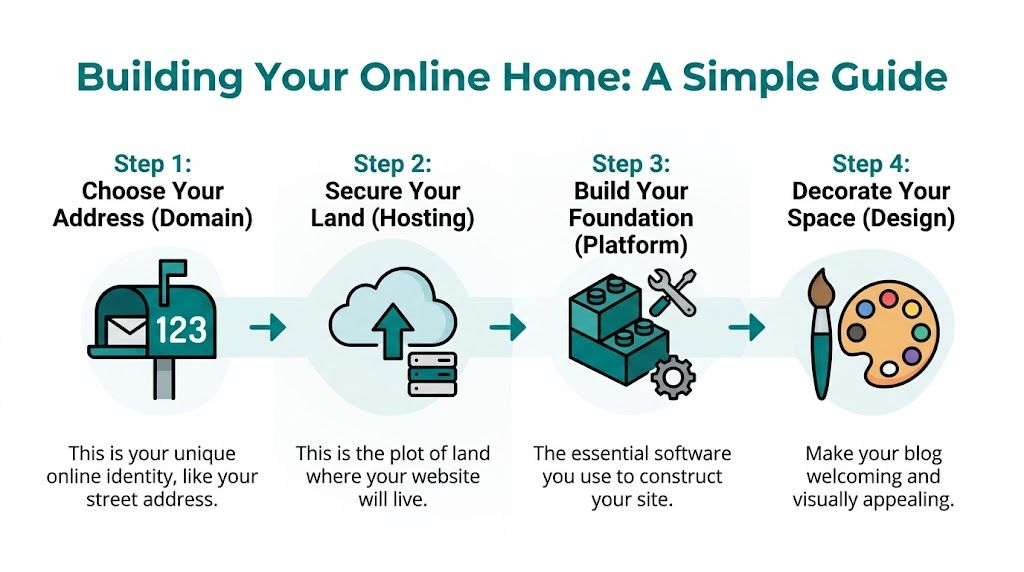
It helps to think of your blog like a home.
Your domain name is your street address. Your hosting is the land your home sits on. WordPress is the building system that lets you create rooms, pages, and posts without needing to know code.
Once those pieces are in place, you're not "doing tech" every day. You're mostly writing and helping people.
Choose a simple foundation
For how to start a blog for Affiliate Marketing, the most practical setup is WordPress.org, which powers 43% of all websites according to this affiliate blog setup guide. That same guide recommends pairing it with a managed host like SiteGround for a stable beginner-friendly setup.
Why this matters is simple. You want a setup you control.
A blog on your own hosting is an asset you own. You aren't borrowing space from a social media platform that can change the rules at any time. You also don't need to touch code to use WordPress. Most hosts offer a guided setup that does the heavy lifting for you.
What to buy first
Here are the only things you need to begin:
A domain name
This is your blog name, like YourNameBlog.com or CalmMoneyAfter50.com. Keep it simple, readable, and easy to spell.Hosting
This is the service that stores your website and keeps it online. Managed hosting is helpful because support teams can guide you if you get stuck.A WordPress theme
A theme controls the look of your site. Choose one that's clean, uncluttered, and easy to read. You do not need fancy design.
What pages your blog should have
Your blog doesn't need dozens of pages at the beginning. It needs a few essential ones.
- Home page that explains who the site is for
- About page that tells your story and builds trust
- Contact page so people and brands can reach you
- Privacy policy and affiliate disclaimer so you're transparent and legally clear
- Blog page where your articles live
Those pages create a sense of safety for readers. They also show affiliate programs that you're serious and legitimate.
Keep the design quiet and clear
A common beginner mistake is trying to make the site beautiful before making it useful.
Your reader doesn't need moving graphics, complicated menus, or ten colors. She needs clear words, a readable font, and a page that feels calm.
Use this checklist:
- Choose white space over clutter
- Pick one main accent color
- Use large, readable text
- Limit your menu to a few items
- Make mobile reading easy
A trustworthy blog often looks simpler than beginners expect. Clean wins.
If you're worried about the tech
That's normal. Most of the fear comes from unfamiliar words, not actual difficulty.
You don't need to become "a tech person." You need to learn a few repeatable actions:
- Log in to your hosting account
- Open WordPress
- Add a page or post
- Click publish
Those are learnable.
If you're exploring options and wondering whether you can do Affiliate Marketing before your site is fully built, this article about affiliate marketing without a website can help you understand the broader picture. Even so, for the calmest long-term path, a blog is still one of the best places to start.
A gentle setup order
If you like knowing the order of things, follow this:
- Buy your domain and hosting
- Install WordPress through your host
- Choose a simple theme
- Create your basic pages
- Write your first article
- Add your affiliate disclosure before you place links
When women feel stuck here, it's usually because they're trying to understand everything at once. Don't. One click, one page, one step.
Your blog is not a test. It's a home you're building slowly.
Creating Content That Helps People and Earns Trust
A blog only becomes useful when it starts answering real questions.
That is good news, because you do not need to become a "content machine." You need to become a helpful guide. The heart of affiliate blogging is not selling. It's solving.
Think in questions, not posts
Instead of asking, "What should I publish?" ask, "What is my reader worried about, confused about, or trying to decide?"
If your niche is budgeting before Retirement, your topics might include:
- How to start a simple budget after 50
- Best planners or apps for women who hate spreadsheets
- How to cut grocery stress without coupon overload
- A gentle comparison of beginner budgeting tools
If your niche is wellness, you might write about shoes, supplements, journals, cookbooks, kitchen tools, or courses you've personally used and can discuss transparently.
SEO is much less scary than it sounds. SEO means using the words people type into Google when they need help.
What a strong affiliate blog post looks like
A practical guide from Copy.ai's affiliate blog writing article recommends writing 2,000+ word posts that solve a reader's problem and including 3-5 natural affiliate links. It also notes that posts with an honest discussion of a product's cons can convert up to 40% higher because trust grows when readers hear the whole story.
That last part matters more than any trick.
You do not need to say a product is perfect. In fact, you shouldn't.
A simple post formula
Try this shape for one of your first articles:
Start with the problem
Example: "If budgeting apps make you feel overwhelmed, you're not the only one."Share what you tried
Briefly explain what did and didn't work for you.Introduce the product naturally
Mention the tool when it fits the story, not as a hard sell.Include pros and cons
When you do this, trust deepens.Help the reader decide
Tell her who it's best for, and who may want something simpler.Add a clear disclosure
Let readers know you may earn a commission if they buy through your link.
Some of the most trustworthy affiliate posts sound like a friend saying, "Here's what helped me, and here's where it may not be the right fit for you."
Salesy language versus helpful language
Here is a simple comparison.
| Pushy version | Helpful version |
|---|---|
| You need this tool right now | If you want a simpler way to track spending, this is the one that felt easiest for me to use |
| This product is the best for everyone | This worked well for me, but if you want fewer features, you may prefer a simpler option |
| Buy it here | You can read more about it here if you think it fits your needs |
The second version feels calmer because it respects the reader.
That respect is what makes Affiliate Marketing feel ethical.
What to write first
If you're staring at a blank screen, begin with one of these:
A beginner guide
"How I started walking daily after 50 and what helped"A review
"My honest review of the planner I actually kept using"A comparison
"Which beginner yoga app felt easiest for me to follow"A resource list
"Tools that helped me organize my home without getting overwhelmed"
A short walk-through can help if you'd like to watch the process in action:
Don't skip your disclosure
When you recommend something and use an affiliate link, say so plainly.
You can keep it simple:
This post may contain affiliate links. If you buy through them, I may earn a commission at no extra cost to you. I only recommend tools and products I believe are genuinely helpful.
That sentence does two important things. It keeps you transparent, and it reminds you to stay honest.
People can feel the difference between guidance and pressure. Trust grows when your content is useful even if someone never buys a thing.
Choosing Your Partners and Growing Your email list
Once you have a few helpful posts on your blog, the next question is usually, "What do I promote?"
Start with what you already know.
The best affiliate partners are often the products, books, tools, memberships, or services you've used yourself. If you've relied on something, it's easier to explain who it helps and where it falls short. That makes your writing stronger and your recommendations more believable.
How to choose affiliate programs with integrity
You do not need dozens of programs. A small group of relevant partners is easier to manage and easier to trust.
Look for products that fit these standards:
You have real experience with them
Personal use gives you a much steadier voice.They match your niche
A Retirement budgeting blog should not suddenly promote unrelated beauty gadgets.They solve a clear problem
Good affiliate offers help a reader move from confusion to relief.You'd recommend them even without a commission
This is the best filter of all.
Some women begin with broad programs like Amazon Associates because readers already know the marketplace. Others join direct brand programs for software, courses, or specialty products in their niche.
Why your email list matters so much
A blog brings people in. An email list helps you stay connected.
That matters because your email list is an audience you own. Social media platforms can shift, disappear, or hide your posts. Your list belongs to you. It's a direct line to the people who raised their hands and said, "Yes, I'd like to hear from you again."
This is one of the quiet strengths of blogging. You're not just posting into the void. You're building a relationship.
According to New Media's Affiliate Marketing statistics, content sites and blogs are the main revenue source for 65% of affiliate publishers, over 78% rely on SEO as their primary traffic source, and newsletters can earn 35% more per subscriber. That tells us something important. The blog and the email list work best together.
What to offer so people join
You do not need a complicated freebie.
A simple reader gift is enough, as long as it's useful. Examples include:
- A one-page checklist for starting a budget
- A short resource guide of your favorite tools
- A simple meal planner
- A gentle beginner roadmap for whatever your niche helps with
Then add a kind invitation on your blog.
For example:
If you'd like more simple tips like this, you can join my email list and I'll send you my beginner checklist.
That is enough.
Keep your emails warm and simple
Your first emails do not need to sound polished or corporate. Write the way you would speak to a thoughtful friend.
A good beginner rhythm looks like this:
Welcome email
Thank her for joining and send the free resourceStory email
Share why this topic matters to youHelpful email
Answer one small questionRecommendation email
Mention a tool only when it fits the topic
If you want a practical primer on the basics, this article on email List Building gives a clear overview. You may also like this internal guide on how to build an email list step by step for beginners if you want a slower walk-through.
Think long term, not crowded
A lot of beginners focus only on getting clicks. A calmer and smarter approach is building trust over time.
If a woman reads your blog, joins your list, and comes to see you as a reliable guide, she doesn't need to be pressured. She already feels safer buying through your recommendation because you've helped her think clearly.
Quiet advantage: An email list is more than a marketing tool. It's a record of trust.
When you're learning how to start a blog for Affiliate Marketing, this is one of the biggest mindset shifts. You are not chasing strangers. You are building a small, steady community.
Your Gentle 60-Day Plan to Launch With Confidence
Most overwhelm comes from trying to do everything this weekend.
You don't need that kind of pressure. You need a steady rhythm that helps you move from idea to action without turning this into another stressful job. A calm 60-day start is enough to create real momentum.
Days 1 to 14
Use the first two weeks for clarity, not speed.
Sit with your notebook and choose your niche. Write down the questions people ask you. List the products and tools you've personally used. Pick the topic that feels both useful and sustainable.
During this stage, keep your decision simple:
Choose one main audience
For example, women over 50 who want simpler budgeting, better wellness habits, or beginner tech confidenceWrite a short promise
Something like, "I help women over 50 simplify meal planning" or "I help beginners understand budgeting without jargon"Brainstorm your first article ideas
Aim for practical topics, not perfect ones
Days 15 to 30
This is your setup phase.
Buy your domain, choose hosting, install WordPress, and create your essential pages. Then select a clean theme and write a short About page in your own voice.
If you start doubting yourself here, remember this. Confusion during setup is normal. It doesn't mean you're failing. It means you're doing something for the first time.
A simple checklist helps:
| Task | Done when |
|---|---|
| Domain chosen | Your blog name feels clear and easy to remember |
| Hosting purchased | Your site is live online |
| WordPress installed | You can log in and create posts |
| Core pages created | Home, About, Contact, Privacy, Disclaimer are visible |
Days 31 to 45
Now begin publishing.
Write your first two articles with a service mindset. Focus on one problem per post. Keep your writing warm, clear, and useful. If a product naturally belongs in the article and you have a legitimate affiliate relationship with it, include it appropriately.
Your first posts might be:
- A beginner how-to
- A product review
- A comparison article
- A short resource guide
At this point, don't measure success by money. Measure it by completion.
You are building the habit of showing up.
Days 46 to 60
Use the last two weeks to strengthen what you've built.
Publish another article. Create a simple freebie for your email list. Add a sign-up form to your blog. Read your posts out loud and simplify any sentence that sounds stiff or confusing.
Then look at your blog through a reader's eyes:
- Can someone tell who the site is for?
- Do the posts solve clear problems?
- Does the site feel honest and calm?
- Is it easy to join your email list?
Progress matters more than polish in the first 60 days.
What not to expect right away
It helps to stay grounded. Affiliate blogging is not instant. You are building a long-term asset.
That means some days will feel quiet. Some posts will be better than others. Some technical tasks will take longer than they should. None of that means you chose the wrong path.
It means you're learning a real skill.
A better question to ask yourself
Instead of asking, "Can I do all of this perfectly?" ask, "Can I keep learning one step at a time?"
That is the question that changes things.
Women over 50 often bring a deep advantage to this work. They know how to stay with something. They know how to care about people. They know the difference between noise and substance. Those qualities matter in blogging more than speed does.
The next five years will pass either way. The only question is whether you'll use them to build something that gives you more peace of mind, more dignity, and more control over your future.
If you'd like gentle, step-by-step support for building a blog and learning Affiliate Marketing without the usual hype, Victoria OHare is a thoughtful place to continue. You'll find beginner-friendly guides, encouragement for women who feel behind, and practical help for creating steady online income with clarity and confidence.