
If you're over 50 and wondering whether it's too late to build income online, you're not alone. Many women feel behind financially, not because they failed, but because life happened. Careers changed, caregiving took time, savings didn't grow the way you hoped, and now the online world can feel like a club you joined too late.
You haven't missed your chance.
Considering affiliate marketing vs digital marketing, the underlying inquiry is often a much more personal question. Which path gives me more peace of mind? Which one can I learn? Which one helps me build something steadier for the years ahead?
Is It Too Late to Build an Income Online
A lot of women reach this stage of life carrying quiet worry.
Maybe you're doing the math in your head while unloading groceries. Maybe you're wondering whether Retirement will feel secure enough. Maybe you've seen younger people talking about online business and thought, "That sounds nice, but I wouldn't even know where to start."
That feeling is more common than you think.

I think of the woman who has spent years being dependable for everyone else. She knows how to solve problems, keep a household moving, support family, and make thoughtful decisions. But when she opens a laptop and sees words like funnel, automation, SEO, and affiliate links, she suddenly feels like a beginner again.
That can be humbling.
It can also make you doubt yourself when you shouldn't.
Life experience still counts
The internet may be newer than your working life, but trust, communication, and common sense are not new. If you've ever recommended a book to a friend, shared a product you loved, helped someone make a decision, or written a thoughtful email, you already understand the human part of online business.
That's the part that matters most.
For women who want a gentle starting point, learning how content can support income is often a helpful first step. If you're curious about that path, this guide on how to make money as a content creator shows how simple online content can become a real asset over time.
You don't need to become a different person to earn online. You need a simple model, some patience, and the willingness to learn one step at a time.
Security matters more than hype
At this age, most women aren't looking for flashy promises. They want dignity. Breathing room. Options. A way to create income that doesn't depend entirely on a paycheck, a pension, or hoping everything goes perfectly.
That isn't fear talking. That's wisdom.
The internet gives you a chance to build something in your own name, at your own pace. Not overnight. Not without effort. But also not out of reach.
A second chapter can begin modestly. One article read. One note in a notebook. One idea you decide to take seriously.
Two Paths to Earning Online Digital and Affiliate Marketing
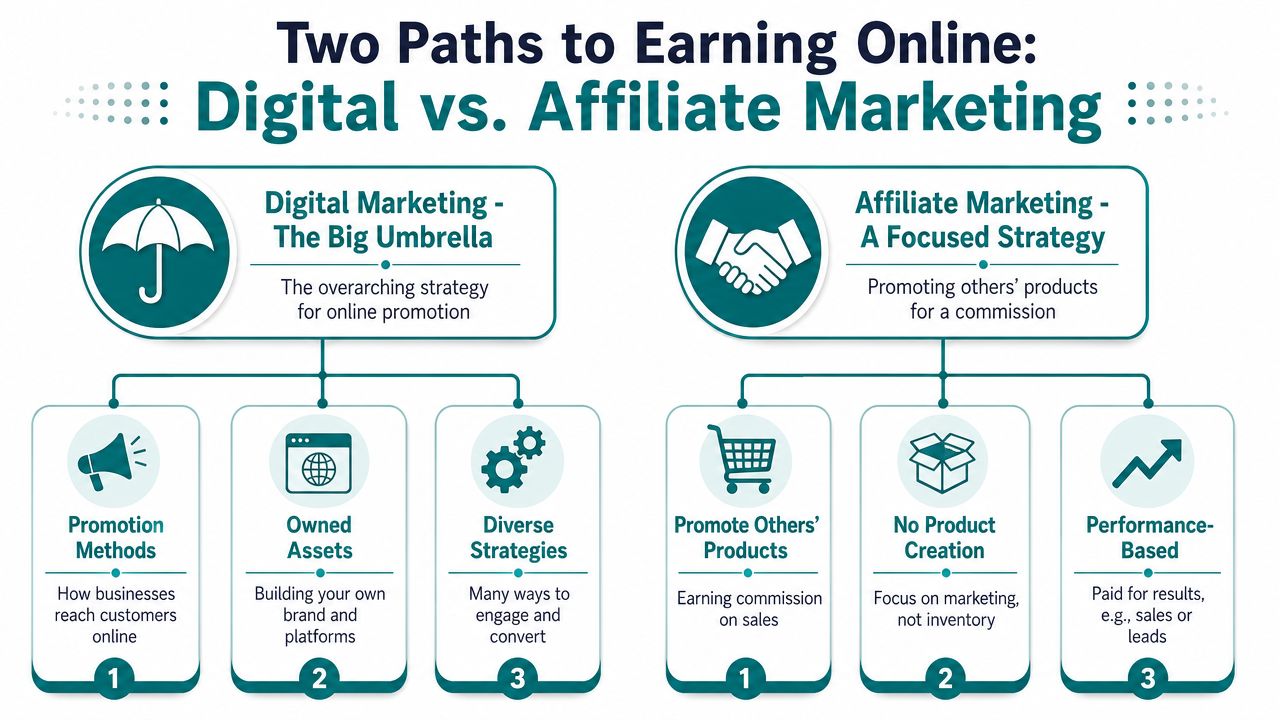
The easiest way to understand this is to think of digital marketing as the big umbrella, and affiliate marketing as one part underneath it.
 Affiliate Marketing as a commission-based sales approach." />
Digital marketing is the broader world of promoting something online. That can include email, content, social media, search, and paid ads. Affiliate Marketing is more specific. It's a performance-based part of digital marketing where someone recommends a product or service and gets paid only when a tracked result happens, such as a sale or lead, as explained by Partnerize in its affiliate vs digital marketing comparison.
Digital marketing is the umbrella
If you own a business, want to grow an audience, or hope to sell your own service someday, digital marketing is the larger skill set. You're learning how people find you online and how to build trust with them.
That might include:
- Writing helpful content people search for
- Sending emails to stay connected with readers
- Using social media to start conversations
- Improving visibility so the right people can find your work
You're building presence, relationships, and often your own brand.
Affiliate marketing is one focused path
Affiliate marketing is simpler to explain. You recommend something useful. If someone buys through your special link, you may earn a commission.
You don't create the product. You don't manage shipping. You don't handle customer support.
That makes it attractive for beginners who want a lower-pressure entry point.
For example, if you use an AI tool and find it helpful, you might look into a program like Join the Satura AI affiliate program. The point isn't to promote random things. It's to share tools you can stand behind.
If you're still sorting out which role fits your season of life, this comparison of brand ambassador vs affiliate marketer for Retirement can make the choices feel less muddy.
Practical rule: Digital marketing helps you build the road. Affiliate Marketing is one way to earn from the traffic on it.
A Closer Look at the Key Differences
When women ask me about Affiliate Marketing vs digital marketing, they usually don't want a textbook answer. They want to know what daily life looks like with each one. They want to know which path feels simpler, which one offers more control, and which one is easier to grow into without feeling swallowed by tech.
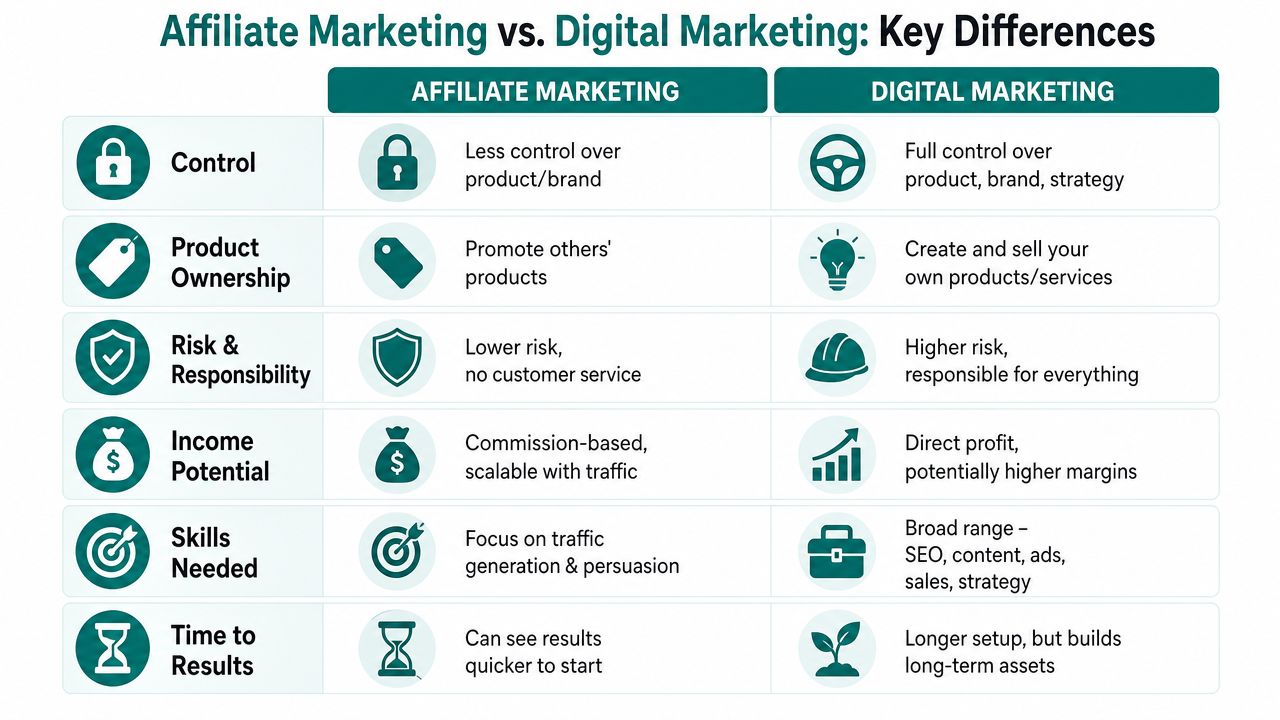
This side-by-side view helps.
| Factor | Affiliate Marketing | Digital Marketing (Broader Strategy) |
|---|---|---|
| Main focus | Recommending other people's products for a commission | Promoting a business, brand, service, or offer online |
| What you own | Your content and audience, if you build them | Your brand, content, audience, and often the offer itself |
| Control level | Less control over the product and checkout experience | More control over messaging, brand, and customer journey |
| Best fit for | Beginners who want a simpler way to start monetizing | People who want to build a long-term business asset |
| Daily tasks | Content, recommendations, link placement, audience trust | Content, email, strategy, traffic, offers, testing |
| Income style | Commission-based | Sales, client work, consulting, services, or product revenue |
| Responsibility | No product delivery or customer support for the item sold | Often responsible for more moving parts |
| Measurement | Partner-level results | Cross-channel business performance |
 Affiliate Marketing and digital marketing regarding control, ownership, risk, and income." />
What each path asks from you
Affiliate marketing usually asks for a narrower set of skills in the beginning. You need to learn how to create useful content, talk to a specific audience, and make honest recommendations.
Digital marketing is broader. You may be learning content, email, audience building, messaging, and traffic strategy all together.
That doesn't mean one is good and the other is bad. It means one may feel more manageable when you're starting from scratch.
Control matters more than most beginners realize
With Affiliate Marketing, you're promoting someone else's product. That can be a relief because you don't need to invent anything yourself. But it also means you're depending on another company for the offer, the tracking, and the payout process.
With digital marketing, especially if you're building your own brand, you have more say in what you create and how you serve people.
For some women, that extra control feels liberating. For others, it feels like too much responsibility at first.
If peace of mind comes from simplicity, Affiliate Marketing may feel gentler. If peace of mind comes from ownership, broader digital marketing may feel stronger.
They measure success differently
The measurement layer shows the difference clearly. Affiliate Marketing often focuses on partner-level numbers like click-through rate, conversion rate, average order value, approved leads, commission payouts, partner quality, and fraud signals, while broader digital marketing often looks at channel-wide measures like CPC, CPL, CPA, ROAS, CAC, and revenue by campaign or channel, as outlined in Shopify's guide to affiliate marketing metrics.
You don't need to memorize those terms today.
What matters is the idea behind them. Affiliate Marketing tends to ask, "Which partner or recommendation led to the result?" Digital marketing asks, "Which channel or campaign is helping the business grow?"
The business lens is different too
Businesses often use affiliate programs as one part of a larger growth strategy. If you want to understand that side, this guide to affiliate marketing for businesses gives useful context.
For beginners, the simpler question is this:
- If you want to start by recommending trusted products, Affiliate Marketing can be a practical entry point.
- If you want to build your own platform and maybe sell your own offer later, digital marketing gives you a wider foundation.
- If you want both, you can begin small and grow into the bigger picture.
If the larger picture interests you, this beginner-friendly guide to digital marketing for beginners can help you understand the skills without the usual overload.
Let's Address Your Doubts and Fears
This is the part many articles rush past. I don't want to rush past it.
When you're considering an online income path after 50, your questions aren't silly. They're wise. You should be careful. You should be skeptical. There are real scams online, and there are also real business models mixed in with the noise.
Is Affiliate Marketing legit
Yes, Affiliate Marketing is a real and significant part of e-commerce. The industry was valued at over $18.5 billion in 2024 and one source estimates it accounts for 16% of global e-commerce sales, according to New Media's Affiliate Marketing statistics roundup.
That said, a legitimate business model can still be used badly by the wrong people.
A healthy way to think about it is this:
- The model is real. Recommending products for a commission is a standard business arrangement.
- The quality varies. Some programs are solid. Some are not.
- Your integrity matters. Trust is the whole game, especially if you're building an audience.
If something promises easy money with no learning, no work, and no patience, walk away.
Am I too old for this
No. In many ways, your age is an advantage.
Women over 50 often communicate with more thoughtfulness, more empathy, and less performance. That matters online. People are tired of being shouted at. They respond to honesty, steadiness, and lived experience.
If you've spent years solving problems for family, coworkers, clients, or friends, you already know how to be useful. Online business still runs on that.
You're not starting from nothing. You're starting from life experience.
Do I need to be good at tech
You need enough tech to keep moving. You do not need to be a genius.
I remember feeling overwhelmed the first time I saw a training dashboard. Too many tabs. Too many labels. I almost clicked away and decided it was for younger people. But after a little time, the screen stopped looking like a foreign language. It started looking like a set of small tasks.
That's usually how this goes.
Try thinking of tech as kitchen equipment. You don't need to understand every part of the oven to bake dinner. You just need to know which button to press next.
A few grounding reminders help:
- Start with one tool at a time. Don't try to master websites, email, video, and analytics in the same week.
- Write before you automate. A clear recommendation written in plain language matters more than fancy software.
- Choose education carefully. Look for training that teaches, not training that dazzles.
Which Path Is Right for You Right Now
The right choice depends less on which model sounds more impressive and more on what will help you sleep better at night.
For many women over 50, that question matters. You may not be looking for the fastest path or the flashiest one. You may be looking for something steady, something you can understand, and something that fits the life you already have.
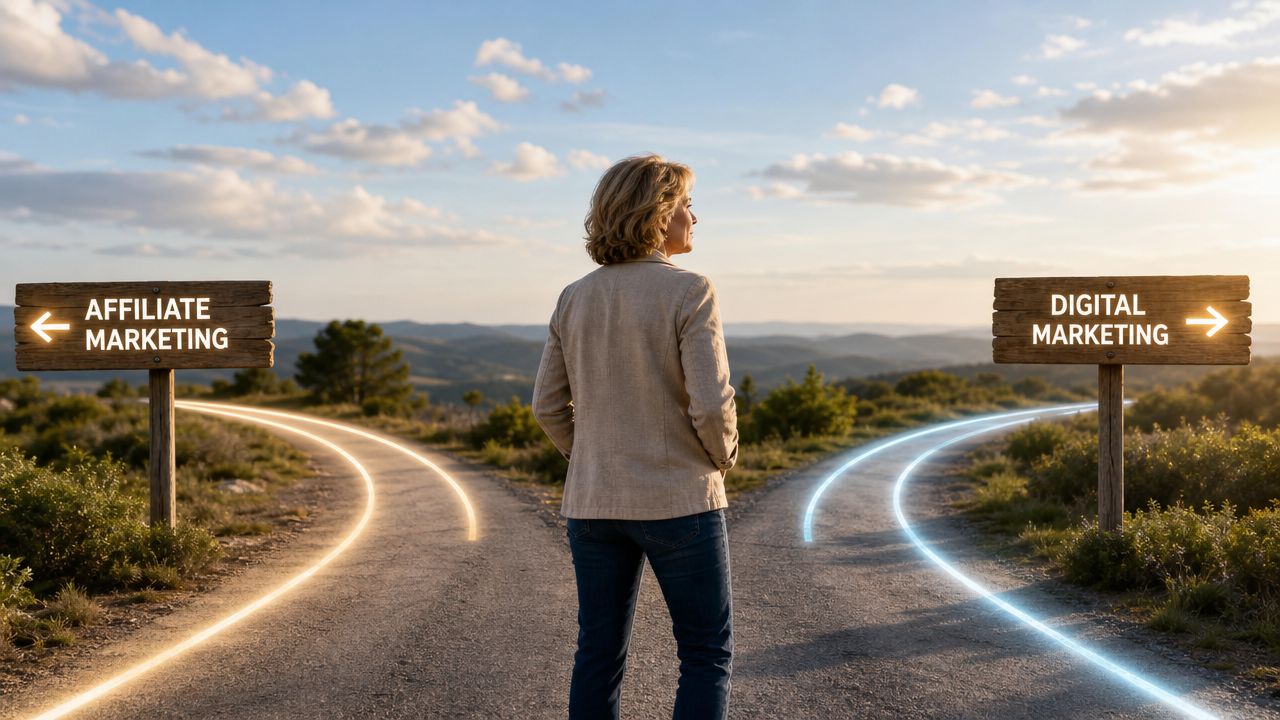 Affiliate Marketing and digital marketing paths." />
Affiliate marketing may fit you better if
Affiliate marketing often feels like renting a stall at a trusted market. You are not making the products yourself. You are choosing what to recommend, building trust, and earning when someone buys through your referral.
That can bring real peace of mind if you want a simpler place to begin.
You may prefer this path if you:
- Enjoy recommending things you already use and trust
- Want to start earning without creating your own product
- Feel calmer with fewer moving parts
- Would rather test a topic first before building something bigger
This path suits women who want to start gently and gain confidence through small wins.
Digital marketing may fit you better if
Digital marketing is closer to building your own shop over time. It usually asks more from you at the beginning, but it can give you more control later.
That sense of ownership matters to many women in this season of life.
You may prefer this path if you:
- Have an idea, service, or message you want to shape yourself
- Care about having more control over what you sell and how you sell it
- Like the idea of building something with your name on it
- Are willing to grow slowly in exchange for stronger long-term ownership
For some women, that feels more meaningful than promoting someone else's offer forever.
You don't have to choose forever
This is not a permanent identity test. It is a starting point.
A practical way to look at it is this. How much of your income do you want to come from recommending other people's products, and how much do you want to come from things you own or create? ClickBank makes that distinction clearly in its discussion of Affiliate Marketing vs digital marketing.
Many women begin with Affiliate Marketing because it is easier to set in motion. Later, as their confidence grows, they add digital marketing skills such as content creation, email writing, or a simple offer of their own.
That is often a calmer path.
A woman might start by sharing helpful notes about gardening, healthy cooking, budgeting, or menopause support. At first, she recommends products or resources she likes. Later, she may create a checklist, a paid workshop, a service, or a newsletter. The path changes because she changes.
Victoria OHare publishes beginner-friendly guides for women building income online in midlife.
If you feel torn, a simple rule helps. Choose the path that feels clear enough to begin, steady enough to continue, and meaningful enough to care about six months from now.
Your First Small and Simple Action Step
Don't start with a website.
Don't start with logos, complicated software, or trying to pick the perfect business name.
Start with a notebook.
Try this in 15 minutes
Write down three topics you naturally care about. They can be ordinary.
Examples might be:
- Home and comfort like organizing, cleaning tools, kitchen products
- Health and wellbeing like walking shoes, supplements you personally use, simple meal planning
- Hobbies and interests like books, gardening, crafts, travel supplies, pet care
Then next to each topic, list one or two products, tools, or services you already use and would sincerely recommend to a friend.
All covered.
Why this works
This small exercise helps you see that online income doesn't begin with pretending to be an expert. It begins with clarity. What do you know, what do you care about, and what have you already tested in real life?
That is the seed of both Affiliate Marketing and digital marketing.
One grows into recommendations. The other can grow into content, an audience, and eventually your own offers. Either way, you stop staring at a blank wall and start with something real.
Small actions calm big fears. A page of honest notes can take you further than a week of overthinking.
If you finish that exercise today, you've already started.
An Invitation to Your Next Chapter
A year from now, you could be sitting at your kitchen table with a small stream of online income coming in, a clearer sense of what you're building, and the quiet relief of knowing you started.
That future does not belong only to younger women, tech experts, or people with endless energy. It can belong to you too.
What matters now is choosing a path that feels steady enough to continue. For some women, Affiliate Marketing offers a gentle beginning. You recommend products you trust, learn how online business works, and build confidence without creating everything from scratch. For others, digital marketing brings a deeper sense of control because it can grow into your own platform, your own audience, and eventually your own offers.
Many women find that the safest feeling comes from combining the two over time. Affiliate Marketing can work like renting out one room in a house while you slowly build ownership of the whole property. You earn as you learn. Then, as your skills grow, digital marketing can give you more control over the business itself.
That kind of progress may look simple from the outside. Simple is often what lasts.
There is something deeply reassuring about building at your own pace. You are not trying to keep up with strangers on the internet. You are creating a business that fits your season of life, protects your peace, and lets your experience matter.
Your caution makes sense. Starting something new after 50 can stir up old doubts. What if I choose wrong? What if I am too late? What if I am not technical enough? Those fears are common, and they do not mean stop. They mean go one careful step at a time.
Five years will pass. The choice is whether those years leave you in the same place, or with more confidence, more control, and a new source of income that feels meaningful.
If you'd like gentle, step by step help as you explore Affiliate Marketing and online business in midlife, you can visit Victoria OHare and browse the beginner-friendly resources there.