
If you're over 50 and wondering whether it's too late to build income online, you're not alone. A lot of women feel behind financially, not because they did something wrong, but because life asked a lot of them. Careers changed. Caregiving happened. Savings didn't always grow the way you hoped.
Then you look at social media and it can feel like a noisy, fast-moving world made for younger people with endless energy and perfect lighting. I remember the first time I tried to understand online business tools. I stared at the screen, clicked in circles, and thought, maybe this just isn't for me.
But that wasn't true then, and it isn't true for you now. You can learn this. You can begin easily. And social media for Affiliate Marketing can be used in a calm, honest way that fits the life you lead.
You Can Build a Secure Future Online It Is Not Too Late
Retirement is supposed to feel like security. For many women, it feels more like a question mark.
You may be wondering whether your savings will stretch far enough. You may be looking at prices, bills, and the years ahead and thinking, I need another option. Not a flashy option. Not a risky option. Just something steady that gives you a little more control.

Feeling behind doesn't mean you are behind
A lot of smart, capable women assume the online world passed them by. They think they should have started years ago, learned all the tools already, or built a following before now.
That thought can stop you before you begin.
But being new is not the same as being too late. It just means you're at the beginning. And beginnings are allowed to be small.
You do not need to become a different person to build online income. You need a simple plan, a little patience, and the willingness to learn one step at a time.
One reason this matters so much in midlife is dignity. Most women I hear from aren't chasing internet fame. They want peace of mind. They want choices. They want to know they can contribute to their household, support themselves, or create a small cushion that helps them breathe easier.
You don't need to do everything at once
The internet can make it look like everyone is running a complicated machine. Posts, videos, funnels, emails, automations. It sounds like too much when you hear all of it at once.
So don't carry all of it at once.
Start with this mindset instead:
- Learn one tool at a time and let yourself be a beginner.
- Choose one platform first instead of trying to be everywhere.
- Share what you use instead of inventing a brand-new identity.
- Build slowly and steadily so this fits your real life.
I think that's the part many women need to hear most. Online business doesn't have to feel frantic. It can feel thoughtful.
I once wrote down three products I already recommended to friends without being paid. A kitchen item, a skincare product, and a simple software tool. That tiny list changed the way I saw this business. I realized I wasn't starting from zero. I was starting from real life.
If that's where you are today, that's enough. You're not late. You're at the point where your second chapter can begin.
What Affiliate Marketing Really Is and Why It Is Not a Scam
Affiliate marketing sounds more complicated than it is.
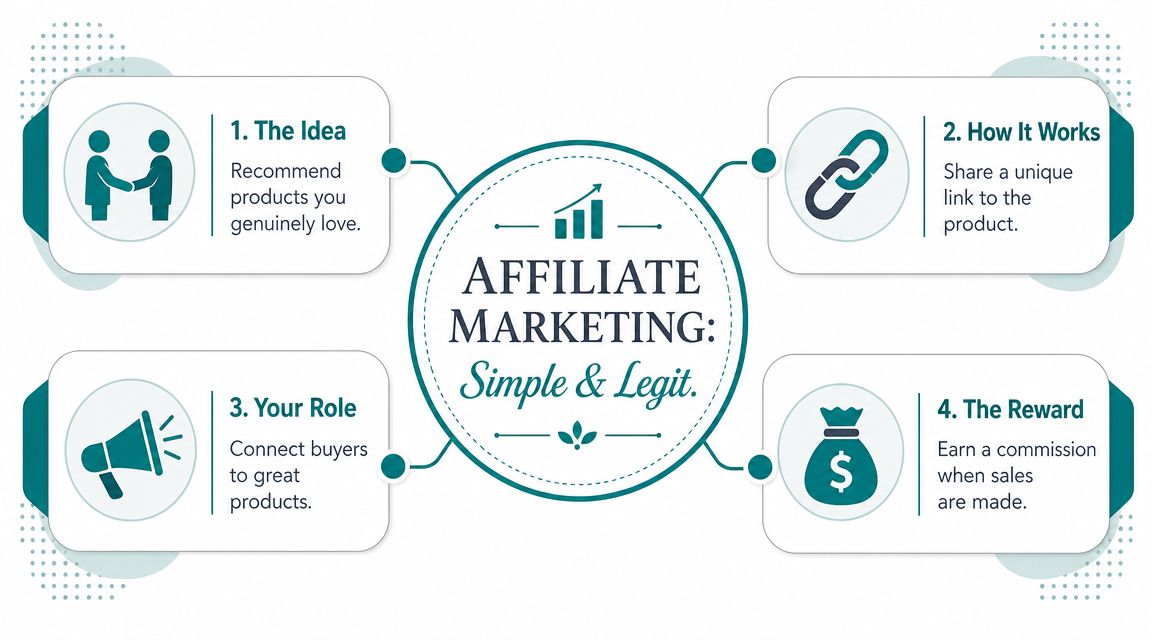
Affiliate marketing is recommending a product or service and earning a commission if someone buys through your unique link or code. You're not creating the product. You're not shipping boxes. You're not handling customer service.
You're making a referral.
 Affiliate Marketing Really Is and Why It Is Not a Scam" />
What it looks like in normal life
Think about how often you already do this.
You tell a friend about the walking shoes that helped your feet stop aching. You mention the collagen powder you like. You post about the reading lamp that made your evenings easier. Affiliate Marketing turns that everyday recommendation into a small income stream when the recommendation is attached to a tracking link or discount code.
That doesn't make it manipulative. It makes it trackable.
Why people worry it's a scam
I understand the caution. There are scams online. That's why education and mentorship matter.
Legitimate Affiliate Marketing is different from a scam in a few important ways:
- You promote a real product people can choose to buy or ignore.
- You disclose your relationship clearly so people know you may earn a commission.
- You don't promise unrealistic results from the product or the business model.
- You earn by helping someone make a decision, not by pressuring them.
A scam usually hides the truth. Ethical Affiliate Marketing does the opposite. It makes the relationship visible.
Practical rule: If you'd feel uneasy recommending it to your sister, don't promote it online.
This isn't a tiny side corner of the internet, either. Social media is now central to affiliate work. One industry roundup on Affiliate Marketing statistics reports that social media is the second most effective traffic source for affiliate marketers, responsible for 67.9% of traffic. The same source says the global Affiliate Marketing industry is projected to grow from $15.7 billion in 2024 to $17 billion in 2025 and reach $38.35 billion by 2030.
That doesn't mean success is automatic. It does mean this is a real business model inside a growing market.
You don't need to be a born salesperson
Many beginners freeze, assuming social media for Affiliate Marketing means acting pushy, polished, or performative.
It doesn't.
Your role is closer to a guide than a salesperson. You notice what helps. You explain why it helped. You share it honestly.
If you enjoy learning about different creator income options, a helpful example is this creator's guide to tweet monetization. Even if X isn't your platform, it shows how online income often starts with simple, trackable recommendations rather than hard selling.
Finding Your Calm Corner of the Internet
The best platform isn't the loudest one. It's the one you'll use consistently.
A lot of beginners get overwhelmed because they think they need to post everywhere. They open Instagram, peek at TikTok, consider YouTube, save Pinterest ideas, then end the day feeling scattered. That's exhausting.
A calmer approach is to choose one platform based on your personality, your time, and the kind of trust you want to build.
Match the platform to your season of life
Recent guidance suggests different platforms serve different goals. Affiverse's platform guide for Affiliate Marketing notes that TikTok can be strong for beginners because of algorithmic reach, YouTube is better for long-term authority, and Pinterest can support evergreen income. It also points out that some platforms are better for specific audience types rather than broad visibility.
That matters because not everyone wants viral growth. Many women want something more grounded.
A simple way to understand it is:
| Platform | Best For… | Effort & Vibe |
|---|---|---|
| Facebook Groups | Conversation, trust, community-based recommendations | Gentle pace, relationship-focused |
| Visual storytelling, reels, stories, personal brand | Moderate effort, more frequent posting | |
| Evergreen content, hobby topics, home, wellness, recipes | Calm and searchable, less chatty | |
| YouTube | Tutorials, product reviews, deeper trust | Higher effort upfront, longer shelf life |
| TikTok | Discovery and quick visibility | Fast-moving, trend-sensitive |
| LinkedIn or X | Professional or B2B recommendations | More niche, more direct |
A simple decision filter
If you're not sure where to begin, ask yourself these questions:
- Do you like conversation? Start with Facebook Groups or Instagram Stories.
- Do you prefer content that lasts longer? Pinterest or YouTube may suit you better.
- Do you dislike trends and fast pace? Skip TikTok for now.
- Do you want to teach clearly? YouTube can be a good home for simple reviews and demos.
I know women who assumed they had to dance on camera because social media looked that way from the outside. They relaxed the minute they realized Pinterest pins, simple talking videos, or thoughtful Facebook posts could work too.
Pick the platform that fits your nervous system, not the one that makes you feel inadequate.
If Instagram feels like your best starting point, this simple beginner guide to using Instagram for Affiliate Marketing can help you understand the basics without making it feel technical.
You are allowed to build slowly
You do not need to master five platforms. One is enough to start.
The women who last in this space usually aren't the loudest. They're the ones who build in a way they can sustain. They choose a calm corner of the internet, show up authentically, and let trust grow over time.
That's often a much better path to peace of mind than chasing attention.
How to Share Affiliate Products Without Feeling Salesy
Most women don't struggle with recommending helpful things. They struggle with the feeling of promoting.
That feeling softens when you stop thinking like an advertiser and start thinking like a helpful friend. Social media for Affiliate Marketing works best when your content answers a question, solves a problem, or shares a personal experience.
Use stories, not sales lines
A pushy post sounds like this: Buy this now.
A helpful post sounds more like this: I was tired of my back hurting by evening, so I tried this desk cushion for two weeks. I'll detail what I liked, what I didn't, and who I think it would help.
See the difference?
One is pressure. The other is context.
Here are a few easy post ideas you can adapt:
A problem and solution post
"I kept losing track of my supplements, so I started using this weekly organizer. It made mornings simpler."A three favorites post
"Three things that make my home office easier, especially on low-energy days."An honest review post
"What I liked about this skincare product after using it for a month."A comparison post
"I tried two journal apps. Here's the one I kept using and why."
Simple disclosure language you can actually use
Transparency builds trust. It also protects your reputation.
You don't need stiff legal language. You need clear language. Try one of these:
Short and simple
"This post contains affiliate links, which means I may earn a commission if you buy through them at no extra cost to you."Warm and natural
"I only share tools I personally use. If you choose to buy through my link, I may earn a small commission."Casual for social posts
"Affiliate link. I may earn a small commission if you decide this is a fit for you."
A lot of newer creators also need a clean place to keep their links organized. If you're unsure how that works, this creator's guide to link in bio gives a simple overview of why one central link page can make social posting easier.
Gentle templates you can borrow
The easiest way to create content is to start with your real life.
Try these fill-in-the-blank examples:
- "I didn't think I needed [product], but it helped me with [specific problem]."
- "If you're struggling with [problem], this is the [tool/product] I've been using."
- "I get asked about [topic], so here are the products I use."
Later, when you're ready for a fuller walkthrough, this gentle guide to selling online without being pushy can help you stay rooted in honesty rather than pressure.
This short video may also help you picture what natural affiliate content can look like in practice.
What trust sounds like
I once almost didn't share a product because I worried people would think I was trying to sell them something. Then I remembered they had already been asking me about it. My hesitation wasn't integrity. It was fear.
So I wrote a plain post. I explained why I used it, who it helped, and who it might not be for. That kind of honesty usually lands better than polished persuasion ever will.
People don't mind recommendations. They mind feeling handled.
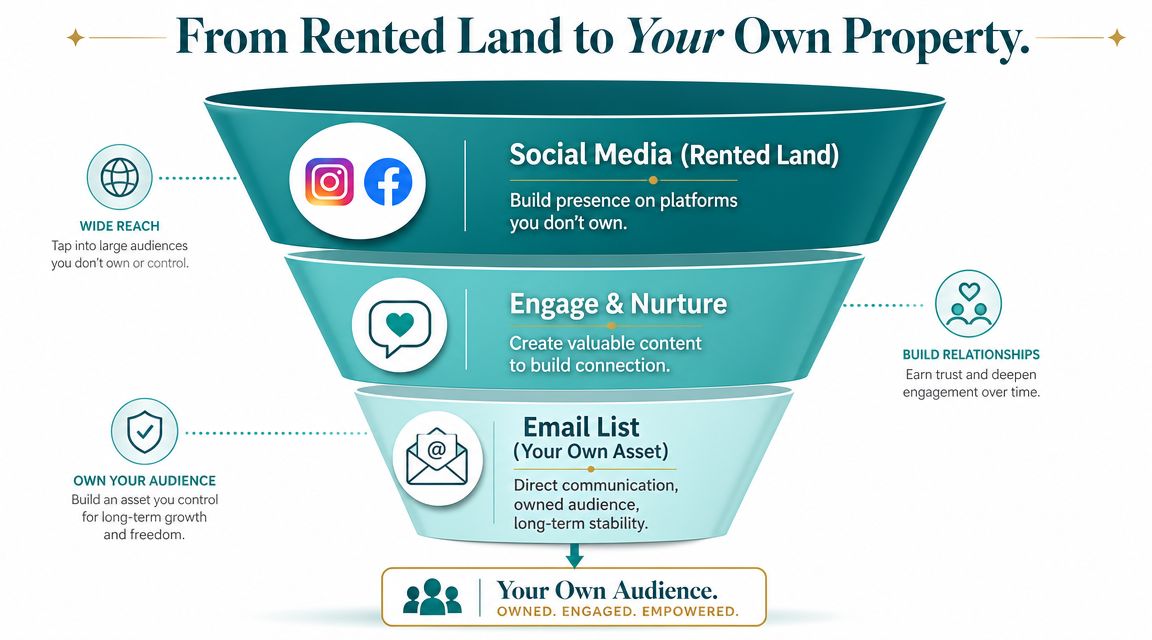
Moving from Rented Social Land to Your Own Asset
Social media is useful. It is not stable.
You don't control the platform, the algorithm, or what happens to your reach next month. That's why many experienced marketers think of social media as rented land. You can build there, but you don't own it.
Your email list is different. That's your asset. It's one of the few places online where you can communicate directly with people who chose to hear from you.
Why email matters so much
This is one of the clearest opportunities in Affiliate Marketing right now. Wix's Affiliate Marketing statistics roundup says 67% of affiliate marketers use social media, while only 42% use email marketing. The same source notes that social media is widely used for acquisition, while stronger strategies often pair that reach with more durable assets like email and content.
In plain language, that means many people are building on borrowed platforms and skipping the part they control.
That doesn't mean you need a complicated funnel. It means you need a simple bridge from your social posts to a place people can join your list.
A beginner-friendly path from post to list
This can be much simpler than it sounds.
Think of the path like this:
- Create helpful social content about a topic your audience cares about.
- Offer one small free resource tied to that topic, like a checklist, short guide, or mini resource list.
- Place that offer on a simple landing page with one clear invitation.
- Add that landing page to your bio link so people can join your email list.
For example, if you post about wellness products, your freebie might be "My 5 Simple Morning Habits Checklist." If you talk about home organization, it could be "The Weekend Declutter Starter Guide."
You don't need graphic design skills for this. You need one topic, one simple promise, and one place for people to sign up.
Keep the first asset small and useful
Your first freebie doesn't need to impress anyone. It just needs to help.
Here are good starter ideas:
- A checklist for a routine or process
- A short PDF with favorite tools or product picks
- A quick-start guide for beginners in your niche
- A simple email series that solves one small problem
If you want help with the basics, this step-by-step guide to building an email list breaks the process into manageable parts.
You can also use simple tools to create landing pages and link pages. Some creators use standalone link-in-bio tools. Others build pages inside their email platform. Victoria OHare also publishes beginner-friendly education on List Building, Affiliate Marketing, and simple automation for women who want a steadier online business model.
Your follower count is not your safety net. Your relationship with your audience is.
Knowing Your Efforts Are Paying Off
Tracking sounds intimidating until you remember what you're really doing. You're not trying to become a data analyst. You're trying to answer one reassuring question.
Is this working?
For beginners, the simplest place to start is your affiliate dashboard. Most programs show a few basic signals, such as clicks, orders, or commissions. You don't need to stare at numbers every day. You just need enough information to notice patterns.
Keep tracking simple and useful
One common mistake is assuming the link click tells the whole story. It often doesn't.
Emplifi's guidance on social media Affiliate Marketing recommends pairing posts with unique discount codes and tagged links using UTMs, because people often discover a product on mobile social media and buy later on another device or in another session. The same guidance suggests creator-specific codes like "JENNY20" and standardized tags such as utm_source=instagram_affiliate to make comparisons more reliable.
If that sounds technical, use the easiest version first:
- Create one code per creator or campaign if the brand allows it
- Label your links clearly so you know where traffic came from
- Review results in one place instead of trying to remember what you posted
A low-stress example
Let's say you post about a supplement organizer on Instagram and again in your email list.
You could use:
- One discount code for the Instagram post
- A tagged link for the email version
- A simple note in your calendar about when each went live
Now you have a better chance of seeing what led to sales. That kind of clarity builds confidence.
If you're curious how more advanced creators compare campaign performance across platforms and people, this overview of Shortimize's creator performance insights gives a useful look at organized tracking without turning it into spreadsheet chaos.
Watch for patterns, not perfection
A helpful review post may outperform a polished product photo. A short personal story may do better than a list of features. An older post may remain effective long after you forgot about it.
That's good news.
You don't need perfect analytics. You need enough peace of mind to keep going and enough insight to make your next post a little stronger.
Your Gentle Path Forward Starting Today
You do not need a complete business plan by tonight.
You need one small action that helps you move from worry to motion. That's how confidence usually begins. Not with certainty, but with a tiny step.
Start with what you already trust
For the next week, notice the products, tools, or services you already mention in everyday life.
Write them down.
Maybe it's a supplement organizer, a skincare item, a Bible study app, a meal planning tool, a walking shoe, or a storage solution that made your house easier to manage. Don't judge the list. Just notice what you already recommend naturally.
Then choose one item and answer these three questions:
- What problem did it solve for me?
- Who would it help?
- Could I explain it in plain language to a friend?
If the answer is yes, you may already have your first affiliate content idea.
Let this be simple
You are not behind. You are learning a new skill in a new season of life.
That matters.
The women who build something meaningful online usually aren't the ones who rushed. They're the ones who stayed honest, kept learning, and built one asset at a time. A post. A link. A landing page. An email list. A little confidence. Then more.
If social media has felt noisy or intimidating, let this article be your reminder that you don't have to use it the loud way. You can use it calmly. Ethically. Strategically. In a way that supports peace of mind rather than pressure.
The next five years will pass either way. The only question is whether you'll use them to build something that gives you more security, more dignity, and more control.
If you'd like gentle, step-by-step help building an online income stream through Affiliate Marketing, List Building, and simple systems, you can explore the beginner-friendly resources from Victoria OHare.