
If you're over 50 and wondering whether it's too late to build income online, you're not alone. A lot of women feel behind financially, not because they did something wrong, but because life asked a lot of them. Careers shifted. Families needed help. Savings got interrupted. Tech changed fast.
You may be looking at Retirement and thinking, "I hope what I have is enough." You may also be thinking, "I don't know if I have the energy to learn something complicated now."
I understand that feeling. The first time I looked at online business training, it felt like everyone else had already learned the language. Funnels. Traffic. Conversions. It sounded like a club I had joined too late.
You haven't joined too late. You can still build something steady, simple, and useful. One path worth understanding is an affiliate marketing course, especially if you want guidance instead of guessing.
That Quiet Question About Your Financial Future
Maybe this sounds familiar.
You sit down with coffee one morning, open your laptop, and check your accounts. Nothing is on fire. But nothing feels fully secure either. You start doing quiet math in your head. Housing. Groceries. Health costs. The little extras that make life feel comfortable, not just survivable.
For many women, that quiet question isn't dramatic. It's personal. "Will I be okay later?" Not wealthy. Not flashy. Just okay.

A lot of readers who explore online income aren't chasing some fantasy lifestyle. They're looking for breathing room. A little more control. A way to create something that doesn't depend entirely on one paycheck, one pension, or one plan working perfectly. That's part of what financial freedom can realistically mean for women over 50.
You don't need to build everything at once. You need a calm place to begin.
I remember talking to a friend who said she didn't want "a big business." She just wanted to stop feeling helpless every time prices went up. That stuck with me because it's such an honest goal.
If that's where you are, you're not behind. You're paying attention. And that can become a turning point.
The New Reality of Retirement
Retirement used to feel more straightforward. Work for decades, save what you can, then slow down with some confidence. For many people now, it doesn't feel that simple.
That's why more adults are looking for a second stream of income before they need it, not after they're already under pressure. This isn't about panic. It's about building options while you still have time and choice.
One reason Affiliate Marketing has become part of that conversation is that it isn't a fringe corner of the internet. The market was valued at $15.7 billion in 2023 and is projected to reach $36.9 billion by 2030, according to Rewardful's Affiliate Marketing statistics roundup. That matters because it shows this model sits inside a larger, established online economy.
Why that matters for beginners
When an industry has real scale, it usually means a few practical things:
- Businesses already use it because it helps them reach buyers through trusted recommendations.
- Beginners can learn a clear model instead of inventing one from scratch.
- Skills carry over from one niche to another because the core process stays similar.
An Affiliate Marketing business isn't magic. It's a method. You recommend products or services through your content, and if someone buys through your referral link, you earn a commission.
That's the simple version.
The more useful version is this. You're learning how to connect helpful content with products people already need. Done well, it's less about selling and more about matching.
A calmer way to think about income
Some women hear "make money online" and immediately pull back. That's understandable. There's a lot of noise online, and some of it deserves your skepticism.
But building a small digital income stream can be a very grounded decision. It can mean creating an asset that keeps working after you've written a post, sent an email, or published a video. Not perfectly. Not instantly. But steadily.
If Retirement security feels less certain than it used to, learning a legitimate online skill isn't a reckless move. It may be one of the more practical ones.
What a Good Affiliate Marketing Course Actually Teaches
Affiliate marketing sounds more mysterious than it is.
At its core, it's recommending a product or service you believe is useful and earning a commission if someone buys through your referral link. If you've ever told a friend, "This is the tool that helped me," you already understand the basic idea.
What confuses beginners is everything around that simple sentence. Where do you find products? How do you choose a niche? What kind of content works? How do links get tracked? That's where a real Affiliate Marketing course can help.
According to AAWP's Affiliate Marketing statistics, affiliate marketers with less than 3 years of experience who take courses earn 57.7% more than peers who rely on self-learning alone. That doesn't mean a course guarantees income. It does suggest that structured learning helps beginners avoid a lot of wandering.
 Affiliate Marketing course." />
The basic business model
A solid course should teach the full path from idea to income.
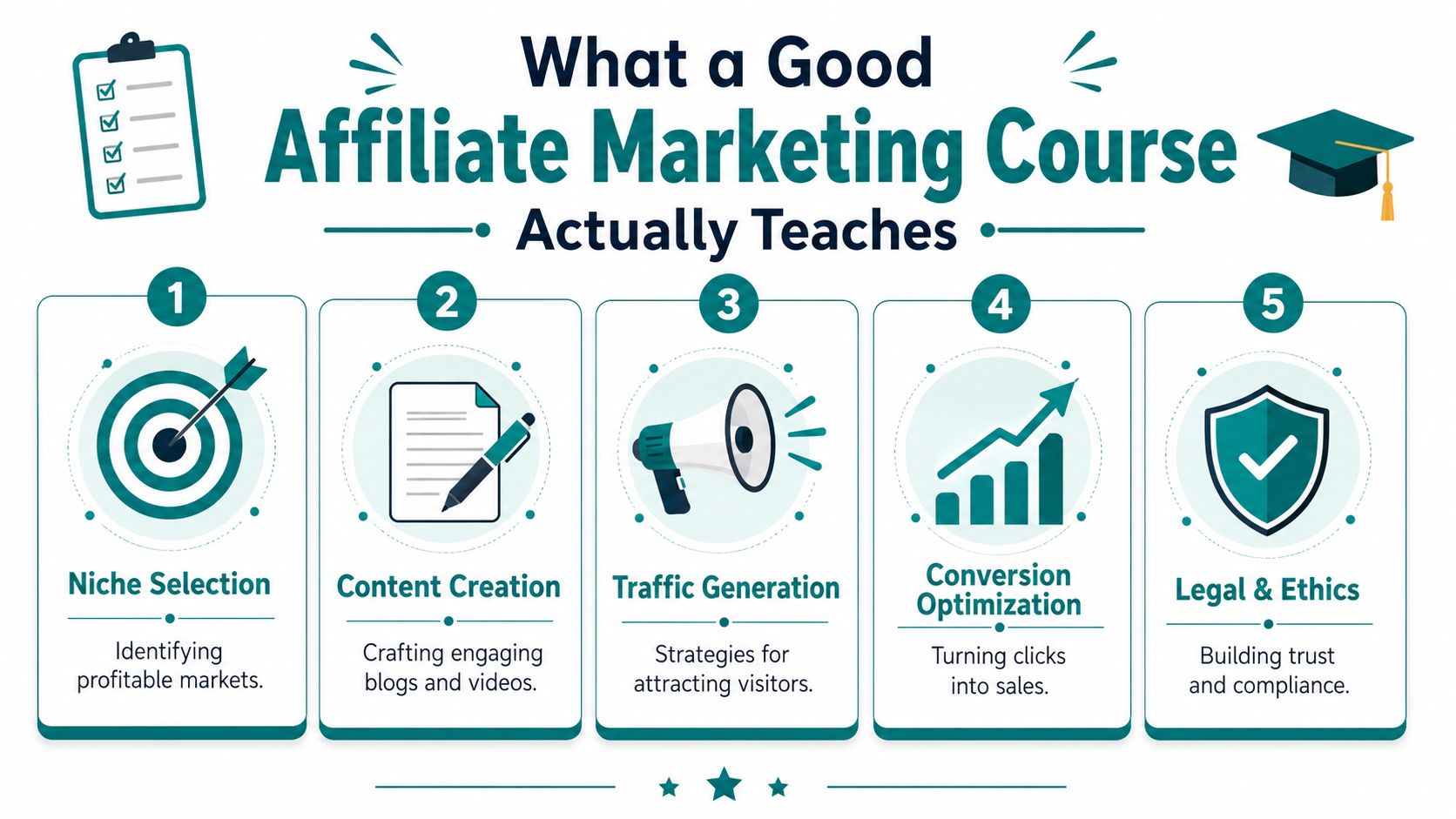
That usually includes:
- Niche selection so you don't build around a topic that's too broad, too vague, or disconnected from buyer intent
- Program selection so you learn how to choose offers that fit your audience
- Content creation so your blog posts, emails, videos, or reviews help people make decisions
- Traffic generation so people can find your content through search, social platforms, or other channels
- Conversion thinking so clicks have a better chance of turning into commissions
A course should make these pieces feel connected. If it only gives you random tips, you'll likely end up with random results.
The part beginners often miss
Many new creators think Affiliate Marketing is just "post a link and hope."
It isn't.
A stronger course teaches you how to build a simple system. For example, you might choose one topic you understand well, write a helpful article answering a common question, recommend one product that fits naturally, and invite the reader onto an email list for future help. That's a business system, even if it starts small.
Practical rule: If a course teaches only traffic tricks but not audience building, it may leave you with attention but no real asset.
This is also where organization matters. If you're using more than one social platform, even basic planning can reduce stress. A practical guide on how to manage social media accounts efficiently can help you think about consistency without feeling like you're chained to your phone.
What real training should include
The strongest courses go beyond motivation and cover the operational side too.
Look for lessons on:
- Tracking basics so you understand how clicks and commissions are recorded
- Simple analytics so you can tell which content is working
- Content structure including keyword research, site planning, and internal organization
- Ethics and disclosure so you build trust instead of sounding pushy
- Audience ownership so you're not relying only on one platform
If you'd like a beginner-friendly explanation of the model itself before comparing programs, this guide on how to start Affiliate Marketing for beginners is a useful next read.
A good Affiliate Marketing course doesn't hand you luck. It teaches you how to make clearer decisions, one step at a time.
Answering Your Biggest Concerns
Some hesitation is healthy. You should ask questions before spending time or money on anything online.
I was cautious too. The first time I opened a training dashboard, I felt a strange mix of hope and suspicion. Hope that I might finally understand it. Suspicion that it would just be another pile of confusing videos. So let's talk through the concerns that stop many aspiring marketers.
Is this a scam
Some online offers are absolutely not trustworthy. That's real.
Affiliate marketing itself, though, is a legitimate model. Companies create referral programs. Publishers, bloggers, creators, and educators recommend products. If a sale happens through a tracked link, a commission is paid. The scammy part usually comes from hype, not from the model.
A healthy sign is when a course teaches process, disclosure, and audience trust. A red flag is when it talks only about fast money and never about content, systems, or skill-building.
Do I need to be a tech genius
No. You need patience more than technical brilliance.
Most beginners are not struggling because they're "bad at tech." They're struggling because they're learning several small new things at once. A website platform. A dashboard. A link. An email tool. That's a lot at first, and it's normal to feel clumsy.
The good news is that these are learnable tasks. You don't need to become a developer. You need someone to explain each step in plain English.
Am I too old and is the market too crowded
Age can help you here.
You already know how people think, what problems matter, and which purchases come from real need instead of impulse. That life experience can guide your niche choice far better than trend-chasing.
Mainstream niches are crowded, but this niche analysis from Post Affiliate Pro notes that lesser-known niches often offer 15% to 50% commission rates, and niche-focused affiliates report 3 to 5 times higher conversion rates than generalists. In simple terms, narrower topics can work better than trying to talk to everyone.
A better question to ask
Instead of asking, "Am I too late?" try asking, "What do I understand that someone else still needs help with?"
That answer might live in:
- A life stage such as caregiving, downsizing, menopause, Retirement planning habits, or Health routines
- A practical skill like organizing a home office, meal planning, travel prep, or budgeting systems
- A values-based niche such as eco-friendly products, financial tools, or a specialized sub-niche in travel
Your experience is not baggage. In the right niche, it's context, trust, and clarity.
How to Choose the Right Affiliate Marketing Course for You
Once you decide to learn, the next question is harder. Which course deserves your attention?
Many beginners get overwhelmed at this stage. Every sales page sounds polished. Every instructor says their system is simple. You don't need to judge with perfect expertise. You just need a clear filter.
 Affiliate Marketing course." />
Start with the learning experience
A course isn't just information. It's a learning environment.
If you're newer to online business, ask these questions first:
| What to check | Why it matters |
|---|---|
| Lesson order | A beginner needs steps in sequence, not a giant library dumped all at once |
| Plain-language teaching | Clear explanations reduce dropout and confusion |
| Replays or self-paced access | Helpful if you're learning around work, family, or caregiving |
| Support area | Even a simple comments section or group can help when you get stuck |
Community matters more than people realize. If you hit one snag and have no place to ask, small confusion can turn into quitting.
Look for mentorship and practical support
Some courses are really just video collections. Others offer feedback, office hours, Q&A spaces, or active communities. You don't need hand-holding forever, but early support can save you weeks of frustration.
A useful course should help with real beginner moments, like:
- Choosing a niche when you have too many ideas
- Setting up your first affiliate links without panic
- Understanding disclosures so you stay transparent
- Troubleshooting simple tech issues when something doesn't look right
If you're comparing platforms that host educational products and trying to understand the business side of affiliate programs, this breakdown on evaluating automated platform referral payouts gives helpful context.
Pay close attention to email list training
This point gets overlooked all the time.
Many beginner courses focus heavily on SEO, social posts, and traffic. Those things matter. But long-term stability usually comes from building something you own, especially an email list.
Impact's course roundup highlights tracking, cookies, data capture, action inquiries, and reversals as important affiliate skills. That same body of guidance supports a bigger lesson for beginners: the most valuable training often includes owned-audience monetization, such as building an email list, because creator business models are shifting toward first-party data and relationship-based marketing.
If a course teaches you how to get attention but not how to keep a relationship, you're still building on rented ground.
Here's a simple way to test this. Look through the curriculum and see whether it includes any of the following:
- Lead magnets such as checklists, guides, or simple freebies
- Email welcome sequences so new subscribers hear from you after joining
- Webinars or simple nurture content that deepens trust over time
- Basic automation that keeps things manageable for one person
For women over 50 and new creators, this matters even more. You may not want to dance on video, chase trends, or post all day. An email list gives you a quieter, steadier asset.
Cost matters, but value matters more
A cheap course that leaves you confused can cost more in wasted time than a more complete one. On the other hand, an expensive course isn't automatically better.
Try this quick checklist before buying:
- Read the curriculum carefully and make sure it teaches a full system, not just inspiration
- Check whether the examples fit beginners rather than assuming prior business experience
- Look for evidence of support such as Q&A, group access, or implementation help
- Notice the teaching philosophy and avoid anything that leans heavily on hype
If you'd like a place to compare beginner-friendly options and see how different programs are presented, these Affiliate Marketing reviews can help you sort through the noise. Victoria OHare also offers educational content for beginners that focuses on Affiliate Marketing, List Building, and simple automation, which may suit readers looking for a more step-by-step learning path.
A short video can also help you think through what to look for before you commit.
A simple filter you can trust
When you're comparing any Affiliate Marketing course, ask:
- Will this help me build an asset, not just chase clicks?
- Can I picture myself following these lessons without feeling lost?
- Does the course respect beginners, or talk over them?
- Is the teaching grounded in systems and trust, not hype?
- Would this still feel useful six months from now?
That last question matters. A good course should help you build something that gets more valuable with time.
Alternatives and Your First Gentle Next Step
You don't have to start with a paid course.
Free YouTube videos, blog posts, podcasts, and mini-guides can be a good entry point. They help you learn the language, see what's possible, and notice what kind of teaching style helps you relax instead of tense up.
The tradeoff is usually structure. Free content often answers one question at a time. That's useful when you're curious. It can become frustrating when you're ready to build because you're collecting pieces without seeing the whole puzzle.
A simple comparison
Here's the practical difference:
- Free content is often best for exposure and basic understanding
- A full course is usually better for sequence, implementation, and reducing trial-and-error
- A community-based program can help when motivation dips or tech confusion shows up
None of these options is wrong. They just serve different stages.
Start where your nervous system can handle it. Then move one level deeper.
If you're still unsure, don't force a big decision today. Choose one small action that gives you clarity without pressure.
One gentle next step
Do this today on a sheet of paper or in a notes app:
- Write down three topics you know from lived experience
- Circle the one you could talk about without pretending to be an expert
- Look at two Affiliate Marketing course curriculums and see whether they teach list-building, not just traffic
That's enough for now.
You don't need to buy anything tonight. You don't need a brand name, logo, or perfect niche by bedtime. You just need evidence that you can take one thoughtful step without spiraling into overwhelm.
That kind of progress counts.
Frequently Asked Questions
How much money can you realistically make
It varies a lot. Your niche, content quality, consistency, traffic sources, and offer selection all affect the outcome.
A healthier mindset is to treat Affiliate Marketing as a skill-based business, not a guaranteed paycheck. Some people earn a little at first while they learn. Others build more meaningful income over time. The point of a good course is not to promise a number. It's to help you shorten the learning curve and make smarter decisions.
How long does it take to see results
Usually longer than people hope, and that's okay.
This work often starts without fanfare. You learn the tools, create content, improve your message, and begin building trust. Results may come in layers. First understanding, then confidence, then occasional commissions, then better consistency. If you expect instant results, you'll probably feel discouraged too soon.
Do I have to show my face on social media
No, not always.
Some people use blogs, email newsletters, simple videos without showing their face, product tutorials, or written reviews. You do need a way to communicate clearly and helpfully, but you don't have to build your business around constant personal exposure if that doesn't suit you.
Is Affiliate Marketing legit for beginners over 50
Yes, it can be.
The key is choosing a legitimate learning path and a niche that fits your experience. Being over 50 is not a disadvantage by default. In many cases, it gives you more perspective, more trustworthiness, and a clearer understanding of real-world problems people want solved.
What if I am not very technical
That's more common than you think.
You don't need advanced skills to begin. You need a willingness to learn simple steps in order. If you can send emails, use search, and follow instructions, you can learn the basics. The right course should explain tools slowly enough that you don't feel shut out.
Should I start with a blog or an email list
For many beginners, these work well together.
A blog can help people discover you. An email list helps you stay connected after they leave. If a course teaches both in a simple way, that's often a strong sign that it focuses on long-term stability, not just quick traffic.
If you'd like a calm, beginner-friendly place to keep learning, you can explore Victoria OHare. The next five years will pass either way. The only question is whether you'll use them to build something that gives you more peace of mind.