
If you're over 50 and wondering whether it's too late to build income online, you're not alone. Many women feel behind financially, not because they failed, but because life happened. Careers changed, caregiving took time, savings got stretched, and Retirement started to feel less certain than it once did.
That uncertainty can make every new online idea feel suspicious or exhausting. You might be asking yourself whether Affiliate Marketing brands are legitimate, whether technology will be too much, or whether younger people already got there first.
You're not behind. You're standing at the beginning of a skill you can learn.
Starting Now For Peace of Mind Later
A lot of readers arrive here in a very ordinary moment. The bills are paid, mostly. The future is the part that feels shaky. You may be looking at Retirement and thinking, "I need one more stream of income, something I can build without starting over completely."
That feeling is real. It deserves respect, not shame.
I remember the first time I tried to understand online business training. I logged in, saw unfamiliar dashboards and menus, and felt my chest tighten. It wasn't that I wasn't capable. I was new. Many people confuse being new with being bad at something.

Why this matters more now
For many people, one paycheck or one Retirement account no longer feels like enough to create peace of mind. That's why learning how to build assets matters. An asset can be something simple, like a blog post, an email list, or a helpful recommendation that continues working after you've created it.
If passive income feels like a big, slippery phrase, this guide on how to create passive income can help make it more concrete.
Here is the quiet shift that changes everything:
- A paycheck stops when work stops. An online asset can continue helping people over time.
- Experience counts. If you've solved real-life problems, cared for a family, managed a budget, or learned to make careful buying decisions, you already understand things people need help with.
- Trust is valuable. Older audiences often have an advantage here because they don't sound rushed, flashy, or performative.
You don't need to become a different person to start. You need a simple process and enough patience to stay with it.
A calmer way to think about starting
You do not need a huge audience.
You do not need to be trendy.
You do not need to know everything before you begin.
What you need is a reason to start and a willingness to learn one step at a time. If Retirement feels uncertain, building a small online income stream can be less about ambition and more about dignity, control, and breathing room.
That's where Affiliate Marketing brands come in. Not as a magic fix. As a practical model you can learn.
What Affiliate Marketing Really Is (And What It Isn't)
Affiliate marketing is simple. You recommend a product, service, or tool through a special link. If someone buys through that link, you may earn a commission.
That sounds very modern, but the idea itself isn't strange. People have always shared recommendations. The online part just makes the tracking possible.

What it is
Think of it this way. If you tell a friend which walking shoes helped your feet, or which budgeting app finally made sense, you're already doing the human part of Affiliate Marketing. The affiliate link is just the business side of that recommendation.
This is not some tiny corner of the internet. Affiliate Marketing is a core growth engine for businesses, with the global market valued at over $18 billion in 2025, and 81% of advertisers use Affiliate Marketing, which shows it's a mainstream business practice, not a niche trick, according to Post Affiliate Pro's 2025 industry overview.
What it isn't
It isn't a guarantee.
It isn't instant money.
It isn't posting random links and hoping strangers click them.
And it isn't reserved for tech experts.
Many beginners assume they need to understand websites, funnels, and automation all at once. You don't. Many only need to learn a few basic actions first:
- Pick a topic you understand. It could be healthy aging, home organization, crafts, gardening, meal planning, faith resources, or beginner online business.
- Choose one product or brand that fits that topic. Start small.
- Share why it helped you. Real use is more convincing than polished hype.
- Use your link transparently. Tell people you may earn a commission.
If you're still trying to picture those early steps, this beginner-friendly guide on earning your first affiliate commission gives a practical walkthrough.
Practical rule: If you wouldn't recommend it to a close friend, don't build content around it.
The three fears most people have
The first is, "Is this a scam?"
That's a healthy question. There are scams online. But Affiliate Marketing itself is a business arrangement between a brand and a promoter. The key is education, transparency, and choosing legitimate companies.
The second is, "Do I need tech skills?"
You need learnable skills, not advanced skills. Clicking through a dashboard, copying a link, writing an email, and adding a disclosure are all teachable.
The third is, "Am I too old?"
No. In fact, maturity can help. People trust grounded recommendations. They can feel the difference between someone chasing attention and someone trying to be useful.
A short visual explanation can help if you're more of a watch-and-learn person:
How to Find Your First Affiliate Partners
The easiest place to start is not with a giant list of brands. It's with your own life.
What do people already ask you about? What have you figured out the hard way? What products do you buy again because they solve a real problem?
Start with your lived experience
A good beginner topic often comes from one of these areas:
- Everyday problem solving. Organizing a small kitchen, finding comfortable shoes, planning simple meals, managing menopause symptoms, or creating a calmer home office.
- Long-time hobbies. Sewing, gardening, baking, card making, walking, travel planning, or home decor.
- A transition you've lived through. Downsizing, caring for parents, re-entering work, preparing for Retirement, or learning online income.
Write down ten products, tools, books, or services you already use in one of those areas. Don't judge the list yet. You're looking for clues.
Two main places to look
Once you have a topic, you can look for affiliate partners in two ways.
Affiliate networks are platforms that host many brands in one place. Examples mentioned often include ShareASale and CJ. You create an account, then apply to specific brands inside the platform.
In-house programs are run directly by a brand. You go to that company's website and look for a link that says "Affiliates," "Partners," or "Referral Program."
Here are a few search phrases that help:
- Brand name plus affiliate program
- Brand name plus partners
- Your niche plus affiliate network
- Product category plus affiliate program
If you want a broader introduction to different partner options, this roundup of affiliate marketing programs is a useful next read.
Why many people begin with Amazon
Many beginners start with Amazon Associates because it's familiar and simple to understand. According to DesignRush Affiliate Marketing statistics, Amazon Associates holds a 46.61% global market share, and 58.5% of affiliate marketers use Amazon's program.
That doesn't mean Amazon is always the best long-term fit. It does mean it's a common starting point because people already know the brand, and beginners often feel safer learning with something recognizable.
Starting with a familiar program can reduce decision fatigue. That's useful when your biggest obstacle is overwhelm, not lack of ability.
A gentle first search plan
Try this simple method over one afternoon:
- Choose one topic you could talk about comfortably for a month.
- List five products or services you use or would feel good recommending.
- Check whether each one has a program through a network or its own website.
- Read the basics before joining. Look for payout rules, approval requirements, and whether the program seems active and professional.
- Apply to one or two only. More than that can become noisy fast.
Some people get stuck here because they think they must pick the perfect niche or the perfect brand right away. You don't. Your first goal is to find a trustworthy starting point that matches your experience.
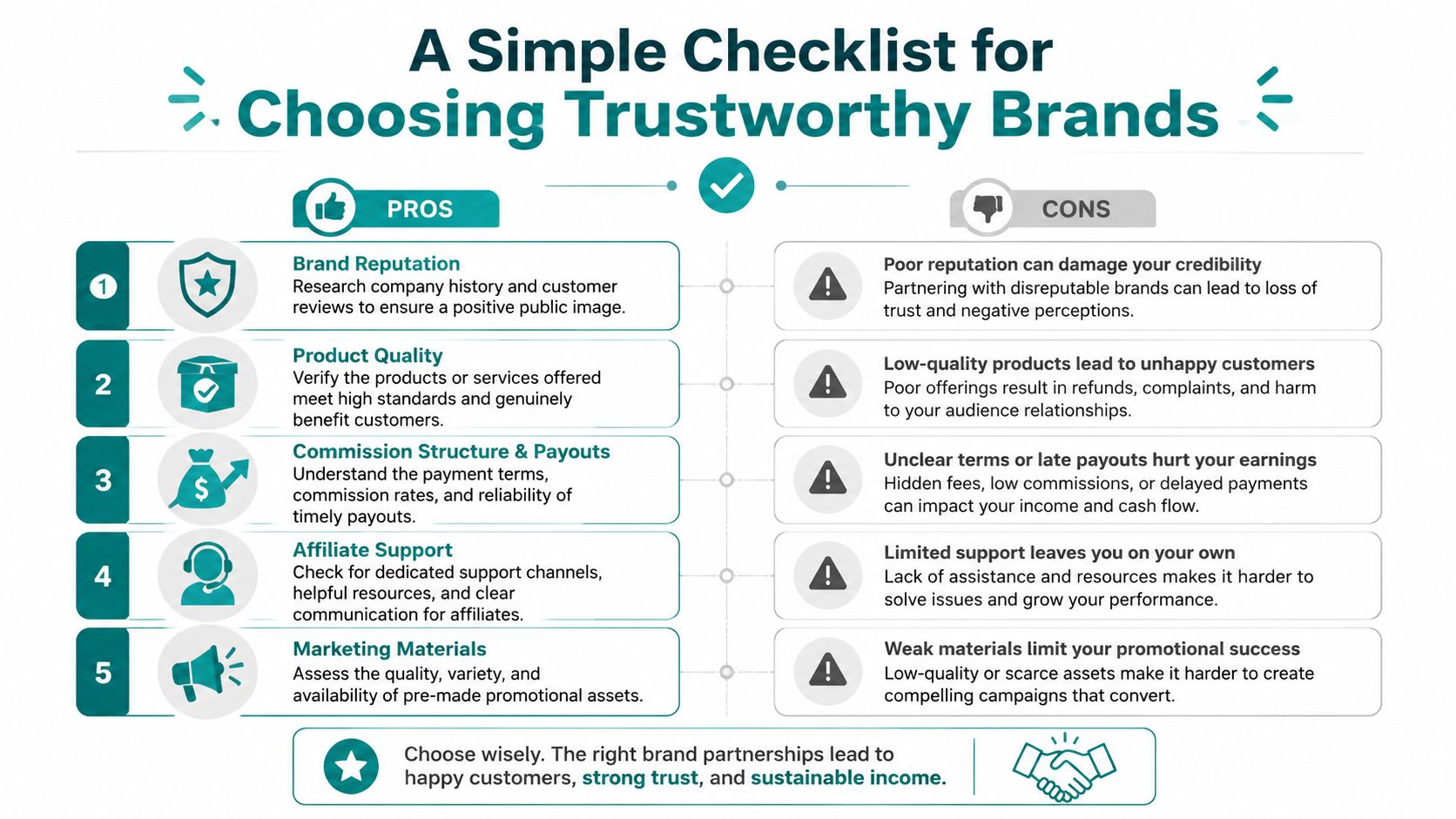
A Simple Checklist for Choosing Trustworthy Brands
Many beginners make life harder than it needs to be. They chase the highest payout and ignore the brand itself. Later, they realize the product feels flimsy, the support is poor, or the audience doesn't respond.
Sustainable affiliate income comes from better fit, not louder promises. The strongest Affiliate Marketing brands are the ones you can recommend with a straight face six months from now.
 Affiliate Marketing brand partnerships." />
What to look for before you apply
Recent niche-focused guidance notes that the most sustainable affiliate income comes from choosing the right brands, not just the highest payouts. The key is long-term stability, product durability, and a clear fit with your audience's needs, as discussed in this niche and partner selection guide from Post Affiliate Pro.
Use this checklist when you're deciding whether a program belongs on your short list:
- Brand trust: Search the company name and read customer feedback. You are not looking for perfection. You are looking for signs that the business is real, active, and generally respected.
- Product usefulness: Ask yourself whether the offer solves a specific problem. Products that help with a clear need are easier to recommend calmly and honestly.
- Repeat value: A product people buy again, renew, or keep using often fits a low-stress business better than a one-time impulse item.
- Clear rules: Read the affiliate terms. A transparent program explains how commissions work, how payments happen, and what affiliates can and cannot do.
- Audience fit: This may be the biggest one. If your readers are practical, budget-conscious, and cautious, a flashy offer may feel wrong even if the payout is tempting.
For example, if you want to see what it looks like when a company lays out expectations clearly, the ClipCreator affiliate program terms are a useful example of the kind of page you should review before joining any program.
Affiliate Networks vs In-House Programs
| Feature | Affiliate Networks (e.g., ShareASale) | In-House Programs (Brand's own program) |
|---|---|---|
| Application process | One platform, then separate applications to brands | Separate sign-up for each brand |
| Ease for beginners | Simpler if you want one dashboard | Simpler if you already love one brand |
| Payments | Often grouped in one place | Paid directly by each company |
| Brand selection | Many options under one roof | Limited to one brand |
| Relationship feel | More platform-based | Often more direct with the company |
| Best use | Exploring multiple Affiliate Marketing brands | Going deeper with a brand you trust |
A values-based question that helps
Would you still recommend this brand if nobody paid you?
That question cuts through a lot of noise. If the answer is no, move on.
Good affiliate partnerships feel steady. You don't need to hide them, defend them, or oversell them.
If you're comparing a few choices and want a structured learning option, Victoria OHare offers training that helps beginners understand how to connect with reputable brands and build around affiliate commissions. That's one way to make the process feel less scattered if you're learning as you go.
Sharing Recommendations That Genuinely Help
A lot of people freeze when they hear the word "promote." It sounds pushy. It sounds like becoming a salesperson. That's not the only way to do this.
A gentler way is to think in terms of helpful sharing.

Share what solved a problem
The easiest content to create is usually built around a real problem you had.
Maybe a back-support cushion made desk work easier. Maybe a meal-planning tool helped you stop wasting groceries. Maybe a simple online course finally explained email marketing in plain English.
Those become natural pieces of content such as:
- A personal review. Explain what problem you had, what you tried, and what changed.
- A favorites list. Gather tools you use for one area of life, like travel essentials, kitchen basics, or work-from-home comfort.
- A how-I-use-it email. Walk readers through exactly how a product fits into your routine.
- A comparison post. If you've tried two similar options, explain who each one is for.
If you need help shaping that kind of content, this guide on how to write affiliate product reviews can give you a practical framework.
Why email can be a better fit than chasing virality
For creators who rely on email, the best affiliate brands aren't necessarily the ones with the highest one-time commission. Stronger choices often have repeat-buy potential and clear problem-solution messaging that fits naturally into a short email sequence or tutorial, as explained in Printful's discussion of affiliate niche fit.
That matters if you're building slowly and want less pressure.
An email list is quieter than social media, but it can also be more stable. People invited you into their inbox. That gives you room to teach, explain, and recommend without performing for an algorithm.
A simple email-first example
Let's say your topic is home organization.
You join an affiliate program for a label maker, storage bins, or a planning app. Instead of dropping a link with no context, you write a short series:
- Email one talks about the stress of clutter and one tiny reset habit.
- Email two shows the tool you used and why it helped.
- Email three answers common concerns like cost, setup, or whether it's worth it.
- Email four shares your affiliate link with a clear disclosure.
That sequence feels like guidance, not pressure.
If people trust your judgment, they don't need a hard sell. They need clarity.
Keep your recommendations clean and honest
A few habits protect your reputation:
- Disclose. Tell readers you may earn a commission if they buy through your link.
- Avoid exaggerated claims. Don't promise outcomes you can't control.
- Stick to what fits your audience. Relevance builds trust more than enthusiasm alone.
- Use products you understand. Familiarity makes your writing calmer and more believable.
When Affiliate Marketing brands match your values and your audience's needs, recommending them starts to feel less like marketing and more like service.
Knowing What Works and Planning Your Next Gentle Step
Tracking sounds technical until you rename it. It really means paying attention.
You are not building spreadsheets for the sake of spreadsheets. You are noticing what helps people.
The few numbers that matter at first
To grow sustainably, it helps to track basic metrics like click-through rate and earnings per click (EPC). That kind of tracking doesn't require complex tools. It serves to identify which content and products resonate most with your audience, as explained in this affiliate tracking and mistakes guide from AAWP.
If those terms feel unfamiliar, here's the plain-English version:
- Click-through rate: How often people click your link after seeing your content
- EPC: How much your clicks are worth on average
- Conversion pattern: Which topics or offers lead to action
- Content source: Whether a blog post, email, or simple social post creates more useful engagement
You do not need to track everything at once.
A low-pressure review habit
Try this once a week or once a month:
| What to check | Simple question |
|---|---|
| Most-clicked link | What topic got the most interest? |
| Best-performing content | Did a review, email, or list post get more response? |
| Brand response | Which Affiliate Marketing brands seem to connect with your readers? |
| Next test | What is one small change you can make next? |
This can stay very simple. A notebook works. A basic spreadsheet works. Your affiliate dashboard works.
If you're sharing content beyond email and want a calmer way to show up professionally, this guide to a LinkedIn posting strategy can help you think about consistency without needing to post all day.
Your next step only needs to be small
Choose one brand.
Create one helpful piece of content.
Share one affiliate link with honesty.
That is enough for now.
You don't need to build a giant online business this month. You need to begin building evidence that you can learn this. Each small action gives you more confidence, more skill, and more control.
Progress gets easier to trust when you can see what your audience actually responds to.
The next five years will pass either way. The question is whether you'll use them to build something that supports your peace of mind.
If you'd like a calm, beginner-friendly place to keep learning, Victoria OHare offers step-by-step guidance on Affiliate Marketing, List Building, and simple online income strategies for people who want to start now, even if they feel behind.