
If you're over 50 and wondering whether it's too late to build income online, you're not alone. Many women feel behind financially, not because they failed, but because life happened. Work, caregiving, marriage, divorce, Health scares, and years of putting everyone else first can leave you staring at Retirement with more questions than answers.
I remember the first time I heard someone say, “You should become an influencer.” I nearly laughed. It sounded like something for young people dancing on their phones, not for someone with bills, responsibilities, and a healthy suspicion of internet hype.
But how to become a paid influencer looks very different when you approach it with calm, clarity, and real-world wisdom. It isn't about chasing fame. It's about building trust, sharing useful knowledge, and turning that trust into income in a way that feels steady and human.
It's Not Too Late to Build a Meaningful Online Income
You may feel late to all of this.
Late to social media. Late to online business. Late to learning the tools. Late to figuring out what people mean by “content,” “niche,” or “affiliate links.”
You're not.
A paid influencer isn't just someone with a huge audience and polished videos. In practical terms, it's a person who has earned enough trust online that brands, platforms, or buyers are willing to pay for access to that trust. That can happen in a quiet, respectable way.
Your life experience is an asset
A woman who has raised children, managed a household, changed careers, cared for aging parents, coped with Health issues, learned to stretch money, or rebuilt after disappointment has something many younger creators don't yet have. She has perspective.
That perspective matters online because people aren't only looking for entertainment. They're also looking for guidance, reassurance, and recommendations they can believe.
You do not need to be the loudest person online. You need to be useful, trustworthy, and clear.
If you've ever helped a friend choose a supplement, organize a pantry, update a wardrobe, care for a garden, plan a trip, simplify Retirement paperwork, or cook on a budget, you've already done the core work of influence. The internet gives that help a wider reach.
This isn't a get-rich-quick path
I want to say this plainly because I understand being cautious. There are scams online. Some people promise instant money, effortless automation, and overnight success. That's not what this is.
This path is closer to planting than winning.
You create helpful content. People begin to notice. Some follow you. Some join your email list. Some trust your recommendations. Over time, that attention becomes an asset you own and can build on.
For many women, that's the deeper appeal. Not glamour. Peace of mind.
A quieter definition of influence
For a midlife audience, “influencer” may not even be the best mental picture. Think of it this way:
- You're a guide: You help people make better decisions.
- You're a curator: You sort through options and recommend what actually helps.
- You're a trusted voice: People return because your advice feels grounded.
That kind of influence can support a second chapter of work that fits your life better than a traditional paycheck. It can be flexible. It can be home-based. It can grow slowly without demanding that you become someone else.
If you've been waiting for permission to begin before you feel fully ready, this is it.
Finding Your Niche and Choosing Your Digital Home
One of the first places people get stuck is the word niche. It sounds technical, but it isn't. A niche is your specific corner of the internet. It's the topic area where people come to you for help, ideas, or recommendations.

Choose a niche people can understand quickly
A strong niche usually sits where three things meet:
- Your experience: What have you lived through, solved, studied, or practiced?
- Your interest: What could you talk about regularly without forcing it?
- A real problem: What do people need help deciding, learning, or improving?
For example, instead of “lifestyle,” you might focus on:
- Budget-friendly wellness for women over 50
- Simple home organization for busy grandmothers
- Beginner container gardening
- Professional style after midlife career changes
- Retirement planning habits for women who feel behind
Those are clear. They tell people who you help and what kind of content to expect.
If you want a practical walkthrough, this niche selection guide for beginners can help you narrow your ideas without overthinking them.
Small and focused often works better
Many beginners think they need a broad topic so they don't “miss people.” Usually the opposite is true. Specificity helps people remember you.
A broad creator says, “I post about Health, beauty, mindset, and travel.”
A focused creator says, “I help women over 50 simplify wellness routines that fit real life.”
The second one is easier to follow, easier to trust, and easier for brands to understand.
According to InfluenceFlow's guide to becoming a paid influencer, engagement quality matters more than raw follower count, and the first 1,000 true followers can take 2-4 months of consistent effort to build. That's encouraging news if you're starting from scratch, because it means depth matters more than looking popular.
Practical rule: Pick a niche that lets people say, “She helps people like me.”
Pick one digital home first
You don't need to be everywhere. That's where many people burn out before they begin.
A simple way to choose your first platform is to ask, “Where does my audience already spend time, and what kind of content feels natural for me to make?”
Here is a simple comparison:
| Platform | Good fit for | What it rewards |
|---|---|---|
| Visual topics like style, wellness, food, home | Photos, short videos, personality | |
| Facebook Group | Community-centered topics and discussion | Conversation, support, loyalty |
| Professional knowledge and service-based expertise | Clear advice, credibility, business topics | |
| Blog | Detailed teaching and search traffic over time | Depth, clarity, evergreen content |
| Email newsletter | Building a direct relationship you own | Consistency, trust, repeat attention |
You can also combine one public platform with email from the beginning. That's often a calmer path than trying to master every app.
A good niche feels honest
Don't choose a topic only because you think it might make money. Choose one you can stay with long enough to become known for it.
People can feel borrowed enthusiasm. They can also feel lived wisdom.
That is your advantage.
Creating Content That Connects and Grows Your Owned Audience
Followers are helpful, but an email list is different. Social media is rented space. Your account sits on someone else's platform, under someone else's rules. An email list is closer to owned land. You can take that relationship with you.

That matters if your goal isn't just visibility, but stability.
According to Zapier's review of social media influencer paths, data from 2025-2026 shows affiliate income driven by email lists grew 28% for creators with fewer than 10,000 followers, while social media creator fund payouts declined. That shift matters for beginners because it points toward owned assets, not just platform-dependent income.
What to post when you're not sure where to start
You do not need to produce glossy, exhausting content.
Start with simple helpful content such as:
- Answering common questions: If people ask you the same thing in real life, that's content.
- Sharing a short story: A lesson you learned often helps someone else feel less alone.
- Recommending something useful: A book, tool, product, or routine that solved a real problem.
- Showing your process: People like seeing how you do something.
- Offering a checklist or reminder: Clear, practical guidance is valuable.
A woman in a gardening niche might post a short video about what she plants first each season, write a caption about the mistake she made when starting out, and then invite people to join her email list for a simple seasonal planting note.
That is content. It doesn't need to be flashy to work.
Use social media for discovery and email for trust
A steady system can look like this:
- Post useful content on one social platform
- Invite interested people to join your email list
- Send simple emails that deepen trust
- Recommend products or resources when relevant
Your email list doesn't need to begin with anything complicated. A short free checklist, a mini guide, a list of favorite tools, or a weekly note can be enough.
Your goal isn't to collect random subscribers. It's to gather the right people in one place and keep helping them.
If visual content feels intimidating, it can help to simplify your production process. Some creators use tools like Glima AI to enhance media using AI motion control when they want to add movement to simple visuals without turning content creation into a technical marathon.
Repurpose one idea instead of starting from scratch
One of the easiest ways to avoid burnout is to stop treating every post as a brand-new assignment.
Take one idea and turn it into several pieces:
- A short Instagram post
- A longer Facebook post
- A simple email
- A blog article
- A talking-point video
If your topic is “how to organize supplements after 50,” that same idea can become a photo caption, a reel, a newsletter note, and a printable checklist.
This is how calm creators stay consistent.
Here is a helpful example of content flow:
| One idea | Social post | Optional extra | |
|---|---|---|---|
| Favorite morning routine | Quick tip video | Explain why it helps | Checklist download |
| Pantry organization | Before-and-after photo | Simple weekly system | Product links |
| Travel packing for midlife women | Packing tip carousel | Full packing note | Printable list |
A short video can also help if you're trying to see how creators structure educational content without sounding stiff:
Consistency matters more than intensity
You do not need a viral moment to become a paid influencer.
You need a rhythm you can keep.
For some people, that's a few social posts a week and one email. For others, it's a blog post every so often and regular short-form content. Victoria OHare covers practical topics like List Building, Affiliate Marketing, and simple automation in a way that fits beginners who want structure without tech overload.
The best system is the one you can follow when life is still life.
Understanding How You Will Get Paid as an Influencer
The money side often sounds mysterious at first, but it becomes much easier once you see the main paths clearly.
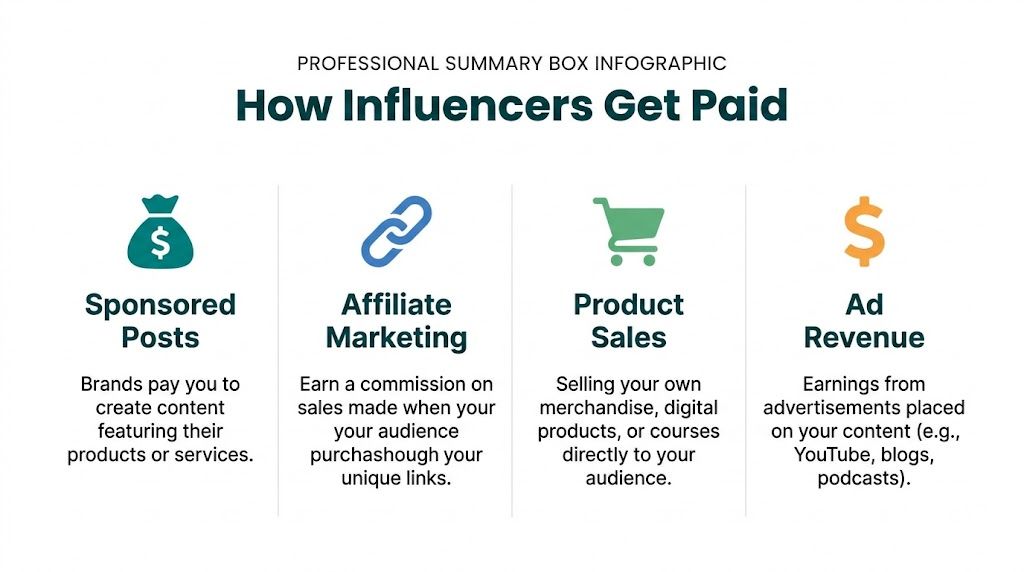
Four common ways creators earn
A paid influencer usually earns in one or more of these ways:
Sponsored posts
A brand pays you to create content featuring its product or service.Affiliate marketing
You recommend something using a special link. If someone buys through that link, you earn a commission.Product sales
You sell your own guide, template, checklist, workshop, or course.Ad revenue
Some platforms pay creators when ads appear around their content.
For beginners, Affiliate Marketing is often the easiest place to start because you don't need to wait for a brand to approve a campaign. You can begin by recommending products you use and explaining why they help.
Which income stream fits a beginner best
Here is the simplest way to understand it:
| Income type | Beginner-friendly | Why |
|---|---|---|
| Affiliate marketing | Yes | Easy to start with trust and useful recommendations |
| Sponsored posts | Later | Usually easier once you have a clear audience and examples of content |
| Brand ambassadorships | Later | Best when you've already shown consistency and alignment |
| Your own products | Yes, in a simple form | A checklist or guide can start small |
According to Beehiiv's breakdown of influencer income, micro-influencers with 10,000 to 50,000 followers earn $200-$1,000 per post, and a creator with 15,000 engaged followers can generate $2,000-$5,000 monthly from affiliate commissions alone. That's a powerful reminder that engagement and relevance can matter more than chasing a huge audience.
A smaller, trusting audience can be more valuable than a larger distracted one.
Real-life style examples
This gets easier when you picture real people.
A woman who shares simple anti-inflammatory meals could earn affiliate income from kitchen tools, cookbooks, or pantry products she uses.
A creator focused on home organization might later be paid for a sponsored post by a storage brand.
A former HR professional who now shares job search advice for women over 50 could create her own interview checklist and also partner with tools relevant to that audience.
If you're curious about the broader context, this guide for social media income gives a useful overview of how different creator revenue models fit different platforms.
Brand ambassadorships are the quieter long game
One-off sponsored posts can be helpful, but many creators prefer longer relationships with brands because they feel more natural and more stable. A brand ambassadorship usually means you promote the same company over time, rather than mentioning something once and moving on.
If you're new to that concept, this explanation of a brand ambassador program for beginners can help you see how those partnerships work in plain language.
For many midlife creators, this is the sweet spot. Fewer random promotions. More trust. More consistency. Less pressure to reinvent yourself every week.
How to Price Your Work and Pitch Brands with Confidence
Talking about money can feel uncomfortable at first. Many women have spent years undercharging, overgiving, or waiting to be noticed instead of stating their value clearly.
This part is learnable too.

Know what early progress often looks like
A lot of beginners think they've failed if brands aren't paying them quickly. In reality, there's usually a runway.
According to InfluenceFlow's 2026 paid influencer timeline, creators often spend months 1-6 building their audience and earning only small affiliate income before landing a first sponsored post in the $300-$1,500 range around months 7-9, often as their audience reaches the 15k-30k range.
That doesn't mean everyone must follow that exact timeline. It means slow early progress is normal.
What to include in a simple media kit
A media kit is just a one-page snapshot of who you are and what you offer.
Keep it simple. Include:
- Your niche: Who you help and what you talk about
- Your audience: A brief description of the people who follow you
- Your platforms: Where you publish content
- Your services: Sponsored posts, affiliate partnerships, newsletter features, short videos, blog content
- A short bio: Why your perspective matters
- Contact details: Make it easy to reach you
You do not need to make it fancy. Clear beats fancy.
A calm way to think about pricing
Pricing isn't only about follower count. It's also about the work involved, your niche, the trust you've built, and whether the brand wants one piece of content or an ongoing relationship.
If pricing makes your head spin, it can help to look at service-based examples outside influencer marketing too. This guide on consulting rates for solopreneurs is useful because it trains you to think like a business owner, not just a content creator.
A healthy starting mindset is this: you're not asking for a favor. You're offering value.
Mindset shift: A brand is not paying for a photo alone. It's paying for your audience trust, your creative work, and your ability to communicate clearly.
A simple pitch email you can adapt
You do not need a complicated pitch. Short and respectful works well.
You can say:
Hello [Brand Name],
I create content for [who you help] focused on [your niche]. I've been using and enjoying [product or service], and I believe it fits my audience because [brief reason].I'd love to explore a partnership where I create [type of content] that highlights [specific benefit]. If helpful, I'm happy to send over my media kit and ideas.
Warmly,
[Your Name]
The strongest pitches are specific. Mention the actual product. Mention why it fits your audience. Show that you've paid attention.
If you want a framework you can personalize, this influencer outreach email template gives you a starting point without sounding robotic.
Protect trust as you grow
If a brand pays you, disclose it clearly. If you use affiliate links, say so. If there is a contract, read it carefully and ask questions if needed.
Professionalism is not about sounding corporate. It's about being clear, honest, and easy to work with.
That alone will set you apart.
Building a Sustainable Business for Long-Term Peace of Mind
The goal isn't just to earn one payment. The goal is to build something that supports you over time.
That changes how you work.
A sustainable creator business is usually built on assets that keep helping you after you make them. An email list. A body of useful content. A library of recommendations. A few trusted partnerships. A simple welcome email for new subscribers. A short digital guide that solves one problem well.
Stability comes from systems, not stress
If you're over 50, you probably don't want another job that follows you around all day and leaves you depleted. You want income with dignity and some control.
That means building simple systems such as:
- A welcome email: New subscribers hear from you automatically
- A content rhythm: You know what you'll post and when
- A shortlist of products you trust: You aren't scrambling for random promotions
- A repeatable process for brand outreach: Less fear, more clarity
None of this has to be complicated. Automation can be gentle. It can be one email that goes out when someone joins your list. It can be a saved note with your pitch template. It can be a simple spreadsheet that tracks the brands you've contacted.
Think in years, not days
This is one of the biggest mindset shifts.
According to Authority Hacker research summarized by Taboola, affiliate marketers with over three years of experience earn 9.45 times more than beginners on average. That doesn't guarantee results for any one person, but it does support an important truth. Persistence matters.
The early stage can feel quiet. You may post and hear little back. You may build slowly. You may wonder whether it's working.
That doesn't mean you're wasting time. It may mean you're building an asset before the payoff becomes visible.
The beginning often looks small from the outside. On the inside, you're learning skills that compound.
Your second chapter can be steady
You do not need to become a different person to do this well.
You need to become a little more visible. A little more consistent. A little more willing to share what you know. A little more comfortable treating your wisdom like something of value.
That is what makes this path hopeful. It isn't reserved for the youngest, the loudest, or the most technical. It belongs to people who are willing to learn, adjust, and keep showing up.
The next five years will pass either way. You can spend them only worrying about security, or you can use them to build something that gives you more of it.
If you'd like a calm, beginner-friendly place to keep learning, Victoria OHare offers step-by-step guidance on Affiliate Marketing, brand ambassadorship, List Building, and simple automation for women who want to build income online without tech overwhelm. You don't need to know everything before you begin. You just need a clear next step.