
If you're over 50 and wondering whether it's too late to build income online, you're not alone. Many women feel behind financially, not because they failed, but because life happened. Careers shifted, caregiving took time, Retirement feels less certain, and technology can seem like a language everyone else somehow learned first.
If the phrase content creator business plan makes you tense up, take a breath. This doesn't need to look like a corporate report or a banker's spreadsheet. It can be a calm, practical roadmap that helps you build income, protect your energy, and create more peace of mind.
I remember how intimidating this felt when I first started learning online business. The words sounded formal. The tools looked cluttered. I almost convinced myself that planning was only for younger people or full-time entrepreneurs. It isn't. A simple plan is just a way to make your next step clearer.
Why Your Creator Journey Deserves a Gentle Plan
A business plan sounds stiff to many people. For a solo creator, it doesn't need to be.
Think of it as a personal guide for decisions. It helps you answer simple questions before you waste time, money, or confidence. Who am I helping? What will I talk about? How will this make money? What will I do each week without burning out?

Why planning matters more than motivation
Motivation comes and goes. A gentle plan stays.
Without a plan, it's easy to spend weeks picking colors for a website, trying random social platforms, or posting content that doesn't connect to any real goal. With a plan, your energy has a direction. That's especially important if you're building this around a job, family responsibilities, or a season of life where you don't want chaos.
The good news is that this space is still growing. The content creator economy is projected to expand from USD 117 billion in 2024 to USD 1,143 billion by 2034, with a 25.6% CAGR, according to Market.us research on the content creator economy. That doesn't mean easy money. It means there is real room for thoughtful, consistent creators who build trust over time.
A business plan isn't pressure. It's peace of mind written down.
What your plan should actually do
Your plan doesn't need twenty pages. One page can be enough if it helps you do these things:
- Stay focused: Choose one audience and one core message instead of trying to help everyone.
- Reduce overwhelm: Decide what kinds of content you'll create before you sit down to post.
- Support income goals: Pick revenue streams that fit your values and your schedule.
- Protect your confidence: Measure progress by actions you can control, not by comparing yourself to strangers online.
A calm plan also helps with skepticism. And I understand being cautious. There are scams online. That's why clear structure matters. If your content creator business plan is grounded in service, simple systems, and patience, it becomes much easier to tell the difference between a real business and a shiny distraction.
A better way to think about it
If you're building an online business for older women, or trying to make money online after 50, your plan can reflect your life. It can be slower, steadier, and more intentional.
You don't need to chase trends. You need a roadmap that respects your experience.
Defining Your Purpose and Your People
Many beginners start by asking, "What niche should I pick?" That's not a bad question, but it can feel cold and confusing.
A better question is this. Who do you feel equipped to help because of what you've lived through?

Start with your lived experience
Your purpose often hides inside ordinary life experience. Not flashy expertise. Real-life wisdom.
Maybe you've learned how to stretch a grocery budget, simplify menopause wellness, organize a small home, care for aging parents, start over after divorce, or build confidence with makeup, fitness, faith, gardening, or side income. Those things matter because someone else is searching for help with them right now.
Try writing answers to these prompts in a notebook:
- What do people already ask me for help with?
- What problem have I personally worked through?
- What could I talk about every week without forcing it?
- What kind of person do I understand deeply?
When your content grows from real understanding, it feels lighter to create.
Don't create fast. Create useful.
Many content initiatives fail because creators rush to post before understanding what their audience needs. Research shows 70% of small businesses fail at content marketing because they prioritize speed over strategy, and the most effective creators begin by learning what their audience requires before making a decision, according to this strategy-first content analysis.
That means your plan should include a listening phase.
You can do that by:
- Reading comments: Look at YouTube, Pinterest, blogs, and Facebook groups in your topic area.
- Noticing repeated questions: Repetition is a clue. If many people ask the same thing, that's content.
- Paying attention to buying decisions: What does someone need to understand before they trust a product, method, or recommendation?
- Writing down exact words: Use the language your audience uses, not polished industry language.
Practical rule: If you don't know what your audience is worried about, don't post more. Listen more.
A simple way to define your people
You don't need a formal customer avatar. Just fill in this sentence:
I help ___ who want ___ but feel ___ .
For example:
| Part | Simple example |
|---|---|
| Who | women over 50 |
| What they want | to earn income online before Retirement |
| What they feel | overwhelmed by tech and unsure what's legit |
That one sentence can shape your entire content creator business plan.
If you need help narrowing your topic without overthinking it, this guide on how to choose a profitable niche is a useful next read.
One small story from experience
The first time I tried to define an audience, I made it much too broad. I wanted to help "anyone who wanted freedom." That sounded inspiring, but it gave me nothing clear to write about. Things got easier when I pictured one real person with one real frustration.
Clarity doesn't make your work smaller. It makes it more useful.
Choosing Your Gentle Revenue Streams
Once you know who you're helping, the next question is simple. How will this become income?
At this point, many people tense up. They worry that monetizing means becoming pushy, fake, or salesy. It doesn't have to. If your business is built around helping people make good decisions, income becomes a natural extension of service.
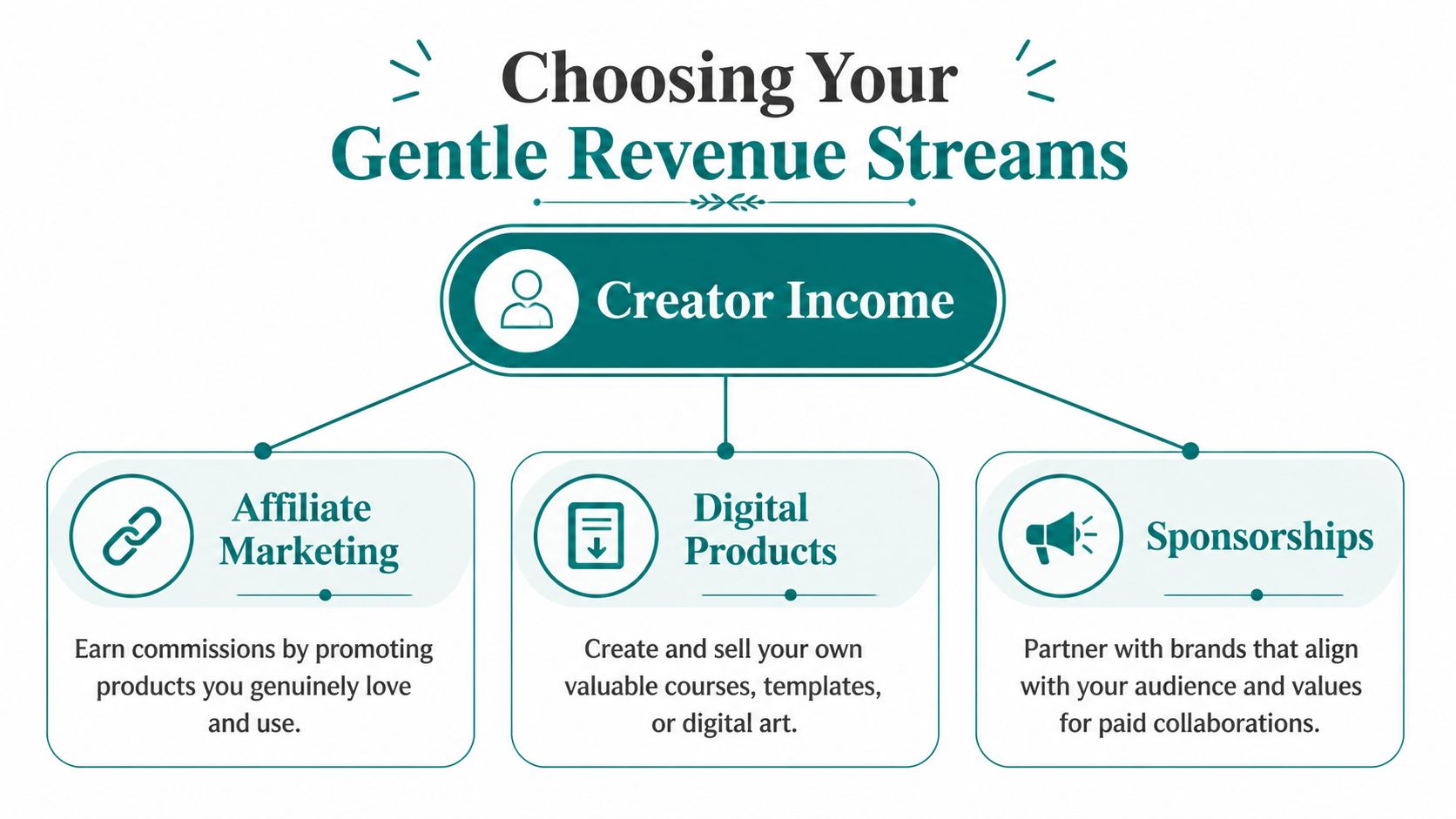 Affiliate Marketing, digital products, and brand sponsorships." />
Three revenue streams that fit a one-person business
The most beginner-friendly options are often these:
Affiliate marketing
This means recommending a product or service and earning a commission if someone buys through your link. In plain language, you're sharing something useful and getting paid for the referral. This works best when you only recommend what fits your audience.Simple digital products
You can turn your knowledge into a checklist, guide, workshop, template, mini course, or printable. It doesn't need to be fancy. It needs to solve a real problem clearly.Brand sponsorships
This is when a company pays you to feature or discuss a product that fits your audience and values. Even small creators can become attractive partners when they build trust with a specific group.
Later, if video becomes part of your strategy, resources like these YouTube monetization tips for side hustlers can help you understand how creators turn content into income in a more structured way.
A lot of people like seeing this explained out loud, so here's a helpful video that walks through the idea of creator income in a more visual way.
Why brands care about trusted creators
This isn't just wishful thinking. 94% of brands believe creator content delivers higher ROI than traditional digital ads, and creator-driven content can achieve 20% more conversions, according to Tribe Group's creator marketing statistics. That matters because it confirms something many newer creators miss. Trust is valuable.
You do not need celebrity status to build a workable business. You need relevance, consistency, and credibility.
How to avoid feeling salesy
The simplest filter is this. Never promote for the commission alone. Promote because it helps.
Ask yourself:
- Would I suggest this to a friend offline?
- Does this solve a problem my audience has?
- Can I explain why it helps in plain language?
- Would I still feel comfortable recommending it a year from now?
Helpful promotion sounds like guidance. Pushy promotion sounds like pressure.
If Affiliate Marketing for beginners over 50 appeals to you, start with products you already use. That could be a skincare item, a budgeting tool, a kitchen product, a wellness resource, or an online platform you've personally tested. Your honesty becomes part of your business model.
If you want more ideas beyond one income source, this list of multiple income streams for a freedom lifestyle can help you think through what fits your season of life.
Your Simple Financial and Content Calendar
A financial plan doesn't need to start with a giant income goal. Start smaller.
Instead of asking, "How do I replace my salary?" ask, "How could I make my first $100?" That question is calm enough to work with. It gives your mind something concrete.
Build around a micro-goal
Your first financial target is not your forever target. It's a training target.
A micro-goal helps you connect content to a real outcome. For example, if you want your first small monthly result, your plan might include:
- One core offer: an affiliate product, a digital download, or a simple service
- One weekly content piece: a blog post, email, video, or Pinterest-supported article
- One call to action: invite readers to join your list or explore the next step
- One review point: notice what people click, reply to, or ask about
At this stage, planning starts to feel practical. You're not guessing. You're testing.
If you like a more structured explanation of planning numbers without making it overly corporate, this guide to modern budgeting and forecasting is a helpful companion.
Publish less. Mean more.
Many beginners think they need to post every day. Usually, they need a repeatable rhythm instead.
83% of marketers believe publishing higher-quality content less frequently is more effective, and 54% of B2B marketers say creating content consistently is a top challenge, according to Salesgenie's content marketing statistics. That's encouraging for solo creators. It means a simpler schedule can still be smart.
A good content creator business plan should protect consistency by lowering friction.
One useful piece of content each week beats a burst of panic posting followed by silence.
A four-week example you can actually use
Here is a gentle sample calendar:
| Week | Main content | Purpose | Simple call to action |
|---|---|---|---|
| Week 1 | Blog post answering a common beginner question | Build trust | Invite readers to join your email list |
| Week 2 | Short email with a personal story and one lesson | Deepen connection | Mention a recommended tool or resource |
| Week 3 | Tutorial or product walkthrough | Support buying decisions | Share an affiliate link if relevant |
| Week 4 | Reflection post or FAQ | Learn what resonates | Ask readers what they need next |
That is enough to begin.
Keep your planning sheet simple
You can track your month in a notebook, Google Docs, or Google Sheets. You do not need a fancy dashboard on day one.
Include these columns:
- Content idea
- Who it's for
- What problem it solves
- What action you want the reader to take
- What you learned after publishing
I remember staring at complicated content calendars once and feeling like I'd never keep up. What finally helped was using one page and one weekly promise to myself. Simpler systems are easier to trust.
Building Your Most Valuable Asset Your email list
Social media can help people find you. It should not be the only place your business lives.
Your email list is different because it's an asset you own. That's why it belongs in every serious content creator business plan, especially if your long-term goal is stability rather than chasing attention.
Owned land versus rented land
A social platform can change its rules, reduce your reach, or make your work harder to discover. Your email list gives you a direct connection to people who asked to hear from you.
That changes the emotional tone of your business. You're not waiting for an algorithm to decide whether your message matters. You have a line of communication you control.
This matters even more for solo creators who want security. Business planning advice often misses the legal and tax realities faced by smaller creators, especially midlife women. It also misses the practical value of protecting audience access. The available guidance highlighted by LivePlan's sample business plan context points to a gap in support for solo creators, while noting that women 50+ can grow email lists 25% faster with relatable stories and 40% quit due to tech and legal fears. If that's you, your hesitation makes sense. It also means list-building deserves extra care because it's one of the few assets that grows with you.
What to offer so people subscribe
You don't need a complicated funnel. Start with one useful free item.
That could be:
- A checklist: helpful for step-by-step topics
- A short guide: good for teaching a beginner concept
- A resource list: useful if your audience wants trusted recommendations
- A mini email series: perfect if you want to welcome people gently over a few days
The best freebie solves one small problem quickly. Not ten problems vaguely.
When someone joins your email list, they're not asking for more noise. They're asking for guidance they can trust.
Automation can be simple
The word automation scares people because it sounds technical. In practice, it can be very human.
A basic setup might look like this:
- Someone downloads your free guide.
- Your email platform sends a welcome email.
- A second email shares your story and what you help with.
- A third email points them to your best content or a trusted recommendation.
It's simple: Not cold. Not robotic. Just consistent.
If you're starting from zero, this guide on how to build an email list from scratch can help you map out the basics in plain language.
A gentle reminder about fear
The first time I set up an email form, I felt clumsy. I worried I'd break something. This is a common experience. But this is learnable. You don't need to master every tool at once. You only need to build one simple bridge between your content and your readers.
And once that bridge is there, your business becomes steadier.
Putting It All Together Your One-Page Plan
By now, your content creator business plan may feel much less intimidating. That's the point.
A useful plan for a solo creator doesn't try to impress anyone. It helps you make clear decisions. One page is often enough when it includes the right pieces.

Your one-page framework
You can write this in a notebook, a Google Doc, or print a page and keep it near your desk.
Include these five parts:
Purpose
What do you want to help people with, and why does it matter to you?People
Who are you serving? What do they want? What confuses or worries them?Revenue
Which one or two income streams fit your values and stage of business?Content
What will you publish each week that helps people move toward a decision?List building
What free resource will you offer so readers can join your email list?
Keep it visible and editable
Your plan is not a contract. It's a working document.
You can adjust it as you learn what your audience responds to. In fact, that's a healthy sign. Some people also find it useful to compare their one-page plan with a broader roadmap for your digital marketing so they can see how content, promotion, and goals connect without getting lost in jargon.
Start with clarity, not complexity. Complexity can come later if you ever need it.
What matters most
If you're wondering how to earn income before Retirement, or whether Affiliate Marketing is legit, this is the quieter truth. Building online income is less about secrets and more about structure. Serve real people. Choose gentle revenue streams. Publish consistently. Build your list. Learn as you go.
You are not behind. You are building from where you are.
The next five years will pass either way. The only question is whether you'll use them to build something that gives you peace of mind.
If you'd like calm, beginner-friendly help putting these ideas into practice, Victoria OHare offers step-by-step guidance for aspiring online entrepreneurs, especially midlife women and new creators who want to build income through Affiliate Marketing, List Building, brand ambassadorship, and simple automation. If that kind of support would make this feel lighter, it's a lovely place to continue learning.