
If you're over 50 and wondering whether it's too late to build income online, you're not alone. Many people reach Retirement with a mix of relief, uncertainty, and a quiet worry that the numbers may not stretch as far as they'd hoped. Add unfamiliar technology to the picture, and it's easy to feel like everyone else got a manual you never received.
You didn't fail. Life happened. Careers changed, caregiving took time, Health needs appeared, prices kept moving, and Retirement stopped looking as simple as it once did.
The good news is that work from home after Retirement doesn't have to mean starting over. It can mean using what you already know in a calmer, more flexible way. It can also mean building something small and steady that gives you more control, more dignity, and more peace of mind.
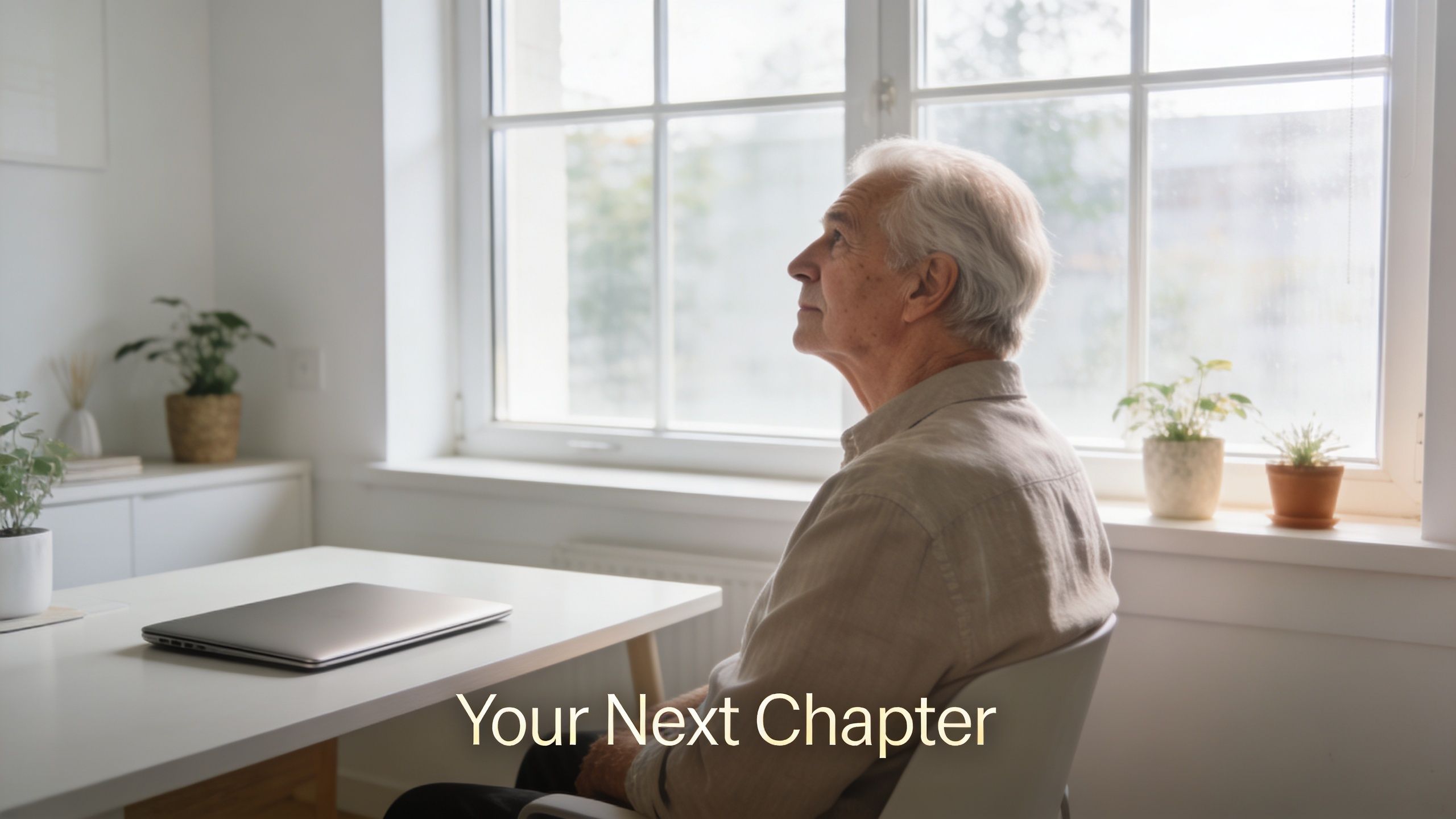
Your Next Chapter An Introduction to Working from Home After Retirement
A lot of people imagine Retirement as a clean finish line. Then reality sets in. Some people want extra income. Some miss feeling useful. Some want options.
I remember feeling that exact mix of freedom and fear. The freedom sounded lovely. The fear sounded practical. What if I needed more income later? What if I wanted structure, but not another draining job? What if I could work, but only on my own terms?
Retirement doesn't always mean work is over
For many retirees, returning to work isn't a crisis move. It's part of a thoughtful plan. According to Health and Retirement Study findings on unretirement and partial Retirement, 82% of people who "unretire" had already expected to work after Retirement, and 41.5% of retirees experience some form of partial Retirement with work.
That matters because it changes the story.
Working after Retirement is not a sign that you got it wrong. For many people, it's a way to keep some income flowing, stay mentally engaged, and shape a second chapter that fits real life better than the old full-time model ever did.
Working in Retirement can be a choice for security, purpose, and independence. It doesn't have to mean going backward.
Your experience is more valuable than you think
The online world often looks like it belongs to younger people who move fast, talk fast, and seem comfortable with every new app. But many successful work-from-home paths don't depend on being trendy. They depend on being helpful, clear, trustworthy, and consistent.
Those are strengths many retirees already have.
If you've managed a household budget, trained coworkers, solved problems at work, supported family members, organized events, sold products, taught classes, answered customer questions, or learned how to stay steady through change, you already have useful skills. Online work often rewards that kind of grounded experience.
Here is the calmer way to think about this next chapter:
- You're not chasing a second full career. You're creating a flexible work life.
- You don't need to know everything today. You only need to learn the next small step.
- You are not behind. Your wisdom is an asset, not a disadvantage.
That is where this starts. Not with pressure. With possibility.
Assessing Your Unique Skills and Retirement Goals
Before choosing a path, pause for a quiet inventory. Not a resume. Not a personality test. Just an honest look at what you know, what you enjoy, and what kind of life you want now.
Many people skip this step and go straight to "What should I do online?" A better question is, "What would fit me well?" That one leads to better choices and less frustration.
Start with your lived experience
Your strongest online work idea may not look impressive on paper at first. It may sound ordinary to you because you've done it for years. That's often the clue.
Ask yourself:
- What do people ask me for help with? Budgeting, organization, caregiving, gardening, travel planning, teaching, confidence, cooking, technology basics, Health routines, paperwork?
- What work came naturally to me? Training others, writing, explaining, listening, selling, supporting clients, solving problems, planning projects?
- What could I talk about for an hour without much preparation? That's often a sign of real knowledge.
- What have I lived through that taught me something useful? Retirement transitions, downsizing, loss, reinvention, Health changes, career shifts, parenting, grandparenting.
- What kind of work do I want now? Quiet and independent, or social and collaborative? Structured or creative? Simple and repeatable, or varied and expressive?
If you're leaning toward a niche-based online business, this guide on how to choose a profitable niche can help you narrow your ideas in a way that still feels natural.
Match your skills to your Retirement life
Not every good idea is a good fit for this season of life.
Remote work can make it easier to keep working longer. Data summarized by Kiplinger from the Center for Retirement Research shows that people 55+ who work remotely are 1.4 percentage points less likely to retire in the following year, which represents a 14.4% reduction in Retirement probability compared with non-remote peers in similar situations, according to this review of remote work and delayed Retirement.
That doesn't mean remote work is bad. It means it can be comfortable enough that work expands unnoticed unless you choose your boundaries on purpose.
Practical rule: Pick a work-from-home path that supports your life. Don't build one that slowly takes it over.
A simple way to think about your goals is to sort them into three buckets:
| Goal type | What it sounds like |
|---|---|
| Security | "I want a cushion so surprise expenses don't throw me off." |
| Freedom | "I want money for travel, family, hobbies, or small comforts." |
| Purpose | "I still want to contribute, teach, create, or stay mentally active." |
Write your version in one sentence
Try this fill-in-the-blank:
"I want to work from home after Retirement so I can ______ without sacrificing ______."
Examples:
- cover extras without sacrificing rest
- stay useful without sacrificing flexibility
- earn online without sacrificing family time
That sentence will help you filter every option that comes next.
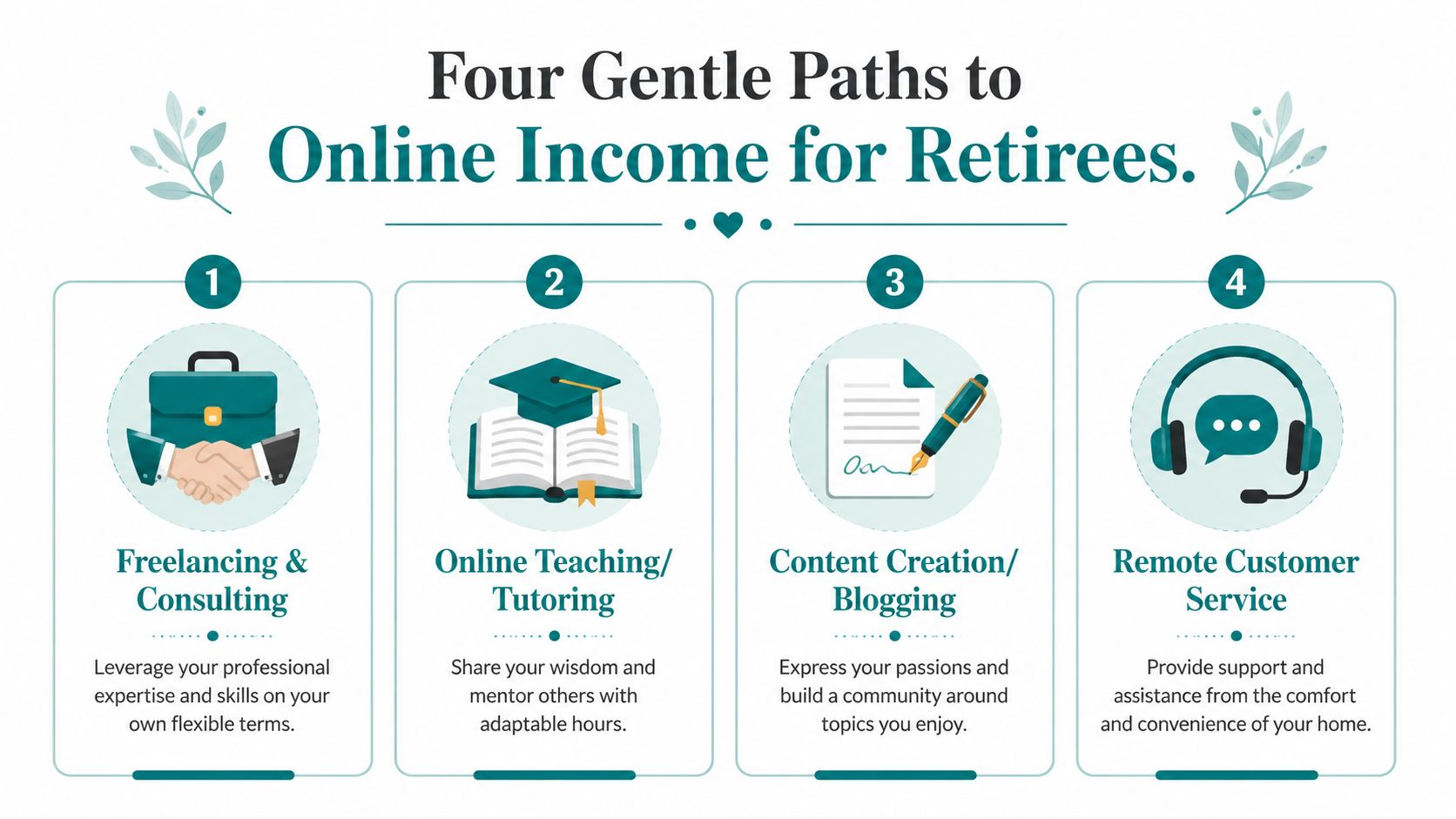
Four Gentle Paths to Online Income for Retirees
Some online income paths feel like jobs. Others feel more like assets you're building over time. Neither is wrong. The question is what suits your energy, schedule, and patience.
A helpful way to compare them is by asking two things. Do I want income now, or am I willing to build something that grows more slowly? And do I want to trade time for money, or create something that can keep working when I'm offline?
A side by side view
| Path | Best for | Income style | Effort at the start |
|---|---|---|---|
| Freelancing or consulting | People with clear professional skills | Active income | Moderate |
| Affiliate marketing | Natural recommenders and storytellers | Can become more scalable | Slow at first |
| Brand ambassadorship | Relationship builders who like sharing trusted products | Mixed | Moderate |
| Micro-services | People who prefer small, defined tasks | Active income | Lighter |
If you'd like more ideas on this broader topic, this article on how to generate income in Retirement gives a useful overview.
Freelancing or consulting
This is often the simplest bridge from past work to present income. You take something you already know how to do and offer it on a flexible basis.
That might mean bookkeeping, writing, editing, project support, customer communication, coaching, proofreading, design review, or administrative help. The appeal is that you don't need to invent a whole new identity. You mostly need a clear offer.
This path suits retirees who like direct service, defined projects, and being paid for expertise right away.
Affiliate marketing
Affiliate marketing means recommending a product or service and earning a commission if someone buys through your referral link. In plain language, it's sharing something useful and getting paid when your recommendation helps someone take action.
This works especially well when you build trust through content such as blog posts, emails, videos, or simple product reviews. Instead of chasing hourly work forever, you're creating a small library of helpful content that can continue to bring in income over time.
There's real opportunity here, but it requires patience. According to Boldin's reporting, a 2025 boom showed 40% growth in senior creators earning over $2,000 per month passively, and Q1 2026 ClickBank data found that niches such as Health supplements and Retirement travel can bring 25% higher commissions for creators over 50, as noted in this article about work-from-home options for seniors.
That doesn't mean every beginner will see those results. It does mean older creators are not locked out of this model.
Brand ambassadorship
This sits somewhere between content creation and relationship marketing. You build an audience around your voice, your story, and your values, then partner with brands you use or respect.
For retirees, this can feel more natural than hard selling. You might share wellness tools, home products, travel resources, hobbies, or educational services that fit your life. The key is honesty. If you wouldn't tell a friend to use it, don't build content around it.
This suits people who enjoy trust-based communication and want to grow gradually.
Micro-services
Micro-services are small online tasks with clear deliverables. Think formatting documents, basic research, voice recordings, proofreading, inbox cleanup, simple customer support, or short writing jobs.
This can be a gentle entry point if you're feeling unsure. The projects are smaller, expectations are clearer, and you can learn how online platforms work without building a whole business on day one.
If you feel overwhelmed, choose the path with the lowest emotional friction, not the one with the loudest promises.
Your Simple Technology and Tool Setup
A lot of retirees get stuck here.
Not because the work is too hard, but because the tools look unfamiliar at first. A login screen, a dashboard, a list of settings. It can feel like walking into a kitchen where every drawer is in the wrong place. The good news is that you do not need to master every appliance to make dinner. You only need a few basics that work well and make sense to you.

A simple setup matters for another reason too. If your goal is steady income after Retirement, you want tools that help you build assets you still own next year, especially an email list, your notes, and your audience relationships. Chasing small one-off tasks can keep you busy. A small system can keep working for you over time.
Start with your home base
Your home base is the small set of tools you return to every day. Keep it plain.
- A reliable computer: A laptop or desktop that can handle email, web browsing, writing, and video calls.
- A stable internet connection: Speed matters less than dependability.
- A separate work email address: This keeps client messages, newsletters, and account logins out of your personal inbox.
- A consistent work spot: A spare room is nice, but a corner of the dining table works if it helps you focus.
That is enough to begin.
If you have been waiting until everything feels polished, you can stop waiting. Many successful home-based businesses start with a basic laptop, one email address, and a simple routine.
Choose tools that match your path
You do not need a pile of subscriptions. Most retirees can start with one or two tools for creating, one for communication, and one for List Building.
- For writing and planning: Google Docs is good for drafts, checklists, outlines, and saved ideas.
- For simple graphics: Canva helps you make clean images without design experience.
- For calls or consultations: Zoom works well for face-to-face conversations.
- For scheduling: Google Calendar gives your week some shape.
- For List Building: An email platform lets you collect subscriber emails, send useful notes, and stay in touch without depending on social media.
That last tool is easy to overlook, but it often becomes the most valuable one. An email list works like a garden. You plant one seed at a time, care for it, and give it time. Months later, you have something real. If you want help comparing options, this guide to best email marketing platforms for small business is a helpful starting point.
Keep the learning light
A short video walkthrough can make new tools feel much less intimidating.
Try these habits while you learn:
- Open one tool at a time: Setting up five accounts in one afternoon creates confusion fast.
- Keep one notebook nearby: Write down passwords, steps, and questions in one place.
- Repeat the same small task a few times: Familiarity grows through repetition.
- Use free plans first: You can test what fits before paying for anything.
- Save tax-related records from day one: Keep receipts, software costs, and income notes in a folder so money decisions stay clear later.
The goal is not to become a technology expert. The goal is to build a simple, steady system you can use with confidence.
Your First 90 Days A Gentle Launch Plan
When people get excited about online income, they often try to do everything in one week. That usually leads to confusion, not momentum.
A quieter approach works better. Think in seasons, not sprints.
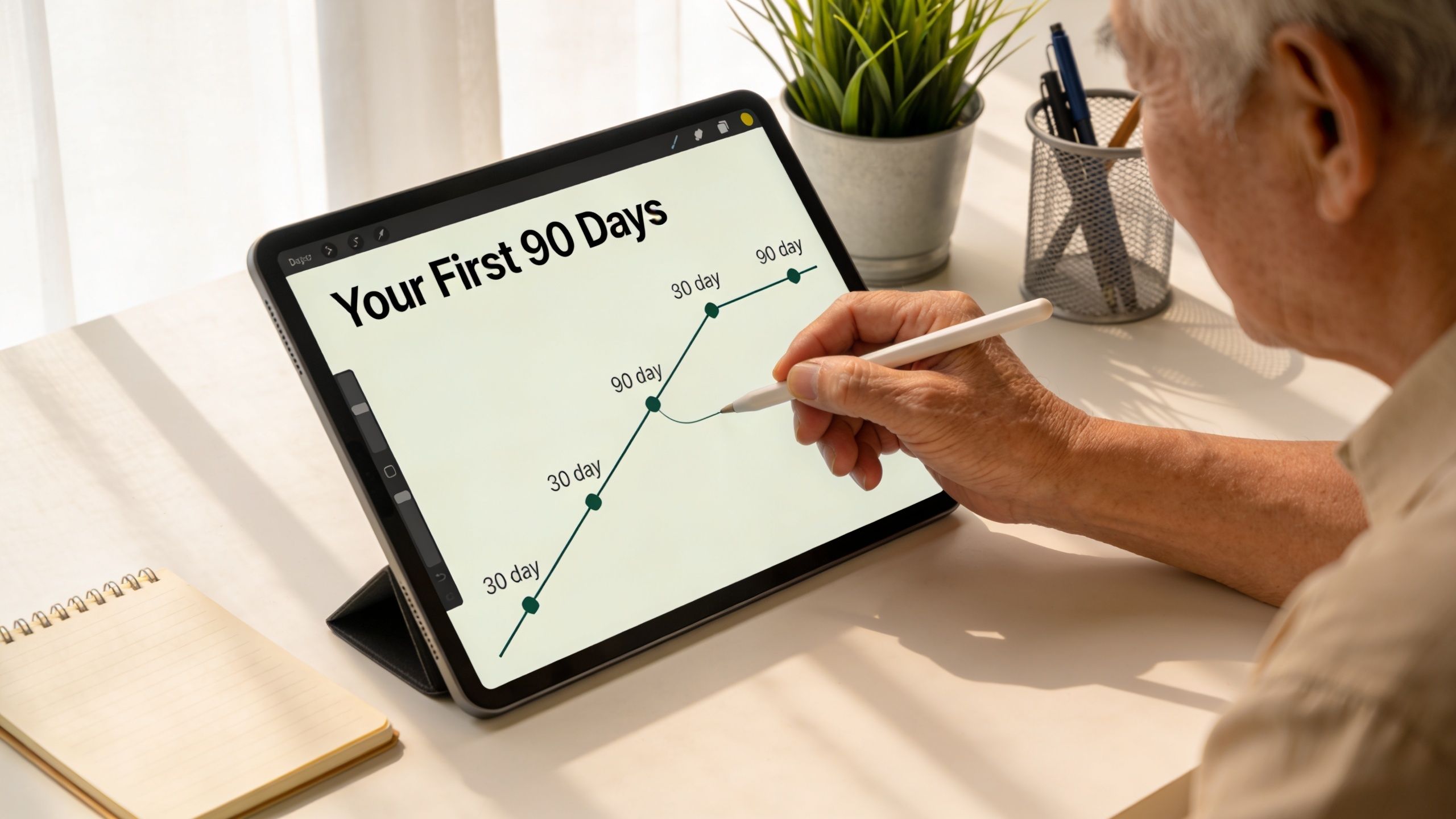
Days 1 to 30 Foundation
Your first month is about choosing and simplifying.
Pick one income path. Not two. Not four. If you're torn between options, choose the one that feels clear enough to act on this week.
Create a short working outline for yourself:
- Who do I want to help? Be specific. Retired travelers, busy grandmothers, beginner gardeners, women navigating menopause, small business owners, former clients?
- What problem can I help with? Advice, clarity, convenience, encouragement, product recommendations, done-for-you help?
- What will I offer first? A service, a review article, a newsletter, a consultation, a simple social profile, or one helpful blog post?
Set up your basic tools. Claim your email address. Organize one folder on your computer. Write a short bio you can use in profiles or email signatures.
Days 31 to 60 Creation and connection
At this point, many people freeze because they think the first thing must be perfect. It doesn't.
If you're freelancing, write a simple description of your service. If you're exploring Affiliate Marketing, publish one honest piece of helpful content about a product or topic you understand. If you're leaning toward a newsletter, send your first email to a small list of friends or interested contacts who agreed to hear from you.
Try a small circle first:
- Tell trusted people what you're building
- Ask for feedback on clarity, not praise
- Notice which questions keep coming up
- Use those questions as content ideas
A small beginning is not a weak beginning. It's usually a wise one.
You are building an asset, not performing for strangers.
Days 61 to 90 Consistency and learning
By the third month, your main job is rhythm.
That means choosing a weekly routine you can keep. Maybe it's writing once a week, posting twice a week, checking email every weekday morning, or doing client work on only three afternoons.
A simple weekly pattern might look like this:
| Day | Focus |
|---|---|
| Monday | Plan your week and review messages |
| Tuesday | Create one piece of content or update your offer |
| Wednesday | Learn one small skill |
| Thursday | Reach out, reply, or connect |
| Friday | Review what worked and tidy your systems |
You don't need dramatic progress. You need repeatable progress.
At the end of the first 90 days, ask:
- What felt energizing?
- What felt draining?
- What got a response from people?
- What do I want to continue, drop, or simplify?
If your first version is clumsy, that's normal. Clarity usually arrives after motion, not before it.
Managing Your Money Taxes and Benefits Wisely
This is the part many "make money from home" articles skip. They focus on earning and ignore the paperwork, taxes, and benefit rules that can create stress later.
A calm plan protects your peace of mind better than a bigger invoice does.
According to AARP's summary, a 2022 Transamerica Center study found that 57% of workers plan to work in Retirement, yet many resources still don't explain how earnings can affect Social Security benefits or Medicare premiums, as discussed in AARP's guide to part-time work from home.
Think like a careful business owner
If you're earning money regularly, treat it with respect from the beginning.
That means:
- Track income: Keep a simple spreadsheet or notebook with dates, amounts, and where the money came from.
- Track expenses: Save receipts for tools, software, office supplies, internet-related costs, and other business purchases that may matter at tax time.
- Use a separate account if possible: It makes your records much easier to follow.
- Set money aside as you earn: Don't wait until tax season to discover what you owe.
If you want a plain-English overview of deductible expenses, this guide on understanding remote work write-offs is a useful companion.
Know the Social Security and Medicare questions early
If you start working before reaching full Retirement age, earned income can affect Social Security benefits under the earnings test. Higher income can also affect Medicare premiums through income-related adjustments.
The point is not to frighten you. The point is to prevent surprises.
Understanding these rules ahead of time helps your new income support your security instead of creating avoidable stress.
A few practical habits help:
- Call before guessing: If you're receiving benefits, ask Social Security or a qualified tax professional how your specific situation may be affected.
- Review every income stream together: Pension, Social Security, contract work, affiliate income, consulting fees, and investment income can interact in ways that aren't obvious at first.
- Plan for quarterly taxes if needed: Some self-employed retirees need to pay taxes during the year, not only in April.
Hobby or business
This confuses many beginners. If you occasionally sell something small, it may feel like a hobby. If you're actively trying to earn profit, promoting your work, tracking activity, and building systems around it, it may be treated more like a business.
That distinction matters because it can affect how you report income and expenses.
If you're unsure, speak with a tax preparer who has experience with self-employment income. This is one of those areas where a short professional conversation can save a lot of stress later.
A simple money routine
Use this monthly checklist:
- Review what came in
- Move a portion into a tax savings bucket
- Save digital copies of receipts
- Check any benefit-related notices
- Write down questions for your accountant or tax preparer
You don't need to become a tax expert. You just need a calm system.
Finding Your Rhythm Scaling Ethically and Staying Healthy
Starting is one thing. Staying steady without burning out is something else.
This part matters more than many people realize, especially in Retirement. If your new venture starts to feel like a bossy, endless job, it defeats the reason you wanted flexibility in the first place.
Build work around your life
I had to learn this the slow way. At first, I thought being serious meant saying yes to everything. More tasks, more time online, more checking messages, more fiddling with little details. It didn't take long to see that this approach creates a very busy hobby and a very tired person.
A better question is, "What pace lets me continue?"
Try these boundaries:
- Set office hours for yourself: Even if you work from your kitchen table, define when work begins and ends.
- Use block scheduling: Group similar tasks together, such as writing on one day and admin on another.
- Protect recovery time: Leave space for appointments, family, walks, hobbies, and simple rest.
- Choose one main income stream first: Depth is often better than scattering your energy.
A sustainable online business should support your Health, not quietly compete with it.
Scale in ways that stay human
Scaling doesn't have to mean going bigger and louder. It can mean going calmer and smarter.
Here are ethical ways to grow:
| Gentle growth move | What it looks like |
|---|---|
| Improve your systems | Save templates, use checklists, organize files clearly |
| Refine your offer | Focus on the service or topic people respond to most |
| Automate small tasks | Use email sequences or scheduling tools for routine steps |
| Raise standards | Work with better-fit clients or promote only trusted products |
For retirees building content-based income, an email list can be one of the healthiest assets to grow because it gives you a direct line to people who chose to hear from you. You aren't depending only on social platforms or hourly availability. You're building a relationship over time.
Watch your energy, not just your earnings
It helps to review your work in two ways:
- Money check: Which activities produce income or build future income?
- Energy check: Which activities leave you steady, and which leave you depleted?
If something makes money but consistently drains you, simplify it, limit it, or replace it. This second chapter should feel like an extension of your values, not a fight against them.
Your Questions Answered A Path to Peace of Mind
Is Affiliate Marketing legit
It can be, yes. But not every person teaching it is trustworthy.
I understand being cautious. There are scams online. The legitimate version is simple. You recommend products or services with integrity, disclose that you may earn a commission, and focus on helping people make informed decisions. If someone is promising instant wealth or pushing you to pressure friends, step away.
Am I too old to start online work
No. You're older, not disqualified.
In many work-from-home models, trust matters more than trendiness. Life experience helps you explain things clearly, relate to real problems, and make thoughtful recommendations. Those are strengths.
Do I need to be good at technology first
No. You need to be willing to learn basic tools gradually.
Most beginners don't fail because they lack talent. They get overwhelmed by trying to learn everything at once. Keep it small. Learn one tool, then one task, then one routine.
Should I do gig work or build assets
If you need income quickly, gig-style work or freelancing may help first. If you want more long-term stability, building assets such as an email list, a helpful blog, or a trusted library of content can create more independence over time.
Often the wisest path is a blend. Use active income to create breathing room while you slowly build something that doesn't depend only on today's hours.
What if I start and no one pays attention
That's common in the beginning. It doesn't mean you've chosen the wrong path. It usually means you need more repetition, clearer messaging, or more time building trust.
Start with helping one person well. Then help another.
What is the smallest first step
Choose one path and take one visible action this week.
That could mean:
- opening a separate work email
- writing down three niche ideas
- describing one service you could offer
- drafting your first helpful email
- creating one piece of content around a product or topic you trust
You do not need a grand reinvention. You need a beginning.
The next five years will pass either way. The only question is whether you'll use them to build something that gives you more peace of mind, more independence, and more choice.
If you'd like a calm, beginner-friendly place to keep learning, you can explore the resources at Victoria OHare. The site focuses on simple, step-by-step guidance for building online income through Affiliate Marketing, brand ambassadorship, List Building, and practical systems that don't assume you're already tech-savvy.