
If you're over 50 and wondering whether it's too late to build income online, you're not alone. Many women feel behind financially, not because they failed, but because life happened. Retirement can feel less certain than it once did, and all the tech talk around online business can make a simple project feel far more complicated than it is.
That doubt is real. So is the overwhelm.
If you've looked at online marketing and thought, "I don't want to pressure people, and I definitely don't want to sound pushy," there's good news. You can grow an email list in a way that feels calm, useful, and human. Quiz funnel lead generation can be one of those ways when you treat it as a conversation, not a gimmick.
A Gentler Way to Grow Your email list
A lot of online marketing feels loud.
You open a website and get hit with pop-ups, countdowns, flashing buttons, and urgent promises. For many new creators, especially those building a trust-based brand, that style feels uncomfortable. It can make you think the only way to grow is to be louder than everyone else.
I remember feeling that tension early on. I didn't want to "shout" at people just to collect an email address. I wanted a quieter way to begin a relationship, something that felt more like helping than persuading.

Why a quiz can feel more natural
A quiz funnel is a short interactive quiz that leads into your email list. Instead of asking a stranger for their email right away, you invite them into a small experience first.
That changes the tone.
A pop-up often says, "Give me your email." A quiz says, "Let me help you understand something about yourself." That's a very different first impression. It feels closer to hospitality than interruption.
A good quiz doesn't corner people. It welcomes them.
For example, if you help women explore online business, you could offer a quiz like "What's Your Best First Step for Building Income Online?" That kind of quiz gives someone a reason to participate because they want clarity, not because they're being pushed.
This isn't just for big brands
Sometimes people assume quizzes are only for ecommerce stores or polished companies with full marketing teams. That's not true. Small creators, bloggers, and beginner affiliate marketers can use them too, especially when the goal is connection.
If you're curious how interactive content works in a more commerce-focused setting, SmashPops' guide for ecommerce marketers gives useful context on why interactive experiences keep attention longer than static pages. Even if your business isn't ecommerce, the bigger lesson still applies. People respond when content invites participation.
A quiz can also sit alongside simpler list-building tools. If you're still comparing ideas, this walkthrough on how to create a lead magnet helps you see where a quiz fits and where a PDF or checklist may be enough.
The deeper reason this works
Many readers in midlife aren't looking for hype. They're looking for peace of mind, a second chapter, and a practical way to build something of their own. A quiz can support that because it starts with listening.
Not every visitor wants a long ebook. Not every person wants to sit through a webinar. But many people will answer a few thoughtful questions if they believe the result will help them make a clearer decision.
That's why quiz funnel lead generation can be such a gentle fit. You're not chasing numbers first. You're starting a conversation with someone who wants guidance.
And no, you're not behind. You can still build an asset online. You can still learn this. You don't need to become a different kind of person to do it.
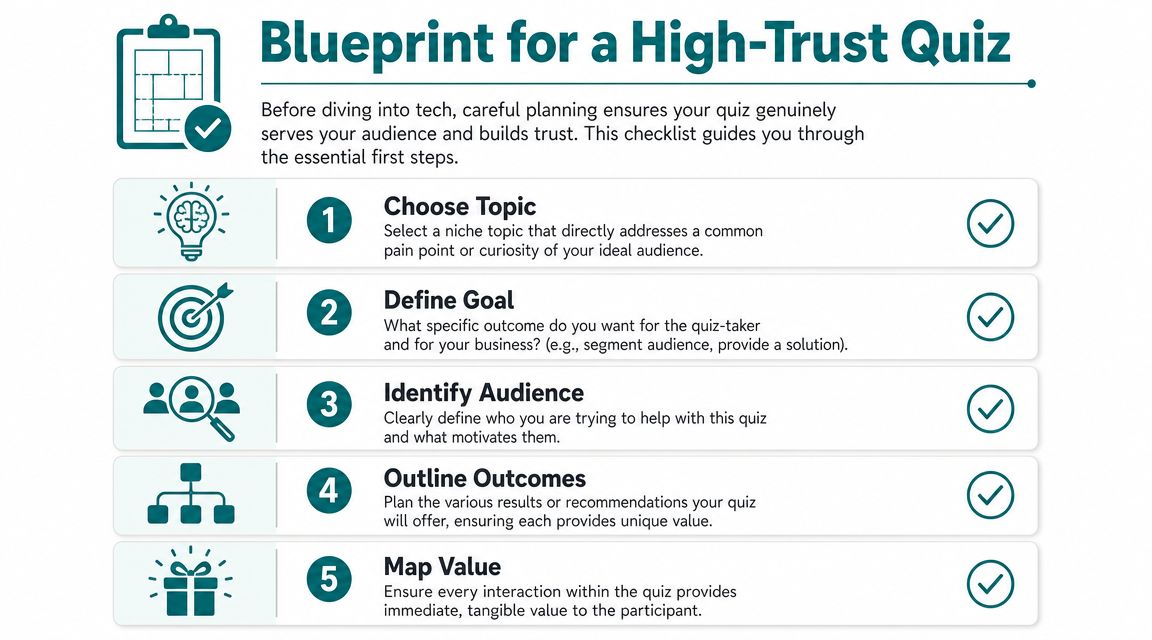
Planning Your First High-Trust Quiz
Before you touch any software, pause and think about the person on the other side of the screen.
The strongest quiz funnels begin with empathy. They don't begin with clever tech or fancy design. They begin with a simple question: What is my reader confused about, worried about, or curious about right now?
Pick a quiz type that suits a beginner
Most first-time creators do well with one of two quiz styles.
| Quiz type | Best for | Example |
|---|---|---|
| Personality quiz | Helping people identify their style, habits, or preferences | "What's Your Creator Style?" |
| Outcome quiz | Helping people choose a path or next step | "Which Online Income Path Fits You Best?" |
A personality quiz works well when your audience needs language for who they are. An outcome quiz works well when your audience needs direction.
If your readers say things like, "I don't know where to start," an outcome quiz is often easier. If they say, "I know I want this, but I don't know what kind of approach suits me," a personality quiz may feel more personal.
Decide if a quiz is better than a simple lead magnet
Many beginners often get stuck at this point. They hear that quizzes convert well, so they assume a quiz is always the right move.
It isn't.
As noted in Litchfield Media's discussion of quiz funnel best practices, a key question is when a quiz beats a simpler lead magnet. Their point is practical: quizzes work best when people are motivated enough to complete the sequence for a personalized result, and when the follow-up can offer more value than a generic download.
That means a quiz is a strong choice when:
- Personalization matters: The answer depends on the person's situation.
- Your audience feels unsure: They need help choosing among several paths.
- You can follow up thoughtfully: Their result leads naturally into useful emails.
A simple PDF may be better when:
- The solution is straightforward: Everyone needs the same checklist.
- Your audience wants speed: They don't want to answer questions first.
- You're still testing your idea: A one-page freebie is easier to create.
Practical rule: If the result changes based on who the reader is, a quiz makes sense. If the advice is the same for everyone, a simpler lead magnet may be better.
Match the topic to your future offer
Your quiz doesn't need to sell anything directly. It does need to point in the same direction as your business.
If you eventually recommend email marketing tools, your quiz could help people discover their communication style or list-building stage. If you teach Affiliate Marketing, your quiz might help people identify which beginner path fits them best.
That alignment matters. A random quiz may get attention, but a relevant quiz builds a list of people who actually care about what you help with.
For a broader view of how this fits into a business, effective content strategy for founders is a useful resource because it connects content choices to business goals in a grounded way.
Keep the promise small and clear
Your quiz does not need to solve someone's whole life.
It only needs to help with one specific next step.
Good quiz promises often sound like this:
- Clarity promise: "Find the best starting point for you"
- Decision promise: "Discover which path fits your schedule and personality"
- Insight promise: "Learn what's slowing your progress"
Those promises work because they're modest and believable. They respect the reader's intelligence.
When you plan with that kind of care, the quiz already starts building trust before anyone clicks the first answer.
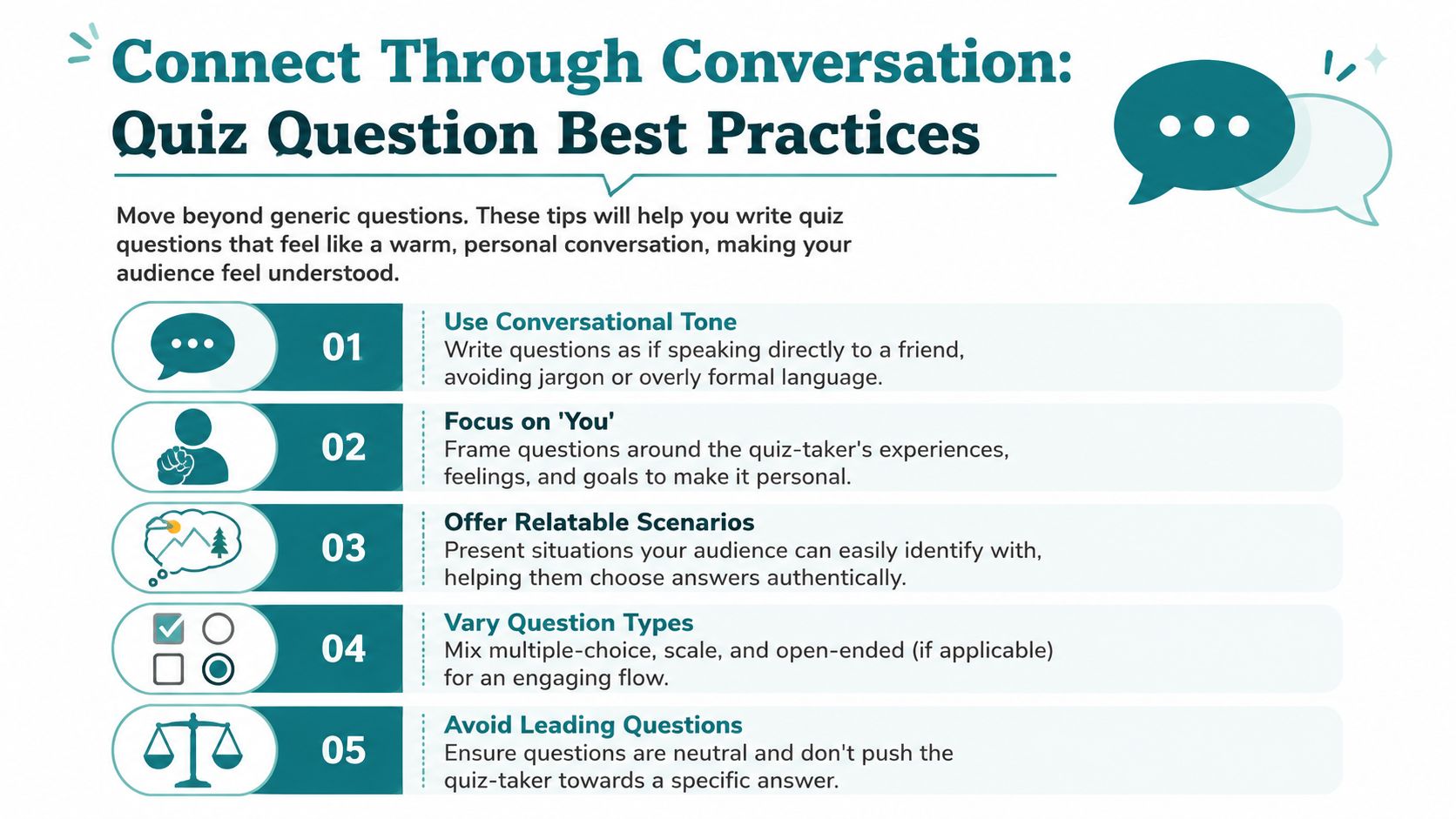
Crafting Questions That Build Connection
A quiz question can feel like a warm conversation, or it can feel like filling out paperwork.
People notice the difference right away.
If your questions are stiff, vague, or overly clever, the quiz starts to feel like work. If your questions sound like something a thoughtful guide would ask, the quiz feels easier to continue.
Keep the quiz short enough to respect their time
There is a practical guideline here. Digioh recommends keeping quizzes to 6 to 8 questions to protect completion rates and still gather enough information for a useful result, as explained in their article on using quizzes for lead generation.
That range is helpful because it forces you to stay focused.
You don't need to ask everything. You only need the questions that help you understand the person well enough to give a useful next step.
Write questions that sound human
Here's a simple test. Read each question out loud.
If it sounds like something you'd say to a friend over coffee, you're close. If it sounds like a form, rewrite it.
Compare these examples:
| Weak version | Better version |
|---|---|
| "What is your primary business obstacle?" | "What's been the hardest part of getting started online?" |
| "Select your current monetization framework" | "How are you trying to earn online right now, if at all?" |
| "What is your preferred content distribution channel?" | "Where do you feel most comfortable showing up right now?" |
The second versions feel gentler because they use normal language. They also reduce shame. That's important for beginners, especially people who already feel late to the game.
Two simple patterns that work well
For an outcome quiz, your questions should help someone move toward a recommendation.
Examples:
- Current stage: "Which best describes where you are right now?"
- Main challenge: "What feels most confusing at the moment?"
- Available time: "How much space do you have each week to work on this?"
- Preferred method: "Would you rather write, talk, teach, or recommend?"
For a personality quiz, your questions should reveal tendencies and preferences.
Examples:
- Work style: "When you're learning something new, what feels easiest?"
- Decision style: "Do you like a clear plan or room to explore?"
- Visibility comfort: "How do you feel about being on camera?"
- Motivation: "What matters most to you right now, freedom, stability, creativity, or connection?"
The best quiz questions don't just sort people. They make people feel understood.
Avoid the common trust breakers
Some questions push too hard. Others make the person feel judged.
Try to avoid:
- Overly personal questions too early: Income, fear, or family stress can feel intrusive.
- Leading questions: Don't nudge them toward the answer you want.
- Jargon-heavy wording: If they need a glossary, they'll leave.
- Trick choices: Answers should feel fair and clear.
A better approach is to ask about experience, goals, and preferences first. Save deeper segmentation for later in your email sequence, after some trust has formed.
End with a result they can use
A kind quiz earns the opt-in by offering something specific.
If someone gets a result like "You are a Thoughtful Builder," explain what that means in plain English. If they get "Start with affiliate content and email List Building," tell them why that path fits their answers.
Give them:
- A name for their result
- A short explanation
- One next step
- A gentle invitation to learn more by email
That structure keeps the quiz from feeling like fluff. It gives the reader a sense that their time mattered.
Assembling Your Funnel with Simple Tools
This is the part that scares many beginners. Not because it's impossible, but because tech often looks harder from the outside.
I remember the first time I logged into a new marketing tool and almost closed the tab. I thought I needed to be "good with technology" to make anything work. Later, I realized most of it was just following prompts, connecting one piece to another, and testing carefully.
That's good news if you're feeling nervous.
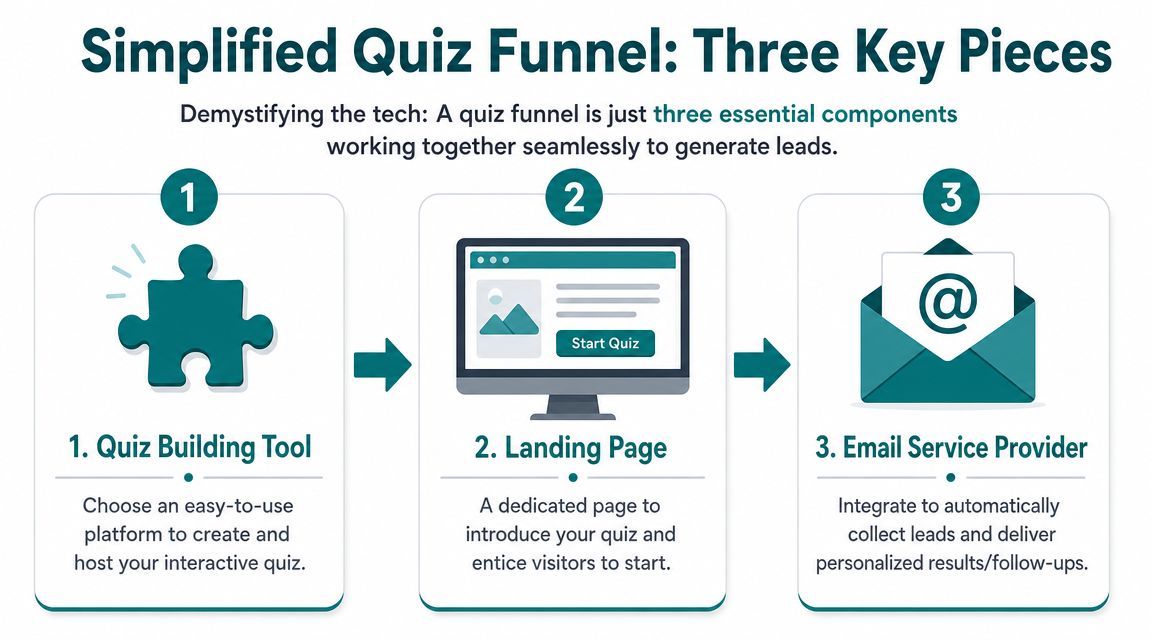
Think of it like digital Lego blocks
A quiz funnel usually has three pieces:
- A quiz builder: For creating the questions and results.
- A landing page: The page where people decide whether to start.
- An email service: Stores the lead and sends follow-up messages.
That is the whole basic system.
You don't need coding for this. Most modern platforms use drag-and-drop builders, checkboxes, and guided setup. If you can fill out an online form and click through a menu, you can learn this.
A visual walkthrough can help if you learn better by watching. This short video shows the overall idea in action.
What to look for in beginner-friendly tools
You don't need the most advanced platform. You need one that feels clear.
Here are the features that matter most at the start:
| Tool piece | Look for | Why it matters |
|---|---|---|
| Quiz builder | Easy question setup, simple result logic, clean design | Less friction while building |
| Landing page tool | Templates, mobile-friendly layout, easy editing | Faster launch |
| Email platform | Tags or segments, automation, easy broadcasts | Better follow-up later |
If you're comparing forms and opt-in layouts, lead capture form templates can give you a feel for what simple, clean sign-up experiences look like.
If you want one place to experiment with pages and automations, this GoHighLevel trial can help you see how an all-in-one setup works for lead capture and follow-up.
Why the effort can be worth it
While quiz funnels can look more complex than a plain opt-in box, they often reward that extra effort. Interact's 2026 report cites a 40.1% start-to-lead conversion rate, meaning just over 4 in 10 people who begin a quiz become leads. The same report also notes that high-performing quiz titles are usually under 15 words and descriptions under 25 words, which points to the value of keeping the experience focused and easy to begin in their quiz conversion report.
That doesn't mean every quiz will perform that way. It does mean the format has real potential when the promise is clear and the setup stays simple.
A calm setup sequence
If you're worried about doing this "wrong," use this order:
- Build the result first: Decide what outcomes people can get.
- Write the questions next: Only ask what's needed to guide them there.
- Create a simple landing page: One promise, one invitation, one button.
- Connect your email tool: Make sure each result can trigger the right message.
- Test it yourself: Click through slowly and fix anything confusing.
You don't have to master every feature. You only need a working first version.
That's how a lot of online business gets built. Not in one perfect leap, but in calm, small steps.
Your Post-Quiz Welcome and Nurture Sequence
Getting the email address is not the finish line. It's the start of the relationship.
Many quiz funnels frequently lose their warmth. The quiz feels thoughtful, but the follow-up becomes generic or too sales-focused. When that happens, people can feel that the actual goal was the email, not the help.
A better approach is to make the next few emails feel like a continuation of the same caring conversation.
As discussed in Sharpen Marketing's piece on quiz funnels, the trust question matters. Their point is worth taking seriously: ethical quiz funnels depend on whether the personalization creates real value and whether the follow-up justifies the extra effort of taking the quiz in the first place. That's what makes the difference between useful personalization and something that feels manipulative.
Email one delivers the result and a warm welcome
Send this soon after they opt in.
This email should do three things:
- remind them of their quiz result
- explain what it means in simple language
- offer one small next step
A basic template might sound like this:
Subject: Your quiz result is ready
Hi [Name],
Thanks for taking the quiz. Based on your answers, your result is [Result Name].
This usually means you're best suited to [brief explanation]. You're not doing anything wrong. You likely just need a path that fits your season of life, comfort with tech, and current goals.
A simple next step is to [one action].
I'm glad you're here.
That tone matters. It reassures instead of impressing.
Email two gives extra help, not pressure
The second email can arrive after a short pause. Its job is to deepen trust.
Offer something small and relevant to their result:
| Quiz result example | Helpful follow-up |
|---|---|
| Cautious Beginner | A simple "start here" checklist |
| Quiet Content Creator | Tips for writing without showing your face |
| Relationship Builder | Ideas for trust-based email content |
You can also answer a common fear in this email. For many readers, that fear is, "Am I too old for this?" or "Do I need to be tech-savvy?"
I understand the caution. There are scams online, and skepticism is healthy. That's why education, simple systems, and patience matter so much. A trustworthy funnel never tries to rush someone past their own good judgment.
Email three introduces you more personally
The third email is where your story can help.
Not a dramatic story. Just a human one.
You might say you felt overwhelmed at first. You might share that your first dashboard looked confusing. You might explain why building an email list matters to you, not just for business, but for independence and peace of mind.
That personal context helps the subscriber see that a real person is behind the screen.
You can also make a soft recommendation here if it's relevant. For example, if their result suggests they need a simple tool or beginner training, you can mention it gently and explain why it may help.
A trust test: If the subscriber never bought anything, would these emails still feel useful? If yes, you're on the right track.
If you want help keeping these automations simple and reader-friendly, this guide to email automation best practices is a helpful next read.
The heart of the sequence is simple. Deliver what you promised. Add a bit more value. Then introduce yourself in a way that feels honest. That's how quiz funnel lead generation becomes relationship building instead of just List Building.
Launch Gently and Learn as You Grow
A launch doesn't have to be a big public event.
For many creators, especially beginners, it's better if it isn't.
A quiet launch gives you room to learn without feeling exposed. Share your quiz with a few trusted people first. Ask a friend to take it. Send it to a family member who will be honest. Post it in a small community where feedback feels safe.
Start with a tiny circle
Ask people simple questions after they take it:
- Was the title clear?
- Did any question feel confusing?
- Did the result sound helpful and accurate?
- Would you want the follow-up emails?
Those answers will tell you more than endless overthinking.
This softer approach also protects your confidence. You don't need a huge audience to begin building an online asset. You need one working step, then another.
Let version one be simple
Your first quiz does not need to be brilliant.
It needs to be:
- Clear enough to understand
- Helpful enough to earn trust
- Connected enough to your email list to work
That's enough.
Many people delay for months because they want certainty before they begin. But confidence usually comes after action, not before it. When you launch gently, you give yourself permission to improve in public at a pace you can handle.
Keep your eyes on the bigger reason
For women thinking about Retirement, second careers, or a more flexible future, this matters for more than marketing. You're building something you own. An email list is an asset. A trusted audience is an asset. A simple system that helps people and grows over time is an asset too.
And assets create options.
You're not too old. You don't need to be a tech expert. You don't have to copy aggressive marketers to make this work. You can build slowly, authentically, and with dignity.
The next five years will pass either way. The only question is whether you'll use them to build something that gives you more peace of mind.
If you'd like calm, beginner-friendly guidance for building an online income stream without hype, Victoria OHare is a helpful place to continue. You'll find step-by-step support around Affiliate Marketing, List Building, and simple automation, all explained in a way that respects where you're starting.